
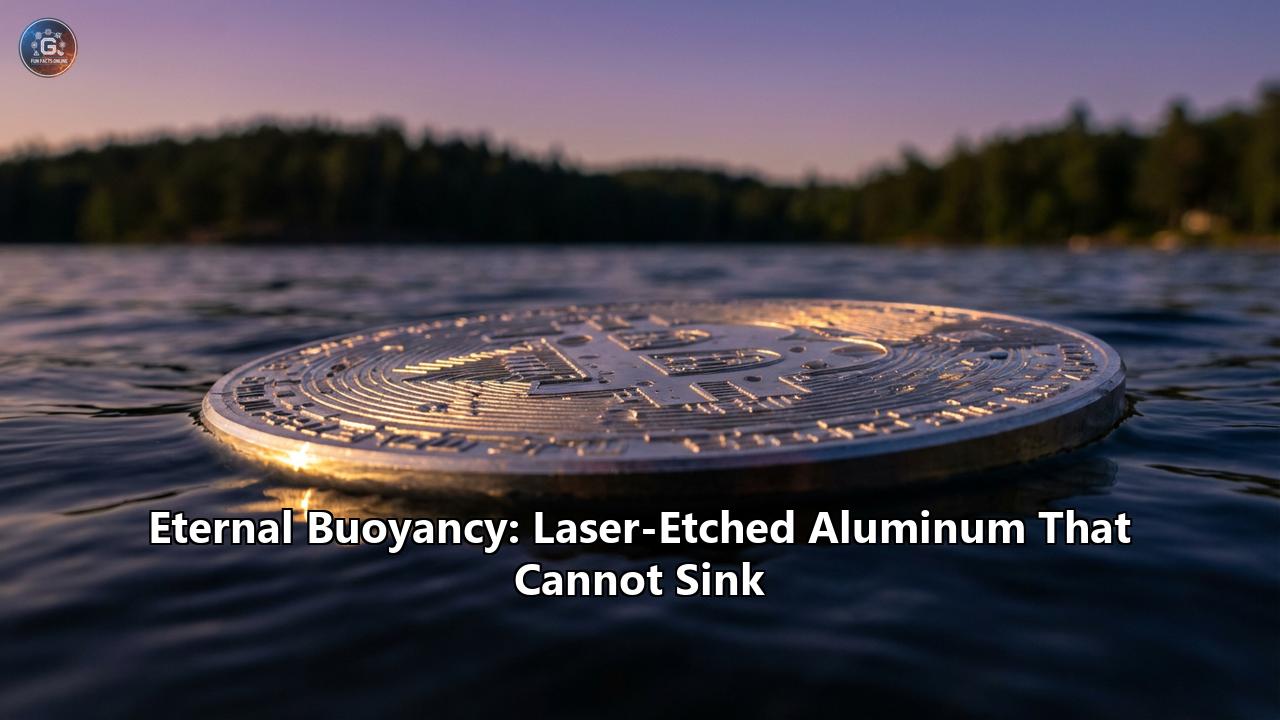
Introduction: The Unsinkable Dream
For as long as humanity has ventured onto the water, we have been haunted by the specter of the "unsinkable" ship. It is a term laden with hubris, most famously associated with the RMS Titanic, a vessel whose 16 watertight compartments were a marvel of 1912 engineering, yet insufficient against the tearing force of an iceberg. For over a century, the concept of unsinkability remained a statistical game: if you have enough reserve buoyancy and enough sealed chambers, you should float—until you don’t.
But what if the material itself refused to sink? What if buoyancy wasn't just a function of hull geometry, but an intrinsic property of the metal?
In a laboratory at the University of Rochester, a team led by Professor Chunlei Guo has turned this science fiction concept into reality. By blasting aluminum with femtosecond laser pulses, they have created a metal that defies the standard laws of wetting. It doesn't just float; it actively fights to stay on the surface. Even when punctured, slashed, or held underwater for months, this "superhydrophobic" aluminum carries its own life jacket of air, a silvery sheath that renders it effectively weightless in water.
As of January 2026, the team has unveiled their latest iteration: a scalable "tube" design that promises to revolutionize everything from oceanographic sensors to the very hulls of future ships. This is the story of how a spider, a fire ant, and a Nobel Prize-winning laser technology converged to create Eternal Buoyancy.
Part I: The Biological Muses
Nature solved the problem of unsinkability millions of years ago. To understand the future of naval architecture, we must first look into the muddy ponds of Europe and the flooded rainforests of Brazil.
The Diving Bell Spider (Argyroneta aquatica)
The Argyroneta aquatica is an evolutionary anomaly—a spider that lives its entire life underwater. It does not have gills. Instead, it survives by engineering a physical gill. The spider weaves a dome-shaped web between underwater plants and fills it with air brought down from the surface.
The key to its survival, however, lies in its own body. The spider’s abdomen and legs are covered in fine, hydrophobic hairs. When it surfaces, these hairs trap a thin layer of air, giving the spider a silvery appearance underwater. This trapped air layer, known as a plastron, serves two functions: it acts as a scuba tank, allowing gas exchange with the surrounding water, and it provides buoyancy. The spider is, in effect, wearing a suit of air that water cannot penetrate.
The Fire Ant Raft (Solenopsis invicta)
In the floodplains of Brazil, fire ants face a different challenge. When waters rise, the colony does not drown; it assembles. Thousands of ants link their bodies together, gripping each other’s legs with mandibles and tarsal claws to form a living raft.
Individually, a fire ant is slightly denser than water and struggles to float. But collectively, their water-repellent exoskeletons trap millions of tiny air bubbles between their bodies. This trapped air reduces the overall density of the "raft" to far less than that of water. You can push a fire ant raft underwater with a stick, and it will deform, bending like a rubber mat, but it will not sink. The moment you release the pressure, it springs back to the surface, its air pockets intact.
Professor Guo and his team looked at these two biological marvels and asked a simple question: Can we do this with metal?
Part II: The Physics of Wetting
To make aluminum act like a spider’s leg, one must master the physics of wetting—the interaction between a liquid and a solid surface. This interaction is governed by the contact angle ($\theta$), the angle at which a water droplet meets a solid surface.
Young, Wenzel, and Cassie-Baxter
- Hydrophilic (Water-Loving): On a standard aluminum surface, water spreads out. The contact angle is low ($<90^\circ$). The water "wets" the surface, pushing air away.
- Hydrophobic (Water-Fearing): If you coat the surface with wax or Teflon, the water beads up. The contact angle increases to above $90^\circ$.
- Superhydrophobic: This is the holy grail. When the contact angle exceeds $150^\circ$, the droplet becomes a near-perfect sphere. It barely touches the surface, sitting on top of the texture like a fakir on a bed of nails.
This "bed of nails" state is known as the Cassie-Baxter state. In this state, the water droplet doesn't actually touch the metal groove bottoms; it sits on a composite surface made of solid metal peaks and trapped air pockets.
$$ \cos \theta_{CB} = f_s (\cos \theta + 1) - 1 $$
Where $f_s$ is the fraction of the solid surface in contact with the liquid. If you can make the solid fraction ($f_s$) tiny—say, by etching billions of nanoscale pillars—the water is mostly touching air. Since water hates touching air (due to surface tension), it beads up and rolls off.
The problem with standard superhydrophobic coatings (like spray-on repellents) is durability. They are chemical layers that can be scratched off. Guo’s team needed a structure, not a coating. They needed to carve the hydrophobicity into the atoms of the metal itself.
Part III: The Laser Chisel
The tool used to achieve this is the femtosecond laser. To appreciate the precision of this tool, consider the timescale. A femtosecond is to a second what a second is to about 31.7 million years.
Chirped Pulse Amplification (CPA)
The technology relies on Chirped Pulse Amplification, a technique that won Donna Strickland and Gérard Mourou the Nobel Prize in Physics in 2018.
standard lasers melt metal. If you fire a continuous beam or even a nanosecond pulse at aluminum, the metal heats up, melts, and reforms as a messy blob. It destroys the delicate microstructures you are trying to create.
Femtosecond lasers are different. They deliver energy so fast that the atoms are ionized and blasted away before they have time to transfer heat to their neighbors. This is "cold ablation." It allows for the creation of incredibly intricate features without melting the surrounding material.
The Etching Process
In the University of Rochester lab, the laser scans across a 1-inch aluminum disk. It carves a hierarchical structure:
- Micro-scale: Deep parallel grooves or pits, measuring roughly the width of a human hair.
- Nano-scale: On top of the ridges of those micro-grooves, the laser etches tiny bumps and chaotic "coral-reef-like" structures just nanometers across.
This dual-scale roughness is critical. The micro-grooves provide durability and space for air, while the nano-structures amplify the water-repellency to extreme levels. The result is a surface that is pitch black (because it traps light as well as air) and so water-repellent that droplets bounce off it like rubber balls.
Part IV: The Unsinkable Design
Creating a superhydrophobic surface was step one (achieved around 2015). Step two was making it buoyant.
The "Sandwich" and the "Tube"
Simply etching a block of aluminum won't make it float; aluminum is denser than water. To achieve buoyancy, the researchers had to trap enough air to counteract the metal's weight.
The breakthrough came with a specific geometric configuration.
- The 2019 Prototype: Two laser-etched aluminum plates were placed facing inward, separated by a small gap. The superhydrophobic surfaces faced each other. When submerged, the water could not enter the gap between the plates because the "hairy" metal surfaces repelled it. This created a waterproof compartment containing nothing but air. Unlike a sealed hollow sphere, this compartment was open to the water at the edges, but the surface tension was so strong the water simply refused to enter.
- The 2026 Tube: The latest iteration, published in Advanced Functional Materials in January 2026, refines this into a tubular structure. The inside of the tube is etched. When the tube is tossed into water, air is trapped inside the core. Because the etching is on the inside, it is protected from abrasion and external damage.
Resilience Testing
The claims of "unsinkability" were tested ruthlessly:
- The Puncture Test: Researchers drilled holes into the tube. In a normal hollow vessel (like the Titanic), a hole releases the air and lets in water. In the laser-etched tube, the water still refused to enter the holes because the edges and interior surface remained superhydrophobic. The air bubble stayed trapped, and the tube stayed afloat.
- The Submersion Test: The team forced the metal underwater and held it there for two months. In standard superhydrophobic materials, the air eventually dissolves into the water (a failure mode known as the Wenzel transition). Guo’s structures retained their air plastron, bouncing back to the surface the moment the weight was removed.
Part V: Applications and the Future Economy
The implications of "Eternal Buoyancy" extend far beyond cool physics demos.
1. The Unsinkable Ship
While building an entire hull out of femtosecond-etched aluminum is currently cost-prohibitive, the technology could be used for critical buoyancy modules. Lifeboats, emergency flotation devices, and "unsinkable" compartments within larger vessels could be made from this material. If a ship's hull is breached, these etched internal structures would refuse to flood, providing reserve buoyancy that never fails.
2. Oceanographic Sentinels
We are currently littering the ocean with sensors to monitor climate change, salinity, and currents. These devices need to float for years. Current buoys rely on foams (which degrade) or hollow shells (which can leak). A laser-etched metal buoy would be practically immortal, immune to the crushing pressure that collapses hollow spheres and the degradation that destroys plastics.
3. Energy Harvesting
The January 2026 update from the lab highlighted a new application: wave energy. The buoyancy of these tubes is "recoverable" and highly responsive. A raft of these tubes could ride the waves, bobbing with high efficiency to drive kinetic energy harvesters, without the risk of waterlogging over time.
4. The "Plastron" Economy
Beyond buoyancy, the stable air layer (plastron) reduces drag. A ship hull that holds a permanent layer of air would slip through the water with significantly less friction, potentially cutting fuel consumption by 10-20%. This is the "lubricated transport" dream of naval engineering.
Part VI: Challenges and Scalability
If this material is so perfect, why aren't we building the Titanic II out of it today?
1. The Cost of Time:Femtosecond laser etching is a serial process. It's like drawing a picture with a single fine-point pen. To cover a square meter of aluminum takes a significant amount of time and energy. As of 2025, industrial femtosecond lasers have become more powerful (reaching kilowatt levels), allowing for faster scanning, but coating the thousands of square meters of a ship's hull remains an economic bottleneck. The cost is currently estimated at thousands of dollars per square meter for the processing alone.
2. The Biofouling Battle:While the metal repels water, the ocean is full of things that aren't water. Proteins, bacteria, and barnacles are persistent. Over months and years, a "biofilm" can form on submerged surfaces, masking the superhydrophobic texture. The "inward-facing" design helps this by shielding the active surface from direct contact with the open ocean biology, but long-term deployment in rich marine environments remains a hurdle that requires field testing.
3. Durability of the Nanostructure:Aluminum is a soft metal. While the "tube" design protects the etched surface, severe crushing or abrasion could smooth out the nano-features, destroying the effect. Researchers are investigating etching harder materials, like titanium and steel, which are tougher but more difficult to process.
Conclusion: A New Age of Materials
The work of Chunlei Guo and his team at the University of Rochester represents a fundamental shift in how we think about materials. We are moving from the "Chemical Age"—where we coat things to change their properties—to the "Structural Age," where we reshape matter itself to do our bidding.
This laser-etched aluminum serves as a reminder that the properties of a material are not just defined by what it is, but how it is arranged. By borrowing the geometry of a spider’s leg and the cooperative physics of fire ants, we have created a metal that refuses to sink. It is a triumph of biomimicry and laser physics, promising a future where our ships are safer, our sensors are more durable, and our relationship with the ocean is a little less precarious.
For now, the "unsinkable metal" sits in a tank in a Rochester lab, a small silver ring floating defiantly on the surface, holding the promise of a fleet that will never know the bottom of the sea.
Further Reading & References
- Advanced Functional Materials, January 27, 2026: "Geometry-Enabled Recoverable Floating Superhydrophobic Metallic Tubes" by Chunlei Guo et al.
- ACS Applied Materials & Interfaces, 2019: Initial publication on parallel-plate superhydrophobic structures.
- Nobel Prize in Physics 2018: Background on Chirped Pulse Amplification (CPA).
- Biology of Argyroneta aquatica (Diving Bell Spider) and Solenopsis invicta (Fire Ant).
Reference:
- https://www.photonics.com/Articles/The-Future-of-Precision-Manufacturing-is-Measured/a70966
- https://be-cu.com/blog/femtosecond-laser-cutting-price-and-cost/
- https://www.lasercontrolcard.com/news/femtosecond-laser-technology-ultra-fast-precision-for-modern-manufacturing/
- https://www.researchgate.net/publication/390065975_Hierarchically_rough_superhydrophobic_metal_surfaces_fabricated_by_a_sandblasting_and_hot_water_treatment_process
- https://www.mdpi.com/2227-9717/9/4/666
- https://www.researchgate.net/publication/374897435_Challenges_and_strategies_for_commercialization_and_widespread_practical_applications_of_superhydrophobic_surfaces