
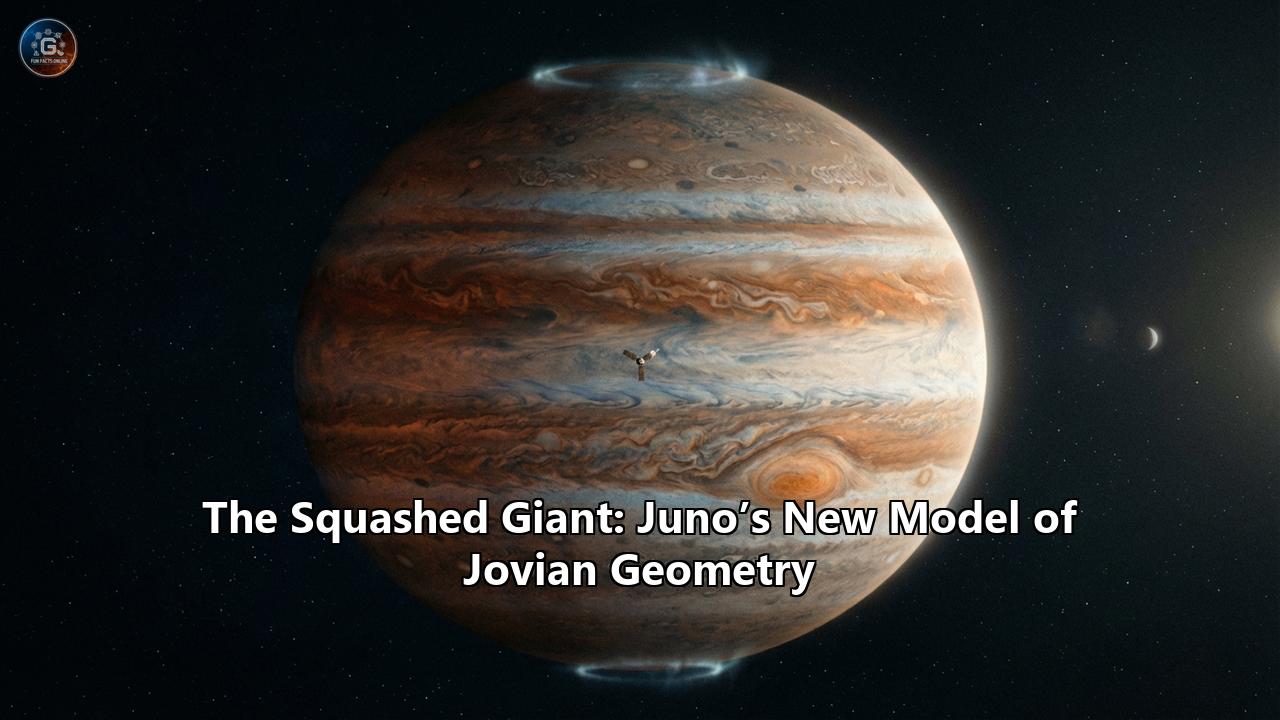
In the vast, swirling dark of the outer solar system, a new portrait of the King of Planets is emerging—and it is not the perfect sphere of classical astronomy. For centuries, Jupiter has hung in our telescopes as a striped marble, a banded oblate spheroid whose precise dimensions were thought to be settled science. We knew it was big, we knew it was gassy, and we knew it bulged at the equator. But we didn't know the half of it.
Data returning from NASA’s Juno spacecraft, specifically from a series of daring radio occultation experiments conducted through late 2025, has shattered our textbook understanding of Jovian geometry. Jupiter is not just bulging; it is significantly more "squashed" than previous models dared to predict. Its equator is narrower, its poles are flatter, and its heart is not a hard stone but a diffuse, fuzzy realm that defies the simple layering of high-school diagrams.
This is the story of the "Squashed Giant"—a planet that is rewriting the rules of planetary formation, fluid dynamics, and the very definition of what it means to be a gas giant. It is a story of gravity science that can detect the movement of a single hair's width from half a billion kilometers away, and of a spacecraft that has peeled back the clouds to reveal a world more complex, more violent, and more beautiful than we ever imagined.
Part I: The Geometry of a Giant
The Illusion of Perfection
To the naked eye, or even through a backyard telescope, Jupiter appears as a disc. But physics dictates that no spinning fluid body can be a perfect sphere. Centrifugal force pushes mass outward against the pull of gravity. For a planet rotating as furiously as Jupiter—which completes a day in less than 10 hours—this effect is dramatic. The planet bulges at the waist.
For fifty years, our "truth" about Jupiter's shape came from the fleeting flybys of the Voyager and Pioneer missions in the 1970s. They pinged the planet with radio waves, measuring the time it took for signals to bounce back or pass through, establishing a baseline radius that astronomers have used ever since. We thought we knew Jupiter’s size to within a few kilometers.
We were wrong.
The new findings, published in Nature Astronomy in February 2026 by a team led by researchers at the Weizmann Institute of Science, reveal a discrepancy that in the world of precision planetary science is nothing short of a chasm. Jupiter is approximately 8 kilometers (5 miles) narrower at the equator and 24 kilometers (15 miles) flatter at the poles than the Voyager models suggested.
"These few kilometers matter," says Dr. Eli Galanti, one of the lead researchers. "Shifting the radius by just a little lets our models of Jupiter's interior fit both the gravity data and atmospheric measurements much better."
It might seem trivial to the layperson—what is 20 kilometers on a planet 140,000 kilometers wide? But in physics, the shape of a body is the fingerprint of its internal forces. A planet’s "oblateness" (how squashed it is) is a direct result of the war between its rotation, its density, and its internal flows. If the shape is different, the interior must be different. The "Squashed Giant" model suggests that the density profile of Jupiter is not a steady gradient but a complex, shifting landscape where winds play a structural role.
The Radio Occultation Revolution
How did Juno see what Voyager missed? The secret lies in the orbit. Voyager and Pioneer were flyby missions—tourists snapping photos as they sped past. Juno is a resident. Since 2016, it has been performing a "dance of death," diving in highly elliptical polar orbits that bring it skimming just 4,000 kilometers above the cloud tops.
But the real breakthrough came when mission planners tweaked Juno’s orbit to pass behind Jupiter relative to Earth. This allowed for "radio occultation." As Juno slipped behind the giant, it continued to beam radio signals back to the Deep Space Network on Earth. These signals didn't just vanish; for a few precious moments, they skimmed through the upper layers of Jupiter’s ionosphere and atmosphere.
As the radio waves passed through the Jovian gas, they were bent (refracted) and slowed down. By measuring the precise delay and frequency shift (Doppler shift) of these signals, scientists could reconstruct the density and pressure of the atmosphere with surgical precision. It was like running a CT scan on the planet's limb.
This method allowed the team to pinpoint the "1-bar level"—the altitude where atmospheric pressure equals that of Earth at sea level, which serves as the "surface" for a gas giant—with ten times the precision of previous missions. The resulting shape was not the smooth, idealized ellipsoid of the 1970s. It was an irregular, dynamically squashed spheroid, molded not just by spin, but by the intense, deep-rooted winds that churn below the clouds.
Part II: The Winds of Change
The Cylindrical Cylinder
When we look at Jupiter, we see stripes: the iconic belts (dark) and zones (light) that run parallel to the equator. For decades, a fierce debate raged in the planetary science community: Are these winds merely "skin deep," a weather phenomenon skimming the surface like clouds on Earth? Or do they extend all the way down to the core?
Juno has settled this debate, and the answer is a strange hybrid that has delighted fluid dynamicists. The winds are not skin deep, but neither do they reach the center. They extend downwards to a depth of about 3,000 kilometers—a "weather layer" that is deeper than the radius of Mercury.
But the geometry of these deep winds is what captivates. They don't wrap around the planet like layers of an onion. Instead, they extend inward parallel to the planet's spin axis, forming a structure that looks like a nest of cylinders. Imagine a set of nesting dolls, but made of spinning fluid cylinders.
This "cylindrical" flow is a consequence of the Taylor-Proudman theorem, a principle of fluid mechanics in rapidly rotating bodies. The high-precision gravity data from Juno matched this theoretical prediction with an eerily perfect score. "When we realized all 40 gravity coefficients measured by Juno exactly matched our calculations for cylindrical flow, it felt like winning the lottery," recalls Professor Yohai Kaspi.
The Magnetic Brake
Why do the winds stop at 3,000 kilometers? Why don't they go all the way down?
The answer lies in the exotic physics of hydrogen. As you descend into Jupiter, the pressure and temperature skyrocket. At 3,000 kilometers deep, the hydrogen gas is crushed so hard that its electrons are squeezed out of their atomic shells. The gas becomes an electrically conducting plasma—a state known as "liquid metallic hydrogen."
Once the fluid becomes conductive, it is gripped by Jupiter’s immensely powerful magnetic field. The magnetic field lines act like stiff rubber bands, resisting the shearing motion of the winds. This creates a "magnetic brake" or viscous drag that kills the zonal jets.
Below this depth, the planet rotates as a rigid body. The "squashed" shape measured by Juno is actually a superposition of two shapes: the rigid, rotating deep interior, and the dynamically distorted "shell" of winds sitting on top of it. The new 2026 measurements have allowed scientists to separate these two contributions for the first time, revealing that the winds themselves contribute to the planet's oblateness, literally pushing the equator outward and flattening the poles.
Part III: The Fuzzy Core
If the shape of the planet was a surprise, the picture of its center was a shock.
The Death of the Solid Core
Standard planetary formation theory, known as "core accretion," tells a tidy story. A young star is surrounded by a disk of gas and dust. Dust sticks together to form pebbles, pebbles form rocks, rocks form planetesimals, and planetesimals smash together to form a solid planetary embryo. Once this rocky/icy core reaches a critical mass (about 10 times the mass of Earth), its gravity becomes strong enough to suck in the surrounding gas, building the massive hydrogen/helium envelope we see today.
For years, we assumed Jupiter had one of these "seeds" inside it—a compact, dense ball of rock and ice, perhaps 10 to 20 Earth masses, sitting clearly defined at the center like a pit in a peach.
Juno has thrown the peach out the window.
Instead of a compact solid core, Juno’s gravity data—which allows us to "weigh" the interior by measuring how the spacecraft speeds up and slows down—revealed a core that is "dilute" or "fuzzy."
There is no hard boundary where the gas ends and the rock begins. Instead, the concentration of "heavy elements" (astronomer-speak for anything heavier than helium, i.e., rock, metal, and ice) increases gradually as you go deeper. This diffuse core extends out to nearly half of Jupiter’s radius. It is a vast, mixing bowl where rock and ice are dissolved into the metallic hydrogen ocean, creating a gradient of density that persists for tens of thousands of kilometers.
How to Make a Fuzzy Core
The discovery of the dilute core set off a scramble among theorists. How do you make a planet with a fuzzy heart?
Two leading theories have emerged, and the debate is currently one of the hottest topics in planetary science.
Theory A: The Giant Impact.In 2019, a team led by Shangfei Liu proposed a violent solution. They suggested that shortly after Jupiter formed, it was smashed head-on by a massive planetary embryo—a "super-Earth" roughly ten times the mass of our own planet.
This wasn't a fender bender; it was a cataclysm that would have liquefied both bodies. The energy of the impact would have shattered Jupiter’s primordial compact core and churned it up into the envelope, like a blender mixing a strawberry into a smoothie. The result would be the diffuse, mixed-up interior we see today.
Theory B: The Pebble Rain.However, newer simulations, including a pivotal 2025 study by researchers at Durham University, suggest that giant impacts might not be able to create the stable fuzzy core Juno sees. Their supercomputer models showed that after such a crash, the heavy materials might settle back down too quickly.
Instead, they propose a "gradualist" approach. As Jupiter was growing, it may have accreted its solids not as large planetesimals, but as a rain of "pebbles"—centimeter-sized chunks of icy dust. If these pebbles dissolved in the envelope as they fell, they would naturally create a composition gradient.
Furthermore, convection (the boiling motion of fluids) might be the key. If the early core was soluble in liquid metallic hydrogen, the churning of the young, hot planet could have "eroded" the core from the outside in, dredging up the rock and ice and mixing it upward.
The consensus is shifting toward this "erosion and enrichment" model. It suggests that Jupiter’s interior is not a static distinct structure, but a dynamic, evolving solution. It implies that "rock" doesn't really exist at the center of Jupiter; at those pressures (millions of atmospheres) and temperatures (tens of thousands of degrees), rock is a fluid, mixing and mingling with the metallic hydrogen in a way that defies terrestrial chemistry.
Part IV: The Metallic Ocean
To understand the squashed giant, one must understand the substance that makes up 90% of it. On Earth, hydrogen is a light, transparent gas. In the deep Jovian interior, it is a metal.
This "metallic hydrogen" is the holy grail of high-pressure physics. It was first predicted in 1935 by Wigner and Huntington, but creating it in labs on Earth has been devilishly difficult, requiring diamond anvils and lasers to replicate the crushing pressures of Jupiter.
Inside Jupiter, this transition happens naturally at about 2 million atmospheres of pressure. In this state, hydrogen atoms are squeezed so tightly that they share their electrons, forming a lattice of protons immersed in a sea of conducting electrons. It looks and acts like a liquid metal—think mercury, but made of hydrogen.
This metallic ocean is the engine of the planet.
- The Dynamo: Because it is conductive and rotating, the swirling motions of the metallic hydrogen generate Jupiter’s magnetic field—the strongest in the solar system. The "fuzziness" of the core affects this dynamo, creating complex, non-dipolar features in the magnetic field that Juno has mapped in detail.
- Helium Rain: Recent models suggest that inside this metallic hydrogen sea, helium (the second most common element) separates out like oil and vinegar. The helium forms droplets that "rain" downward toward the center. This "neon rain" (neon likely dissolves in the helium droplets) releases gravitational energy as it falls, providing an extra heat source that explains why Jupiter radiates almost twice as much heat as it receives from the Sun.
The new "squashed" geometry measurements are crucial here because they provide boundary conditions for this fluid. If the planet is flatter, the pressure gradients inside are different, which changes our estimates of where the helium rain starts and stops.
Part V: A Tale of Two Giants
Juno’s findings have forced a re-examination of Jupiter’s sibling, Saturn.
Data from the Cassini mission’s "Grand Finale" in 2017—where it dove between Saturn and its rings—hinted at a similar story. Saturn, too, seems to have a diffuse core and deep zonal winds (though Saturn’s winds go even deeper, down to 9,000 km).
The "Squashed Giant" model unifies these two worlds. It suggests that "fuzzy cores" are the norm, not the exception, for gas giants. This has profound implications for exoplanet science. When we gaze at a "Hot Jupiter" orbiting a distant star, we can no longer assume it is a simple layered cake of gas-over-rock. It is likely a complex, graded mixture.
The 8-kilometer adjustment in Jupiter’s equatorial radius also recalibrates the standard ruler for the universe. Jupiter is the yardstick by which all other giant planets are measured. Astronomers describe exoplanets as "0.8 Jupiter Radii" or "1.2 Jupiter Masses." By refining the definition of "Jupiter Radius" (taking into account the squashing and the wind depth), Juno has effectively sharpened the resolution of telescopes looking light-years away.
Part VI: The Human Element
Behind the gigabytes of data and the spherical harmonic coefficients are the people who have dedicated their careers to understanding a world they will never touch.
Scott Bolton, the Principal Investigator of Juno, has steered the mission through radiation storms and budget cycles, insisting on the elliptical orbits that made the gravity science possible.
Yohai Kaspi and Eli Galanti at the Weizmann Institute have spent years refining the mathematical models that translate Doppler shifts into wind depths. Their work is a testament to the power of indirect observation—determining the weather 3,000 kilometers down by watching a spacecraft twitch in orbit.
And then there are the citizen scientists. Juno’s camera, JunoCam, was added almost as an afterthought for public outreach. Yet, the raw data it sends back is processed by a global army of volunteers—artists and coders who stitch together the stunning, swirling images that grace magazine covers. They have found "faces" in the storms (including the viral "Ghost of Jupiter" in the Jet N7 region), spotted new cyclones, and tracked the changing color of the Great Red Spot.
This collaboration between high-level physics and grassroots enthusiasm mirrors the planet itself: a rigid, mathematical deep interior overlaid by a chaotic, colorful, and accessible surface.
Part VII: The Future – JUICE and Europa Clipper
The story of the Squashed Giant is far from over. Juno is currently in its extended mission, continuing to tighten its orbit and fly past the Galilean moons.
Meanwhile, help is on the way. The European Space Agency’s JUICE (Jupiter Icy Moons Explorer) mission is en route, scheduled to arrive in 2031. While JUICE is focused on the moons Ganymede, Callisto, and Europa, it carries instrumentation that will complement Juno’s findings, particularly in measuring the magnetic environment and the interaction between the moons and the planet’s gravity field.
NASA’s Europa Clipper is also on its way, targeting the ocean moon Europa.
But for the planet itself—the massive, squashed, fuzzy-cored, metallic-hydrogen-filled ball of gas—Juno remains the gold standard.
Conclusion: A New Paradigm
The "Squashed Giant" is more than just a correction of a few kilometers in a textbook. It is a symbol of the new era of planetary science, where "close enough" is no longer good enough.
We now know that Jupiter is a dynamic, fluid body from cloud top to core. It is a planet where winds cut deep, where rock dissolves into metal, and where the shape of the world itself pulses with the rhythm of its internal engine.
Juno has taught us that to understand a giant, you cannot just look at its face; you must weigh its heart. And its heart, it turns out, is fuzzy, vast, and wonderfully squashed.
Deep Dive: The Science of "Squashing"
To truly appreciate the "Squashed Giant" discovery, we must delve into the physics of oblateness and gravity harmonics.
1. Hydrostatic Equilibrium and RotationA non-rotating planet would be a sphere. Add rotation, and the equator moves faster than the poles. On Jupiter, the equator spins at 45,300 km/h (28,148 mph). This centrifugal force pushes mass outward.
The degree of this flattening depends on the planet's internal density distribution. A planet with all its mass in the center (a point mass) would flatten differently than a planet with uniform density throughout. By measuring the shape, we measure the density profile.
2. Gravity Harmonics (J-values)Scientists describe the gravity field using "spherical harmonics," denoted as J2, J3, J4, etc.
- J2 represents the main oblateness (the bulge).
- J3, J5, J7 (Odd Harmonics) represent North-South asymmetry. Since a fluid planet should be symmetric, non-zero odd harmonics are the "smoking gun" for deep atmospheric winds. If the winds were shallow, J3 would be zero. Juno found a large J3, proving the winds are deep.
- J4, J6 (Even Harmonics) refine the density profile.
The new 2026 model uses "High-Degree Gravity Harmonics" (up to J40) matched with the radio occultation shape data. This combination revealed that the "1-bar" surface is not an equipotential surface (a surface of constant gravity potential) as previously assumed. The strong zonal winds actually warp the shape of the planet, piling up atmospheric mass in some latitudes and thinning it in others, creating "dents" and "bulges" on top of the global oblateness.
3. The 8km/24km CorrectionThe finding that Jupiter is 8 km narrower at the equator and 24 km flatter at the poles than the Voyager standard is significant because it changes the calculated mean density of the planet.
- Old View: Larger volume -> Lower mean density.
- New View: Smaller volume -> Higher mean density.
A higher mean density implies that the "Equation of State" (the rulebook for how hydrogen compresses under pressure) needs tweaking. This suggests that the deep interior is slightly more compressible or contains a higher fraction of heavy elements (metals/rocks) than previously modeled. This directly supports the "dilute core" hypothesis—there is more "rock" dissolved in the hydrogen bath than we thought.
The "Ghostly Face" of Jet N7
In the midst of this hard physics, the Juno mission also offered a moment of pareidolia—the human tendency to see faces in random patterns. During a close flyby of the northern latitudes (Jet N7), JunoCam captured a turbulent region of swirling clouds and vortices along the terminator (the line between day and night).
The low angle of sunlight cast long shadows, accentuating the topography of the cloud deck. The resulting image, processed by citizen scientist Vladimir Tarasov, bore a striking resemblance to a distorted, ghostly human face, dubbed "The Face of Jupiter."
While scientifically, this was "just" a region of turbulent vorticity and convective storms, it served as a viral reminder of the chaotic beauty of fluid dynamics. The same physical laws governing those "eyes" and "mouth"—the conservation of vorticity, the Coriolis effect—are the same laws that squash the planet and drive the deep cylindrical winds. It reminds us that Jupiter is not a static backdrop, but a living, moving entity.
Implications for Exoplanets
The "Squashed Giant" model is currently being applied to the study of WASP-76b and HAT-P-7b, two "Hot Jupiters" detected by the James Webb Space Telescope (JWST).
These planets are tidally locked to their stars, roasted to thousands of degrees. Astronomers are now asking: If Jupiter (cold and fast-spinning) has a dilute core and deep winds, what happens to a Hot Jupiter?
- Does the intense heat prevent the core from being fuzzy, or make it fuzzier?
- Does the slow rotation (due to tidal locking) mean they are spherical, or does the heat create a thermal bulge?
Juno’s data suggests that "fuzziness" might be a universal trait, implying that Hot Jupiters are also metal-enriched throughout their envelopes. This affects their spectra—the chemical fingerprints we read with JWST. If heavy elements are mixed up into the atmosphere rather than locked in a core, we should see stronger signatures of water, methane, and ammonia in their skies. Early JWST results seem to confirm this "metallicity enhancement," offering a cosmic validation of the Juno findings.
Final Thoughts
The Juno mission was named after the Roman goddess Juno, wife of Jupiter. In mythology, the god Jupiter would draw a veil of clouds around himself to hide his mischief. Only Juno had the power to peer through the clouds and see the true nature of her husband.
The spacecraft has lived up to its name. It has peered through the clouds, past the winds, and into the crushing dark of the core. It has found a world that is squashed, fuzzy, and metallic—a world that is stranger than we knew, but now, finally, a world we are beginning to understand.
The Squashed Giant spins on, its secrets unraveled one orbit, and one kilometer, at a time.
Reference:
- https://scitechdaily.com/nasas-juno-spacecraft-discovers-jupiters-winds-penetrate-the-planet-in-cylindrical-layers/
- https://www.youtube.com/watch?v=iTHApjlyVa0
- https://www.youtube.com/watch?v=uTQMscMIHHM
- https://en.wikipedia.org/wiki/Pebble_accretion
- https://www.sciencealert.com/the-mystery-of-jupiters-strange-core-can-finally-be-explained
- https://www.sysu.edu.cn/newsen/info/1701/59151.htm
- https://earthsky.org/space/core-shows-possible-giant-impact-for-jupiter/
- https://www.courthousenews.com/scientists-uncover-clues-to-the-mystery-of-jupiters-core/
- https://boris-portal.unibe.ch/bitstreams/fdf5960f-06b5-486a-872b-0821496030da/download
- https://arxiv.org/abs/1809.05383
- https://www.rochester.edu/newscenter/laboratory-laser-energetics-jupiter-of-metallic-hydrogen-329292/
- https://arxiv.org/html/2403.11657v1
- https://www.semanticscholar.org/paper/Comparison-of-the-Deep-Atmospheric-Dynamics-of-and-Kaspi-Galanti/3ad8ae958912b885a996330f284feea0fec354f4
- https://www.tandfonline.com/doi/full/10.1080/23746149.2021.1961607
- https://s3.us-west-2.amazonaws.com/caltechauthors/7c/8a/0c37-292e-4a29-827b-5ce7f1e72c3e/data?response-content-type=application%2Foctet-stream&response-content-disposition=attachment%3B%20filename%3D2021GL092912.pdf&X-Amz-Algorithm=AWS4-HMAC-SHA256&X-Amz-Credential=AKIARCVIVNNAKP37N3MU%2F20260206%2Fus-west-2%2Fs3%2Faws4_request&X-Amz-Date=20260206T114100Z&X-Amz-Expires=60&X-Amz-SignedHeaders=host&X-Amz-Signature=6111844eaba850df779d54c403299510020ac70ac22935560fe7d5d273701e95
- https://academic.oup.com/mnras/article/542/2/947/8238119
- https://www.sciencedaily.com/releases/2025/08/250821224559.htm