
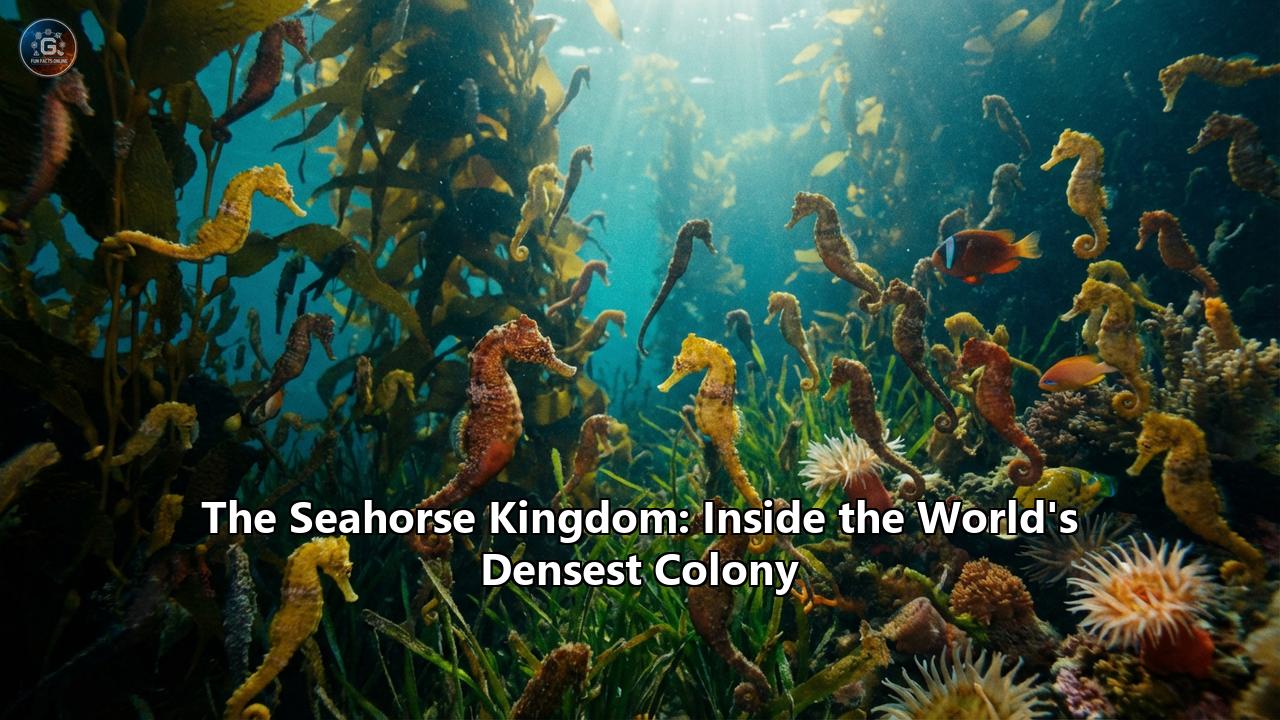
The water of Sweetings Pond does not look like the seat of an empire. Tucked away on the thin, hook-shaped island of Eleuthera in the Bahamas, it appears to be nothing more than a quiet, landlocked lagoon, shielded by a perimeter of scrub brush and limestone. It is a mile long, unconnected to the sea by any visible channel, and for centuries, locals avoided it, whispering of giant monsters that dwelt in its depths.
They were right about the monsters, but they were wrong about the scale.
Below the surface of this isolated saltwater lake lies a biological anomaly that has stunned marine biologists and redefined our understanding of one of the ocean’s most enigmatic creatures. Here, in the sun-dappled shallows, the lined seahorse (Hippocampus erectus) has built a metropolis. While in the open ocean a diver might count herself lucky to spot a single seahorse in an hour, in Sweetings Pond, the density is so high it defies logic. They drape themselves over rocks, they cling to submerged ropes in clusters, and they swim openly in the water column, unafraid and unhidden.
This is the Seahorse Kingdom—the densest known colony of seahorses on Earth.
To enter this world is to step into an evolutionary laboratory where the rules of the ocean have been suspended. But the story of the seahorse is not just about this one miraculous pond. It is a global saga of biological marvels, tragic collapses, and a desperate fight to save a creature that looks like a dragon, eats like a vacuum, and gives birth like a mammal. From the "fallen capital" of Portugal’s Ria Formosa to the "seahorse hotels" of Sydney Harbor, the empire of the seahorse is vast, fragile, and utterly captivating.
Part I: The Hidden Capital
The Miracle of Sweetings PondFor thousands of years, Sweetings Pond has been an "island on an island." Roughly 10,000 years ago, rising sea levels following the last Ice Age pushed the Atlantic Ocean into this limestone depression. Eventually, the waters receded, but the pond remained connected to the sea through porous limestone rock, allowing water to filter in and out with the tides but preventing any large creatures from entering or leaving.
This geological accident created a fortress. The primary predators of the seahorse—tuna, snapper, wahoo, and sharks—were locked out. Inside, a small population of lined seahorses found themselves in a paradise with no enemies and an endless supply of food.
The result is a phenomenon known as "ecological release." Without the constant pressure of predation, the seahorses of Sweetings Pond have shed the shy, cryptic behaviors that define their cousins in the open ocean. In the wild, a seahorse is a master of invisibility, spending 99% of its life anchored to a blade of seagrass, changing color to match its background, terrified that a single movement will invite death.
In Sweetings Pond, the seahorses have forgotten fear.
Dr. Heather Mason, a marine biologist who has spent years studying this unique population, describes the experience of diving there as surreal. In the rest of the Caribbean, Hippocampus erectus is elusive, nocturnal, and rare. In Sweetings Pond, they are diurnal (active during the day). They float in the water column, interacting with one another, grazing, and engaging in social behaviors rarely seen elsewhere. The density here is staggering—estimated to be tens of times higher than typical healthy populations.
Evolution in Real TimeThe isolation of Sweetings Pond has done more than just boost numbers; it is changing the animals themselves. Biologists believe we are witnessing the early stages of speciation. The seahorses here are developing different body shapes compared to their oceanic counterparts. Their snouts are slightly different, adapted to the specific prey available in the lagoon. Their colors are vibrant, ranging from rusty oranges to deep blacks and bright yellows, often contrasting sharply with the substrate rather than blending in.
Because they don't need to anchor themselves as tenaciously against powerful ocean currents, their behavior has shifted. They are the "Lords of the Lagoon," swimming with a leisurely grace that would be suicidal in the open Atlantic.
But even a fortress is not impenetrable. For years, the location of Sweetings Pond was a closely guarded secret among scientists, fearful that the aquarium trade—which voraciously consumes seahorses—would descend upon the lake. In September 2023, the Bahamian government officially declared Sweetings Pond the "Seahorse National Park," granting it the highest level of protection. It was a move to secure the crown jewel of the seahorse world, ensuring that this evolutionary experiment continues undisturbed.
Part II: The Subjects — Anatomy of an anomaly
To understand why a "Seahorse Kingdom" is such a biological marvel, one must understand the seahorse itself. It is an animal that seems to have been assembled by a committee that couldn't agree on a design. It has the head of a horse, the tail of a monkey, the eyes of a chameleon, the pouch of a kangaroo, and the armor of a stegosaurus.
The Engineering of the SnoutThe seahorse is a voracious predator. It has no teeth and no stomach. Its digestive system is a simple tube, which means food passes through it incredibly quickly. As a result, a seahorse must eat constantly to survive. An adult can consume 30 to 50 times a day, while seahorse fry (babies) can eat 3,000 pieces of food in a single day.
Their hunting method is a masterpiece of physics. A seahorse is one of the only fish with a neck, allowing it to swivel its head to track prey (usually tiny crustaceans like copepods and mysid shrimp). When it locks onto a target, it uses a technique called "elastic recoil feeding." The seahorse stores energy in the muscles and tendons of its neck, locking them in place like a loaded crossbow. When it releases this energy, the head snaps forward faster than the human eye can follow.
Simultaneously, the snout expands, creating a powerful vacuum. The suction is so intense and the strike so fast (less than 6 milliseconds) that the prey is often inside the snout before it even registers a pressure wave. It is the most efficient strike in the animal kingdom, with a success rate of over 90%—far higher than a great white shark or a lion.
The Armor and the TailUnlike most fish, which have scales, seahorses are covered in bony plates arranged in rings and covered by a thin layer of skin. This makes them tough and unappetizing to many predators, though crabs and water birds will still eat them.
Their most defining feature, however, is the prehensile tail. It is square in cross-section, not round. Engineering studies have shown that a square tail offers better grip and resistance to crushing than a round one. When a seahorse grasps a stem of seagrass, the flat surface of the tail creates more friction, allowing it to hold on during storms that would sweep other fish away.
The Chameleon’s GazeSeahorses are visual hunters. Their eyes can move independently of one another—one looking forward for prey, the other scanning backward for predators. This binocular independence is crucial for an animal that cannot swim away from danger. They rely entirely on camouflage.
Under the skin, seahorses possess chromatophores—cells that contain pigment. They can expand or contract these cells to change color almost instantly. They can turn bright red to match a sponge, mottled brown to match silt, or even grow fleshy appendages called "cirri" to mimic the texture of algae. In Sweetings Pond, this camouflage is used less for hiding and more for communication, particularly during their elaborate courtship rituals.
Part III: The Courtship and the King’s Burden
In the Seahorse Kingdom, the gender roles are famously reversed. It is the only animal species on Earth where the male experiences true pregnancy.
The DanceThe romance of the seahorse is one of the most elegant spectacles in nature. It begins with a daily greeting. Every morning, the male and female of a bonded pair (seahorses are often monogamous for a breeding season) will meet to reinforce their bond. They change color, brightening into creamy whites or iridescent oranges.
They engage in a "predawn dance," intertwining their tails and swimming in circles, sometimes spiraling upward in the water column. This dance synchronizes their reproductive cycles. As they pirouette, the female’s eggs ripen, and the male’s pouch prepares to receive them.
The TransferWhen the female is ready to hydrate her eggs, the dance reaches its climax. The pair rises in the water column, belly to belly. The female inserts her ovipositor—a tube-like organ—into the male's brood pouch, located on his abdomen. In a matter of seconds, she transfers hundreds, sometimes thousands, of eggs.
The male then fertilizes the eggs inside his body. But his role is not just a vessel; he provides life support. The inside of the pouch becomes a placenta-like environment. It becomes highly vascularized, providing oxygen to the developing embryos. The male regulates the salinity within the pouch, slowly adjusting it to match the outside seawater to prepare the babies for the shock of birth. He also produces a form of nutrient-rich fluid, a "dad milk," to nourish the young.
The BirthGestation lasts anywhere from two to four weeks, depending on the species and water temperature. When the time comes, the male undergoes muscular contractions that look remarkably like labor. He pumps his tail and crunches his abdomen, shooting clouds of tiny, fully formed seahorses out of his pouch.
In Sweetings Pond, this event is a population explosion. A single male Hippocampus erectus can release up to 1,000 fry. In the open ocean, 99.9% of these would be eaten by plankton feeders within days. In the protected waters of the pond, the survival rate is significantly higher, fueling the incredible density of the colony.
Once the babies are born, they are on their own. The parents provide no care. The father, exhausted and deflated, will usually be ready to mate again within hours.
Part IV: The Fallen Metropolis — The Tragedy of Ria Formosa
To understand the significance of Sweetings Pond, one must look at what was lost in Europe. Until recently, the title of "World’s Densest Seahorse Colony" belonged to the Ria Formosa lagoon in the Algarve region of southern Portugal.
The Golden AgeIn the early 2000s, Ria Formosa was a biological wonder. The seagrass meadows were so thick with long-snouted seahorses (Hippocampus guttulatus) and short-snouted seahorses (Hippocampus hippocampus) that divers described it as walking through a forest of curious, floating horses. Estimates placed the population at nearly 2 million individuals. It was a kingdom of gold and green, a sanctuary where the Atlantic met the Mediterranean.
The CollapseThen, the siege began. Between 2012 and 2018, the population crashed. Surveys revealed a decline of over 90%. In some areas, the seahorses vanished entirely.
The causes were a "perfect storm" of human impact.
- Illegal Fishing: As Asian seahorse populations were depleted for Traditional Chinese Medicine (TCM), the black market turned its eyes to Europe and Africa. Poachers targeted Ria Formosa, snorkeling at night to scoop up thousands of animals. A dried seahorse is worth more per gram than silver in some markets.
- Habitat Destruction: The lagoon is a popular boating area. Anchors dragged through the seagrass beds, ripping up the Zostera grass that the seahorses rely on for shelter. Without the grass, the seahorses were cast adrift, vulnerable to currents and predators.
- Noise Pollution: Research has shown that seahorses can be stressed by loud noises. The constant roar of boat engines in the shallow lagoon disrupted their feeding and breeding.
The "City of Two Million" became a ghost town. Today, strict conservation measures are in place. Project Seahorse and local universities have launched breeding programs and "sanctuary zones" where boating is prohibited. The population is showing slow, fragile signs of stabilization, but the "Kingdom" of Ria Formosa serves as a stark warning: even the densest colonies can disappear in the blink of an eye.
Part V: The Global Empire — Provinces of the Strange
While Sweetings Pond is the capital and Ria Formosa the ruin, the Seahorse Kingdom has outposts in every corner of the ocean. The diversity of the family Syngnathidae is astonishing.
The Pygmy Villages of the Coral TriangleIn the waters of Indonesia, the Philippines, and Papua New Guinea, live the "pygmies." These seahorses are the size of a grain of rice. Hippocampus bargibanti, the pygmy seahorse, lives exclusively on gorgonian seafans. It is so well camouflaged that it was only discovered accidentally when a scientist brought a gorgonian into a lab and noticed the "bumps" were moving. They mimic the color and the texture of the coral polyps so perfectly that they are invisible to the naked eye unless they move.
The Dragons of the SouthIn the cold waters of Southern Australia, the seahorse lineage took a psychedelic turn. Here live the Seadragons. The Weedy Seadragon and the Leafy Seadragon are larger cousins of the seahorse. They do not have pouches (the male carries the eggs glued to the underside of his tail) and they are not built for grasping. Instead, they are built for camouflage. The Leafy Seadragon looks exactly like a piece of drifting kelp. It has leaf-like appendages sprouting from its body that serve no function other than disguise. They are the mythical beasts of the kingdom, floating aimlessly, confident in their disguise.
The Giants of the PacificThe Big-Bellied Seahorse (Hippocampus abdominalis) or "Pot-Bellied Seahorse" patrols the waters of New Zealand and Australia. Growing up to 35cm (14 inches) long, they are the heavyweights of the family. They are strong swimmers and have been known to travel miles, a stark contrast to the homebody nature of most seahorses who rarely venture more than a few meters from their holdfast.
Part VI: The Siege — An Empire Under Threat
Despite the sanctuary of Sweetings Pond, the global status of the seahorse is dire. They are listed on CITES (Convention on International Trade in Endangered Species), yet the illegal trade flourishes.
The TCM TradeThe primary driver of seahorse extinction is Traditional Chinese Medicine. It is believed that eating dried seahorses treats ailments ranging from asthma to impotence and lethargy. It is estimated that 150 million seahorses are killed every year for this trade. They are caught as bycatch in shrimp trawlers or targeted specifically by divers. Because seahorses are difficult to farm (they are prone to disease and require live food), the vast majority of the market is supplied by wild-caught animals.
The Curio TradeWalk into a souvenir shop in a beach town, and you might see a dried seahorse in a shell varnish or a resin paperweight. These "curios" account for roughly 1 million deaths a year. It is a grim irony that the animal is loved for its beauty, and that beauty is the reason for its death.
The Habitat CrisisSeahorses are "specialists." They need specific environments—seagrass, mangroves, or coral reefs. All three of these habitats are disappearing. Seagrass meadows are being dredged for marinas; mangroves are being cut down for shrimp farms; coral reefs are bleaching due to warming oceans. When the castle falls, the knight falls with it.
Part VII: The Engineers — Rebuilding the Kingdom
In the face of this siege, a resistance movement has formed. Scientists and conservationists are using ingenuity to rebuild the Seahorse Kingdom.
The Seahorse Hotels of SydneyIn Sydney Harbor, the White's Seahorse (Hippocampus whitei) was facing local extinction. Their natural habitat of soft corals and seagrass had been destroyed by boat moorings and jetties.
Enter the "Seahorse Hotel."
Researchers from the Sydney Institute of Marine Science designed biodegradable metal cages that mimic the structure of a complex reef. These cages are placed on the sea floor and quickly become encrusted with algae and sponges.
The results were immediate. Seahorses flocked to the hotels. They used the metal bars as holdfasts and the growing sponges as camouflage. It was a successful urban housing project for fish. The project was so successful that they began releasing zoo-bred seahorses into the hotels, where they survived, mated, and gave birth.
iSeahorse and Citizen ScienceBecause seahorses are so hard to find, scientists cannot monitor them all. Project Seahorse created "iSeahorse," a global app where divers and snorkelers can log sightings. This "crowd-sourced" data has led to the discovery of new colonies and helped identify hotspots that need protection. It turns every recreational diver into a scout for the Kingdom.
Part VIII: The Future of the Colony
We return to Sweetings Pond.
The sun is setting over Eleuthera. The water in the pond turns a deep, bruised purple. Below the surface, the seahorses are settling in for the night, wrapping their tails around the roots of mangroves or the limestone rocks.
The designation of this site as a National Park is a victory, but it is fragile. A single hurricane could breach the barriers and wash the colony out to sea. A slight rise in water temperature could kill the prey they rely on. The introduction of a single invasive species—like a lionfish—could wipe them out in months.
Sweetings Pond stands as a testament to what nature can do when left alone. It is a window into a world where the seahorse is not a fleeing refugee, but a dominant, thriving master of its domain.
For now, the Kingdom holds. The males are pregnant, the fry are eating, and the dance continues. In a world where the ocean is increasingly empty, this density of life is not just a biological statistic; it is a sign of hope. It proves that if we provide the sanctuary, nature will fill it.
The Seahorse Kingdom is real. It is hidden in a lake in the Bahamas, it is fighting for its life in the seagrass of Portugal, and it is waiting for us to decide whether it will be a legend we tell our grandchildren, or a living wonder we preserve for eternity.
Reference:
- https://www.marlin.ac.uk/species/detail/1788
- https://www.nationalgeographic.com/animals/article/seahorse-sweetings-pond-bahamas
- https://www.afar.com/magazine/see-the-worlds-most-seahorses-in-this-bahamas-national-park
- https://bnt.bs/news/seahorse-national-park-designation-celebrated-with-dedication-ceremony/
- https://en.wikipedia.org/wiki/Seahorse
- https://en.wikipedia.org/wiki/Mayotte
- https://oceanario.pt/en/conservation/inaqua/seahorses-in-ria-formosa-endangered/
- https://algarvedailynews.com/news/cases/ria-formosa/13359-ria-formosa-long-nosed-seahorse-population-down-94
- https://oceanoazulfoundation.org/uncategorized/the-seahorses-of-ria-formosa-riding-to-extinction/
- https://www.youtube.com/watch?v=RIfUMg9Mh-w
- https://www.goodgoodgood.co/articles/national-park-seahorses-bahamas