
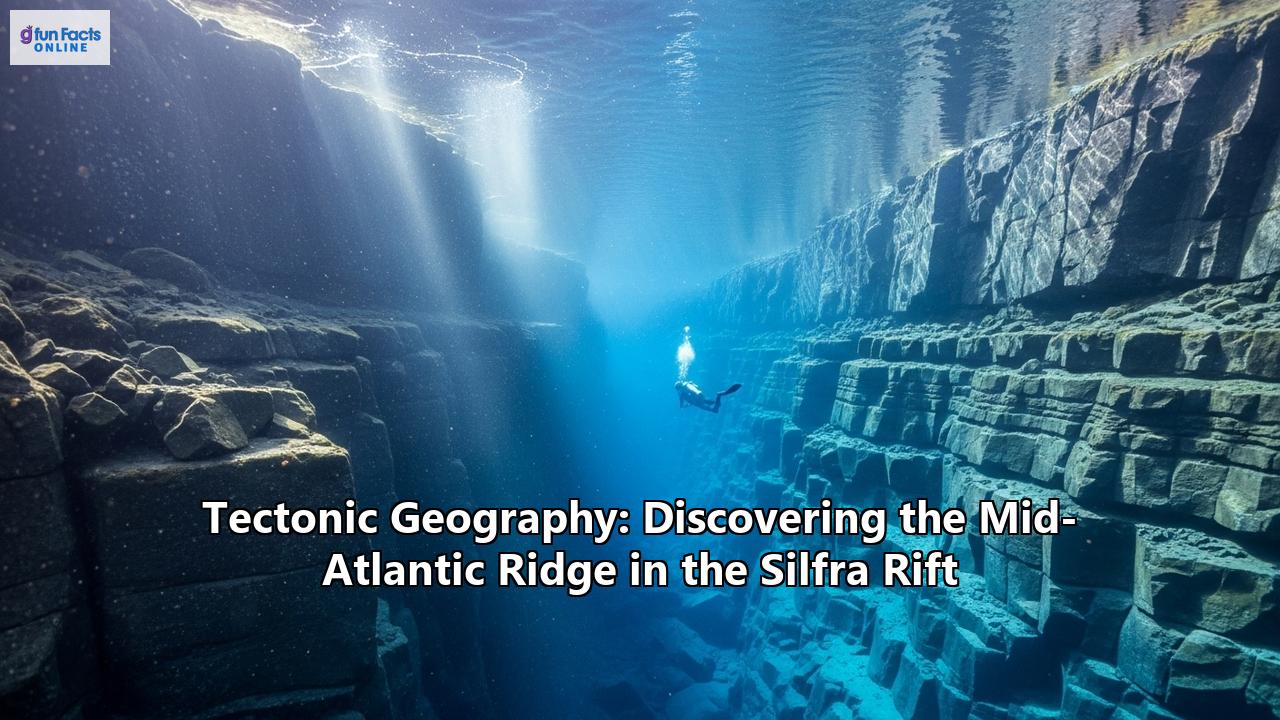
An odyssey into the Earth's very heart, "Tectonic Geography: Discovering the Mid-Atlantic Ridge in the Silfra Rift," unveils a world where continents are born and the raw power of our planet is laid bare. This exploration delves into the submerged majesty of the Mid-Atlantic Ridge, a colossal mountain range hidden beneath the waves, and its most spectacular terrestrial revelation: the Silfra Rift in Iceland. Here, the very fabric of our world is visibly tearing apart, offering a unique window into the dynamic forces that have shaped our planet for eons.
The Unveiling of a Hidden World: The Mid-Atlantic Ridge
For centuries, the vast expanse of the Atlantic Ocean floor remained a mystery, a blank canvas on our maps. It was only in the mid-20th century that the true nature of this underwater realm began to emerge, thanks to the pioneering work of a few intrepid scientists. Their discoveries would not only reshape our understanding of the oceans but would also provide the crucial evidence for the then-controversial theory of continental drift.
The Mid-Atlantic Ridge is a monumental submarine mountain range that snakes its way down the center of the Atlantic Ocean, stretching for an astonishing 16,000 kilometers (approximately 10,000 miles) from the Arctic Ocean to near the southern tip of Africa. It is the longest mountain range on Earth, a title it holds with the majority of its peaks and valleys concealed by the ocean's depths. This colossal structure is a divergent plate boundary, the seam where the tectonic plates of our planet are pulling apart. In the North Atlantic, it marks the separation of the North American and Eurasian plates, while in the South Atlantic, it divides the South American and African plates.
The discovery of this immense underwater feature was a gradual process. In 1853, Matthew Fontaine Maury first inferred the existence of a ridge in the North Atlantic based on soundings from the USS Dolphin. The expedition of HMS Challenger in 1872 further confirmed a large rise in the middle of the Atlantic while investigating a route for a transatlantic telegraph cable. However, it wasn't until the 1950s, with the advent of sonar technology, that the true scale and bizarre bathymetry of the Mid-Atlantic Ridge were revealed.
At the forefront of this revelation were Marie Tharp and Bruce Heezen of Columbia University's Lamont Geological Observatory. While Heezen collected data at sea, Tharp, who was not permitted on the research vessels due to the prevailing attitudes towards women in science at the time, painstakingly translated the echo-sounding data into detailed maps of the ocean floor. It was during this meticulous process that Tharp made a groundbreaking discovery: a deep rift valley running along the crest of the ridge. Heezen, initially skeptical and dismissing her findings as "girl talk," was eventually convinced when the data from earthquake epicenters aligned perfectly with the rift valley she had mapped. This discovery was a pivotal piece of evidence for the theory of seafloor spreading, proposed by Harry Hess in 1960, which posits that new oceanic crust is formed at mid-ocean ridges and then moves away from them. Tharp's work, though not immediately recognized, was instrumental in the paradigm shift that led to the widespread acceptance of plate tectonics.
The Mid-Atlantic Ridge is a dynamic and geologically active region. The plates are moving apart at an average rate of about 2.5 centimeters (1 inch) per year, roughly the speed at which our fingernails grow. As the plates separate, magma from the Earth's mantle wells up to fill the gap, creating new oceanic crust. This process of seafloor spreading is accompanied by volcanic activity and frequent earthquakes along the ridge. The ridge itself is a massive bulge on the ocean floor, thought to be caused by upward convective forces in the asthenosphere pushing the oceanic crust and lithosphere upwards.
While most of the Mid-Atlantic Ridge is submerged, there are a few places where its peaks rise above sea level to form islands. The Azores, Ascension Island, St. Helena, and Tristan da Cunha are all volcanic islands that have been born from the activity of the ridge. However, the most significant and accessible place to witness the Mid-Atlantic Ridge on land is Iceland.
Iceland: A Land Forged in Fire on the Mid-Atlantic Ridge
Iceland owes its very existence to the Mid-Atlantic Ridge and a volcanic hotspot in the Earth's mantle that lies beneath it. The combination of the divergent plate boundary and the hotspot has resulted in intense volcanic and geothermal activity, creating the island's unique and dramatic landscape. The Mid-Atlantic Ridge runs directly through the center of Iceland, with the western part of the country, including the capital Reykjavík, situated on the North American Plate, and the eastern part on the Eurasian Plate. This makes Iceland one of the few places on Earth where a mid-ocean ridge can be observed above sea level.
The influence of the Mid-Atlantic Ridge is evident throughout Iceland. The country is a hotbed of volcanic activity, with numerous active volcanoes. The movement of the tectonic plates creates fractures in the Earth's crust, allowing magma to rise to the surface. This has resulted in vast lava fields, towering volcanoes, and frequent, though usually minor, earthquakes. The same geological processes that fuel the volcanoes also provide Iceland with an abundance of geothermal energy. Water seeps down through the fractured crust, is heated by the underlying magma, and returns to the surface as hot springs and geysers. Iceland has harnessed this natural resource to become a world leader in geothermal power, using it for both electricity generation and heating.
The most dramatic and accessible place to see the Mid-Atlantic Ridge in Iceland is in Þingvellir National Park. This UNESCO World Heritage Site is not only a place of immense geological significance but also holds a deep cultural and historical importance for the Icelandic people.
Þingvellir National Park: Where History and Geology Converge
Þingvellir National Park, located about 40 kilometers east of Reykjavík, is a place where the grandeur of nature and the echoes of history are inextricably intertwined. It is here that the rift valley of the Mid-Atlantic Ridge is most clearly visible, with the dramatic cliffs of the Almannagjá gorge marking the eastern edge of the North American Plate. A walking path takes visitors through this gorge, allowing them to literally walk between the continents.
But Þingvellir's significance extends far beyond its geological wonders. It was here, in 930 AD, that the Althing, one of the world's oldest parliamentary assemblies, was established. For over 850 years, Icelanders from all over the country would gather at Þingvellir for two weeks each summer to set laws, settle disputes, and make important decisions. The Lögberg, or Law Rock, was the focal point of the assembly, where the lawspeaker would recite the laws of the land. The remains of the booths, temporary shelters built by those attending the Althing, can still be seen today. The establishment of the Althing at Þingvellir is considered the founding of the Icelandic nation, and the site holds a deep symbolic meaning for the Icelandic people. In 1944, when Iceland declared its full independence from Denmark, the celebration was held at Þingvellir, a testament to its enduring importance in the nation's history.
The park's unique combination of natural and cultural heritage led to its designation as a UNESCO World Heritage Site. The Þingvellir Commission, established in 1930, is responsible for the management and conservation of the park, ensuring that this precious site is preserved for future generations.
Within this remarkable landscape of Þingvellir lies a true geological gem, a place where the forces of the Mid-Atlantic Ridge have created a subterranean wonderland of unparalleled beauty: the Silfra Rift.
Silfra: A Submerged Jewel in the Crown of the Mid-Atlantic Ridge
The Silfra Rift is a fissure that formed in 1789 as a result of earthquakes accompanying the divergent movement of the North American and Eurasian tectonic plates. It is located on the northern shore of Þingvallavatn, Iceland's largest natural lake, and is one of the most popular and unique diving and snorkeling sites in the world. Silfra is the only place on Earth where you can dive or snorkel directly in the crack between two tectonic plates.
The water in Silfra is renowned for its astonishing clarity, with underwater visibility often exceeding 100 meters (328 feet). This incredible purity is due to the fact that the water is meltwater from the nearby Langjökull glacier, about 50 kilometers to the north. This glacial meltwater travels for 30 to 100 years through a vast underground network of porous lava rock before it seeps into the Silfra fissure. This natural filtration process removes any impurities, resulting in some of the clearest and most pristine water on the planet. The water is so pure that it is safe to drink at any point during a dive or snorkel.
The water temperature in Silfra remains a constant 2 to 4 degrees Celsius (36 to 39 degrees Fahrenheit) year-round. While this may sound frigid, the constant flow of fresh water into the fissure prevents it from freezing, making it possible to explore Silfra's underwater world in any season.
A journey through Silfra takes you through a series of distinct sections, each with its own unique character. The experience begins at the Big Crack, the narrowest part of the fissure, where in some places you can literally touch both the North American and Eurasian continents at the same time. From there, you enter Silfra Hall, where the fissure widens, and the sheer scale of the underwater canyon becomes apparent. The journey continues into the majestic Silfra Cathedral, a vast, deep section that inspires awe with its grandeur. Finally, the fissure opens up into the Silfra Lagoon, a shallow, sandy area with incredible visibility, where fields of vibrant green algae create a stunning contrast with the deep blue of the water.
Diving or snorkeling in Silfra is often described as a surreal and otherworldly experience. The feeling of floating in a seemingly bottomless abyss of crystal-clear water, with the rugged, volcanic rock formations of the two continents on either side, is truly unforgettable. The way the sunlight filters through the water, creating a mesmerizing play of light and shadow, adds to the magical atmosphere of this unique underwater environment.
While the frigid water temperatures may seem daunting, specialized dry suits are used to keep divers and snorkelers warm and comfortable. Numerous tour operators in the area provide all the necessary equipment and guidance for a safe and enjoyable experience in Silfra.
The Living Ecosystem of the Mid-Atlantic Ridge
Beyond the dramatic landscapes of Iceland, the Mid-Atlantic Ridge is home to a fascinating and unique ecosystem, much of which is still being explored. The discovery of hydrothermal vents along the ridge in the 1970s revolutionized our understanding of life on Earth. These vents, which spew out superheated, mineral-rich water from the Earth's interior, support vibrant communities of organisms that thrive in the absence of sunlight.
These chemosynthetic ecosystems are based on bacteria that derive energy from the chemical compounds in the vent fluids, a process that is fundamentally different from the photosynthesis that powers most life on the surface. The communities around these vents are dominated by unique species that are adapted to the extreme conditions of high temperature, pressure, and chemical concentrations.
The fauna of the Mid-Atlantic Ridge hydrothermal vents is distinct from that of the Pacific. While Pacific vents are known for their giant tube worms, the Atlantic communities are characterized by an abundance of shrimp, particularly the species Rimicaris exoculata. These shrimp often form dense swarms around the vent openings and are thought to have a symbiotic relationship with bacteria that grow on their bodies. Other inhabitants of these ecosystems include various species of mussels, clams, snails, and fish, many of which are endemic to these vent sites.
The biodiversity of the Mid-Atlantic Ridge is still being uncovered, with new species being discovered with each new expedition. The study of these unique ecosystems provides valuable insights into the origins of life on Earth and the potential for life to exist in other extreme environments in the universe.
However, these fragile ecosystems are also facing threats from human activities. The mineral-rich deposits around hydrothermal vents have attracted the interest of the deep-sea mining industry. The potential environmental impacts of mining in these areas are a cause for concern, and there is a growing recognition of the need for a precautionary approach to protect these unique and valuable ecosystems.
The Enduring Legacy of the Mid-Atlantic Ridge and Silfra
The Mid-Atlantic Ridge and the Silfra Rift are more than just geological curiosities; they are a testament to the immense and ongoing power of the forces that shape our planet. They offer a tangible connection to the deep history of the Earth, a reminder that the ground beneath our feet is not static but is in a constant state of flux.
From the pioneering discoveries of Marie Tharp and Bruce Heezen to the ongoing scientific research into the unique ecosystems of the hydrothermal vents, the Mid-Atlantic Ridge continues to be a source of new knowledge and wonder. And in the crystal-clear waters of the Silfra Rift, we are given the extraordinary opportunity to witness these powerful geological processes firsthand, to float between continents in a silent, submerged world of breathtaking beauty.
A visit to Þingvellir and the Silfra Rift is not just a journey to a stunning natural landscape; it is a journey into the very heart of tectonic geography, an experience that will forever change the way you see the world. It is a powerful reminder of the dynamic and ever-changing nature of our planet, a world that is constantly being remade before our very eyes.
Reference:
- https://www.researchgate.net/publication/249551162_Marie_Tharp_oceanographic_cartographer_and_her_contributions_to_the_revolution_in_the_Earth_sciences
- https://www.researchgate.net/publication/223218759_Ecology_and_Biogeography_of_the_Hydrothermal_Vent_Fauna_of_the_Mid-Atlantic_Ridge
- https://dusk.geo.orst.edu/Pickup/Esri/U22A-02-Marie-Tharp-djw.pdf
- https://ocean.si.edu/ecosystems/deep-sea/making-mark-ocean-floor
- https://www.cmnh.org/exhibits/g3-3-308
- https://en.wikipedia.org/wiki/Marie_Tharp
- https://www.britannica.com/place/Mid-Atlantic-Ridge
- https://www.britannica.com/science/seafloor-spreading
- https://en.wikipedia.org/wiki/Geothermal_power_in_Iceland
- https://www.quora.com/How-does-Icelands-location-on-the-mid-Atlantic-Ridge-contribute-to-its-frequent-volcanic-activity
- https://pubs.usgs.gov/of/1995/0573/report.pdf
- https://www.mos.org/blog/the-earth-around-us/inside-out
- https://whc.unesco.org/en/list/1152/
- https://www.dive.is/dive-sites/silfra
- https://www.youtube.com/watch?v=7sbwJRPk9hA
- https://www.thingsites.com/thing-site-profiles/thingvellir-iceland
- https://www.iatlantic.eu/news/connecting-the-vents/
- https://www.introducingiceland.com/althing-icelandic-parliament
- https://adventures.is/iceland/attractions/silfra-fissure/
- https://www.dive.is/about-us/the-silfra-iceland-blog/diving-in-iceland/why-diving-in-silfra-needs-to-be-on-your-bucket-list
- https://divebuddies4life.com/diving-in-iceland/
- https://gobi.org/projects/hydrothermal-vent-ecosystems-2/
- https://www.vliz.be/imisdocs/publications/ocrd/289264.pdf
- https://www.frontiersin.org/journals/marine-science/articles/10.3389/fmars.2021.657358/full