
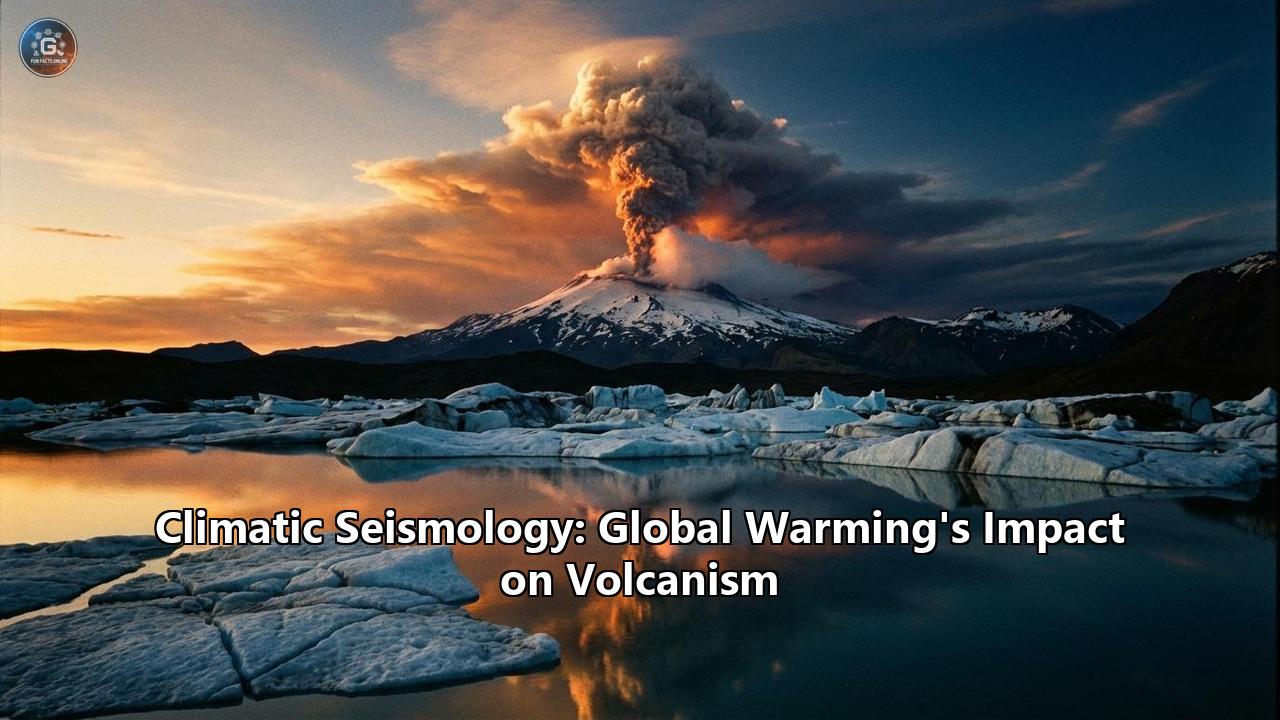
For centuries, humanity has viewed the Earth as a dichotomy: the volatile, ever-changing sky above, and the solid, immovable ground below. We have treated meteorology and geology as distant cousins, assuming that the slow, deep-time tectonic machinations of the Earth’s mantle are deaf to the rapid, seasonal temper tantrums of the atmosphere. But a new, terrifyingly elegant field of study is shattering this illusion. Welcome to the era of Climatic Seismology—a scientific frontier revealing that the Earth’s crust is not a deaf and blind monolith, but a highly sensitive membrane. As global temperatures rise and the climate radically shifts, the sky is effectively speaking to the magma deep underground. And the magma is preparing to answer.
The premise sounds like the plot of a Hollywood disaster film: global warming melting glaciers and causing heavier rains, which in turn rip the proverbial lid off dormant volcanoes, triggering a barrage of explosive eruptions. Yet, this is not science fiction. From the retreating ice caps of the Chilean Andes to the hidden subglacial mountain ranges of West Antarctica, scientists are uncovering a profound and undeniable link between climate change and volcanism. We are discovering that human-induced climate change is doing more than just altering the weather; it is literally re-engineering the seismic and volcanic stability of the planet.
The Physics of Fire and Ice: Decompression Melting
To understand how a warming atmosphere can awaken a subterranean giant, one must first understand the immense physical pressure exerted by the cryosphere—the frozen water part of the Earth system. Glaciers and ice caps are not merely cold; they are unfathomably heavy. A continental ice sheet can be several miles thick, representing billions of tons of localized mass pressing down on the Earth’s lithosphere.
This immense weight exerts a downward force that compresses the Earth’s crust and the underlying mantle. Deep beneath the surface, rock exists at temperatures so extreme that it should theoretically be liquid magma. However, because of the staggering pressure from the rock and ice above it, the material remains in a solid, albeit highly plastic, state. The molecules are simply packed too tightly together to transition into a liquid phase.
When a glacier retreats and melts due to rising global temperatures, this immense weight is suddenly lifted. In geological terms, "suddenly" can mean a few centuries or even decades. The removal of this mass causes a phenomenon known as glacial isostatic adjustment, or isostatic rebound. The Earth’s crust, relieved of its icy burden, physically flexes and rises.
More importantly, the pressure in the underlying mantle drops precipitously. This pressure drop triggers a phase change in the superheated rock, a process known as decompression melting. As the pressure releases, the solid mantle rock instantly liquefies into magma. Furthermore, the gases dissolved within the existing magma chambers—like water vapor, carbon dioxide, and sulfur dioxide—suddenly expand.
Brad Singer, a geoscientist at the University of Wisconsin-Madison, elegantly compares this process to a universally understood experience: "When you take the load off, it’s just like opening a Coca-Cola bottle or a champagne bottle. It’s under pressure, and the dissolved gases in the melt come out as bubbles".
In a magma chamber, the rapid expansion of these gas bubbles violently increases the internal pressure of the reservoir against the surrounding rock. When the outward pressure of the expanding magma exceeds the structural integrity of the rock containing it, the result is an explosive volcanic eruption. By melting the ice, we are popping the cork on the Earth’s most destructive champagne.
Ghosts of the Pleistocene: Lessons from the Deep Past
Scientists first began theorizing the link between glacial melt and volcanism in the 1970s, but the most striking evidence comes from reading the geological record of the deep past. The planet has undergone massive deglaciation events before, most notably at the end of the Last Glacial Maximum, transitioning into the Holocene epoch approximately 10,000 to 15,000 years ago.
Iceland—a volcanic island perched precariously atop the diverging North American and Eurasian tectonic plates—serves as the ultimate historical laboratory for climatic seismology. During the peak of the last ice age, Iceland was smothered beneath an immense, heavy ice sheet. When the climate naturally warmed and the ice rapidly retreated, the isostatic rebound was violent. Magma production surged as decompression melting took hold. The geological record shows that during this period of deglaciation, volcanic eruption rates in Iceland spiked to 30 to 50 times higher than they are today.
However, until recently, most of this data was confined to unique, mid-ocean rift environments like Iceland. The burning question for modern geologists was whether this phenomenon applied to continental volcanic arcs—the very arcs where millions of humans currently live.
The answer, presented at the prestigious 2025 Goldschmidt Conference in Prague, was a resounding and ominous "yes."
A groundbreaking study led by Pablo Moreno-Yaeger, a researcher from the University of Wisconsin-Madison, turned the spotlight on the Mocho-Choshuenco volcano in the Chilean Andes. By utilizing advanced argon dating (40Ar/39Ar) and crystal analysis of volcanic rocks, the research team painstakingly reconstructed the life cycle of the volcano before, during, and after the last ice age.
The findings were a revelation. Moreno-Yaeger’s team discovered that between 26,000 and 18,000 years ago, at the absolute freezing peak of the last Ice Age, the thick Patagonian Ice Sheet acted as a colossal heavy lid. It violently suppressed the volume of eruptions. But the magma didn't just disappear; it pooled. Over millennia, a massive, highly pressurized, silica-rich magma reservoir accumulated 10 to 15 kilometers beneath the surface.
When the climate warmed and the ice sheet rapidly melted about 13,000 years ago, the sudden loss of weight caused the crust to relax. The trapped gases within the massive subterranean reservoir expanded, culminating in a series of incredibly explosive, continent-scarring eruptions that formed the modern volcano.
"Glaciers tend to suppress the volume of eruptions from the volcanoes beneath them," Moreno-Yaeger noted. "But as glaciers retreat due to climate change, our findings suggest these volcanoes go on to erupt more frequently and more explosively".
The Antarctic Powder Keg: The World's Hidden Threat
While historical studies in Chile and Iceland offer a retrospective warning, climatic seismologists are currently turning their eyes toward the south, where a modern time bomb is ticking. The greatest risk of a climate-driven resurgence in volcanism lies in West Antarctica.
Beneath the miles-thick ice of the West Antarctic Ice Sheet lies one of the largest volcanic provinces on the planet. Scientists have identified more than 100 volcanoes buried completely out of sight beneath the ice. Currently, these subglacial giants are dormant, heavily suppressed by the billions of tons of ice resting upon them. But the Antarctic Peninsula is one of the fastest-warming regions on Earth. Warm ocean currents are actively destabilizing and melting the ice sheet from below, while rising atmospheric temperatures attack it from above.
As this ice is expected to thin and disappear in the coming decades and centuries due to soaring anthropogenic greenhouse gas emissions, the pressure on this massive subglacial volcanic network will rapidly decrease. The implications of a multi-volcano awakening in Antarctica are staggering, creating a catastrophic positive feedback loop.
If decompression melting triggers widespread eruptions beneath the West Antarctic Ice Sheet, the immense heat released by the magma will begin melting the ice sheet from the bottom up. This basal melting lubricates the bedrock, causing the glaciers to slide into the ocean at exponentially faster rates. The dual effect of atmospheric warming and subterranean volcanic heating could destabilize the entire region, accelerating global sea-level rise on a timeline far faster than current climate models predict.
According to a 2020 study, 245 of the world's potentially active volcanoes lie underneath or within a mere 3 miles (5 kilometers) of glacier ice. From the icy peaks of the Cascades in North America to the frozen reaches of the Kamchatka Peninsula in Russia, the melting of the cryosphere threatens to unleash a global symphony of seismic and volcanic unrest.
The Deluge and the Dome: When Extreme Rain Triggers Eruptions
While the melting of glaciers represents the long-term, slow-burn threat of climate change on volcanology, global warming is driving another, much more immediate meteorological trigger: extreme rainfall.
As the Earth’s atmosphere warms, its capacity to hold water vapor increases. The Intergovernmental Panel on Climate Change (IPCC) has extensively documented that average rainfall, and the frequency of extreme precipitation events, has surged in many world regions since 1950. A warmer, wetter atmosphere leads to torrential, concentrated downpours. And just as ice interacts with magma through pressure, liquid water interacts with magma through thermodynamics and structural erosion.
A landmark 2022 study published by The Royal Society utilized nine general circulation models to project the impact of unchecked global warming on subaerial volcanic regions. The conclusion was alarming: extreme heavy rainfall is projected to increase throughout the 21st century, drastically raising the incidence of rainfall-induced volcanic hazards at more than 700 volcanoes around the globe.
How exactly does rain cause an eruption? The process is twofold.
First, there is the threat of structural destabilization. Many stratovolcanoes are built from loose layers of ash, pumice, and cooled lava. They are geologically fragile. When subjected to extreme, prolonged rainfall, the water aggressively infiltrates the fractures and pores of the volcanic edifice. The hydrostatic pressure builds within the rock, weakening the volcano’s structural integrity. This can lead to catastrophic flank collapses—where an entire side of the mountain shears off. When a flank collapses, it instantly removes the rock confining the pressurized magma chamber below. The result is a lateral blast, highly reminiscent of the devastating 1980 eruption of Mount St. Helens.
Secondly, extreme rainfall interacts directly with shallow magma and hydrothermal systems. When massive amounts of cold water rapidly percolate into the highly heated rock surrounding a magma chamber, the water instantly flashes into steam. Water expands to 1,700 times its original volume when it turns to steam. This violent, instantaneous expansion causes phreatic (steam-driven) explosions, blasting through the volcano's plug and clearing the throat for the magma to follow.
We have already witnessed modern precedents for this. Extreme rainfall has been identified as a direct trigger for primary explosive activity and dome collapses at notorious volcanoes such as Gunung Merapi in Indonesia, Las Pilas in Nicaragua, and the Piton de la Fournaise on Réunion Island. As Thomas J. Aubry, a researcher specializing in the intersection of climate and volcanism, noted: "Precipitation... can infiltrate deep underground and react with the magma system to trigger an eruption".
Furthermore, extreme rainfall exacerbates secondary volcanic hazards, most notably lahars. A lahar is a violent mudflow composed of volcanic ash, debris, and water. When extreme rain hits the slopes of a recently erupted volcano, it mobilizes the loose ash into a slurry that moves with the consistency of wet concrete at highway speeds, wiping out everything in its path. With 58% of active above-ground volcanoes expected to be subjected to more extreme precipitation as temperatures rise, the human cost of these rainfall-driven secondary hazards will be immense.
The Oceanic Squeeze: Sea-Level Rise and Coastal Stress
While melting ice removes pressure from continental crusts, that melted water does not simply vanish—it flows into the oceans. The redistribution of Earth’s mass from ice caps to the global ocean creates an entirely different set of seismic consequences for island and coastal volcanoes.
The weight of the rising oceans increases the hydrostatic load on the seafloor and coastal tectonic margins. Just as the removal of water weight from a drained reservoir can trigger earthquakes, the addition of millions of cubic kilometers of water to the ocean basins alters crustal stress fields.
Many of the world’s most dangerous volcanoes lie along coastal subduction zones, such as the "Ring of Fire" bordering the Pacific Ocean. As sea levels rise, the increased water weight flexes the oceanic lithosphere. This bending can alter the delicate stress balance of tectonic faults that govern magma ascent pathways. While the science on sea-level-induced volcanism is still in its infancy compared to glacial unloading, historical sea-level transgressions have been statistically correlated with shifts in volcanic arc activity. The Earth is a closed system of mass; when you shift millions of gigatons of water from the poles to the equator, the planetary crust groans under the changing load.
The Ultimate Climatic Feedback Loop
The relationship between climate change and volcanism is not a one-way street; it is a complex, terrifyingly efficient feedback loop.
Historically, massive volcanic eruptions have been viewed as climate coolers. When a volcano experiences a highly explosive eruption, it injects millions of tons of sulfur dioxide (SO2) into the stratosphere. These sulfur aerosols act as a planetary sunshade, reflecting incoming solar radiation back into space. The 1991 eruption of Mount Pinatubo, for instance, cooled the global climate by about 0.5 degrees Celsius for over a year. Some scientists and geoengineers have even floated the controversial idea of artificially mimicking this effect to combat global warming.
However, this cooling effect is ephemeral. "The moment you stop emitting sulfur dioxide, the climate will very quickly warm," explains Daniel Douglass of Northeastern's Marine Science Center.
The long-term story is entirely different. Sustained volcanic eruptions release immense quantities of greenhouse gases, primarily carbon dioxide (CO2) and methane. If melting glaciers trigger a global surge in volcanic activity that lasts for centuries, the cumulative output of volcanic CO2 will add to the already critical levels of anthropogenic greenhouse gases in the atmosphere.
Pablo Moreno-Yaeger explicitly warns of this consequence: "Over time the cumulative effect of multiple eruptions can contribute to long-term global warming because of a buildup of greenhouse gases. This creates a positive feedback loop, where melting glaciers trigger eruptions, and the eruptions in turn could contribute to further warming and melting".
Adding another layer of complexity is how global warming actually alters the behavior of the volcanic plumes themselves. The height a volcanic ash plume reaches is governed by temperature and density gradients in the atmosphere. Because climate change is warming the troposphere, the density dynamics are shifting. Researchers project that in tropical zones, volcanic plumes will not rise as high in the future—potentially falling by 1 to 2 kilometers by the end of the century. A lower plume means the sulfur dioxide is less likely to reach the stratosphere where it can reflect sunlight. Instead, the gases remain trapped in the lower troposphere, where they are washed out by rain as acid rain, completely nullifying the short-term volcanic cooling effect while maintaining the long-term CO2 warming effect.
The Vanguard of Climatic Seismology
How do we prepare for a world where the weather commands the magma? The answer lies in the rapid technological advancement of volcano seismology. Over the past decade, the integration of portable broadband seismic instrumentation, high-resolution tomography, and machine learning has revolutionized our ability to peer into the Earth’s fiery belly.
Seismologists are no longer just looking at major earthquakes; they are using small-aperture seismic antennas to map the spatio-temporal properties of long-period seismicity, and utilizing moment tensor inversions to model the source geometry of magmatic fluids in real-time. We can now image subsurface volcanic structures at scales of a few hundred meters, watching how magma pools and reacts to external pressure changes.
Crucially, this data is being married to meteorological and atmospheric satellite tracking. Agencies like NASA utilize highly advanced Earth-observing satellites to monitor sulfur dioxide emissions from restless volcanoes—such as the intense monitoring of the Philippines' Mayon volcano during its early 2026 eruption, where SO2 emissions spiked to over 7,600 metric tons in a single day. Similarly, the Geophysical Institute in Alaska is combining snow, ice, and permafrost tracking with their Alaska Volcano Observatory to understand how the shifting cryosphere is directly stressing the Aleutian volcanic arc.
By feeding climate models, glacial melt rates, precipitation forecasts, and real-time seismic tomography into advanced machine-learning algorithms, scientists are hoping to create short-term predictive forecasts. The goal is to identify which volcanoes are structurally compromised by heavy rains and which magma chambers are nearing the critical threshold of decompression due to glacial melt.
Conclusion: Navigating the Age of Fire and Ice
The emergence of Climatic Seismology fundamentally rewrites our relationship with the planet. We can no longer view global warming merely as an atmospheric crisis—a matter of stronger hurricanes, hotter summers, and rising tides. By pumping billions of tons of carbon into the sky, humanity has inadvertently reached its hand deep into the Earth's mantle.
The ice that crowns our mountain peaks and polar regions is not just a passive victim of a warming world; it is the structural scaffolding that keeps our tectonic environment stable. As we melt the ice and supercharge the atmosphere with moisture, we are uncorking magma chambers that have slumbered since the mammoths walked the Earth, and greasing the structural faults of mountains that overlook cities of millions.
The ground beneath our feet is intimately, inextricably bound to the sky above our heads. If we fail to arrest the warming of the climate, we will not just reap the whirlwind—we will reap the fire. Our ultimate success in mitigating climate change may be measured not only by the preservation of our coastlines and ecosystems, but by our ability to keep the great, fiery giants of the Earth fast asleep.
Reference:
- https://www.polytechnique-insights.com/en/columns/planet/climate-change-will-also-have-an-impact-on-volcanic-eruptions/
- https://www.ehn.org/melting-glaciers-may-trigger-more-volcanic-eruptions-new-research-warns
- https://www.ecowatch.com/melting-glaciers-volcano-eruptions.html
- https://www.preventionweb.net/news/how-climate-change-might-trigger-more-earthquakes-and-volcanic-eruptions
- https://www.smithsonianmag.com/smart-news/melting-glaciers-will-likely-lead-to-more-volcanic-eruptions-study-suggests-now-all-eyes-are-on-antarctica-180986945/
- https://indianexpress.com/article/explained/explained-climate/melting-glaciers-volcanic-eruptions-10114077/
- https://www.livescience.com/planet-earth/volcanos/melting-glaciers-could-trigger-volcanic-eruptions-around-the-globe-study-finds
- https://royalsocietypublishing.org/rsos/article/9/7/220275/96735/Volcanic-hazard-exacerbated-by-future-global
- https://cos.northeastern.edu/are-volcanoes-impacted-by-climate-change-or-is-it-the-other-way-around/
- https://www.usgs.gov/publications/volcano-seismology
- https://www.iavceivolcano.org/content/uploads/2023/03/13-thelen-et-al-trends-in-volcano-seismology.pdf
- https://science.nasa.gov/earth/earth-observatory/eruption-at-mayon/
- https://www.gi.alaska.edu/