
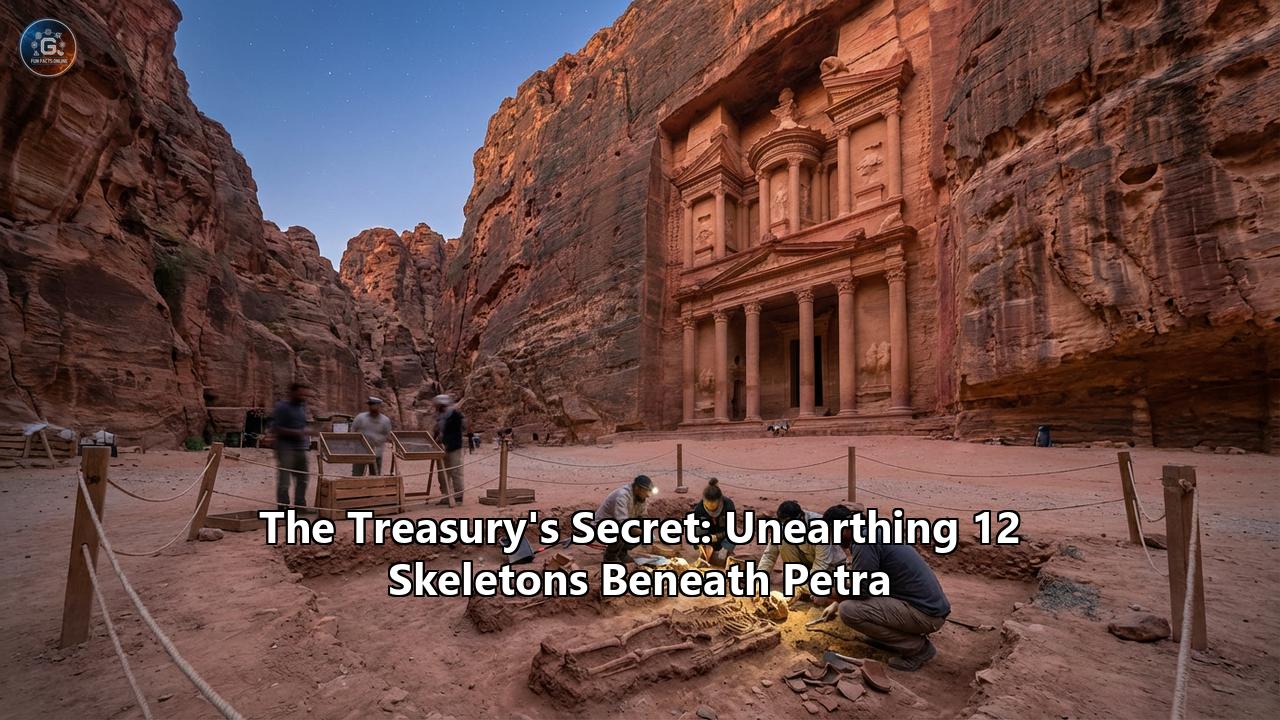
In the sun-scorched canyons of Jordan, where the desert sands meet the towering walls of rose-red sandstone, a secret has lain hidden for two millennia. It is a secret that has survived the rise and fall of empires, the prying eyes of treasure hunters, and the footsteps of millions of tourists who have gazed up at the world’s most famous rock-cut monument: Al-Khazneh, the Treasury of Petra.
For decades, this architectural marvel has been the face of ancient mystery. It was here, in the climatic finale of the 1989 film Indiana Jones and the Last Crusade, that Harrison Ford’s rugged archaeologist found the Holy Grail. For millions of moviegoers, the Treasury was the temple of the Grail, a place of traps, ancient knights, and divine artifacts. Reality, as it turns out, is stranger—and far more compelling—than fiction.
In August 2024, a team of archaeologists led by Dr. Pearce Paul Creasman, Executive Director of the American Center of Research (ACOR), made a discovery that has sent shockwaves through the scientific community. Beneath the heavy flagstones of the Treasury’s courtyard, they unearthed a previously unknown tomb containing at least 12 ancient skeletons. Among the bronze and iron grave goods was a ceramic chalice—a real-life "grail" cradled in the hands of the dead.
This is the story of that discovery. It is a journey that takes us deep into the heart of the Nabataean Kingdom, through the advanced science of modern archaeology, and into the lives of the mysterious people who carved a city from stone. This is the unearthing of the Treasury's secret.
Part I: The Discovery – A Secret Revealed
The discovery of the 12 skeletons was not a stroke of luck; it was a triumph of persistence and technology. For nearly two hundred years, since the Swiss explorer Johann Ludwig Burckhardt reintroduced Petra to the Western world in 1812, archaeologists have scratched at the surface of the city. While the facades are visible to all, the ground beneath Petra is a labyrinth of unexcavated history.
The 2003 Precedent
The road to the 2024 discovery began two decades earlier. In 2003, archaeologists uncovered a series of tombs beneath the right side of the Treasury’s facade. These tombs had been looted in antiquity and later disturbed by flash floods, leaving behind only fragmentary evidence. However, their existence planted a seed of curiosity: if there were tombs on the right, could there be tombs on the left?
For years, this question remained unanswered. Excavating beneath a UNESCO World Heritage site—one of the New Seven Wonders of the World—is a bureaucratic and logistical nightmare. You cannot simply dig holes in front of a monument that attracts thousands of visitors a day.
The Return of the Archaeologists
In 2024, Dr. Pearce Paul Creasman and his team, accompanied by Josh Gates, the host of the Discovery Channel’s Expedition Unknown, received rare permission to investigate. They didn't start with shovels; they started with radar.
Dr. Richard Bates, a geophysicist from the University of St Andrews in Scotland, employed advanced ground-penetrating radar (GPR) and electromagnetic conductivity sensors. These non-invasive tools allow scientists to "see" underground by sending radio pulses into the earth and measuring the reflection of the signals. Solid rock bounces back differently than loose soil, and—crucially—differently than empty space.
As Bates dragged his sensors across the pink dust of the Treasury plaza, the data began to paint a picture. There were anomalies beneath the pavement on the left side of the Treasury—voids that matched the dimensions of the tombs found in 2003. "The data was screaming at us," Bates would later recall. There was something down there.
The Excavation
With the radar data providing a treasure map, the physical work began. The team carefully lifted the paving stones, unsure of what they would find. Would it be another looted chamber, empty save for dust and debris? Or perhaps a natural fissure?
As the dirt was cleared, the outlines of a tomb emerged. But unlike the 2003 discovery, this one was different. The seal was intact. As the team breached the chamber, they were met not with emptiness, but with the heavy, stale air of a space that had been closed off for nearly 2,000 years.
Inside, the beam of their flashlights revealed a sight that defied expectation. The tomb was not empty. It was crowded.
Lying in the dust were the skeletal remains of at least 12 individuals. They were surrounded by grave goods: bronze artifacts, iron implements, and ceramics. It was a "time capsule" of the 1st century AD, the golden age of Petra.
The "Holy Grail" Moment
In a twist of irony that no scriptwriter could have planned better, one of the skeletons was found holding a ceramic vessel. It was the top of a broken jug, shaped distinctly like a chalice. When Josh Gates and the team saw it, the connection was instant. Here, at the very site where Indiana Jones chose the "cup of a carpenter," a real ancient Nabataean had been buried with a simple clay cup.
"It was the ultimate moment of life imitating art," Gates said. But beyond the cinematic parallel, the cup and the skeletons offered something far more valuable than a movie prop: data.
Part II: The Mystery of the 12
Who were these people? The discovery of 12 individuals in a single tomb beneath Petra’s most prestigious monument raises more questions than it answers. To understand the significance, we must understand the real estate.
The Treasury is the most prominent building in Petra. It stands at the end of the Siq, the narrow canyon entrance to the city, greeting every visitor with its 40-meter-high facade. In the ancient world, location was everything. You did not get buried under the Treasury unless you were someone of immense importance.
The Royal Connection
The prevailing theory among archaeologists has long been that the Treasury (Al-Khazneh) was a mausoleum for a Nabataean king, likely Aretas IV, who ruled from roughly 9 BC to 40 AD. This period was the zenith of Nabataean power.
If the Treasury is indeed a royal mausoleum, the individuals buried beneath it could be members of the royal family. Were they the children of the King? His wives? Or perhaps high-ranking ministers and generals who served the court? The fact that there are 12 of them suggests a family crypt or a multi-generational burial site.
The Condition of the Remains
Unlike many skeletons found in the region, which are often scattered by looters or animals, these skeletons were "articulated." This means the bones were still arranged in their anatomical positions. They had not been disturbed. This rarity allows osteologists (bone specialists) to study them in situ, understanding exactly how they were laid to rest.
However, the preservation was not perfect. Petra is prone to flash floods, and over two millennia, water has seeped into the porous sandstone. Some of the skeletons were found with mold, and the humidity has made the bones fragile. Excavating them required the delicate touch of surgical instruments.
The Grave Goods
The artifacts found with the bodies—bronze, iron, and ceramics—are the keys to dating the tomb. Preliminary analysis places the burial between the mid-1st century BC and the early 2nd century AD. This aligns perfectly with the reign of Aretas IV and the subsequent Roman annexation of Petra in 106 AD.
The presence of bronze and iron suggests wealth. Metal was a valuable commodity in the ancient desert. The ceramics, including the famous "grail," are typical of Nabataean fineware—pottery so thin and delicate it is often called "eggshell ware." This pottery was a status symbol, exported throughout the ancient world, and its presence here confirms the high status of the interred.
Part III: The Nabataeans – Masters of the Desert
To truly appreciate the "Treasury's Secret," we must step back and look at the civilization that built it. The Nabataeans are one of history’s most enigmatic people. Unlike the Romans or Greeks, they left behind very few written records. We have no Nabataean history books, no biographies of their kings, no manifestos of their priests. We know them almost exclusively through what they built and what others wrote about them.
From Nomads to Kings
The Nabataeans began as nomadic Arab tribes from the Arabian Peninsula. In the 4th century BC, they migrated north into the Edomite mountains of southern Jordan. Initially, they lived in tents, refusing to build houses or plant crops, believing that possessing property made a man a slave to whoever could conquer his land.
But they possessed a secret weapon: knowledge of water.
In a landscape where thirst killed, the Nabataeans knew where the hidden springs were. They learned to carve cisterns into the rock, camouflaging the openings so that only they could find them. This allowed them to cross the "uncrossable" deserts, opening up trade routes that others dared not travel.
The Incense Route
Their wealth came from the trade in frankincense and myrrh. These aromatic resins, harvested from trees in southern Arabia (modern-day Yemen and Oman), were essential to the religious rituals of the Mediterranean world. The Greeks, Romans, Egyptians, and Babylonians burned tons of incense every year to appease their gods.
The Nabataeans became the middlemen of this lucrative trade. They bought the incense cheap in the south and transported it across the desert on camel caravans to the ports of Gaza and Alexandria. Petra was the central hub of this network, a "secure warehouse" where caravans could rest, trade, and pay taxes.
By the 1st century BC, the "tent-dwelling" nomads had become fabulously wealthy. They decided to settle down and build a capital that reflected their power. They chose a valley hidden behind mountains, accessible only through a narrow crack in the earth: Petra.
Engineering Miracles
Petra is not just a city of beautiful facades; it is a machine for surviving the desert. The Nabataeans were hydraulic engineers par excellence. They didn't just find water; they controlled it.
The city is ringed by a complex system of dams, channels, and ceramic pipes. When the winter rains came, flash floods would roar through the canyons, threatening to destroy the city. The Nabataeans built dams to divert this water into cisterns and reservoirs. They had pressurized water systems that brought fresh water into the city center, feeding fountains, baths, and swimming pools.
In the middle of the desert, the Nabataeans had a garden city. This display of "conspicuous consumption" of water was a psychological power play. It showed visitors—tired, dusty merchants from the desert—that the Nabataeans had mastered nature itself.
Part IV: The Treasury (Al-Khazneh) – Legend and Reality
The building where the 12 skeletons were found, Al-Khazneh, is the crown jewel of Nabataean architecture. But what is it?
The Legend of the Urn
The name "Al-Khazneh" is Arabic for "The Treasury." It comes from a local Bedouin legend that the great stone urn perched atop the monument's roof was filled with gold and jewels, hidden there by an Egyptian Pharaoh (or sometimes a bandit king) who pursued the Israelites.
For centuries, Bedouin tribesmen would fire rifles at the stone urn, hoping to crack it open and release the gold. You can still see the bullet pockmarks on the urn today. Of course, the urn is solid sandstone. There is no gold inside. The real treasure was always the history buried below.
Architectural Fusion
The Treasury is a masterpiece of cultural synthesis. It stands nearly 40 meters high and was carved from the top down. The workmen started on a ledge high on the cliff face, carving the roof and the urn, and then cut the floor away beneath them as they descended.
The style is "Hellenistic," borrowing heavily from Greek architecture. It features Corinthian capitals, a pediment, and statues of figures from Greek mythology, including Castor and Pollux (the Dioscuri) and Amazons. However, it also incorporates Egyptian elements (the goddess Isis is associated with the central figure) and distinct Nabataean touches (the "crow-step" designs).
This blend was intentional. It showed that Petra was a cosmopolitan city, a place where East met West. It told Roman and Greek visitors, "We are civilized; we know your culture."
Mausoleum or Temple?
For years, scholars debated the building's function. Was it a temple to the goddess Al-Uzza? A treasury for taxes? Or a tomb?
The discovery of the 12 skeletons beneath the courtyard—and the earlier tombs found in 2003—strongly supports the mausoleum theory. The elaborate facade was likely a memorial to a deceased king (Aretas IV), designed to be seen by everyone entering the city. The actual burials took place in the chambers carved beneath the monument, leaving the main hall above for rituals or as a memorial space.
The 12 skeletons found in 2024 were not inside the building but beneath it. This is a crucial distinction. The Nabataeans often buried their dead in chambers cut into the rock below the ornate facades. The facade was the tombstone; the chamber was the grave.
Part V: The Science of the Skeletons
The excavation is over, but the real work has just begun. The 12 skeletons have been removed from the tomb and transported to labs for analysis. This is where modern science will illuminate the ancient darkness.
DNA Analysis
Dr. Creasman and his team hope to extract DNA from the inner ear bones or teeth of the skeletons. Ancient DNA (aDNA) is notoriously difficult to recover from desert environments because heat degrades genetic material. However, if successful, DNA could reveal:
- Kinship: Are the 12 individuals related? Is this a father, mother, and children? A dynasty?
- Origins: Did they originate in Petra, or did they come from the Arabian Peninsula or elsewhere? This would track the migration patterns of the Nabataeans.
Strontium Isotope Analysis
Scientists will also use Strontium isotope analysis. Strontium is a natural element found in soil and water. As children grow, strontium from their food and water is locked into their tooth enamel. Because different geological regions have different strontium "signatures," scientists can analyze a tooth and tell you exactly where that person grew up.
They will compare the strontium in the teeth (childhood diet) to the strontium in the bones (adult diet).
- If the signatures match, the person was a local who lived and died in Petra.
- If they differ, the person was an immigrant.
Given Petra’s role as a trade hub, finding foreigners buried in such a high-status tomb would be a revelation.
Diet and Disease
Bones also record a person's life history. Osteologists will look for:
- Wear patterns on joints: Did they do hard labor, or did they live a life of leisure? (Likely the latter, given the tomb's location).
- Diet: Carbon and nitrogen isotopes can reveal what they ate. Did they have a diet high in meat (a luxury)? Did they eat fish imported from the Red Sea?
- Disease: Traces of arthritis, healed fractures, or nutritional deficiencies will flesh out the biography of these individuals.
Part VI: Petra – The Rose-Red City
While the Treasury is the headline, the discovery of the 12 skeletons recontextualizes the entire city of Petra. It reminds us that this was a city of the dead as much as the living.
A City of Tombs
Walking through Petra, one is struck by the sheer number of tombs. There are over 600 carved facades in the city. For the Nabataeans, death was not an end but a continuation. They spent vast fortunes carving these eternal homes.
The Royal Tombs, a row of massive facades carved into the cliff face known as Jebel al-Khubtha, overlook the city center. These include the Urn Tomb, the Silk Tomb, and the Palace Tomb. Like the Treasury, these were likely the resting places of kings. The discovery of the 12 skeletons beneath the Treasury suggests that all these massive monuments might hide similar, undiscovered chambers beneath their courtyards.
The Living City
But Petra was not just a necropolis. Recent excavations have revealed the bustling metropolis that existed alongside the tombs.
- The Great Temple: A massive complex in the city center that was likely a senate house or administrative center, not a religious temple. It had a theatron (theater) capable of seating hundreds of people.
- The Garden and Pool Complex: Excavations have found a massive swimming pool with an island pavilion in the middle of the city—a decadent display of water wealth.
- The Monastery (Ad-Deir): Located high in the mountains, this massive structure resembles the Treasury but is larger and simpler. It was likely a temple used for religious festivals.
The 12 skeletons lived in this city. They walked these streets, bathed in these pools, and worshipped in these temples. They watched the sun turn the sandstone cliffs to fire at sunset, just as tourists do today.
Part VII: The Enduring Mystery
The discovery of the 12 skeletons beneath the Treasury is a landmark moment in archaeology. It is rare to find an unlooted tomb in Petra. It is rarer still to find one in such a prominent location. And it is almost poetic to find one that so perfectly mirrors the pop-culture mythology of the site.
But as with all good science, this discovery solves one mystery only to create ten others.
- Why were these specific 12 people chosen for this honor?
- Why was the tomb sealed and never reopened, while others were reused for centuries?
- What other secrets lie beneath the feet of the millions of tourists who walk down the Siq every year?
Josh Gates, standing in the dust of the newly opened tomb, summed it up best: "Even in front of one of the most famous buildings in the world, there are still huge discoveries to be made."
Petra has not given up all her secrets. The 12 skeletons are voices from the past, finally ready to speak. As the labs begin their work and the DNA sequencers hum to life, we are about to meet the people who built the Rose-Red City. The Treasury was never just a building; it was a vault. And after 2,000 years, the vault has finally been opened.
The "Treasury's Secret" is no longer a legend of gold and bandits. It is the story of people—fathers, mothers, rulers, and dreamers—who carved their immortality into the living rock, waiting for the day they would be found. That day has come.
Reference:
- https://www.gp-radar.com/article/gpr-helps-uncover-tomb-buried-beneath-petra-treasury
- https://www.frontpagedetectives.com/latest-news/archaeologists-stunned-to-find-secret-2-000-year-old-tomb-underneath-the-treasury-building-in-petra
- https://allthatsinteresting.com/petra-hidden-tomb
- https://news.artnet.com/art-world/tomb-found-beneath-indiana-jones-location-2553313
- https://www.popularmechanics.com/science/archaeology/a69710269/petra-tomb-indiana-jones-discovered/
- https://www.timesofisrael.com/researchers-uncover-hidden-tomb-under-indiana-jones-landmark-in-petra/
- https://www.archaeological.org/lecturer/pearce-paul-creasman-2/
- https://nieuws.kuleuven.be/en/content/2012/strontium-in-bones-reveals-geographical-origin-of-human-remains202c
- https://www.researchgate.net/publication/392064724_Strontium_Isotope_and_DNA_Analysis
- https://pubmed.ncbi.nlm.nih.gov/11005180/
- https://pmc.ncbi.nlm.nih.gov/articles/PMC2587582/