
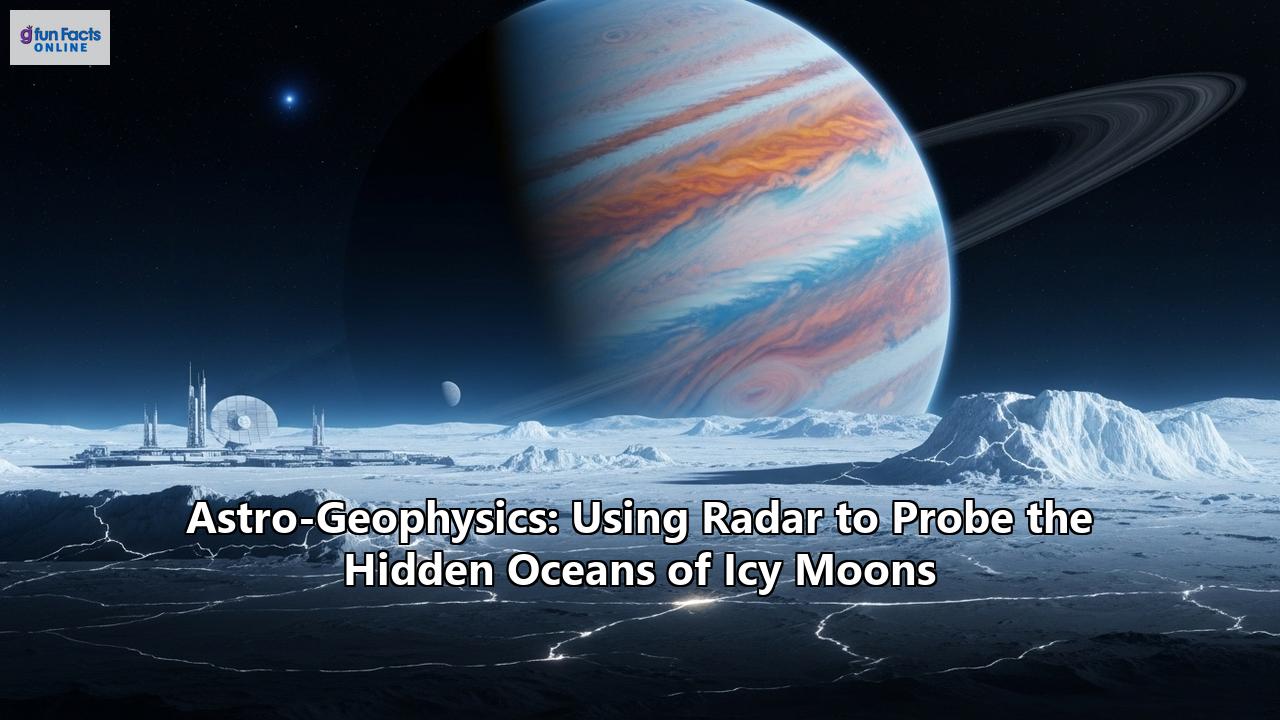
In the vast, cold reaches of our solar system, beyond the rocky inner planets and the gas giants, lie enigmatic worlds cloaked in ice. These icy moons, orbiting the colossal planets of Jupiter and Saturn, have captivated the imaginations of scientists and the public alike. Once considered frigid, desolate outposts, they are now viewed as some of the most promising locations to search for life beyond Earth. The key to this newfound optimism lies hidden beneath their frozen surfaces: vast, global oceans of liquid water.
Astro-geophysics, a field that blends astronomy, geology, and physics, is at the forefront of exploring these mysterious worlds. One of the most powerful tools in the astro-geophysicist's arsenal is radar, a technology capable of peering through kilometers of solid ice to reveal the secrets locked within. This ability to probe the hidden depths of icy moons is revolutionizing our understanding of these distant bodies and bringing us closer to answering one of humanity's most profound questions: are we alone in the universe?
The Allure of Icy Worlds
The outer solar system is home to a host of icy moons, but a select few have emerged as top priorities for scientific investigation. These are worlds where the evidence for subsurface oceans is compelling, sustained by the immense gravitational pull of their parent planets. This gravitational squeezing, known as tidal heating, generates enough warmth to keep water in a liquid state, despite surface temperatures that plummet to hundreds of degrees below freezing.
Europa: The Crisscrossed Jewel of JupiterJupiter's moon Europa is perhaps the most iconic of the icy ocean worlds. Roughly the size of Earth's Moon, its surface is a geologically young and dynamic landscape of cracks, ridges, and bands, with a notable lack of large impact craters. This suggests a surface that is constantly being reshaped, possibly by the ocean below. Data from NASA's Galileo mission in the 1990s provided the strongest evidence for Europa's ocean. The spacecraft's magnetometer detected a magnetic field around Europa that is best explained by the presence of a global, electrically conductive layer, such as a salty ocean. It is estimated that this ocean could contain more than twice the amount of water in all of Earth's oceans combined, concealed beneath an ice shell thought to be around 15 to 25 kilometers thick.
Ganymede: The King of MoonsGanymede, another of Jupiter's Galilean moons, holds the distinction of being the largest moon in our solar system, even larger than the planet Mercury. Like Europa, it is believed to harbor a subsurface ocean, a fact supported by observations from the Galileo spacecraft and the Hubble Space Telescope. What makes Ganymede particularly intriguing is the possibility that its ocean is not a single body of water, but rather a series of stacked oceans and ice layers, a sort of planetary club sandwich. This complex internal structure could have profound implications for the potential for life.
Callisto: The Ancient, Cratered WorldThe outermost of Jupiter's large moons, Callisto, presents a different kind of puzzle. Its ancient, heavily cratered surface suggests a less geologically active history than its siblings. However, magnetometer data from the Galileo mission also hints at the presence of a subsurface ocean. If confirmed, Callisto's ocean would demonstrate that even on worlds with less tidal heating, the conditions for liquid water can exist.
Titan: A World of Lakes and a Hidden SeaSaturn's largest moon, Titan, is a world of its own, boasting a thick, nitrogen-rich atmosphere and lakes and seas of liquid methane and ethane on its surface. But beneath this frigid, hydrocarbon-rich landscape, evidence from the Cassini-Huygens mission suggests the presence of a vast ocean of liquid water. The presence of this subsurface ocean, coupled with the complex organic chemistry occurring in its atmosphere and on its surface, makes Titan a compelling target in the search for life's precursors.
Enceladus: The Little Moon with a Big SurpriseOne of the most astonishing discoveries in recent planetary science came from Saturn's small moon, Enceladus. The Cassini spacecraft directly observed plumes of water vapor and ice particles erupting from "tiger stripes" near its south pole, spewing material from a subsurface ocean into space. These geysers offer a direct sample of the moon's hidden ocean, and analysis of the plume material has revealed the presence of organic molecules, a key ingredient for life.
Unveiling the Unseen: The Power of Radar
To move from tantalizing hints to concrete knowledge about these hidden oceans, scientists are turning to the power of radar. This technology, which stands for RAdio Detection And Ranging, works by sending out radio waves and analyzing the echoes that bounce back from a target. The properties of these returning signals—their strength, timing, and polarization—can reveal a wealth of information about the composition, structure, and roughness of a surface, even one that is hidden from view.
Ice-Penetrating Radar: A Window into the DeepFor exploring icy moons, a specific type of radar known as ice-penetrating radar (IPR), or radar sounding, is particularly valuable. This technique uses long-wavelength radio waves, typically in the high-frequency (HF) and very-high-frequency (VHF) bands, which can travel through ice with relatively little attenuation. The reason for this remarkable transparency is that pure water ice has low electrical conductivity, meaning it doesn't absorb radio waves as readily as other materials like rock.
As the radar waves travel through the ice shell, they are reflected by any changes in the dielectric properties of the material they encounter. This includes boundaries between different ice layers, inclusions of other materials like salts or brines, and, most importantly, the interface between the bottom of the ice shell and a liquid water ocean. A smooth, strong, and flat reflection is the tell-tale sign of a large body of liquid water, as the sharp contrast in dielectric properties between solid ice and liquid water creates a powerful echo.
The depth of these features can be precisely calculated by measuring the time it takes for the radar signal to travel from the spacecraft, down through the ice, and back again. The thickness of the ice shell is a critical parameter for understanding the habitability of an icy moon. A thinner shell would allow for more efficient exchange of materials between the surface, where radiation from Jupiter can create life-sustaining compounds, and the ocean below.
Synthetic Aperture Radar: Painting a Detailed PictureAnother powerful radar technique is Synthetic Aperture Radar (SAR). SAR is an imaging technique that uses the motion of the spacecraft to synthesize a much larger antenna, resulting in high-resolution images of a planet's surface. While optical cameras can be obscured by thick atmospheres, like Titan's, or the darkness of the outer solar system, SAR can pierce through these obstacles to map the geology below.
By analyzing the backscatter—the amount of radar signal reflected back to the spacecraft—from different parts of the surface, scientists can infer its roughness and composition. Smooth surfaces, like liquid lakes, appear dark in SAR images because they reflect the radar signal away from the spacecraft, while rough surfaces, like crater ejecta or fractured ice, appear bright because they scatter the signal in many directions, including back towards the antenna. The polarization of the radar signal can also provide clues about the surface material. For instance, a high circular polarization ratio (CPR) can be an indicator of water ice.
Missions to the Outer Realms: A History and a Future of Radar Exploration
Our understanding of the icy moons has been shaped by a series of robotic explorers, each building on the discoveries of the last.
Pioneers and Voyagers: The First GlimpsesThe Pioneer and Voyager missions of the 1970s provided the first close-up images of Jupiter's and Saturn's moons, revealing their diverse and intriguing surfaces. While these early missions did not carry ice-penetrating radar, their observations laid the groundwork for future exploration by identifying these worlds as compelling targets.
Galileo: Unveiling Europa's OceanThe Galileo mission, which orbited Jupiter from 1995 to 2003, was a game-changer for our understanding of the Galilean moons. While it didn't have a dedicated ice-penetrating radar, its magnetometer provided the crucial evidence for Europa's subsurface ocean. Galileo's detailed images of Europa's surface also revealed "chaos terrain," regions of disrupted ice that may have formed over subsurface lakes, further strengthening the case for liquid water within the ice shell. The mission's observations of Ganymede and Callisto also provided the first hints of their hidden oceans.
Cassini-Huygens: A Deep Dive into the Saturn SystemAt Saturn, the Cassini-Huygens mission (2004-2017) revolutionized our view of Titan and Enceladus. Cassini's powerful radar instrument pierced through Titan's thick haze to map its surface, discovering vast seas of liquid methane and ethane and networks of river channels. Gravity measurements from the spacecraft also strongly suggested the presence of a subsurface water ocean. At Enceladus, while not a primary radar target, Cassini's other instruments made the spectacular discovery of its plumes, confirming the presence of a subsurface ocean and offering a tantalizing glimpse into its composition.
The Next Wave of Exploration: JUICE and Europa ClipperBuilding on this legacy, two ambitious new missions are poised to unlock the secrets of the icy moons with unprecedented detail, and radar is at the heart of both.
The European Space Agency's JUpiter ICy moons Explorer (JUICE), which launched in 2023, will perform a comprehensive study of the Jovian system, with a particular focus on Ganymede. After a series of flybys of Europa and Callisto, JUICE will become the first spacecraft to orbit a moon other than our own, entering orbit around Ganymede. Its Radar for Icy Moons' Exploration (RIME) instrument is a key part of its scientific payload. Operating at a frequency of 9 MHz, RIME is designed to penetrate up to 9 kilometers into the ice shells of Ganymede, Europa, and Callisto, mapping the subsurface structure and searching for the ice-ocean interface. The primary scientific goals for RIME at Ganymede are to characterize the moon as a planetary object and a potential habitat, while at Europa, it will focus on exploring recently active zones.
NASA's Europa Clipper mission, launched in October 2024, is specifically designed to investigate the habitability of Europa. Rather than orbiting Europa directly, which would expose it to Jupiter's intense radiation, Europa Clipper will make a series of close flybys of the moon from a long, looping orbit around Jupiter. Its Radar for Europa Assessment and Sounding: Ocean to Near-surface (REASON) instrument is a dual-frequency radar, operating at both 9 MHz and 60 MHz. The lower frequency is for deep penetration, to search for the ocean and characterize the overall structure of the ice shell, while the higher frequency will provide higher-resolution images of the upper part of the shell, searching for trapped bodies of water or brines. The REASON instrument recently passed a key test during a flyby of Mars, successfully imaging the Martian subsurface and demonstrating its readiness for its primary mission at Europa.
Answering the Big Questions: The Scientific Goals of Radar Sounding
The data returned from these advanced radar instruments will help scientists answer some of the most pressing questions about the icy moons.
How Thick is the Ice?One of the most fundamental questions is the thickness of the ice shells. As mentioned, this has significant implications for habitability. By precisely timing the radar echoes from the ice-ocean interface, both RIME and REASON will be able to create detailed maps of ice shell thickness. This will reveal how the thickness varies across the surface, which can provide clues about heat flow from the interior and the geological processes that shape the ice shell.
Where is the Water?Beyond simply detecting the main ocean, radar can also search for pockets of liquid water within the ice shell itself. These "perched" lakes could be important habitats, potentially more accessible than the deep ocean. The higher-frequency channels of the REASON instrument are specifically designed for this purpose. Radar can also help identify potential cryovolcanic features, where water from the interior may have erupted onto the surface. Combined with thermal and spectral data, radar can help discriminate between eruptions from the deep ocean and those from shallower reservoirs.
What is the Ice Shell Like?The radar data will also reveal the internal structure of the ice shells. Layers in the ice, detected as faint radar reflections, can provide a record of the moon's history, much like ice cores on Earth. By tracing these layers, scientists can understand how the ice has flowed and deformed over time. The way the radar signal is scattered and absorbed can also provide information about the temperature and composition of the ice, including the presence of salts and other impurities.
Is There an Exchange Between the Ocean and the Surface?A key aspect of habitability is the exchange of materials between the ocean and the surface. The surface of Europa is constantly being bombarded by radiation from Jupiter, which can create oxidants and other compounds that could be a source of chemical energy for life. Radar data can help identify pathways, such as fractures or upwelling plumes of ice, through which these surface materials could be transported down to the ocean. Conversely, it can also identify areas where ocean material may have been brought up to the surface.
The Astrobiological Implications: The Search for Habitable Worlds
Ultimately, the goal of exploring these icy moons is to assess their potential to harbor life. While radar cannot directly detect life, it provides crucial information about the conditions that could support it. By confirming the existence of liquid water oceans, determining the thickness and structure of the ice shells, and identifying pathways for material exchange, radar missions like JUICE and Europa Clipper are laying the groundwork for future missions that could search for biosignatures.
The discovery of a thin, dynamic ice shell on Europa, for example, would make it a more promising candidate for life, as it would facilitate the transport of essential chemical elements between the surface and the ocean. The identification of subsurface lakes within the ice shell would provide a new and potentially more accessible target for future landers. At Ganymede, understanding the complex, layered structure of its ocean is key to assessing whether there is contact between the liquid water and the rocky mantle, a process that could provide the chemical nutrients necessary for life. For Titan, while its surface is too cold for life as we know it, its subsurface water ocean, potentially in contact with a rocky core, remains a tantalizing possibility.
A New Era of Discovery
Astro-geophysics is on the cusp of a new golden age of discovery. The use of radar to probe the hidden oceans of the icy moons is a testament to human ingenuity and our relentless desire to explore the unknown. As the JUICE and Europa Clipper missions make their long journeys to the outer solar system, the scientific community awaits with bated breath the data that will be returned. These missions, with their powerful radar eyes, will not only rewrite our textbooks on the formation and evolution of planetary systems but also bring us one step closer to knowing whether the spark of life has ignited elsewhere in the cosmos, in the dark, deep oceans of these distant, icy worlds.
Reference:
- https://astrobiology.com/2025/04/identifying-signatures-of-past-and-present-cryovolcanism-on-europa.html
- https://www.numberanalytics.com/blog/astrobiology-icy-moons
- https://www.lpi.usra.edu/meetings/nlsc2008/pdf/2027.pdf
- https://www.frontiersin.org/journals/astronomy-and-space-sciences/articles/10.3389/fspas.2024.1422898/full
- https://science.nasa.gov/missions/europa-clipper/mission-dispatch-using-radar-to-study-earth-and-europa/
- https://news.yahoo.com/possibility-life-scientists-map-saturns-211526329.html
- https://science.nasa.gov/missions/europa-clipper/mission-dispatch-using-radar-to-study-earth-and-europa/
- https://www.numberanalytics.com/blog/ultimate-guide-radar-sounding-planetary-science
- https://www.planetary.org/worlds/saturn
- https://www.youtube.com/watch?v=w7ux7bVpwGY
- https://astrobiology.nasa.gov/nai/articles/2019/5/9/the-habitability-of-titan-and-its-ocean/index.html
- https://www.planetary.org/articles/0222-radar-in-earth-and-planetary-science
- https://www.mdpi.com/2072-4292/16/5/890
- https://www.jsg.utexas.edu/news/2023/07/new-radar-technique-lets-scientists-probe-invisible-ice-sheet-region-on-earth-and-icy-worlds/
- https://tc.copernicus.org/preprints/tc-2020-9/tc-2020-9-manuscript-version3.pdf
- https://www.mdpi.com/2073-4441/15/5/889
- https://ess.uw.edu/2025/03/unlocking-the-secrets-of-icy-moons-how-the-cenotectic-could-revolutionize-the-search-for-life-beyond-earth/
- https://www.fuw.edu.pl/~op2ds/wyklad/Evans-igs_journal_vol05_issue042_pg773-792.pdf
- https://www.mdpi.com/2072-4292/15/23/5605
- https://aasnova.org/2025/06/17/seeding-life-in-the-oceans-of-moons/
- https://www.researchgate.net/publication/258674261_Modeling_of_Radar_Backscatter_from_Icy_and_Rough_Lunar_Craters
- https://news.cornell.edu/stories/2024/10/scientists-supporting-mission-assess-europas-habitability
- https://www.lpi.usra.edu/science/kiefer/Education/SSRG2-Europa/europa.html
- https://astrobiology.com/2024/12/illuminating-the-mysteries-of-icy-ocean-worlds.html
- https://ntrs.nasa.gov/citations/20250002105
- https://www.space.com/esa-jupiter-moons-juice-spacecraft-ice-penetrating-radar
- https://www.nasa.gov/missions/europa-clipper/can-life-exist-on-an-icy-moon-nasas-europa-clipper-aims-to-find-out/
- https://news.utexas.edu/2015/06/01/antarctica-radar-to-scour-europa-for-life-supporting-environ/
- https://www.universetoday.com/articles/europa-clipper-could-help-discover-if-jupiters-moon-is-habitable
- https://www.researchgate.net/publication/225769320_Radar_Signal_Propagation_and_Detection_Through_Ice
- https://astrobiology.com/2023/11/investigating-europas-habitability-with-the-europa-clipper.html