
The history of human civilization is fundamentally a history of materials. The Stone Age, the Bronze Age, the Iron Age—our very eras are defined by the substances we could master. For millennia, this mastery was the product of serendipity, intuition, and agonizingly slow trial and error. An alchemist would mix powders in a mortar, a blacksmith would quench hot steel in a new liquid, or a potter would fire clay at a slightly higher temperature, hoping for a breakthrough. Even in the modern era, materials science has largely remained an artisanal pursuit. Edison tested thousands of filaments before finding carbonized bamboo. The path from a theoretical material to a commercial product has traditionally been a marathon of 10 to 20 years.
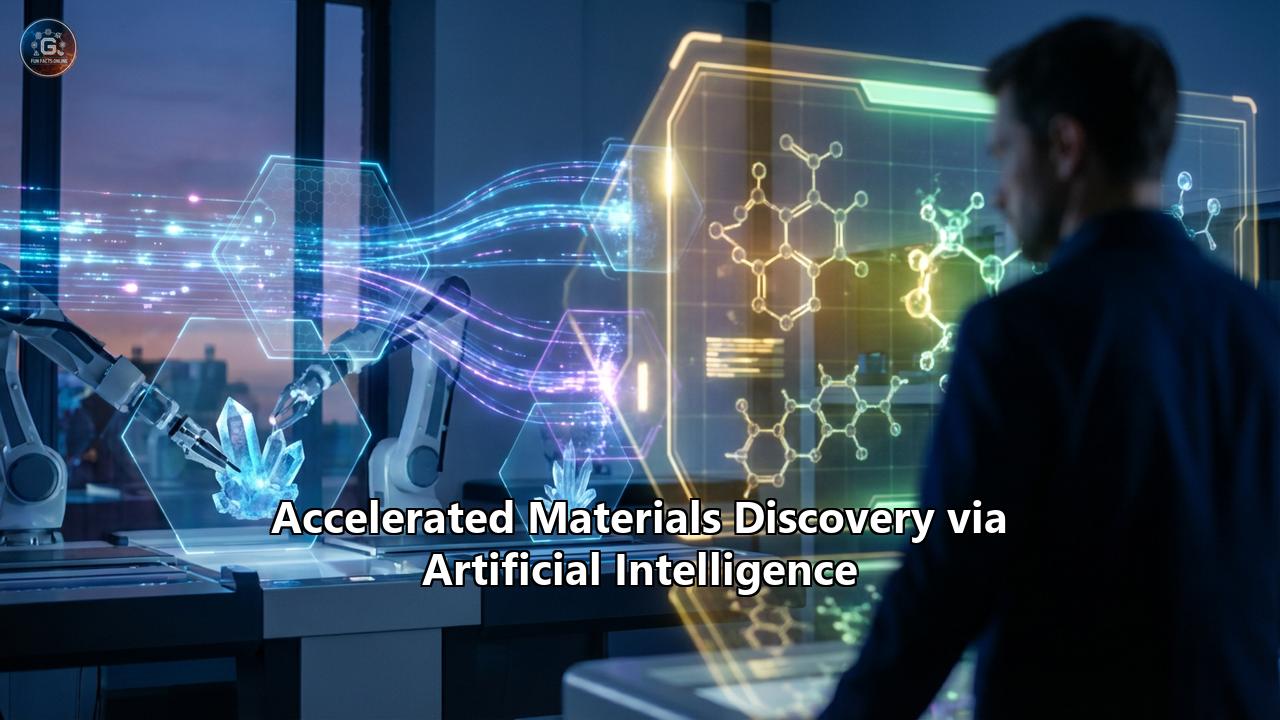
That timeline is collapsing. We are currently witnessing the most profound shift in the history of scientific discovery. We have entered the age of Accelerated Materials Discovery (AMD), driven by the convergence of Artificial Intelligence (AI), high-throughput computing, and autonomous robotics.
In late 2023, Google DeepMind announced a breakthrough that served as the "Sputnik moment" for this field: an AI system named GNoME (Graph Networks for Materials Exploration) had predicted the structure of 2.2 million new crystals. In one fell swoop, a single algorithm added an order of magnitude more potential materials to humanity’s knowledge base than had been discovered in the entire history of science up to that point. But GNoME is just one star in a rapidly expanding constellation. From Microsoft’s MatterGen to autonomous "self-driving" laboratories like Berkeley’s A-Lab and Argonne’s Polybot, we are building a new infrastructure for invention. We are moving from the age of discovery—finding what is already there—to the age of design—generating exactly what we need.
This article explores the comprehensive landscape of this revolution. We will open the "black box" of the AI architectures making this possible, step inside the robotic labs that run 24/7 without human intervention, and examine the specific material classes—from high-entropy alloys to solid-state batteries—that are poised to change our world.
Part I: The New Engine of Discovery — How the AI Works
To understand why this moment is revolutionary, we must first understand why traditional AI (like the kind used to identify cats in photos) fails at materials science, and how new architectures have been built to solve the physics of the atomic world.
1. Beyond Images: The Rise of Graph Neural Networks (GNNs)
For years, Computer Vision (CV) was the darling of the AI world. Convolutional Neural Networks (CNNs) could look at a grid of pixels and tell you if it contained a dog or a hotdog. Materials scientists initially tried to force-fit their problems into this "grid" framework. They would take 2D images of crystal structures or try to represent molecules as simple text strings. But nature is not a 2D grid of pixels. Nature is 3D, continuous, and governed by complex symmetries.
Enter the Graph Neural Network (GNN). In the language of GNNs, a material is a graph. Atoms are "nodes," and the chemical bonds or forces between them are "edges." This representation is intuitive and powerful because it mimics the actual physical reality of the material.
The Magic of Message PassingThe core operation of a GNN is "message passing." Imagine a crystal lattice where every atom is holding a packet of information about itself (its element type, atomic mass, electronegativity). In a GNN layer, every atom sends a "message" to its neighbors.
- Aggregation: An atom collects messages from all its connected neighbors. It might sum them up, average them, or apply a complex function.
- Update: The atom then updates its own state based on what it "heard" from its neighbors.
If you repeat this process three times (three layers), an atom "knows" about its neighbors' neighbors' neighbors. It gains a view of its local environment. This allows the GNN to learn complex relationships between structure and property. For example, it might learn that "a lithium atom sitting in a cage of six oxygen atoms, next to a cobalt atom, creates a high-voltage environment."
Equivariance: The Physics of RotationOne of the biggest technical leaps in recent years (2024-2026) has been the development of E(3)-equivariant GNNs. In simple terms, if you take a molecule and rotate it 90 degrees, it’s still the same molecule with the same energy. A standard neural network might see the rotated coordinates as a completely different input and give a different prediction. An equivariant network is mathematically guaranteed to understand that rotation doesn't change the physics. This drastically reduces the amount of training data needed because the AI doesn't have to "re-learn" what a molecule looks like from every possible angle. It understands the 3D geometry of space itself.
2. Generative AI: Midjourney for Matter
For decades, computational materials science was about screening. You would define a list of 10,000 known candidates and calculate their properties to find the best one. It was a search process.
Today, we are moving to generative models. Just as tools like Midjourney or DALL-E can generate an image of an astronaut riding a horse—an image that never existed before—generative materials AI can "dream up" new crystal structures that have never been synthesized.
Diffusion Models for CrystalsThe technology powering this is often the Diffusion Model, the same architecture behind modern image generators.
- Forward Process (Destruction): You take a known, stable crystal structure (like salt, NaCl) and slowly add "noise" to the atoms' positions until they are just a random cloud of particles.
- Reverse Process (Creation): You train a neural network to reverse this. You give it a cloud of random noise and ask it to "denoise" it step-by-step, shifting the atoms slightly until they lock into a stable, physically valid crystal lattice.
Models like DiffCSP (Diffusion for Crystal Structure Prediction) and Microsoft’s MatterGen use this approach. You can even condition them. Instead of saying "draw a cat," you say "generate a material that is stable, has a bandgap of 1.5 eV, and contains no toxic elements." The model starts with noise and denoises it toward that specific target. This is Inverse Design, the holy grail of materials science.
3. Transformers and the Language of Chemistry
While GNNs handle 3D crystals well, the Transformer architecture (the "T" in ChatGPT) is revolutionizing how we understand chemical recipes and synthesis. By treating chemical reactions as "sentences"—where reactants are words and the product is the meaning—LLMs can predict reaction outcomes or suggest synthesis pathways.
A key development has been the fine-tuning of Large Language Models (LLMs) on vast corpuses of scientific literature. A standard LLM might hallucinate a chemical formula. A domain-specific model, like those developed for the "Genesis Mission" or integrated into tools like Matlantis, can read millions of PDFs, extract specific synthesis parameters (temperature, time, precursors), and structure that data for robotic labs. They act as the bridge between human knowledge (papers) and robotic action.
Part II: The Robot Chemist — Autonomous Laboratories
AI predicting a material is only step one. The bottleneck has always been synthesis. A human student can maybe mix 5 to 10 samples a day. If an AI predicts 10,000 candidates, a human team is paralyzed.
The solution is the Self-Driving Laboratory (SDL). These are closed-loop systems where AI acts as the "brain" and robots act as the "hands."
1. The Anatomy of an Autonomous Lab
Imagine a room filled with robotic arms, liquid handlers, and furnaces. There are no humans inside.
- The Planner (AI): The AI system selects a material to make from its predicted list.
- The Synthesis (Robot): A robotic arm measures out powders or liquids, mixes them, and places them in a furnace or reactor.
- The Characterization (Sensors): Once the reaction is done, another robot takes the sample to an X-ray diffractometer (XRD) or an electron microscope to see what was actually made.
- The Feedback (Active Learning): This is the critical step. The AI looks at the result. Did it make the target material? If not, what impurities formed? The AI updates its internal model of the world and decides what experiment to run next.
This loop runs 24/7. It learns from failure. In a traditional lab, a failed experiment is often discarded. In an SDL, "negative data" is gold—it teaches the AI where the boundaries of stability lie.
2. Case Studies in Autonomy
Berkeley’s A-LabThe A-Lab at Lawrence Berkeley National Laboratory is a premier example. In a 2023 landmark study, it operated for 17 days straight. The AI planned the synthesis of 58 predicted materials. The robots executed the recipes. The result? It successfully synthesized 41 novel compounds. A human team might have taken months to achieve the same throughput. Crucially, when the A-Lab failed, it generated new "recipes" on the fly, adjusting temperatures or heating times based on the XRD feedback, effectively "debugging" the chemistry in real-time.
Argonne’s PolybotWhile A-Lab focuses on inorganic crystals, Argonne National Laboratory’s Polybot focuses on polymers (plastics). Polymers are notoriously difficult because their properties depend not just on chemistry, but on processing (how fast you cool them, how much you stretch them). Polybot uses AI to navigate this high-dimensional processing space. In recent campaigns, it has optimized electronic polymers for flexible devices, autonomously discovering processing windows that human intuition—which typically varies one variable at a time—would miss.
RoboChem (University of Amsterdam)Focused on organic chemistry and photocatalysis, RoboChem represents the "benchtop" revolution. It uses a flow chemistry setup where chemicals are pumped through tubes illuminated by LEDs. The AI optimizes the flow rate, light intensity, and concentration to maximize yield. In 2024, it demonstrated the ability to outperform human chemists in optimizing complex molecular syntheses, finding conditions that reduced waste and energy use significantly.
The "Active Learning" BrainThe secret sauce of these labs is Bayesian Optimization. The AI doesn't just try random things. It constructs a probabilistic model of the "landscape" of the experiment. It calculates an Acquisition Function, usually balancing Exploration (trying something totally new where uncertainty is high) and Exploitation (refining a region that looks promising). This allows the robot to "zoom in" on the optimal material with the fewest possible experiments—a critical efficiency when ingredients are expensive salts like gold or palladium.
Part III: Fields Transformed — The Killer Apps
We are not just discovering random materials; we are targeting the specific bottlenecks of the 21st century: energy, sustainability, and computing.
1. High-Entropy Alloys (HEAs): The Cocktail Problem
For thousands of years, alloys were mostly one metal with a pinch of others (e.g., steel is mostly iron with a bit of carbon). High-Entropy Alloys (HEAs) break this rule. They are mixes of 5 or more elements in roughly equal proportions. The number of possible combinations is astronomical—billions of potential recipes.
AI is the only way to navigate this space.
- Refractory HEAs for Aerospace: We need engines that run hotter to be more efficient. AI models are now predicting HEAs containing Molybdenum, Niobium, Tantalum, and Tungsten that can withstand temperatures above 1500°C without cracking. A recent success story involved the Zr-Nb-Mo-Hf-Ta system, where AI guided researchers to a specific composition that balanced high-temperature strength with room-temperature ductility—a notorious trade-off in metallurgy.
- The "Phase Stability" Challenge: The hardest part of HEAs is predicting if the mix will stay a solid solution or separate into brittle chunks. New "Phase Diagram" AI agents use active learning to map these boundaries, effectively telling the robot, "If you add 2% more Titanium here, the alloy will fail. Don't go there."
2. The Battery Revolution: Solid-State Electrolytes
The lithium-ion battery is reaching its theoretical limit. The world wants Solid-State Batteries (SSBs), which replace the flammable liquid electrolyte with a solid ceramic or glass. This would make EV batteries safer and more energy-dense.
The challenge is finding a solid material that lets lithium ions zip through it as fast as a liquid.
- GNoME's Contribution: A huge chunk of the 380,000 stable crystals GNoME identified are potential lithium-ion conductors.
- Superionic Conductors: AI is identifying non-intuitive structures. For example, researchers have used generative models to design halide-based electrolytes that are soft (good for contact) but highly conductive. The AI can optimize for "Li-ion hopping pathways"—literally visualizing the tunnel the ion takes through the crystal lattice and widening it.
3. Metamaterials: Architected Matter
Metamaterials gain their properties not from what they are made of, but how they are structured (like a microscopic lattice).
- GraphMetaMat: A recent breakthrough from UC Berkeley, GraphMetaMat, uses deep learning to design 3D truss structures. The key innovation here is defect tolerance. In the real world, 3D printing isn't perfect. GraphMetaMat designs structures that expect manufacturing errors. It reinforces areas likely to fail during printing. This moves metamaterials from "lab curiosities" to "industrial components" that can be used in car bumpers or aerospace panels to absorb energy.
4. Carbon Capture and MOFs
Metal-Organic Frameworks (MOFs) are sponges for gas. They have incredibly high surface areas (a sugar cube's worth of MOF can have the surface area of a football field). We need them to suck CO2 out of the air.- The Combinatorial Explosion: You can make MOFs by combining metal nodes and organic linkers. There are trillions of possibilities.
- AI Screening: In 2024-2025, researchers used AI to screen hundreds of thousands of hypothetical MOFs for their ability to bind CO2 specifically in the presence of water (humidity), which usually ruins the sponge. The AI found hydrophobic pockets within the molecular structures that protect the CO2 binding sites, leading to materials that work in real-world exhaust flues, not just dry lab conditions.
Part IV: The Data Bottleneck and the Human Element
If AI is the engine, data is the fuel. And right now, the fuel is dirty.
1. The "Garbage In" Problem
Historic materials data is a mess. It's locked in PDF tables, hand-written lab notebooks, or inconsistent Excel files. "Room temperature" might mean 20°C in one paper and 25°C in another.
- The Materials Project: This has been the hero of the field. By calculating the properties of known materials using quantum mechanics (DFT) and making that data open-source, they provided the "ImageNet" for materials science. GNoME and MatterGen were largely trained on this clean, calculated data.
- The Reality Gap: However, calculated stability (at 0 Kelvin in a vacuum) is not real-world stability (in humid air at 300 Kelvin). A major challenge for 2026 is building datasets of "failed experiments"—knowing what doesn't work is statistically vital for AI, but scientists rarely publish their failures.
2. The "Artisan to Industrial" Transition
We are trying to turn an art form into an industry. This requires standardization.
- Robot-Ready Formats: We are seeing the rise of standard data schemas (like GEMD) that describe a material's entire history: "Mixed for 10 mins at 500 RPM, baked at 200°C for 2 hours." Without this "metadata," the AI cannot learn the relationship between process and property.
3. The Human-in-the-Loop
Will robots replace scientists? No. They will replace the technician work of pipetting and weighing.
- The "Why" Question: AI can say "mix A and B to get C," but it often cannot explain why physically. Humans are needed to derive the physical laws from the AI's patterns.
- Safety and Ethics: An AI optimized to find "highly reactive energy materials" might inadvertently discover a powerful explosive or a toxin. Human guardrails are essential. The concept of "dual-use" risk in AI-designed materials is a growing policy concern.
Part V: The Future — The Matter Compiler
Where does this lead? We are moving toward the concept of a Matter Compiler.
In software, you write high-level code (Python), and a compiler turns it into machine code (0s and 1s) that the hardware understands.
In the future of materials:
- The Prompt: You will type a request: "I need a transparent conductor for a solar cell that is flexible, costs less than $10/kg, and contains no indium."
- The Compiler (AI): The AI (a descendant of GNoME/MatterGen) will inverse-design the crystal structure and the molecule.
- The Driver: The AI will consult a database of synthesis literature and generate a robotic procedure file.
- The Printer (SDL): The file is sent to a regional "foundry" (like a cloud compute center, but for chemistry). The robot synthesizes it, tests it, and mails you the sample.
Governments are waking up to this. The US Department of Energy's "Genesis Mission" and similar initiatives in the EU and China are funding the creation of these "AI-for-Science" foundation models. They recognize that the nation with the best materials AI will control the next generation of batteries, chips, and defense technologies.
Conclusion
We are standing at the precipice of a new era of abundance. For all of human history, we were limited by the materials we could stumble upon. We built with stone because we found stone. We built with steel because we figured out how to cook rock.
Now, we are entering an era where we can ask: "What is the theoretical limit of this physical property?" and then use AI to build a ladder of atoms to reach it. The integration of AI, robotics, and materials science—Accelerated Materials Discovery—is not just about making better batteries or stronger alloys. It is about untethering human innovation from the constraints of chance. It is the transition from finding our future in the dirt to writing it in the code. The 10,000-year epoch of trial and error is over. The epoch of design has begun.
Reference:
- https://www.researchgate.net/publication/388646109_AI-Driven_High-Entropy_Alloy_Discovery_The_Future_of_Autonomous_Material_Science_with_Multi-Agents_Generative_AI_and_Quantum_Computing
- https://pubs.acs.org/doi/10.1021/acsami.4c04486
- https://yenra.com/ai20/microtechnology-and-nanotechnology-design/
- https://completeaitraining.com/news/uncertainty-aware-ai-fuses-expert-knowledge-and-data-to/
- https://theaisummer.com/gnn-architectures/
- https://arxiv.org/html/2406.09263v2
- https://workshop.camml.ac.uk/notebooks/05-generative/diffusion_model.html
- https://medium.com/@monikayadav7452/understanding-graph-neural-networks-gnns-from-basics-to-building-with-molecules-96dce9428498
- https://www.emergentmind.com/topics/graph-neural-network-gnn-architecture
- https://www.geeksforgeeks.org/deep-learning/what-are-graph-neural-networks/
- https://deepfa.ir/en/blog/graph-neural-networks-gnn-architecture-applications
- https://openreview.net/forum?id=DNdN26m2Jk
- https://www.latest.com/ai-driven-materials-discovery-top-1-breakthrough
- https://academic.oup.com/ooms/article/2/1/itac006/6637521
- https://engineering.berkeley.edu/news/2025/07/a-smarter-approach-to-designing-metamaterials/