
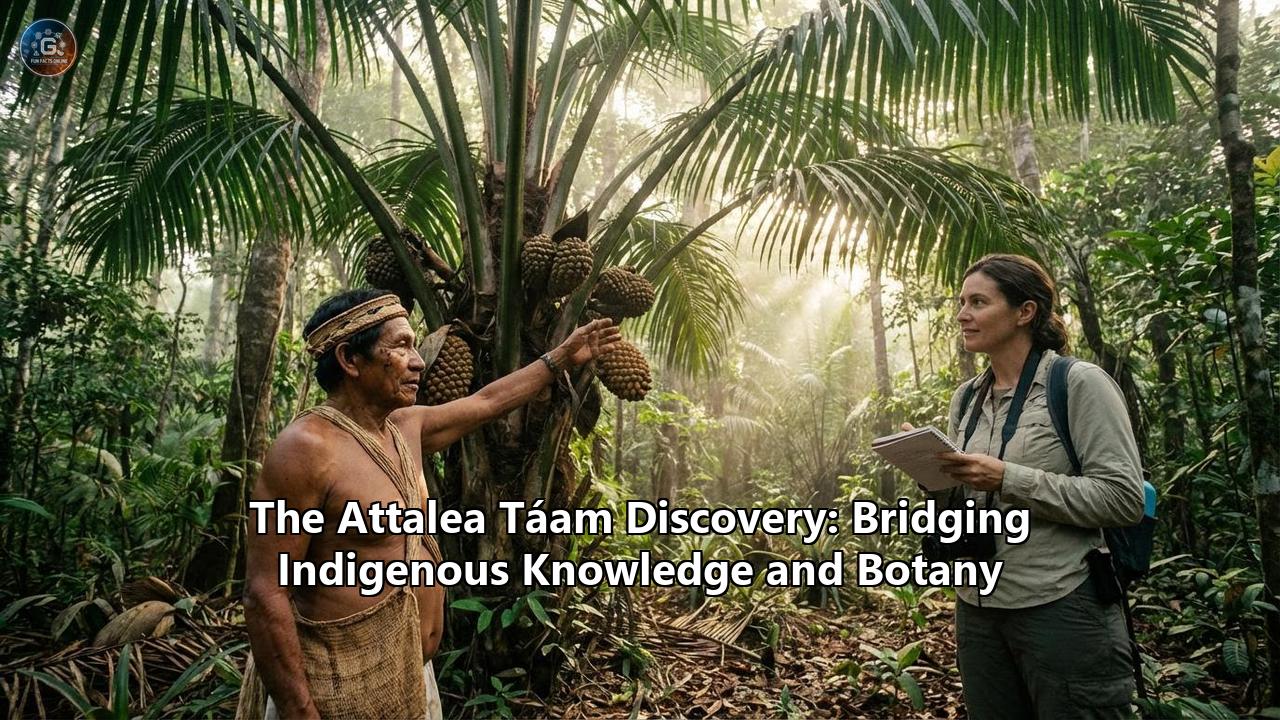
Deep in the heart of the Colombian Amazon, where the canopy forms a nearly impenetrable ceiling of emerald and the air hums with the vital energy of ancient ecosystems, a remarkable revelation has bridged the gap between age-old indigenous wisdom and modern botanical science. The discovery of a towering new palm species, formally named Attalea taam, is not merely a triumph of taxonomy; it is a profound testament to the power of participatory, equitable science. For generations, the Indigenous Cacua people have known, utilized, and revered this magnificent tree, referring to it simply as "táam". Now, thanks to an unprecedented collaboration between the Cacua and researchers from the University of Zurich, the rest of the world is finally being introduced to one of the most significant botanical finds of the decade.
The journey to uncovering Attalea taam reads like a classic narrative of exploration, yet it is beautifully grounded in the principles of 21st-century decolonial science. The story unfolds in the remote Vaupés department of southeastern Colombia, near the border with Brazil. This is a region of terra firme rainforests that fiercely guards its mysteries, requiring a demanding journey to access. To reach the Cacua community of Wacará, one must navigate a two-hour boat ride down the winding rivers from Mitú, followed by an arduous two-hour trek through dense, humid jungle foliage.
It was into this isolated landscape that Rodrigo Cámara-Leret, a professor at the University of Zurich’s Department of Systematic and Evolutionary Botany, and his seasoned PhD student Juan Carlos Copete ventured. The duo, who first began conducting field research together over fourteen years ago, traveled to Wacará following a serendipitous tip from a local professor. What they encountered was not just a virgin forest teeming with unidentified flora, but a community possessing an encyclopedic, yet critically endangered, understanding of the surrounding biome.
The Cacua people are one of the smallest Indigenous groups in Colombia, numbering approximately 147 to 200 individuals. Until the 1960s, they lived a semi-nomadic lifestyle, moving harmoniously with the rhythms of the forest. Today, as they transition toward a more settled, sedentary existence, they face a myriad of modern challenges. The introduction of solar panels, satellite internet, and secondary boarding schools has brought unprecedented exposure to Western influences, while concurrently threatening their traditional ethnobotanical knowledge. Decades ago, the legendary ethnobotanist Richard E. Schultes noted that the Cacua’s extensive knowledge of useful plants merited urgent study. Yet, for nearly thirty-five years, in-depth ethnobotanical studies of the community remained virtually nonexistent.
The introduction of Attalea taam to the global scientific record changes this narrative entirely. The discovery occurred when the researchers were presented with a palm fruit they could not readily identify. Sparked by scientific curiosity and guided by the profound expertise of Cacua elders and a young local hunter, the botanists were led deep into the ancient woodlands. The indigenous guides knew exactly where these wild palms thrived, intuitively understanding the health of the populations and the delicate balance required to harvest the fruits sustainably without endangering the species.
When the researchers finally stood beneath the canopy of Attalea taam, they were met with a breathtaking botanical giant. The palm is a commanding solitary tree that can reach astonishing heights of up to 23 meters (approximately 75 feet). Its thick, upright trunk is unmistakably characterized by beautiful, well-marked orange-brown ring-shaped leaf scars, giving the stem a striking banded appearance. Atop this towering pillar sits a magnificent crown of massive, feather-shaped fronds that erupt upward and outward, some measuring up to 12 meters in length. It is a dominant canopy species, a true architectural pillar of the Amazonian landscape that dictates the structure of the forest itself.
From a strict taxonomic perspective, classifying palms within the Attalea genus is notoriously difficult. The genus is widespread across the tropical lowland rainforests of the Americas, but its species exhibit considerable morphological differences, often featuring male, female, and hybrid inflorescences. To confirm that "táam" was indeed a species unknown to Western science, the researchers had to look closely at its microscopic and reproductive traits. Upon returning to Zurich, detailed digital microscopy and morphological analyses confirmed its uniqueness. Attalea taam is distinguished by staminate (male) flowers possessing three stamens with straight anthers, and spatulate petals adorned with specific clusters of hair-like structures called trichomes on the adaxial side. Furthermore, cross-sections of its endocarps—the innermost layer of the fruit surrounding the seed—revealed a distinct lack of internal fibers, a definitive marker that separated it from its closest relatives.
However, the anatomy of the palm only tells half the story; its ecological and cultural significance is equally profound. For the Cacua people, Attalea taam is an anchor of food security and daily survival. Just below the massive crown of leaves, the palm produces dense clusters of oval fruits. Taking nearly a year to ripen, these fruits mature into a warm yellow-brown hue with a distinct brown apex. Inside each fruit lies a single seed encased in a sweet, highly nutritious orange flesh that is relished by both the local wildlife and the indigenous community. Beyond sustenance, the massive fronds of the palm are harvested by the Cacua to meticulously thatch the roofs of their barns and dwellings, proving the tree's multifaceted utility.
What makes the publication of this discovery in the journal Phytotaxa so revolutionary is not just the description of a new canopy giant, but the methodology behind it. The project was a masterclass in participatory ecology and intercultural cooperation. The research was conducted on equal terms; while the scientists analyzed floral structures in Swiss laboratories, the Cacua collaborators independently mapped the geographical distribution of the trees, photographed specific habitats, and documented local soil conditions. The study was even subjected to a local peer-review process within the indigenous community, ensuring that their intellectual property and traditional names were respected and formally integrated into the scientific nomenclature. The species epithet, taam, is a direct homage to the Cacua word, immortalizing their linguistic heritage in the annals of global botany.
The ripple effects of this expedition go beyond a single species. During their collaborative fieldwork, the team also extended the known geographical distribution ranges for two other vital palm species in the region: Attalea insignis (known to the Cacua as “béi”) and Attalea septuagenata (“tah”). By documenting these distributions, the research has painted a richer, more accurate picture of the megadiverse Colombian Amazon. It highlights how indigenous territories are often the ultimate strongholds of biodiversity, actively managed and preserved by the people who have called them home for millennia.
The unveiling of Attalea taam arrives at a critical juncture for environmental science and cultural preservation. As the Amazon faces unprecedented threats from deforestation, climate change, and globalization, the safeguarding of both biodiversity and traditional knowledge is a race against time. The Cacua’s transition into a more settled lifestyle is emblematic of the cultural shifts occurring across the globe, where ancient wisdom risks being diluted or lost entirely. By engaging in equitable, pluralistic science, researchers are not merely extracting data; they are validating and helping to preserve the ethnobotanical libraries held within indigenous minds.
For horticulturists and conservationists, Attalea taam represents a fascinating new frontier. Because it is a canopy species native to the mature terra firme rainforest, its cultivation requires environments that can mimic the rich, well-drained tropical soils and ample vertical space of the Amazon. While it remains completely unknown in commercial cultivation, its discovery emphasizes the hidden horticultural treasures that still exist in remote biomes, waiting to be understood and protected.
Ultimately, the discovery of Attalea taam is a celebration of human curiosity and mutual respect. It proves that when Western scientists step out of the sterile confines of the laboratory and walk humbly alongside the true guardians of the forest, the results are extraordinary. Every time researchers enter the primeval forest with open minds, as Professor Cámara-Leret noted, they emerge with something new. But in the case of Attalea taam, they emerged with something much greater than a new species—they emerged with a blueprint for the future of scientific discovery. It is a future where knowledge is not owned but shared, where indigenous names are spoken with the same reverence as Latin binomials, and where the majestic canopy of the Amazon continues to inspire wonder, one striking, orange-ringed palm at a time.
Reference:
- https://pure.au.dk/portal/en/publications/attalea-taama-new-palm-species-well-known-by-the-cacua-indigenous/
- https://www.news.uzh.ch/en/articles/news/2026/citizen-sience.html
- https://bioengineer.org/collaborative-research-on-equal-footing-in-the-amazon/
- https://phytotaxa.mapress.com/pt/article/view/phytotaxa.739.1.5
- https://www.researchgate.net/publication/400022399_Attalea_taam-a_new_palm_species_well_known_by_the_Cacua_Indigenous_people
- https://projectpalm.net/species/attalea-taam
- https://www.reddit.com/r/palmtalk/comments/1rbarn8/wella_new_palm_discovery_has_been_brought_forward/