
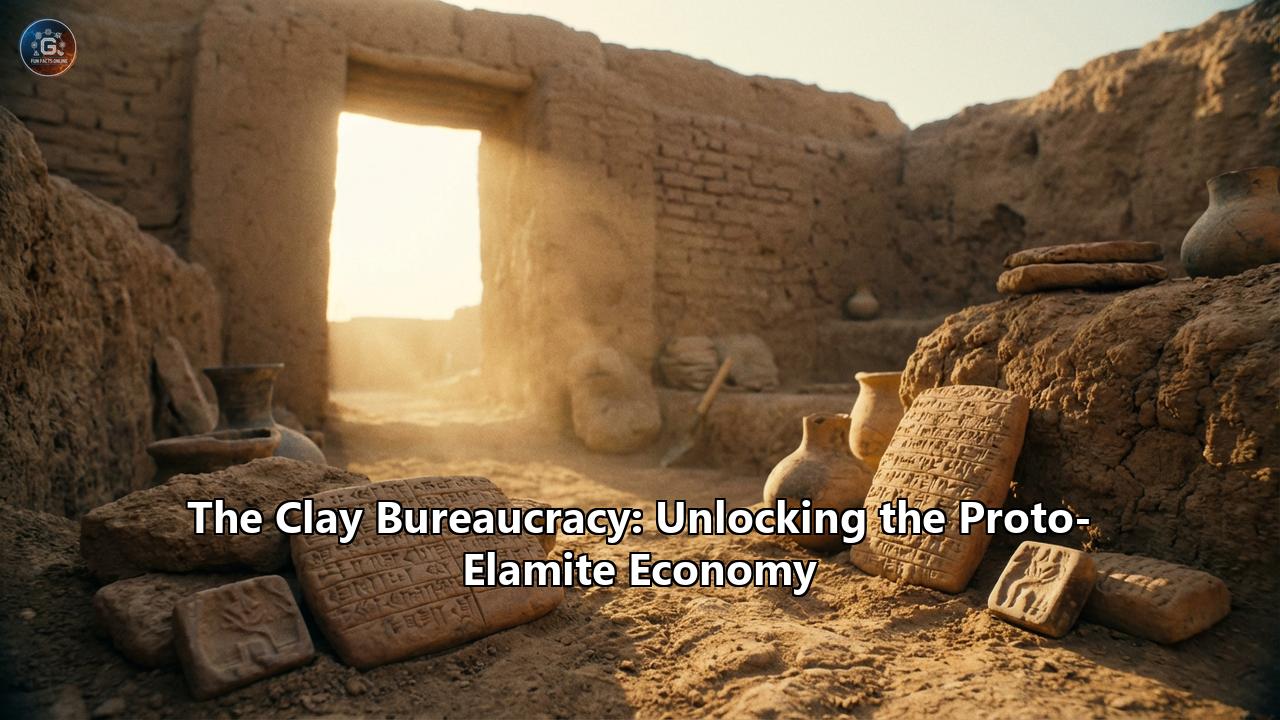
In the vast, sun-baked plains of southwestern Iran, beneath the modern hum of Khuzestan, lies the ghost of a civilization that once rivaled the first cities of Mesopotamia. It was a world not of stone pyramids or towering ziggurats—though it knew them—but of mud. Its palaces were brick, its vessels were ceramic, and its memory was etched into wet clay. This is the world of the Proto-Elamites, a culture that flourished around 3200 BCE, at the very dawn of human urbanization.
For over a century, the Proto-Elamites have remained an enigma, a "poor relation" to their famous Sumerian neighbors to the west. While Uruk and Ur have surrendered the secrets of their epics and kings to the decipherment of cuneiform, the Proto-Elamites have kept their silence. They left behind no Epic of Gilgamesh, no hymns to Inanna, no boastful royal chronicles. Instead, they left us their receipts.
Thousands of clay tablets, inscribed with a script that looks like a chaotic dance of abstract symbols and animal heads, constitute the primary legacy of this lost era. These are not works of literature; they are the debris of a "Clay Bureaucracy"—a sophisticated, sprawling, and ruthless administrative machine that managed an economy of industrial scale before the invention of money, markets, or the wheel as we know them.
To understand the Proto-Elamite economy is to unlock a different kind of human history. It is a story of how the first complex societies in Iran organized themselves not through the charisma of kings, but through the terrifying efficiency of accountants. It is a story of a "collapse of knowledge," where a writing system died because its users forgot how to teach it. And, thanks to a firestorm of recent scholarly debate, it is a mystery that is finally beginning to crack, revealing a civilization that may have invented a phonetic writing system centuries before the West.
This article delves deep into the mud-brick heart of Susa and the Iranian plateau to reconstruct the Proto-Elamite economy. We will explore the mechanics of their "clay bureaucracy," the lives of the workers whose rations were meticulously weighed, and the dramatic scholarly war currently waging over the meaning of their silent script.
Part I: The Rise of Susa and the Birth of the LedgerTo understand the Proto-Elamite phenomenon, one must first understand the world of the late 4th millennium BCE. This was a time of explosion. In southern Mesopotamia, the city of Uruk had ballooned into a metropolis of tens of thousands, sucking in resources from a vast periphery. But to the east, across the marshes and into the Zagros foothills, a parallel revolution was taking place.
The City of SusaSusa, the beating heart of the Proto-Elamite world, was already ancient by the time this story begins. Located on the fertile Susiana plain, it was a natural gateway between the Mesopotamian lowlands and the mineral-rich Iranian highlands. Around 3100 BCE, Susa underwent a radical transformation. It severed its cultural umbilical cord with Mesopotamia. The pottery styles changed. The artistic motifs shifted. And, most importantly, the writing changed.
Archaeologists call this period "Susa III," but it is better known as the Proto-Elamite period. It represents a moment of "schismogenesis"—a deliberate cultural breakaway. The elites of Susa were asserting their own identity, distinct from the Uruk culture. But they faced the same problem as their Mesopotamian counterparts: how to feed, control, and organize a population that had grown too large for simple tribal bonds.
The solution was a command economy of staggering complexity, run by households of immense power. These were not nuclear families in the modern sense but vast institutional estates—temples, palaces, or elite clans—that operated like corporations. They owned the land, the flocks, and the people. And to manage it all, they needed a technology of control.
The Invention of the TabletWriting in the ancient Near East did not begin as a way to write poetry; it began as a way to ensure the warehouse manager wasn't stealing the grain. In Mesopotamia, this evolved into proto-cuneiform. In Iran, it evolved into Proto-Elamite.
While the two systems shared a common ancestor—the system of clay "tokens" and "bullae" (clay envelopes) used for counting sheep and jars of oil—they diverged sharply. The Proto-Elamite scribes developed a script that was visually distinct. Unlike the box-like, non-linear structure of early Mesopotamian text, Proto-Elamite was written in straight, horizontal lines, reading from right to left. It was a "linear" script, a feature that would haunt decipherers for 5,000 years.
The tablets they produced are masterpieces of functional minimalism. They are thick, pillow-shaped lumps of clay, often covered in seal impressions—images of demons, animals, and heroes rolled onto the wet surface to authenticate the document. Over these images, the scribes pressed their styluses to record transactions.
The Mechanics of the Clay BureaucracyThe Proto-Elamite economy was not a market economy. You did not go to a bazaar to buy bread with coins. You were likely a dependent laborer attached to a Great Household. You worked—herding sheep, grinding grain, weaving textiles—and in return, the Household gave you a ration.
The clay tablets were the central nervous system of this redistribution.
- Input: A tablet might record the arrival of 500 bushels of barley from a harvest in a peripheral village.
- Processing: Another tablet might calculate the amount of flour expected from milling that barley, factoring in a specific "loss rate" or fee for the miller.
- Output: A final tablet would list the disbursement of that flour to 50 workers, broken down by gender, age, and status.
This system required a standardized way of measuring reality. The Proto-Elamites were obsessed with quantification. They had different numerical systems for different goods.
- System D: Used for grain.
- System B: Used for discrete objects (like jars).
- System S: Used for counting animals and humans.
The fact that they used the same counting system for sheep and human laborers is a chilling detail that reveals the nature of their economy. To the scribe, a worker was simply a unit of energy input, requiring a specific unit of caloric maintenance (barley) to function.
Part II: The Tablet’s Tale – Inside the AdministrationLet us imagine a specific tablet, excavated from the Acropolis of Susa. It is roughly the size of a smartphone, but thicker. On its reverse, a seal impression shows a lion walking on two legs, mastering two bulls—a symbol of the Household’s power.
On the obverse, the text begins with a "header," a logographic sign representing the institution or the specific department (e.g., the "Department of Plow Oxen"). Below that, a list of entries.
The Grain AdministrationThe most common tablets are grain accounts. The Proto-Elamite sign for a plow is clear, as are the signs for bundles of grain. Administrative sophistication is evident in how they handled "predictive" accounting. They didn't just record what happened; they recorded what should happen.
- Yield Estimates: Scribes would estimate the yield of a field based on the seed sown. If the actual harvest fell short, the farmer owed the difference.
- Ration Calculation: Rations were standardized. A male supervisor might receive 60 liters of barley a month. A female laborer, 30. A child, 20. These amounts were not arbitrary; they were calculated to keep the workforce alive and productive, with zero surplus.
While Mesopotamia was an agrarian river-valley civilization, the Proto-Elamite domain covered the Zagros mountains and the Iranian plateau. This meant pastoralism—sheep and goats—was far more central to their economy.
Tablets from Susa and the highland site of Tepe Yahya show massive herds of animals. But these were not free-roaming shepherds. They were state employees.
- The "Dairy" Tablets: Some of the most complex deciphered texts deal with the production of cheese and butter oil. The administration knew exactly how much milk a nanny goat should produce in a season. The shepherd was responsible for delivering that amount in processed cheese. If he failed, he was in debt.
- Wool and Textiles: The hair of the goat and the wool of the sheep were tracked into the textile workshops, where female laborers wove the cloth that was likely a major export of the Proto-Elamite state.
Perhaps the most poignant aspect of the clay bureaucracy is its record of humanity. The Proto-Elamites had specific signs for "male worker," "female worker," "young male," and "young female."
Recent studies by scholars like Jacob Dahl have illuminated a dark reality. The texts show groups of workers with no names, only numbers. They are grouped in a way that suggests gangs of dependent labor—essentially slaves or serfs.
- Child Labor: There is explicit evidence of children in the workforce. Small rations were allotted to "young ones," indicating that as soon as a child was old enough to carry a basket or tend a lamb, they were integrated into the economic machine. The state did not distinguish between the labor of a beast of burden and the labor of a human child; both were assets to be maximized.
We have described what the tablets did, but we have not yet fully explained what they are. The Proto-Elamite script is one of the last great undeciphered writing systems of the ancient world. But why is it undeciphered? And what does its failure tell us about the economy it served?
The "Undeciphered" ParadoxTechnically, we can "read" the numbers. We understand the accounting systems thanks to the groundbreaking work of Jöran Friberg and later Peter Damerow and Robert Englund. We know a tablet is about barley because of the grain sign. We know it lists 100 units because of the numerical signs.
But the "header" signs—the names of the people, the gods, the specific descriptions of the goods—remain largely opaque.
For decades, scholars assumed Proto-Elamite was a precursor to the later Elamite language, just as Old English is to Modern English. They assumed it was a full writing system capable of recording poetry, history, and speech.
Professor Jacob Dahl of the University of Oxford has challenged this view with a radical and compelling theory. He argues that Proto-Elamite was not a true writing system in the sense of recording spoken language (glottographic). Instead, it was a complex system of mnemonic symbols and ideograms designed exclusively for administration.
The "Collapse of Knowledge" TheoryDahl’s analysis of the corpus reveals something strange. Over the few centuries that Proto-Elamite was used (c. 3100–2900 BCE), the script did not get better; it got worse.
- Lack of Standardization: In Mesopotamia, scribes were trained using "lexical lists"—standardized lists of words (trees, professions, birds) copied over and over. This ensured that a scribe in Uruk wrote the sign for "king" the same way as a scribe in Ur.
- The Elamite Chaos: No such lexical lists have been found for Proto-Elamite. Without a "school" system to enforce standards, every scribe seems to have developed their own variations. New signs appear and disappear. The system became bloated with thousands of unique signs that were likely only understood by the specific clique of scribes who invented them.
Dahl proposes that this represents the world's first known "collapse of knowledge." The bureaucracy became so insular, so complex, and so lacking in educational infrastructure that the writing system collapsed under its own weight. It wasn't destroyed by invasion; it died because the scribes forgot what the signs meant. By 2900 BCE, the script vanishes. The scribes of the Iranian plateau went back to being illiterate for 500 years—a "Dark Age" of administration—until they eventually adopted the simpler Mesopotamian cuneiform.
Part IV: The Counter-Revolution – François Desset and the Linear Elamite BreakthroughJust as Dahl’s "collapse" theory was cementing itself as the standard model, a bombshell dropped in the world of Assyriology. In 2020, French archaeologist François Desset announced that he had deciphered Linear Elamite, a script used in Iran much later, around 2300–1900 BCE.
But Desset went further. He made a claim that directly contradicts the "dead end" theory of Proto-Elamite.
The Continuity HypothesisDesset argues that Linear Elamite is not a separate invention but the direct descendant of Proto-Elamite. He believes:
- Proto-Elamite was phonetic: He asserts that the undeciphered signs in Proto-Elamite are not just ideograms but represent syllables of the Elamite language (Hatamtite).
- Sister, not Daughter: He challenges the idea that Proto-Elamite is a derivative of Mesopotamian proto-cuneiform. He suggests they are "sister scripts" that emerged simultaneously from a common ancestor (the token system) but followed different evolutionary paths.
- No Collapse: Instead of a collapse of knowledge, Desset sees a continuous, albeit poorly attested, tradition of writing in Iran that links the 3100 BCE tablets to the 2300 BCE inscriptions.
Desset’s breakthrough came from a set of silver vessels (the Gunagi vessels) with bilingual inscriptions (or rather, inscriptions of the same names) in Linear Elamite and Cuneiform. By cross-referencing royal names like Puzur-Sushinak, he unlocked the phonetic values of the Linear Elamite signs.
He is now applying these values back in time to the Proto-Elamite script. If he is right, the "chaotic" signs of the Clay Bureaucracy might actually be the world’s oldest syllabary—a writing system far more advanced and abstract than the heavy logograms of Mesopotamia.
The War of the ScribesWe are currently in the middle of a scholarly "war."
- Team Dahl: Argues that the statistical variability of Proto-Elamite proves it wasn't phonetic. If a sign changes shape every 10 years, it can't be a stable letter. He sees Proto-Elamite as a failed experiment in administrative notation.
- Team Desset: Argues that the variability is just handwriting style and that underlying it is a coherent phonetic system recording the Elamite language.
For the reader, this debate highlights that the history of this economy is still being written. Was it a sophisticated state that invented the alphabet 2,000 years early? Or was it a paranoid bureaucracy that drowned in its own unreadable paperwork?
Part V: The World of the Cylinder Seal – Demons and AccountantsWhile the tablets are the "spreadsheets" of the economy, the cylinder seals are its "corporate branding."
The Proto-Elamites were masters of glyptic art. To authenticate a tablet, a scribe would roll a small stone cylinder, carved in reverse, over the wet clay to create a continuous panoramic image.
The "Proto-Shiva" and the Bull-MenThe imagery on these seals is strikingly different from Mesopotamia. While Sumerians carved scenes of kings feeding flocks or temple facades, the Proto-Elamites carved monsters.
- Animals as Humans: A recurring motif is animals acting like humans. We see lions rowing boats. We see bulls counting grain. We see bears drinking beer from jars. This "World Upside Down" might represent fables or myths, but in an administrative context, they likely represented specific departments. The "Lion" seal might be the symbol of the Palace Guard; the "Bull" seal, the Agricultural Ministry.
- The Proto-Shiva: One famous seal impression from Susa shows a bull-man figure sitting in a yogic, cross-legged position, horned and powerful. This image bears a haunting resemblance to the "Pashupati" (Lord of Beasts) seal found thousands of years later in the Indus Valley Civilization (Harappa).
While diffusionist theories are risky, this link suggests that the Proto-Elamite economy was not isolated. It was the pivot point of the ancient world, connecting the Tigris to the Indus. The "Clay Bureaucracy" of Susa may have influenced the administrative styles of the great cities of Pakistan and India.
The Seal as Legal PowerIn the economy of the time, the seal was the person. If a warehouse warden lost his seal, he lost his ability to authorize rations. It was his credit card and his signature. The loss of a seal was a bureaucratic catastrophe, sometimes recorded in the tablets themselves. The sheer number of seals found—thousands of them—indicates a society obsessed with property, ownership, and chain of custody.
Part VI: The Collapse and the LegacyAround 2700 BCE, the Proto-Elamite system vanished. The settlements on the Iranian plateau, like Tepe Yahya and Shahr-i Sokhta, shrank or were abandoned. Susa fell under the sway of Mesopotamian dynasties. The linear script stopped being used.
Why did it fail?The economic answer lies in the fragility of centralization. The Proto-Elamite economy was a "top-heavy" system. It relied on the intense extraction of resources from a wide, rugged geography to feed a centralized elite in Susa.
- The "Underfunding" Hypothesis: If we accept Dahl’s view, the state failed to invest in the human capital required to maintain the bureaucracy. They trained scribes to count, but not to understand the system. Over generations, the "code" degraded until it was useless. A bureaucracy that cannot read its own records is a bureaucracy that cannot tax its people.
- The Resistance: Alternatively, the mobile, pastoralist population of the Iranian highlands may simply have rejected the control of the Susa elites. You can tax a farmer who is stuck to his field; it is much harder to tax a shepherd who can drive his flock into the mountains. The "Clay Bureaucracy" may have been defeated by the geography of Iran itself.
The Proto-Elamite period was a brief, brilliant flash in human history. For a few centuries, the people of the Iranian plateau built an economic machine of dazzling complexity. They tracked the calories of thousands of workers, managed herds of millions of animals, and traded lapis lazuli from Afghanistan to Iraq.
They attempted to bind this world together with mud—clay tablets to record it, clay seals to authorize it, and clay bricks to house it.
Whether their writing system was a "dead end" or the "mother" of all Iranian scripts remains to be seen. But their legacy is undeniable. They proved that an economy could be run not just by muscle and sword, but by data. They were the world's first technocrats, and their silent tablets are a testament to the enduring, and sometimes crushing, power of bureaucracy.
As we stare at the digital spreadsheets that rule our modern lives, we are looking at the great-grandchildren of the clay tablets of Susa. The medium has changed from mud to silicon, but the impulse remains the same: to count, to control, and to bring order to the chaos of human exchange.
Sidebar: The Scribe’s Toolkit
- The Clay: Finely levigated alluvial clay, cleaned of pebbles to ensure a smooth writing surface.
- The Stylus: A reed cut with a triangular tip. Unlike the Sumerian stylus which made wedge shapes (cuneiform), the Proto-Elamite stylus was often pressed deep to make circular numerical holes or dragged to create the linear "script."
- The Seal: Made of limestone, bitumen, or glazed steatite (fired to a high hardness). Drilled through the center to be worn on a string around the neck—always ready to do business.
- Sign M388: A sign that looks like a hairy triangle. Meaning: "Nanny Goat."
- Sign M218: A jar with a spout. Meaning: "Butter/Oil."
- The Challenge: If you see M388 followed by M218, you know it’s a dairy account. But if you see M388 followed by a string of abstract lines... is that the name of the shepherd? The god of goats? Or a note that the goat is dead? This is the frontier of modern archaeology.
Reference:
- https://www.smithsonianmag.com/history/have-scholars-finally-deciphered-a-mysterious-ancient-script-180980497/
- https://www.youtube.com/watch?v=GjPvIZqFjcY
- https://thelostkingdoms.com/deciphering-the-enigmatic-writings-of-ancient-civilizations/
- https://www.nationalgeographic.com/history/article/decoding-ancient-languages-linear-elamite
- https://www.researchgate.net/publication/316475114_Proto-Elamite_Writing_in_Iran
- https://www.ox.ac.uk/oxford-heritage-projects/unlocking-past
- https://www.hsmt.ox.ac.uk/people/professor-jacob-dahl
- https://www.youtube.com/watch?v=bUrvXj2w5RE