
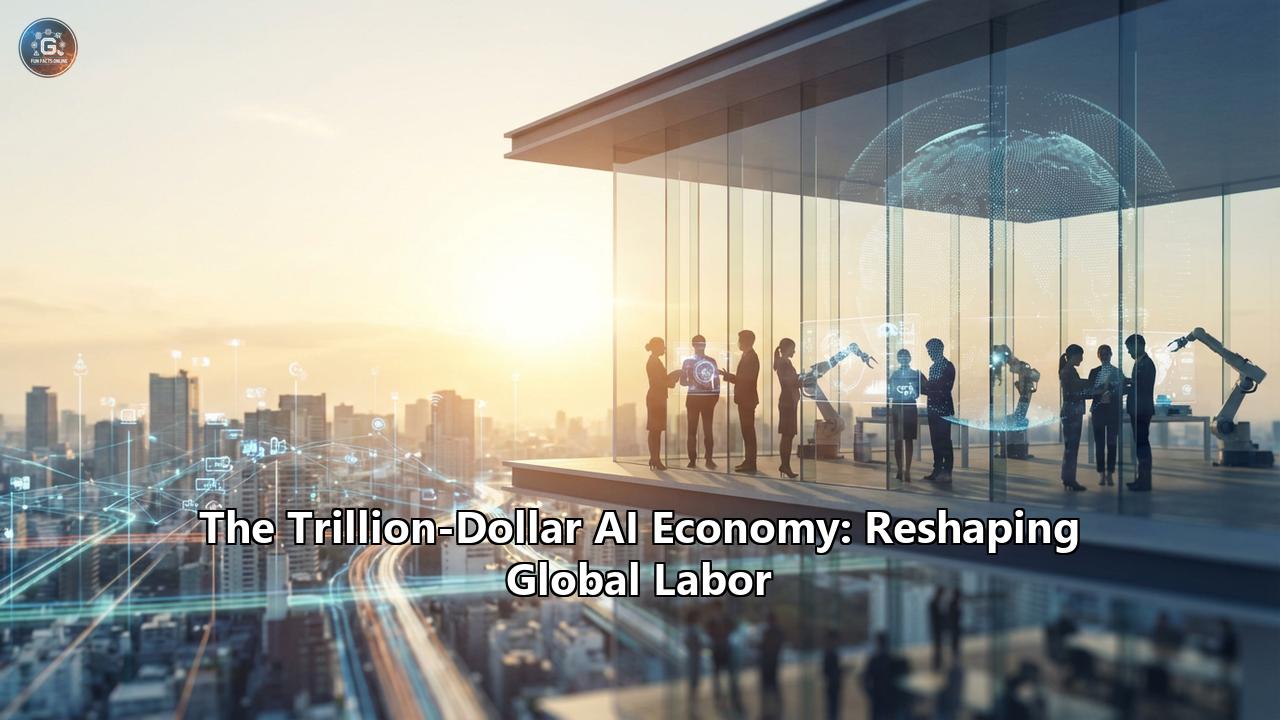
The artificial intelligence narrative has decisively shifted from theoretical wonder to hard economic reality. We have crossed the threshold into what economists and business leaders universally recognize as the Trillion-Dollar AI Economy. This is no longer a speculative venture capital pitch or a distant futurist vision; it is the definitive architectural framework fundamentally rewiring global industries, supply chains, and, most profoundly, the labor market. The conversation has moved beyond the parlor tricks of large language models generating poetry. Today, the focus is on systemic deployment, autonomous execution, and a structural metamorphosis of the global workforce that is unprecedented in its speed and scale.
To comprehend the sheer magnitude of this transformation, one must first look at the macroeconomic math. Leading financial and consulting institutions have placed staggering valuations on AI’s economic impact. Generative AI and advanced machine learning models are projected to inject an extraordinary amount of capital and productivity into the global system. According to Goldman Sachs, breakthroughs in generative AI could drive a 7% increase in global GDP—equivalent to almost $7 trillion—and lift productivity growth by 1.5 percentage points over a ten-year period. McKinsey & Company’s extensive research suggests that generative AI could add between $2.6 trillion and $4.4 trillion annually to the global economy, a figure that eclipses the entire GDP of nations like the United Kingdom.
Zooming out to the end of the decade, the forecasts become even more monumental. PwC projects that artificial intelligence could add a staggering $15.7 trillion to global GDP by 2030. To put this into perspective, that is more than the combined current economic output of China and India. Of this projected gain, $6.6 trillion is expected to come directly from productivity enhancements, while $9.1 trillion will be driven by consumption effects as AI enables the creation of highly personalized, novel products and services. These are not mere incremental improvements; they represent a seismic leap in human economic capacity.
However, beneath these soaring macroeconomic projections lies a complex, often turbulent reality for the global workforce. The engine driving this next phase of the AI economy is the rapid maturation of "Agentic AI." If the hallmark of 2023 and 2024 was generative AI—systems that assist humans by producing text, images, and code—the defining technology of the present era is agentic AI. These are autonomous systems capable of reasoning, complex decision-making, multi-step task execution, and workflow coordination without continuous human oversight.
Agentic AI functions not merely as an assistive software tool but as a "digital worker" capable of operating independently across enterprise ecosystems. The market for agentic AI in the labor sector is experiencing explosive growth. Valued at $5.2 billion in 2024, it is projected to soar to an impressive $196.6 billion by 2034, registering a compound annual growth rate (CAGR) of 40.3%. Firms actively leveraging agentic AI are already reporting profound impacts on their operational structures, including a reported 19% decrease in labor costs per employee. This cost reduction is achieved largely by deploying AI agents to handle routine, time-consuming tasks in sectors like customer service, finance, and IT operations, while human employees are redeployed toward high-value strategic and relational endeavors.
In customer service alone—which accounted for a dominant 33.9% share of the agentic AI labor market adoption in 2024—virtual assistants are autonomously resolving complex, multi-tiered queries that previously required entire floors of human representatives. This capability to orchestrate tasks and make autonomous decisions is flattening traditional corporate hierarchies. As agentic AI systems assume the responsibilities of resource allocation, project coordination, and routine decision-making, the necessity for middle management is significantly reduced. Executive roles are simultaneously shifting from relying on intuition and human reporting to interpreting and acting upon real-time, AI-generated operational insights.
But what does this mean for the human worker? The World Economic Forum’s (WEF) Future of Jobs Report 2025 provides the definitive, data-driven blueprint of the impending labor transition. The report forecasts that AI will trigger the most significant labor transformation since the Industrial Revolution, fundamentally altering 86% of businesses by 2030. The headline numbers present a striking dichotomy: AI and related technologies are projected to displace 92 million existing jobs worldwide by the end of the decade, while simultaneously creating 170 million new roles.
On paper, this results in a net positive gain of 78 million jobs. However, viewing this transition purely through the lens of net job creation masks a critical, systemic crisis: the "Skills Bust". The global economy is hurtling toward a massive structural mismatch. The 92 million jobs being eliminated—heavily concentrated in administrative support, routine coding, basic accounting, and mid-level cognitive processing—require vastly different skill sets than the 170 million jobs being created in AI orchestration, algorithm monitoring, data architecture, and complex human-AI hybrid management.
This mismatch has triggered a global scramble for talent. Public data reveals that 63% of employers report that skills shortages are actively blocking their business growth. Consequently, workers possessing proven AI competencies are already commanding a massive 56% wage premium, a figure that more than doubled in just twelve months. The stark reality is that 59% of the global workforce will require extensive reskilling or upskilling by 2030 to remain relevant. Yet, data suggests that over 120 million people are at risk of not receiving this vital training, threatening to widen global economic inequality.
To navigate this landscape, it is crucial to understand the difference between frictional and structural unemployment. During previous technological shifts, displaced workers experienced frictional unemployment—a temporary gap while they updated their resumes and transitioned to similar roles in different companies. The current wave of AI-driven layoffs, however, is predominantly structural. When an enterprise integrates an agentic AI system that automates 30% of its current work hours, those displaced roles are permanently eliminated from the economy. Sending a polished resume to apply for a structurally eliminated position yields a near-zero return on investment.
Economic researchers point to the concept of "creative destruction," a theory heavily emphasized in the 2025 Nobel Prize in Economics awarded for research into technological deployment. Historically, between the commercial deployment of a general-purpose technology and its positive stabilization in the labor market, there exists a "destructive gap" lasting 10 to 15 years. With the AI revolution commencing in earnest around 2023, the stabilization window is projected for the early 2030s. Workers in their 40s and 50s caught in this transition cannot rely on legacy expertise; survival in the new economy requires a radical pivot. Successful career changers in this era are those who abandon the pursuit of old positions and focus entirely on building new, AI-augmented capabilities.
While seasoned professionals grapple with structural displacement, the entry-level workforce is facing its own unique paradigm shift. A collaborative 2026 executive briefing by PwC and the World Economic Forum, drawing on a survey of over 9,300 entry-level employees across 48 economies, reveals a complex psychological landscape. Entry-level jobs have traditionally served as the foundational bridge between formal education and professional mastery, allowing young workers to learn by executing basic administrative, analytical, and research tasks. Today, these are precisely the tasks most easily automated by agentic AI.
Interestingly, the data shows that younger workers are generally optimistic: 47% express curiosity and 38% excitement about AI's impact on their roles, compared to only 29% who feel worried. They are adapting rapidly, utilizing AI tools to accelerate their learning curves and punch above their weight class. However, there is a profound underlying anxiety regarding skill longevity. Over 25% of entry-level workers believe that half or more of their current skill sets will be rendered entirely irrelevant within just three years. Furthermore, business leaders are deeply divided on how AI will shape early-career pipelines; 36% of executives believe AI will increase entry-level opportunities, while 38% expect a sharp reduction, creating a highly volatile environment for new graduates.
The friction of this transition is acutely visible at the enterprise level. Despite the omnipresence of AI in corporate strategy, scaling the technology from localized pilots to enterprise-wide profitability remains a formidable challenge. McKinsey’s 2025 Global AI Survey highlights this operational bottleneck: while nearly 90% of organizations regularly utilize AI, and 78% deploy it in at least one business function, roughly two-thirds remain stuck in the experimentation phase.
The "AI high performers"—the rare organizations actually capturing substantial value—are those that recognize AI not merely as a cost-cutting mechanism, but as an engine for holistic growth and innovation. These industry leaders are taking the difficult step of entirely redesigning their core workflows around AI capabilities. They report tangible cost benefits in software engineering, IT, and manufacturing, coupled with significant revenue gains in marketing, corporate finance, and product development. Yet, despite the hype, only 39% of companies globally report a measurable enterprise-wide impact on Earnings Before Interest and Taxes (EBIT). The trillion-dollar economy is highly lucrative, but the wealth is currently concentrating in the hands of the few organizations capable of mastering AI-first workflow design and overcoming integration chaos.
This concentration of wealth and capability extends beyond corporate entities to the geopolitical stage. The infrastructure required to power the AI economy—data centers, specialized silicon, and vast energy grids—is monumental. The semiconductor supply chain, dominated by a handful of titans, has become the ultimate geopolitical flashpoint. Nations are fiercely competing to establish themselves as epicenters of AI innovation. A prime example is the 2026 India AI Impact Summit, which drew a staggering 250,000 attendees and featured a landmark $1.1 billion state-backed venture capital fund specifically targeting deep-tech and AI startups. This aggressive move signals a definitive shift from traditional labor arbitrage models to high-value, IP-based AI platform development.
Similarly, elite global forums like the 2026 Cisco AI Summit in San Francisco are no longer just technology showcases; they are high-stakes summits where the "power brokers" of the trillion-dollar AI economy converge to dictate the future of digital infrastructure, regulatory policy, and capital allocation. In these rooms, the conversations revolve around compute shortages, the fracturing of global AI regulations across the U.S., EU, and Asia, and the urgent need to mitigate the societal fallout of workforce disruption.
As AI assumes a greater share of analytical, routine, and even creative labor, the economic premium is shifting dramatically toward uniquely human traits. Emotional intelligence, highly nuanced communication, empathetic leadership, and ethical problem-solving are becoming the most valuable assets in the labor market. The future workforce must exist in a state of perpetual beta—constantly learning, unlearning, and adapting alongside their evolving AI counterparts.
The trillion-dollar AI economy represents the most significant technological wager in human history. The sheer scale of capital investment ensures that the momentum of AI integration will not reverse. We are transitioning from an era where humans operated machines to an era where humans orchestrate intelligent agents. The friction of this transition—the displaced jobs, the frantic race for new skills, the flattening of corporate structures—is the unavoidable cost of entering a hyper-productive economic reality. For businesses, policymakers, and workers alike, the mandate is clear: clinging to the legacy paradigms of the pre-AI labor market is a guaranteed path to obsolescence. The future belongs to those who view artificial intelligence not as a rival for human labor, but as the ultimate catalyst for human augmentation.
Reference:
- https://www.goldmansachs.com/insights/articles/generative-ai-could-raise-global-gdp-by-7-percent
- https://www.makebot.ai/blog-en/mckinsey-report-how-generative-ai-is-reshaping-global-productivity-and-the-future-of-work
- https://www.researchgate.net/publication/399802710_Agentic_AI_and_Labor_Market_Polarization_Who_Gains_Who_Loses_and_How_Fast
- https://market.us/report/agentic-ai-in-labor-market/
- https://www.silicon.eu/how-will-agentic-ai-impact-the-job-market-18096.html
- https://www.gsdcouncil.org/blogs/agentic-ai-and-workforce-transformation-job-impact-and-skills-demand
- https://economictimes.indiatimes.com/news/international/us/is-ai-helping-corporates-or-taking-your-job-6-key-takeaways-from-mckinseys-2025-ai-report/articleshow/125233938.cms?from=mdr
- https://www.hfsresearch.com/research/agentic-ai-shatter-workforces-and-economies/
- https://sustainabilitymag.com/articles/wef-report-the-impact-of-ai-driving-170m-new-jobs-by-2030
- https://www.reddit.com/r/jobs/comments/1r918q1/the_wef_says_92_million_jobs_will_be_displaced_by/
- https://www.biztechreports.com/news-archive/2025/12/10/the-ai-jobs-boom-versus-the-skills-bust-ai-december-10-2025
- https://www.goldmansachs.com/insights/articles/how-will-ai-affect-the-global-workforce
- https://www.pwc.com/gx/en/issues/workforce/ai-entry-level-careers.html
- https://medium.com/@l.churchill427/the-trillion-dollar-ai-bet-52b16a7ecc49
- https://cryptorank.io/news/feed/7fa6f-india-ai-impact-summit-2025-updates
- https://techedgeai.com/ciscos-ai-summit-2026-brings-the-power-brokers-of-the-trillion-dollar-ai-economy-to-one-stage/