
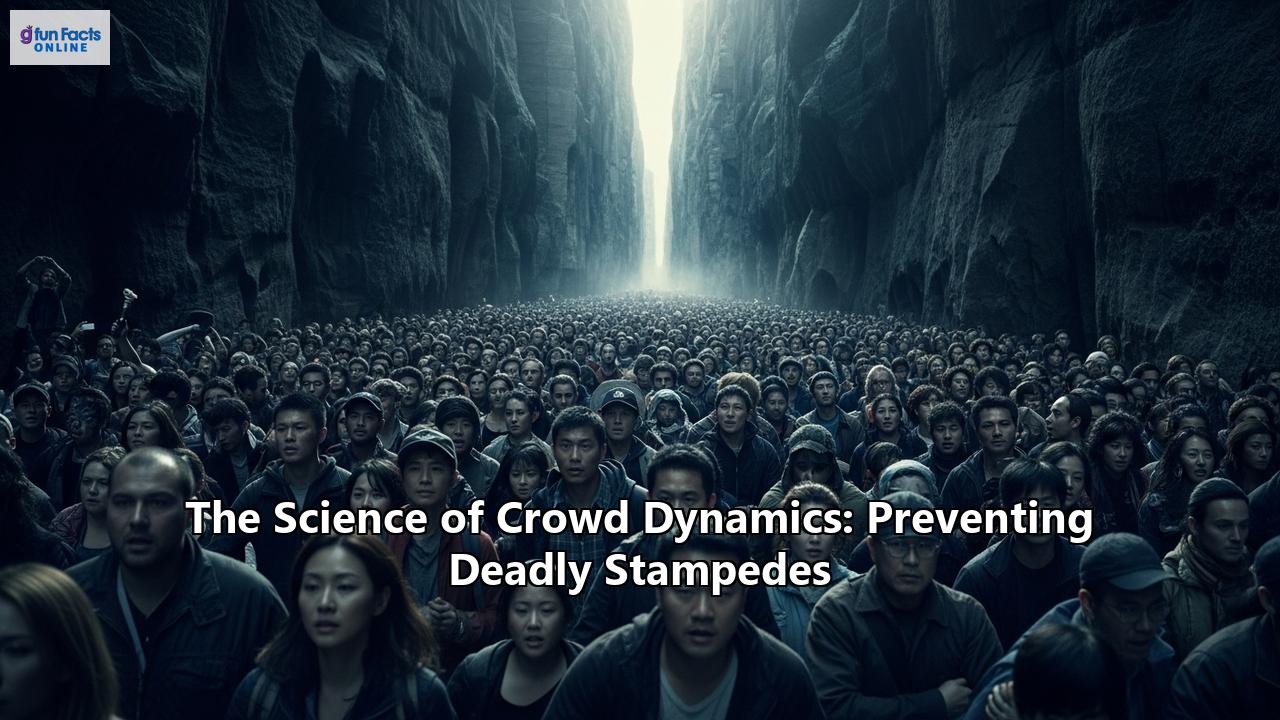
A hush falls over a sea of people, a shared moment of anticipation before a concert begins. Thousands move as one toward a stadium gate, their excitement a palpable force. A religious festival draws millions, a testament to collective faith. These are crowds, a fundamental part of the human experience. Yet, within this collective energy lies a terrifying potential for disaster. When the flow of people is disrupted, when density reaches a critical point, the crowd itself can become a killer. The resulting tragedies, often mislabeled as "stampedes," are more accurately described as crowd crushes or collapses, and they are almost always preventable.
The science of crowd dynamics is a multidisciplinary field dedicated to understanding the intricate dance of people in large gatherings. By drawing on physics, psychology, computer science, and engineering, experts can dissect the causes of deadly incidents and, more importantly, develop strategies to stop them from ever happening. This is not a study of abstract forces, but a science with a deeply human purpose: to ensure that moments of communal joy, faith, and celebration do not turn into scenes of unimaginable horror.
Deconstructing Disaster: It's a Crush, Not a "Stampede"
The first step in understanding these events is to use the right language. The word "stampede" conjures images of panicked, irrational animals, a narrative that wrongly blames the victims for their own demise. Professor Keith Still, a leading expert in crowd science at Manchester Metropolitan University, is adamant on this point: "People don't die because they panic. They panic because they are dying." The term "stampede" is a loaded one, suggesting a mindless mob, when the reality is far more tragic and complex.
The fatal events are almost invariably crowd crushes or collapses. These are not born of panic, but of physics. When the density of a crowd exceeds a critical threshold—typically around five to six people per square meter—the nature of the crowd changes. Individuals lose control over their own movements and are swept along by the physical forces of the mass around them. The crowd begins to behave like a fluid, with shockwaves of movement passing through it that can knock people off their feet.
Once someone falls, a "hole" is created in the crowd. People behind them, still being pushed forward, have no support and tumble into the gap, creating a horrific domino effect. The pressure can become immense, exerting forces strong enough to bend steel barriers. In this environment, people die not from being trampled, but from compressive asphyxia—they are literally squeezed to death while standing upright. These incidents are not spontaneous acts of chaos; they are the direct and predictable result of organizational failures in planning, design, and management.
The Physics of People: Modeling Crowd Movement
To prevent such disasters, scientists first need to understand how crowds move. They do this by creating sophisticated models that can simulate and predict pedestrian flow under different conditions. These models generally fall into three categories.
Fluid Dynamics and Macroscopic Models
One of the earliest and most intuitive ways to understand crowd movement is to treat the crowd as a fluid. Macroscopic models, derived from fluid dynamics, don't focus on individuals but on average characteristics like density, speed, and flow. Just as water flows through pipes, a crowd flows through corridors, gates, and open spaces. This analogy is surprisingly powerful. Planners can use fluid dynamics equations to anticipate where "pressure" will build up and where "bottlenecks" will occur.
This approach helps in designing venues for optimal flow, such as creating wider entry points, ensuring multiple exit routes, and using one-way systems to prevent the human equivalent of turbulence. The concept of "stop-and-go waves," familiar to anyone who has been in a traffic jam, also applies to crowds. A minor blockage can send ripples backward through the crowd, increasing density and pressure far from the source of the problem.
The Social Force Model (SFM)
While the fluid analogy is useful, people are not water molecules. They have intentions, desires, and react to their surroundings. This is where microscopic models, which simulate the behavior of each individual, become essential. One of the most influential is the Social Force Model (SFM), developed by Professor Dirk Helbing.
The SFM posits that an individual's movement is determined by a combination of "social forces." These include:
- A driving force: The person's motivation to move toward a destination, like a stadium seat or an exit.
- Repulsive forces: The tendency to maintain a certain distance from other people and from obstacles like walls or barriers. This force is analogous to the repulsion between two electrons; it grows stronger the closer the individuals get.
- Attractive forces: The tendency for people in a group, like families or friends, to stick together.
By programming these forces into a computer simulation, the SFM can realistically replicate complex crowd phenomena, including the spontaneous formation of lanes in two-way traffic and the "clogging" effect at bottlenecks. It can show how, as density increases, the forces exerted by physical contact between bodies begin to dominate, leading to the dangerous, involuntary movements that precede a crush.
Agent-Based Models (ABM)
Agent-Based Models (ABM) take the individual simulation a step further. In an ABM, each person is an autonomous "agent" with their own set of characteristics and decision-making rules. These agents can be programmed with varying goals, walking speeds, risk tolerances, and even knowledge of the environment. An ABM can simulate a diverse crowd of people—parents with children, elderly individuals, or groups of teenagers—and model how their heterogeneous behavior affects the overall crowd dynamics.
This approach is particularly useful for modeling complex scenarios. For example, ABMs can explore how people make choices based on their vision—the angle and depth of what they can see—guiding them toward their ultimate destination while adapting to the local environment. Planners can use these simulations to test "what-if" scenarios: What happens if an exit is blocked? How will the crowd react to a new sign? Where are the most likely points of congestion if a popular food stall is placed in a certain location? This moves beyond simple physical forces to incorporate a more nuanced, psychological dimension into the simulation.
The Crowd Mind: Debunking the Myth of Mass Panic
For decades, crowd disasters were explained by the simplistic and flawed concept of "mass panic." This theory, rooted in the 19th-century work of Gustave Le Bon, suggested that individuals in a crowd lose their sense of self and are swept up by a primitive, irrational mob mentality. In an emergency, this was thought to lead to a "panic stampede," where selfish survival instincts take over, causing people to trample each other in a desperate rush for safety. Modern research has shown this to be a dangerous myth.
The Social Identity Model of Collective Resilience
The reality of human behavior in emergencies is often the exact opposite of panic. Extensive research, including analyses of survivor testimonies from events like the 2005 London bombings, shows that cooperation and altruism are common. The leading explanation for this is the Social Identity Model (SIM).
The SIM proposes that when a group of people share a common experience of an emergency—a "common fate"—they can develop a new, emergent sense of shared social identity. The boundary between "me" and "them" dissolves, replaced by a sense of "us." This psychological transformation has profound behavioral consequences:
- Increased Support: When people see others as part of their own group, they are more likely to offer help and support, even to strangers. The well-being of others becomes linked to their own.
- Coordinated Action: A shared identity allows for greater coordination and orderly behavior. People might let others go first during an evacuation or work together to overcome an obstacle.
- Collective Efficacy: This sense of unity can foster a belief that the group can overcome the challenge together, reducing feelings of helplessness.
Conversely, when a sense of shared identity is weak or absent, more individualistic and competitive behaviors are likely to emerge. Therefore, a "panic" situation is not an inevitability but a social psychological outcome. It is more likely to occur when people feel isolated and disconnected from those around them.
This has critical implications for crowd managers. Instead of treating crowds as an untrustworthy mob prone to panic, responders should aim to foster this sense of shared identity. Clear, honest, and respectful communication is key. When authorities provide information and treat the crowd as a group of responsible individuals, they empower the crowd's natural resilience and capacity for self-organization. Withholding information or using coercive control measures can break down trust, fragment the group, and make dangerous outcomes more likely.
Lessons Written in Tragedy: Case Studies of Crowd Disasters
The evolution of crowd science has been driven by the painful lessons learned from real-world disasters. Each tragedy provides a dataset of what went wrong, allowing experts to refine models and develop better safety protocols.
The Hillsborough Disaster (1989)
On April 15, 1989, a fatal crush at the Hillsborough Stadium in Sheffield, England, resulted in the deaths of 96 Liverpool football fans. The disaster was a turning point in the understanding of crowd safety. The official inquiry, led by Lord Justice Taylor, identified the main cause as a failure of police control.
A late influx of fans toward the Leppings Lane end of the stadium created severe overcrowding outside the turnstiles. In an attempt to alleviate the pressure, police ordered an exit gate to be opened. This sent an additional 2,000 fans flooding into the already-packed central pens. The gradient of the terrace and the steel perimeter fences designed to prevent pitch invasions turned the pens into deadly traps. The disaster highlighted a profound lack of understanding of crowd dynamics and the lethal physics of high-density crowds.
Lessons Learned: The Taylor Report's recommendations revolutionized stadium safety. It led to the introduction of all-seater stadiums for top-tier football clubs, eliminating the high-density standing terraces. It also emphasized the need for better training for police and stewards in crowd dynamics, including how to recognize critical density levels. The disaster underscored that safety systems cannot just be tested with figures on a computer; they must account for the complex reality of human beings.The Hajj Pilgrimage Disasters (Ongoing)
The annual Hajj pilgrimage to Mecca is one of the largest mass gatherings on Earth, presenting immense crowd management challenges. Its history has been marked by several tragic incidents, including a devastating crush in Mina in 2015 that killed over 2,000 pilgrims. The causes are multifaceted, involving extreme crowd densities at ritual sites, bottlenecks in pedestrian pathways, and the sheer logistical complexity of managing millions of people from over 140 countries.
The rituals must be performed on a fixed schedule within a small geographical area, leading to predictable surges in density. For instance, the area around the Kaaba can see densities rise from a manageable 4 people per square meter to a dangerous 8, and in some spots, even 12.
Lessons Learned: In response to these tragedies, Saudi authorities have invested heavily in a science-based approach to crowd management. This includes:- Infrastructure Changes: Major reconstruction of the Jamarat Bridge (where the "stoning of the devil" ritual takes place) into a multi-level structure to separate flows of people.
- Technological Integration: The use of video monitoring, crowd simulation models to predict flow, and RFID wristbands to help track and manage pilgrims.
- Logistical Planning: Implementing strict scheduling for different groups of pilgrims to perform rituals, managing luggage transport to reduce congestion, and improving transport systems.
The Hajj serves as a living laboratory for crowd science, demonstrating the need for a holistic approach that combines architectural design, advanced technology, and meticulous operational planning.
The Love Parade Disaster (2010)
The 2010 Love Parade electronic music festival in Duisburg, Germany, ended in tragedy when 21 people were killed and over 650 injured in a crush. The disaster was a textbook case of poor planning and an unsuitable venue. The festival grounds, a former freight railway station, could only be accessed via a single, long ramp which also served as the main exit.
As crowds trying to enter met with crowds trying to leave on this single ramp, a catastrophic bottleneck formed. An investigation by Dirk Helbing and his team using video analysis revealed that the disaster was not a "stampede" but a result of "crowd turbulence" or a "crowd quake." As density on the ramp reached critical levels, the pushing and swaying became uncontrollable, leading to the domino effect of people falling and being crushed. The analysis concluded that the event was a systemic failure; the site was simply not suitable for the expected number of attendees, and once the inflow started, the tragedy became almost inevitable.
Lessons Learned: The Love Parade disaster highlighted the absolute necessity of a thorough risk assessment and venue suitability analysis before any large event. It showed that managing access and egress is paramount and that having a single point of entry and exit for a massive crowd is a recipe for disaster. The event was permanently cancelled, a stark reminder of the devastating consequences of ignoring the fundamental principles of crowd safety.A Blueprint for Safety: Practical Strategies for Crowd Management
The science of crowd dynamics is not just theoretical; it provides a practical toolkit for preventing disasters. Effective crowd management is a holistic process that begins long before the first person arrives and ends long after the last one has left. It can be broken down into several key areas.
1. Design and Layout: Engineering for Flow
The physical environment is a primary determinant of crowd behavior. Smart design can guide, channel, and protect people.
- Capacity Analysis: The first step is to determine the safe capacity of a venue, not just as a single number, but broken down by zones. This involves calculating the available space and the maximum safe density for each area.
- Clear Entry and Egress: There must be multiple, clearly marked, and unobstructed entry and exit points. The width and number of gates must be sufficient to handle the expected flow without creating queues that spill into hazardous areas like traffic routes.
- Flow Routes and Bottlenecks: Circulation routes should be designed to be intuitive and prevent crisscrossing flows of people. Potential bottlenecks—narrow corridors, stairways, or areas around concessions—must be identified and mitigated. This can be done by widening paths or implementing one-way systems.
- Barriers and Zoning: Physical barriers can be used effectively to direct crowd flow, manage queues, and separate different areas of an event. Zoning an event space for different activities (e.g., performance area, food court, quiet zone) helps to distribute the crowd more evenly.
2. Planning and Risk Assessment
No two crowds are the same. Planning must be tailored to the specific event and its audience.
- Know Your Audience: Understanding the demographics and likely behavior of the attendees is crucial. A crowd at a rock concert behaves differently from a crowd at a religious festival or a family-friendly fair.
- Comprehensive Risk Assessment: Before the event, organizers must conduct a thorough risk assessment, identifying all potential hazards. This includes crowd-related risks like surging and crushing, as well as venue-related risks like structural failures or poor lighting.
- Phased Arrival and Departure: For very large crowds, encouraging phased entry and exit can prevent dangerous peaks in density. This can be achieved through staggered start times, offering pre- or post-event entertainment, or tiered ticket pricing.
- Contingency Planning: An emergency plan is not an option; it is a necessity. This plan must cover various scenarios, including evacuation procedures, medical emergencies, and unexpected surges in crowd size. It must be clearly communicated to all staff.
3. Information and Communication
Communication is one of the most powerful and underestimated tools in crowd management. It builds trust, empowers self-organization, and counters the outdated "mass panic" model.
- Clear Signage: Abundant, clear, and well-lit signage is essential for navigation. Signs should direct people to exits, restrooms, first aid stations, and other facilities, reducing confusion and frustration that can lead to congestion.
- Public Address Systems: A reliable PA system is critical for broadcasting information, instructions, and emergency alerts. Clear and timely communication can guide behavior and prevent dangerous rumors from spreading.
- Real-Time Updates: Using mobile apps or social media to provide real-time updates on queue times, congested areas, or schedule changes can help attendees make informed decisions and distribute themselves more evenly.
- Staff as Information Hubs: Well-informed staff are a crucial link to the crowd. They should be able to provide directions and information, and their calm, professional demeanor can have a de-escalating effect.
4. Technology: The Future of Crowd Safety
Technology is revolutionizing the ability of organizers to monitor and manage crowds in real time.
- CCTV and Video Analytics: Modern CCTV systems do more than just record. When combined with artificial intelligence (AI), they can perform real-time video analytics to automatically count people, estimate crowd density, and detect abnormal movement patterns or behaviors that might signal a developing problem. This allows for early intervention before a situation becomes critical.
- Drones: Drones provide an invaluable aerial perspective, offering a wide-field view of a large event. They can transmit real-time data to a central command post, allowing managers to spot bottlenecks or security issues that might not be visible from the ground.
- AI and Predictive Modeling: AI systems can analyze vast amounts of data—from ticket sales and social media sentiment to real-time density maps—to predict how a crowd is likely to behave. This allows for a proactive rather than reactive approach, enabling organizers to make adjustments, such as opening more gates or deploying more staff, before a problem escalates.
- Sensors and IoT Devices: A network of sensors (like LiDAR) and other Internet of Things (IoT) devices can provide granular, real-time data on crowd density, flow rate, and movement. This information can trigger automatic alerts when pre-defined safety thresholds are breached.
The science of crowd dynamics has revealed a fundamental truth: deadly crowd crushes are not unavoidable accidents. They are failures of planning, imagination, and management. They happen when the simple physics of how bodies move in a confined space are ignored, and when the complex psychology of how humans behave under pressure is misunderstood.
By embracing a scientific approach—studying the lessons of past tragedies, using sophisticated models to predict behavior, and implementing practical strategies based on evidence—we can design safer spaces and manage large gatherings more intelligently. It requires a shift in mindset, away from the myth of the "panicked mob" and toward an understanding of the crowd as a collection of individuals whose safety depends on a system of well-designed infrastructure, clear communication, and informed management. The goal is to make every large gathering, whether a concert, a match, or a pilgrimage, a source of shared experience and not a potential site of tragedy. The science is clear; the responsibility to apply it is ours.
Reference:
- https://www.google.com/search?q=time+in+Ruhr,+DE
- https://www.armaghbanbridgecraigavon.gov.uk/download/21502/event-safety/57928/event-plan-appendix-1-crowd-management-guidance.pdf
- https://www.gkstill.com/CV/PhD/Chapter3.html
- https://www.hse.gov.uk/pubns/indg142.htm
- https://arxiv.org/abs/1206.5856
- https://www.yalescientific.org/2013/05/mind-of-the-mob-the-geosimulation-of-crowd-control/
- https://www.smithsonianmag.com/science-nature/what-fluid-dynamics-can-teach-us-about-navigating-crowds-180961823/
- https://www.bitsathy.ac.in/crowd-control-using-fluid-dynamics/
- https://pedestriandynamics.org/
- https://theconstellation-group.com/crowd-management-best-practices/
- https://www.frontiersin.org/journals/built-environment/articles/10.3389/fbuil.2021.656799/full
- https://www.researchgate.net/publication/1947096_Social_Force_Model_for_Pedestrian_Dynamics
- https://www.mdpi.com/2220-9964/7/2/79
- https://www.mdpi.com/2075-5309/14/7/1945
- https://www.researchgate.net/publication/228931870_An_agent-based_approach_to_modelling_pedestrian_behaviour
- http://www.diva-portal.org/smash/get/diva2:1864894/FULLTEXT01.pdf
- https://www.fielddrive.com/blog/crowd-control-techniques-event-management
- https://www.tandfonline.com/doi/abs/10.1080/10463283.2018.1471948
- https://www.qeios.com/read/K26NKZ
- http://www.sussex.ac.uk/affiliates/panic/IJMH%20(Drury%20&%20Winter).pdf.pdf)
- https://pmc.ncbi.nlm.nih.gov/articles/PMC4389693/
- https://www.gkstill.com/CV/PhD/Chapter2.html
- https://www.informamarkets.com/en/home.html
- https://www.crowdrisks.com/uploads/1/4/6/1/146195766/2000_still.pdf
- https://www.jesip.org.uk/wp-content/uploads/2022/03/Hillsborough-Stadium-Disaster-final-report.pdf
- https://www.imperialwhocc.org/wp-content/uploads/2021/11/Homework-Mina-Stampede-Hajj-2015.pdf
- https://planningmalaysia.org/index.php/pmj/article/download/1601/1280/2489
- https://www.researchgate.net/publication/366879348_An_Examination_of_Evolving_Crowd_Management_Strategies_at_Pilgrimage_Sites_A_Case_Study_of_'Hajj'_in_Saudi_Arabia
- https://pmc.ncbi.nlm.nih.gov/articles/PMC7104005/
- https://journalmodernpm.com/manuscript/index.php/jmpm/article/download/560/493/681
- https://www.svpt.uni-wuppertal.de/fileadmin/bauing/svpt/Publikationen/LoPa_EVC_Beitrag_english.pdf
- https://time.com/archive/6935308/the-culprit-in-a-tragic-human-stampede-physics/
- https://www.spiegel.de/international/germany/disaster-investigation-love-parade-report-calls-organizers-to-task-a-710381.html
- https://www.researchgate.net/publication/300661320_The_Love_Parade_Disaster
- https://www.numberanalytics.com/blog/crowd-control-sports-venues
- https://www.hse.gov.uk/event-safety/crowd-management-controls.htm
- https://www.agsprotect.com/blog/crowd-management-strategies
- https://swoogo.events/blog/crowd-management-events/
- https://www.eventible.com/learning/crowd-management-events/
- https://talkbase.io/blog/8-ways-to-manage-big-crowds-at-large-events
- https://a4ssecurity.com.au/how-technology-enhances-modern-crowd-control-methods/
- https://www.google.com/search?q=time+in+Sheffield,+GB
- https://surveillancesecure.com/how-security-technology-can-assist-with-crowd-management-and-people-counting/
- https://www.criticalts.com/articles/modern-approaches-for-effective-crowd-monitoring-and-management/
- https://kustomsignals.com/blog/crowd-monitoring-tech-being-used-across-the-world
- https://www.rysun.com/rysun-xchange/from-chaos-to-control-the-role-of-ai-in-modern-crowd-management/