
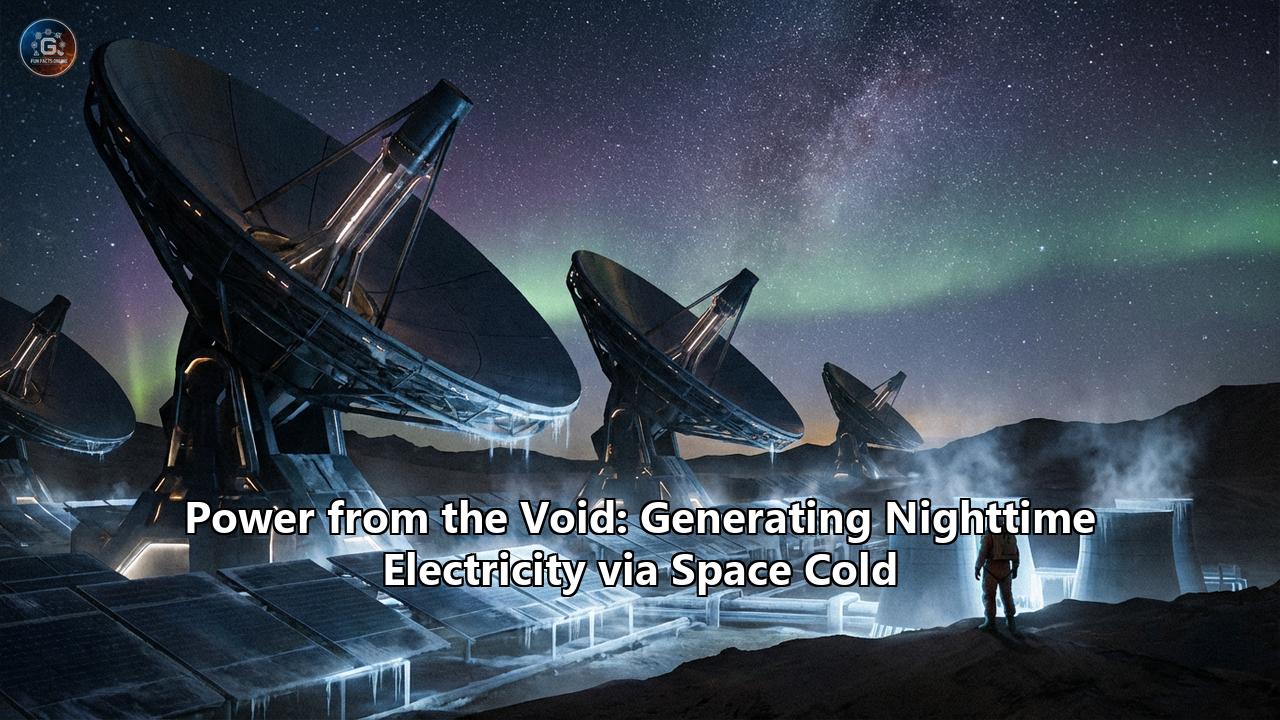
For as long as humanity has been harnessing the power of the sun, we have been plagued by one inescapable, astronomical inconvenience: the sun eventually sets. Solar energy is the undisputed champion of the renewable energy revolution, turning rooftops into power plants and sprawling deserts into vast engines of electricity. But the moment twilight fades, the world’s solar infrastructure goes to sleep. To keep the lights on, we have historically relied on fossil fuels, nuclear power, or massive, expensive lithium-ion batteries to store the sun's daytime bounty.
But what if the darkness of night wasn’t a dead zone for energy generation? What if the freezing, pitch-black void of outer space could be tapped as an invisible, limitless reservoir of power?
In recent years, brilliant minds in physics and electrical engineering have inverted our understanding of renewable energy. They are proving that the night sky is not an empty canvas, but a thermodynamic goldmine. By harnessing a phenomenon known as radiative cooling, scientists are developing "anti-solar panels" and thermoradiative diodes that generate electricity not by absorbing the blazing heat of the sun, but by exhaling Earth's heat into the unimaginably cold abyss of deep space.
This is the story of how we are learning to generate power from the void.
The Physics of the Cosmic Heat Sink
To understand how a solar panel can generate electricity in pitch darkness, we first have to abandon the idea that energy only comes from a glowing, hot source like the sun. Instead, we must look at energy through the lens of thermodynamics.
In the universe of thermodynamics, power is generated by the difference in temperature between two bodies. A traditional heat engine—whether it is a coal-fired plant, a car engine, or even a traditional solar photovoltaic cell—works because heat flows from something hot to something cold. In a conventional solar panel, the sun (a blazing 5,800 Kelvin) acts as the hot emitter, and the relatively cool solar panel on Earth (around 300 Kelvin) acts as the cold absorber. The flow of energy from the sun to the panel is what we capture and convert into electricity.
But the Earth does not just hoard this heat. If it did, our planet would have boiled over billions of years ago. Instead, the Earth balances its thermal budget. Every day, it absorbs massive amounts of solar radiation, and every night, it releases an equal amount of energy back into the universe in the form of invisible infrared light.
Where does this heat go? It goes into the deepest, coldest heat sink imaginable: outer space, which sits at a chilling 3 Kelvin (roughly -270 degrees Celsius, or just a few degrees above absolute zero).
Because there is a vast temperature difference between the relatively warm surface of the Earth and the freezing void of space, there is a continuous, massive flow of thermal energy shooting skyward every night. For billions of years, this escaping energy has been totally wasted. Now, researchers have realized that if they can place a technological tollbooth along this escaping pathway, they can extract electricity from the heat as it flees into the cosmos.
The Stanford Breakthrough: Harvesting the Chill
One of the most profound breakthroughs in this field came from a team of researchers at Stanford University, led by electrical engineering professor Shanhui Fan and researcher Sid Assawaworrarit. Their approach relies on a naturally occurring process called "radiative cooling".
If you have ever woken up on a clear autumn morning to find frost on your car windshield—even though the air temperature never dropped below freezing—you have witnessed radiative cooling in action. On a clear night, a surface facing the sky radiates its heat so efficiently into space that its temperature can actually drop several degrees below the temperature of the surrounding ambient air.
The Stanford team decided to exploit this precise temperature gap. They took an off-the-shelf, commercial solar panel and made a seemingly bizarre modification: they attached a thermoelectric generator (TEG) to it. A TEG is a solid-state device that produces an electrical current whenever there is a temperature difference between its top and bottom sides.
Under the clear California night sky, the Stanford solar panel did what all objects do: it emitted infrared photons out into the atmosphere. Because the sky was clear, those photons escaped the Earth entirely, carrying heat away with them. The surface of the solar panel cooled down until it was physically colder than the air around it.
At this moment, the magic happened. The ambient air, now warmer than the solar cell, began to transfer heat back into the panel. The thermoelectric generator, perfectly sandwiched between the cooler solar cell and the warmer ambient air, intercepted this flow of heat. Driven by the temperature differential, the TEG generated a measurable electrical current.
They were generating electricity from the coldness of space.
During their rooftop experiments, the Stanford device produced roughly 50 milliwatts of power per square meter (50 mW/m²). While this is a minuscule fraction of what a standard solar panel produces during the peak of the day (often upwards of 150 to 200 Watts per square meter), it was a monumental proof-of-concept. It proved that existing solar infrastructure could be retrofitted to act as a dual-engine: harvesting incoming solar radiation by day, and harvesting the outgoing thermal radiation by night.
The UNSW Innovation: The Thermoradiative Diode
While Stanford engineers used thermoelectric generators to capture ambient heat flowing into a super-cooled panel, a team halfway across the world in Australia approached the problem from the quantum level.
At the University of New South Wales (UNSW) in Sydney—home to the School of Photovoltaic and Renewable Energy Engineering, which invented the PERC solar cell architecture that dominates the global market today—researchers took the concept of the "anti-solar panel" to its literal extreme. Led by Associate Professor Ned Ekins-Daukes and Dr. Phoebe Pearce, the UNSW team successfully demonstrated a device called a "thermoradiative diode".
To understand the thermoradiative diode, it helps to imagine a traditional solar cell running in reverse. A conventional photovoltaic cell is a semiconductor diode. When a high-energy photon from the sun strikes the cool semiconductor, it excites an electron, causing it to jump across a bandgap and create an electrical current.
A thermoradiative diode flips the script entirely. Instead of absorbing high-energy photons from a hot sun, the device itself is the hot object. It is manufactured from specific semiconducting materials—similar to those used in military night-vision goggles, such as mercury cadmium telluride—that are highly sensitive to infrared light. Sitting on the warm Earth and pointed at the ultra-cold void of space, the diode eagerly emits its own thermal energy in the form of infrared photons.
Every time the diode ejects an infrared photon into the cold universe, the departure of that energy leaves behind an electron hole. The physics of the semiconductor dictate that as these photons leave the material to cool the device, a low-voltage electrical current is generated. The device is directly converting the emission of light into electrical power.
In a landmark paper published in the journal ACS Photonics, the UNSW team proved definitively that they could generate electricity through this exact emissive process. "In the same way that a solar cell can generate electricity by absorbing sunlight emitted from a very hot sun," Dr. Pearce noted, "the thermoradiative diode generates electricity by emitting infrared light into a colder environment".
The resulting power was incredibly small—roughly 100,000 times less than what a standard daytime solar panel produces—but it completely validated the underlying physics. Just as the very first solar cells in the 1950s produced only fractions of a watt and were seen as mere laboratory curiosities, the thermoradiative diode is currently at the very beginning of its evolutionary curve.
The Applications: Where Does the Void Power Go?
It is easy to dismiss 50 milliwatts per square meter as an irrelevant novelty. You certainly couldn’t boil a kettle, run a refrigerator, or charge an electric vehicle with such a trickle of power. However, in the modern era of hyper-efficient microelectronics, a little continuous power goes an incredibly long way.
The immediate applications for nighttime energy generation via space cold are vast, highly specialized, and economically thrilling:
1. Off-Grid Sensors and the Internet of Things (IoT)We live in an increasingly connected world. Millions of environmental sensors, weather stations, agricultural monitors, and structural health sensors are deployed in remote locations. These devices currently rely on small batteries, which degrade over time and must be manually replaced—a logistical nightmare for sensors deployed in dense jungles, deep oceans, or high mountains. A nighttime energy harvester, producing a steady trickle of milliwatts, is more than enough to keep a low-power microprocessor running and transmitting data 24 hours a day, effectively eliminating the need for battery replacements.
2. Deep Space ExplorationPerhaps the most poetic application for thermoradiative diodes is in the very environment they exploit: deep space. When spacecraft venture far beyond the orbit of Mars, the sun’s light becomes too faint to power standard solar panels. Traditionally, probes like Voyager, Cassini, and the Curiosity rover have relied on Radioisotope Thermoelectric Generators (RTGs)—devices that generate electricity from the heat of decaying radioactive plutonium. But Plutonium-238 is rare, incredibly expensive, and heavily regulated.
In the pitch-black void of deep space, a satellite could use thermoradiative diodes to generate power by radiating its own internal heat (or heat generated by onboard systems) directly into the 3-Kelvin abyss. This "reverse solar panel" could ensure that probes never completely die as long as they hold onto residual warmth.
3. Extending the Lifespan of BatteriesIn off-grid homes and remote villages that rely on solar power, the battery bank is the most expensive and fragile component. If solar panels can be modified to generate even a modest amount of power at night, it reduces the baseline load on the battery. Powering standby LED lights, keeping internet routers alive, and running basic monitoring equipment overnight directly from the sky-cooling panels would drastically extend the lifespan of the community's battery storage.
4. Waste Heat RecoveryThe principles of the thermoradiative diode do not have to be pointed at the sky. Industrial plants, server farms, and vehicle engines produce massive amounts of waste heat. By wrapping these hot environments in thermoradiative diodes, engineers could recapture escaping thermal radiation, turning the waste heat back into usable electricity before it dissipates into the environment.
The Engineering Challenges Ahead
As beautiful as the concept is, harvesting power from the void is fraught with massive physical and engineering challenges.
The biggest hurdle is the Earth's atmosphere. Our atmosphere is incredibly good at blocking infrared light—which is precisely why the greenhouse effect keeps our planet habitable. But for radiative cooling to work effectively, the infrared photons must escape the atmosphere and hit the vacuum of space. Clouds, humidity, and pollution all act as thermal blankets, reflecting the infrared heat right back down to the ground. Therefore, these nighttime generators are highly dependent on clear, cloudless skies.
Secondly, there is the issue of thermodynamics and material science. The maximum theoretical efficiency of a thermoradiative engine is dictated by the Carnot limit. Because the temperature difference between the ambient air (say, 300 K) and the radiatively cooled panel (say, 295 K) is incredibly small, the theoretical maximum efficiency of the thermoelectric generator is capped at just a few percent. To increase the power output, researchers must engineer new "metamaterials" that are flawlessly transparent to visible light but possess highly selective emissivity in the "atmospheric transparency window" (wavelengths between 8 and 13 micrometers).
Furthermore, current thermoradiative diodes require expensive materials like indium antimonide or mercury cadmium telluride. Scaling this up to match the cheap, ubiquitous silicon used in daytime solar panels will require a massive leap in semiconductor manufacturing and material discovery.
The Dawn of 24/7 Solar
Despite the challenges, the race is on. The ultimate vision shared by researchers at Stanford, UNSW, and beyond is the creation of a unified, dual-action solar panel.
Imagine looking at the roof of your home a decade from now. The silicon panels absorbing the sunlight are coated in a microscopic, intricately patterned silica glass. During the day, this glass allows visible sunlight to pass through flawlessly, generating massive amounts of electricity. Simultaneously, the coating acts as a radiative cooler, dumping the excess heat of the sun into space, keeping the silicon cold and operating at peak daytime efficiency.
Then, the sun goes down. The silicon cells shut off. But the panel isn't dead. The patterned silica continues to aggressively beam the roof's heat into the freezing cosmos. A thermoradiative diode layer, or an integrated thermoelectric generator, clicks into gear. Slowly, quietly, a small but steady current of electricity begins to flow back into your home, driven entirely by the icy depths of the universe.
Humanity's pursuit of energy has always been a story of looking up: worshiping the sun, burning the ancient compressed sunlight we call coal, and refining the raw power of atoms. Generating power from the void represents a profound philosophical shift. It teaches us that energy is not just found in the light, the fire, and the heat.
Energy is also found in the shadows, the silence, and the eternal, freezing dark of the cosmos. By embracing the cold, we may just find the final piece to a truly perpetual, twenty-four-hour renewable energy future.
Reference:
- https://www.urdesignmag.com/anti-solar-panels-make-solar-power-generation-possible-at-night/
- https://futuresfoundation.org.au/anti-solar-panels-can-generate-electricity-night/
- https://thegadgetflow.com/blog/stanfords-new-solar-panels-work-without-sunlight-heres-what-they-use-instead/
- https://www.sonnenseite.com/en/science/stanford-engineers-invent-a-solar-panel-that-generates-electricity-at-night/
- https://www.asme.org/topics-resources/content/new-solar-energy-device-beams-heat-into-space
- https://www.youtube.com/watch?v=gqPunQbyG4Y
- https://web.stanford.edu/~llfan/projects/oe-28-17-25460.pdf
- https://www.allsetenergy.com.au/articles/australian-researchers-show-solar-can-be-generated-at-night/
- https://www.unsw.edu.au/newsroom/news/2022/05/night-time-solar-technology-can-deliver-power-in-dark
- https://www.extremetech.com/science/reverse-solar-panel-generates-electricity-at-night
- https://ieeexplore.ieee.org/document/9300980/
- https://www.findaphd.com/phds/project/thermoradiative-power-generation-or-solar-power-at-night/?p173106
- https://www.youtube.com/watch?v=rhvnTQJ3xFQ
- https://engineering.stanford.edu/news/stanford-engineers-invent-transparent-coating-cools-solar-cells-boost-efficiency