
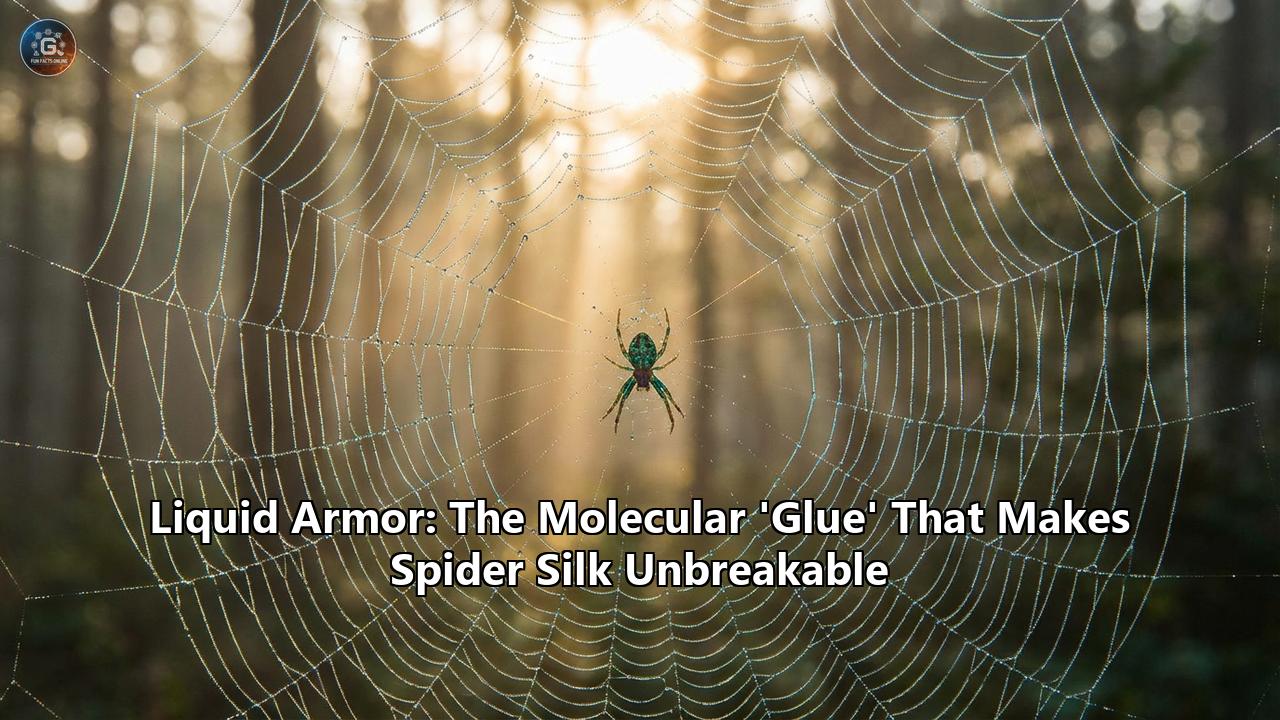
The spider web is a structure of paradoxes. It is gossamer-thin, yet stronger than steel by weight. It is nearly invisible, yet capable of stopping a hurtling insect in mid-flight without snapping. For centuries, this material has baffled engineers and biologists alike. How can a creature spin a fiber at room temperature, using water as a solvent, that outperforms our most advanced synthetic polymers forged in high-heat industrial vats?
The answer, it turns out, lies in the realm of the molecular. Recent breakthroughs have peeled back the layers of this biological mystery to reveal a mechanism that borders on science fiction: a "liquid armor" inherent in the silk’s chemistry. This isn't just about a strong solid fiber; it is about a material that exists in a state of flux, utilizing a "molecular glue" and fluid dynamics to achieve what solid materials cannot.
This article delves deep into the science of spider silk, exploring the newly discovered molecular interactions that lock the fiber into place, the physics of the "liquid wire" that keeps webs taut, and the revolutionary future of bio-inspired liquid armor that could change everything from bulletproof vests to suspension bridges.
Part I: The Paradox of the Golden Orb
To understand the magnitude of the "liquid armor" discovery, we must first appreciate the material itself. Dragline silk, the safety line used by orb-weaver spiders, has a tensile strength comparable to high-grade alloy steel (roughly 1.3 gigapascals) and a toughness that exceeds Kevlar.
Toughness is distinct from strength. Glass is strong but brittle; it resists deformation until it shatters. Rubber is stretchy but weak; it deforms easily but breaks under relatively low stress. Spider silk occupies a "Goldilocks" zone of materials science. It can stretch up to 40% of its length without breaking, absorbing massive amounts of kinetic energy, yet it retains enough stiffness to hold its shape.
If a spider web were scaled up to the size of a fishing net, it could catch a passenger jet in flight. This hyperbolic comparison, often cited in popular science, is mathematically sound based on the energy absorption capabilities of the material. But for decades, the question remained: How?
The secret isn't just in the final solid fiber. It is in the transition—the alchemy that turns a liquid protein "soup" inside the spider’s gland into an insolvable, unbreakable solid in a fraction of a second.
Part II: The Molecular Glue
In early 2026, a team of researchers from King’s College London and San Diego State University cracked a code that had eluded scientists for fifty years. They identified the specific "molecular glue" that facilitates the instantaneous transformation from liquid dope to solid silk.
The key players are two amino acids: arginine and tyrosine.
The Architecture of Spidroins
Spider silk is composed primarily of proteins called spidroins. These are massive molecules, repetitive and prone to tangling. Inside the spider's silk gland, these proteins are stored as a highly concentrated liquid, known as "dope." In any other biological context, proteins at such high concentrations would clump together, forming useless aggregates (similar to the amyloid plaques in Alzheimer's disease). But inside the spider, they remain fluid and organized.
The researchers discovered that the interplay between arginine and tyrosine prevents this premature clumping while preparing the proteins for their final, rigid state.
The Proton Trigger
The process begins with a chemical trigger. As the silk dope moves through the spider's spinning duct, the environment becomes increasingly acidic (the pH drops). This acidity protonates the molecules—essentially adding a positive charge to them.
This is where the "glue" activates. Arginine is a positively charged amino acid, while tyrosine is aromatic and generally hydrophobic. Under normal conditions, they might ignore each other. But in the specific environment of the spinning duct, the protonation causes the arginine and tyrosine residues on different protein chains to lock together.
This interaction is the "spark" that ignites the fiber formation. It pulls the disorganized protein chains into alignment. The "molecular glue" doesn't just stick them together randomly; it forces them into a highly ordered structure known as a beta-sheet crystal.
The Beta-Sheet Crystal: The Bricks of the Wall
Imagine the silk fiber as a wall. The beta-sheet crystals are the bricks. They are incredibly hard, dense structures where protein chains are folded back on themselves and locked with hydrogen bonds. These crystals provide the silk's tensile strength.
However, a wall made only of bricks would crumble if the ground shook. You need mortar. In spider silk, the "mortar" is the amorphous, non-crystalline regions of the protein chains that connect the crystals. These regions are rubbery and disordered, giving the silk its elasticity.
The arginine-tyrosine "glue" is the architect that ensures the bricks are laid correctly in the split second before the silk leaves the spider's body. It creates a semi-crystalline network that is tough enough to withstand impact but organized enough to hold together.
Part III: The "Liquid Wire" Phenomenon
While the "molecular glue" explains the strength of the dry fiber, another phenomenon explains the "unbreakable" nature of the web itself. This concept, often termed "liquid wire," was illuminated by researchers at Oxford University and the Université Pierre et Marie Curie.
Anyone who has walked into a spider web knows it is sticky. This stickiness comes from microscopic droplets of glue that coat the capture spiral of the web. For years, this was thought to be merely an adhesive for catching flies.
It turns out, these droplets are microscopic engines.
The Windlass Mechanism
When a spider web is stretched, the silk extends. But when the tension is released—say, after a gust of wind or a struggling insect moves—the thread doesn't sag. A sagging web is useless; it can't transmit vibrations to the spider, and it can't entangle prey.
The researchers discovered that the glue droplets act as powered spools. When the silk fiber creates slack, the surface tension of the liquid droplet reels the excess fiber inside the droplet. The fiber literally liquefies and coils up inside the bead of glue.
This creates a hybrid material: a solid thread that behaves like a liquid.
- Solid State: Under tension, the thread unspools from the droplets and acts like a spring.
- Liquid State: Under compression, the thread vanishes into the droplets, maintaining constant tension without buckling.
This "liquid wire" capability means the web is effectively self-tensioning. It is a biological smart material that actively manages its own structural integrity. No man-made cable can do this. If you stretch a steel cable and then release it, it goes slack. Spider silk retracts, instantly ready for the next impact.
Part IV: The Liquid Crystalline Journey
To fully grasp the "liquid armor" concept, we must look at the state of the matter before it becomes a fiber. The silk dope inside the spider is a liquid crystal.
Liquid crystals are familiar to us from LCD screens (Liquid Crystal Displays). They are a state of matter between liquid and solid, where molecules can flow like a liquid but maintain an ordered orientation like a crystal.
Flow-Induced Crystallization
As the spider squeezes the dope through its S-shaped spinning duct, the shear forces align the long protein molecules. Because they are liquid crystals, they flow easily, requiring very little energy from the spider. This is a stark contrast to industrial polymer spinning, which often requires high heat and high pressure to force viscous plastic through a nozzle.
The liquid crystalline nature allows the spider to pack an immense amount of protein into a small space. It is "liquid armor" in storage—a high-density potential energy waiting to be deployed.
When the aligned molecules hit the acidic gradient and the arginine-tyrosine glue activates, the liquid crystal "snaps" into a solid crystal. This phase transition is irreversible. The spider cannot turn the silk back into dope. It has forged a solid from a liquid in milliseconds, at ambient temperature.
Part V: Supercontraction and Shape Memory
Spider silk possesses another property that contributes to its reputation as "liquid armor": supercontraction.
When dragline silk is exposed to high humidity or water, it shrinks by up to 50% in length and swells in diameter. At the molecular level, water molecules infiltrate the amorphous (rubbery) regions of the silk, disrupting the hydrogen bonds that hold the chains in a semi-extended state. This causes the chains to entropy-coil, shrinking the fiber.
This might sound like a flaw—your clothes shrinking in the wash is rarely a good thing. But for a spider, it is a survival mechanism. In the humid morning air, the web tightens, pulling itself taut against the weight of dew.
This ability effectively resets the molecular history of the silk. If a fiber has been stretched and deformed, wetting it triggers supercontraction, which can restore its elasticity. It is a form of self-healing. The "liquid" component (water) interacts with the solid structure to repair fatigue.
Part VI: Synthetic Silk – The Holy Grail
Understanding the molecular glue and liquid wire physics is the first step. The second is replicating it. For decades, "synthetic spider silk" has been the Holy Grail of materials science. We have cracked the genetic code; we know the DNA sequence for spidroins. But we have struggled to spin it.
The Bacteria Problem
Early attempts involved inserting spider genes into E. coli bacteria. The bacteria produced the proteins, but they couldn't spin them. The proteins formed messy clumps (inclusion bodies) that had to be dissolved in harsh solvents. The resulting fibers were weak—nothing like the real thing.
We now know why: we were missing the liquid crystalline phase and the precise pH gradient that activates the arginine-tyrosine glue.
The Goat Solution
One of the most famous experiments involved "spider goats"—genetically modified goats that produced spidroin protein in their milk. This solved the volume problem (you can get a lot of milk from a herd), but the spinning problem remained. You still had to extract the protein and figure out how to pull it into a fiber.
The New Wave: Biomimetic Spinning
With the 2026 discovery of the arginine-tyrosine mechanism, the game has changed. Scientists are now building biomimetic spinnerets. These are microfluidic devices that mimic the S-shape of the spider's duct. They precisely control the pH gradient and the ion concentration to trigger the "molecular glue" artificially.
Instead of just squirting protein out of a nozzle, these devices coax the proteins to self-assemble. We are moving from "manufacturing" silk to "growing" it.
Part VII: Applications of Liquid Armor
If we can mass-produce material with the properties of spider silk—incorporating the molecular glue and liquid wire mechanics—the applications are limitless.
1. Ballistics and Body Armor
Current body armor (Kevlar/Ceramic) is heavy and rigid. It stops bullets by dissipation of energy, but it restricts movement.
"Liquid Armor" based on spider silk technology would be radically different. Because of its toughness (energy absorption), a silk-based vest could be thinner and lighter than Kevlar.
More importantly, researchers are developing shear-thickening fluids (STFs) reinforced with synthetic silk proteins. This creates a true "liquid armor"—a fluid that flows flexibly when you move but hardens instantly upon impact (like a bullet). The silk proteins provide the tensile framework that prevents the hardened fluid from shattering, creating a flexible, bulletproof skin.
2. Medical Sutures and Scaffolds
The human body rejects many synthetic materials. But spider silk is biocompatible. The ancient Greeks used cobwebs to bandage wounds, and they were onto something.
Synthetic silk sutures are finer than a human hair but stronger than steel, allowing for microsurgeries (eye, nerve, brain) that were previously impossible. Furthermore, because the material is protein-based, it can be programmed to biodegrade at the exact rate the wound heals.
Beyond sutures, silk "liquid armor" can be used to coat implants. A titanium hip replacement coated in silk protein is less likely to be rejected by the immune system and encourages bone growth.
3. Aerospace and Automotive
In aviation, weight is the enemy. A material that is lighter than carbon fiber but tougher would revolutionize aircraft design.
Imagine airplane wings made of a silk-composite that can flex during turbulence (absorbing energy like a web) rather than snapping. The "liquid wire" damping properties could be used in engine mounts to eliminate vibration entirely.
4. The Space Elevator
This is the theoretical frontier. To build a space elevator—a cable tethered from Earth to a satellite—we need a material with a specific strength-to-weight ratio that currently no material possesses. Carbon nanotubes are the leading candidate, but they are brittle and hard to manufacture in long lengths.
Spider silk is the only material that comes close to the necessary toughness. While natural silk isn't quite strong enough, a "super-silk" enhanced with carbon nanotubes and assembled using the arginine-tyrosine glue mechanism could be the cable that finally takes us to the stars.
Part VIII: The Future is Soft and Strong
The term "Liquid Armor" is more than a catchy headline. It represents a paradigm shift in how we think about strength.
For the Industrial Revolution, strength meant hardness. Iron. Steel. Concrete. Materials that resisted change.
The Biological Revolution teaches us that true strength lies in adaptability. The spider web survives the storm not by being immovable, but by being fluid. It yields, it absorbs, it reshapes, and it persists.
The discovery of the molecular glue—the specific interaction of amino acids that locks liquid into solid—completes the puzzle. We now possess the blueprints for nature's most miraculous material. As we master the ability to synthesize this "liquid armor," we step into a future where our buildings, our vehicles, and our clothing are not just built, but engineered with the resilience of life itself.
The spider has been telling us this secret for 300 million years. We are finally learning to listen.
Reference:
- https://pubs.acs.org/doi/abs/10.1021/acsnano.7b01532
- https://www.ox.ac.uk/news/2016-05-16-scientists-create-novel-liquid-wire-material-inspired-spiders-capture-silk
- https://nationaltoday.com/us/ca/san-diego/news/2026/02/06/researchers-decode-spider-silks-molecular-stickers-for-stronger-materials/
- https://www.eurekalert.org/news-releases/1115480
- https://www.researchgate.net/publication/12053010_Liquid_crystalline_spinning_of_spider_silk
- https://frank.itlab.us/photo_essays/papers/Spider_silk_crystalline_nature.pdf
- https://www.youtube.com/shorts/336UPh60PFg
- https://futurism.com/scientists-develop-synthetic-spider-silk-for-engineering-medicine
- https://www.zmescience.com/science/news-science/liquid-wire-spider-silk/
- https://www.tandfonline.com/doi/abs/10.1080/02678292.2023.2236573
- https://pubmed.ncbi.nlm.nih.gov/19477107/
- https://www.youtube.com/watch?v=xEcHKEgpUEE
- https://www.youtube.com/watch?v=ozXw7BIEWtI
- https://pmc.ncbi.nlm.nih.gov/articles/PMC9996717/