
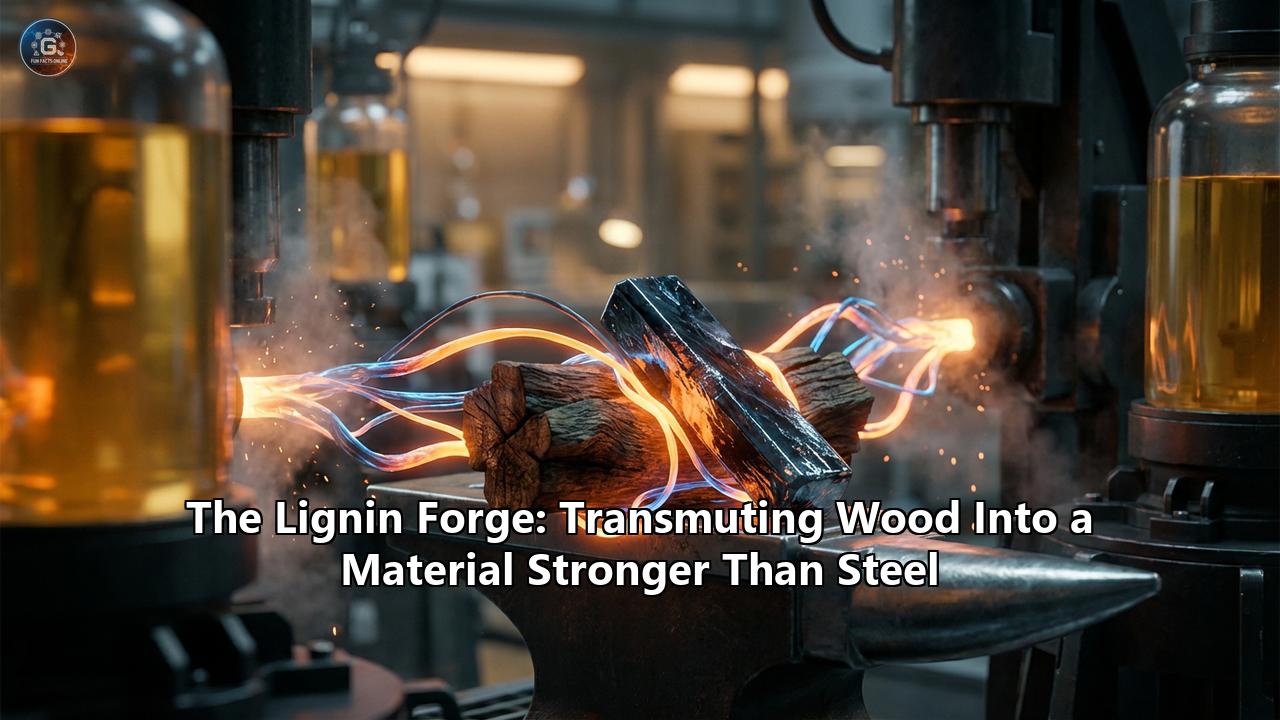
Alchemy. For millennia, it was the fool’s errand of turning base metals into gold. But in the 21st century, a new form of transmutation has emerged from the laboratories of materials science, one that promises a revolution arguably more valuable than gold. It does not seek to create a shiny, inert metal, but to reinvent the very skin of our planet: wood. This is the story of the Lignin Forge, a technological crucible where ordinary timber is stripped of its weaknesses, compressed under heat and chemistry, and reborn as a material that defies the natural order—a substance stronger than steel, lighter than aluminum, and tougher than titanium.
This is not science fiction. It is the dawn of the "Cellulose Age," where the skylines of the future may be grown in forests rather than smelted in blast furnaces.
Part I: The Alchemist’s Dilemma
To understand the magnitude of this breakthrough, we must first understand the material itself. Wood is nature’s composite. It has served humanity for thousands of years as fuel, shelter, and tool. It is abundant, renewable, and effectively sequesters carbon. Yet, for high-performance engineering, wood has always been the "poor relation" to modern alloys.
Natural wood is, fundamentally, a bundle of hollow tubes (tracheids and vessels) held together by a glue. These tubes are made of cellulose—one of the strongest biological fibers known to man. But nature didn’t design trees to stop bullets or support hundred-story skyscrapers; it designed them to stand upright and transport water. As a result, wood is porous. It is 60% empty space (air). It swells with moisture, rots with fungi, and burns with ease. Its mechanical properties are "anisotropic," meaning it is strong in one direction (along the grain) but pitifully weak in another.
For centuries, engineers accepted these limitations. If you wanted strength, you chose steel. If you wanted lightness, you chose aluminum. If you wanted the best of both, you paid a fortune for titanium or carbon fiber. Wood was relegated to the frame of a house or the veneer of a table.
But the researchers at the University of Maryland, led by pioneers like Liangbing Hu and Teng Li, asked a different question: What if the weakness of wood is not in the material itself, but in the empty space it carries?
The answer lay in the "glue" that holds the tree together: Lignin.
Part II: The Lignin Forge
The process of transmuting wood into a super-material is a delicate dance of destruction and creation. It is not as simple as crushing a log; if you compress natural wood, it just bounces back or crushes into dust. The structural memory of the wood fights you. To forge it, you must first relax it.
Step 1: The Chemical Bath (Partial Delignification)
The first stage of the Lignin Forge is a chemical bath, typically a boiling solution of sodium hydroxide (NaOH) and sodium sulfite (Na2SO3)—chemicals familiar to the paper pulp industry. This is where the alchemy begins. The goal is not to remove all the lignin (as one would to make paper), but to remove just enough.
Lignin is a rigid, brown polymer that encrusts the cellulose fibers, preventing them from moving. It is the "stiffener." By removing roughly 45% of the lignin, the researchers make the wood spongy and flexible. The remaining lignin plays a crucial, unsung role: it prevents the structural integrity of the wood from failing completely during the next step. It acts as a spacer and a binder, ensuring the material doesn't turn into a pile of loose fibers.
Step 2: The Hot Press (The Anvil)
Once the wood is chemically "relaxed," it is placed into a hot press—the anvil of this modern forge. The wood is compressed perpendicular to the grain at temperatures around 100°C (212°F).
This is where the magic happens. Under roughly 5 megapascals of pressure (about 725 psi), the hollow tubes of the wood collapse. The cell walls are crushed flat. The thickness of the wood is reduced by 80%, transforming a chunky 5-inch block into a sleek 1-inch plate.
Step 3: The Hydrogen Bond (The Transmutation)
As the cell walls collapse and touch, something occurring at the nanoscale changes everything. The cellulose nanofibers, now stripped of their bulky lignin spacers and forced into intimate contact, begin to form hydrogen bonds.
In natural wood, these fibers are too far apart to bond effectively. In the densified wood, they are packed so tightly that they act as a single, unified material. Millions of hydrogen bonds zip the fibers together like molecular Velcro. The result is a material that is no longer really "wood" in the traditional sense. It is a biological ceramic-metal hybrid. It is Densified Wood.
Part III: Properties of the New Element
The numbers that emerge from the testing labs are staggering. This new material—often colloquially called "Super Wood"—possesses a suite of properties that seem contradictory.
1. Strength vs. Weight: The Specific Strength King
The most critical metric in modern engineering is "specific strength"—strength divided by density. Steel is strong, but it is heavy (density ~7.8 g/cm³). Titanium is the gold standard (density ~4.5 g/cm³).
Densified wood has a density of roughly 1.3 g/cm³. It is incredibly light—lighter than carbon fiber composite. Yet, its tensile strength (the force required to pull it apart) skyrockets from a meager 30-50 MPa (megapascals) in natural wood to nearly 600 MPa.
- Compared to Steel: It is 1/6th the weight but has a specific strength that is higher than most structural steels (like A36 or 304 stainless).
- Compared to Titanium: It rivals the specific strength of Ti-6Al-4V alloys, the workhorse of the aerospace industry, but at a fraction of the cost.
2. Ballistic Resistance: Nature’s Kevlar
Perhaps the most visual demonstration of the Lignin Forge’s power is the ballistic test. In experiments, researchers fired steel projectiles at natural wood. The bullets blew right through, splinters flying.
When they fired the same projectiles at a laminate of densified wood (stacked in a plywood-like cross-grain pattern) of the same thickness, the result was different. The projectile didn't penetrate. It was caught. The densified wood absorbs energy through a mechanism distinct from metals. Metals deform; ceramics shatter. Densified wood dissipates energy by delaminating slightly and stretching its cellulose fibers, much like Kevlar. It is a natural armor.
3. Toughness: The Anti-Brittle
Usually, when you make a material harder (like glass or high-carbon steel), it becomes brittle. Densified wood defies this rule. Because it retains the long, fibrous nature of cellulose, it has incredible "fracture toughness." It is 10 times tougher than natural wood. You can bend it, batter it, and stress it, and it resists catastrophic failure.
Part IV: The Rivalry – Wood vs. The World
To appreciate the disruptive potential of this material, we must place it in the ring with the champions of the industrial age.
| Property | Densified Wood | 304 Stainless Steel | Ti-6Al-4V (Titanium) | Aluminum (6061-T6) |
| :--- | :--- | :--- | :--- | :--- |
| Density (g/cm³) | ~1.3 | 7.9 | 4.4 | 2.7 |
| Tensile Strength (MPa) | ~450 - 600 | ~500 - 600 | ~950 | ~310 |
| Specific Strength | High | Low | High | Medium |
| Cost | Low | Medium | Very High | Medium |
| Sustainability | Carbon Negative | Carbon Intensive | High Energy Cost | High Energy Cost |
The Steel Killer?Steel’s dominance is based on low cost and high absolute strength. Densified wood cannot yet match the absolute ultimate tensile strength of high-end specialized steels (which can reach 2000+ MPa), but for 90% of construction and automotive applications, we don't need that maximum. We need stiffness and strength per pound. In this arena, densified wood is lethal to steel’s market share. A car door made of "Super Wood" would be just as safe as a steel one, but lighter, improving fuel efficiency, and it would cost significantly less to produce than a carbon fiber equivalent.
The Carbon Fiber AlternativeCarbon fiber is the current king of lightweight performance. However, it has a dirty secret: it is expensive to make (requiring massive energy to graphitize polyacrylonitrile) and it is brittle. If you hit a carbon fiber bike frame against a rock, it cracks. Densified wood offers a similar weight profile but with superior impact tolerance and a vastly lower price point. It democratizes high-performance materials.
Part V: Applications – A Wooden Future
If the 20th century was the age of Steel and Concrete, the 21st could be the age of Advanced Timber. The applications of the Lignin Forge are boundless.
1. The Wooden Skyscraper
We are already seeing the rise of "Mass Timber" buildings using Cross-Laminated Timber (CLT). But these are limited by the natural softness of wood. Densified wood beams could replace the steel rebar and I-beams in these structures. Imagine a 100-story tower where the structural columns are not mined from the earth, but grown in a forest. Such a building would be a massive carbon sink, locking away thousands of tons of CO2.
2. Automotive Lightweighting
Electric vehicles (EVs) are heavy due to their batteries. Every kilogram saved in the chassis extends the range. Automakers have flirted with carbon fiber (e.g., the BMW i3) but backed off due to cost. Densified wood offers a sustainable, cheap, lightweight alternative for bumpers, side-impact beams, and interior panels. "InventWood," a spinoff company commercializing this tech, is already exploring these avenues.
3. Aerospace and Defense
The ballistic properties make it a prime candidate for lightweight armor in vehicles or even personal body armor. In aerospace, where weight is everything, interior components (seats, cabinets, floor panels) could be switched from honeycomb aluminum to densified wood, saving fuel and reducing the carbon footprint of flight.
4. The Transparent Wood Windshield
A cousin to the densified wood process involves removing the lignin entirely and replacing it with a refractive-index-matching polymer. This creates "Transparent Wood"—a material that looks like glass but is tougher and a better insulator. While technically a different branch of the same tree (pun intended), it highlights the versatility of manipulating the wood nanostructure.
Part VI: The Green Forge – Sustainability and Alchemy
The most compelling argument for the Lignin Forge is not mechanical; it is environmental.
Steel production is responsible for roughly 7-9% of global CO2 emissions. It requires massive open-pit mines, coal-fired blast furnaces, and global shipping of heavy ore. Aluminum is effectively "solid electricity" due to the energy required to smelt bauxite.
Densified wood flips the script.
- Carbon Sequestration: Trees absorb carbon as they grow. Using them in long-term structural applications keeps that carbon locked up for centuries.
- Low Energy Processing: The chemicals used (NaOH, Na2SO3) are standard and recyclable within closed-loop systems (similar to modern paper mills). The temperature required (100°C) is boiling water—a far cry from the 1,500°C required to melt steel.
- Abundance: We do not need to mine rare earth metals or source titanium from conflict zones. We can use fast-growing, low-density softwoods like pine, poplar, or balsa. The Lignin Forge effectively "upcycles" cheap, weed-like trees into premium structural materials, reducing the pressure to harvest old-growth hardwoods.
Part VII: The Challenges of Scale
If this material is so perfect, why are we not driving wooden cars today? The answer lies in the difficulty of scaling "alchemy."
The Size Limit:Currently, most densified wood is made in batch presses. Making a 2x4 is easy; making a 40-foot continuous beam is hard. The heat and pressure must be applied uniformly. If the center of the wood doesn't reach the right temperature, the densification fails.
The Speed:The chemical bath takes hours. The pressing takes hours. Steel is rolled out in seconds. For this to compete, the process needs to be continuous and faster.
Self-Densification – A New Hope?Recent advancements from Nanjing University (2024-2025) have proposed a "self-densification" method using a different chemical cocktail (LiCl/DMAc) that causes the wood to shrink and densify without massive external pressure. This could solve the geometry problem, allowing for complex 3D shapes that don't need to be flattened in a press.
Conclusion: The Transmuted World
The Lignin Forge represents a profound shift in our relationship with materials. For too long, we have operated on a "take-make-waste" linear model, digging up the earth to build strong things. Densified wood suggests a "grow-make-return" circular model.
We are standing on the precipice of a new material age. It is a future where the strongest materials are not forged in fire and smoke, but born in the quiet of a forest. It is a future where our cities breathe, our cars are grown, and the line between the biological and the industrial vanishes.
The alchemists of old were wrong. The ultimate transmutation was never lead into gold. It was wood into steel. And it is finally here.
Reference:
- https://createdigital.org.au/new-wood-based-super-material-strong-steel-six-times-lighter/
- https://www.thechemicalengineer.com/news/new-densified-wood-is-as-strong-as-steel/
- https://www.thermofisher.com/blog/metals/wood-at-one-fifth-its-original-thickness-outperforms-steel-and-titanium/
- https://www.azobuild.com/news.aspx?newsID=23756
- https://mmta.co.uk/densified-wood-to-challenge-metal-cheaper-than-composites-and-as-strong-as-titanium/
- https://www.jeelix.com/titanium-vs-stainless-steel/
- https://www.cabidigitallibrary.org/do/10.5555/collection-news-65240/full/
- https://www.pulpandpaper-technology.com/articles/chemical-pulping-methods