
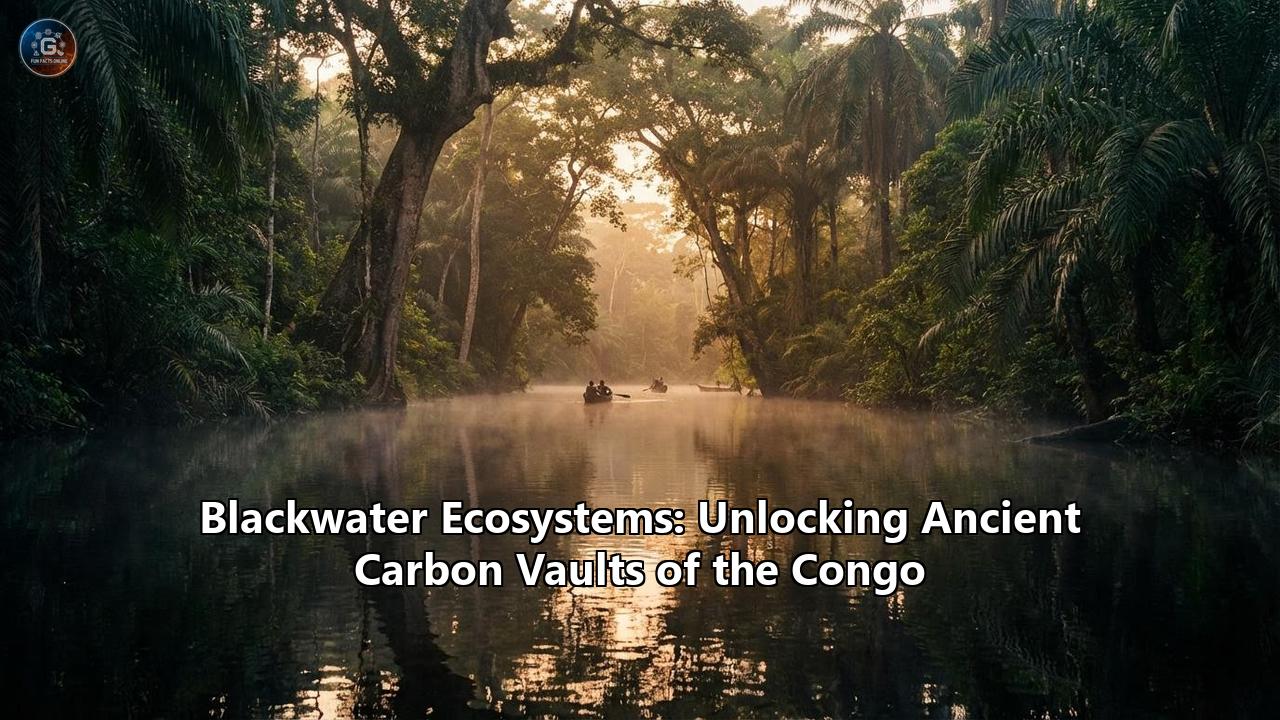
Plunge your hand into the waters of the Ruki River, and within inches, it completely vanishes. Meandering through the untouched lowland rainforests of the Democratic Republic of the Congo (DRC), the water is so profoundly dark that it resembles a deeply steeped, opaque black tea. For decades, the true nature of this river—and the sprawling blackwater lakes it connects to—remained one of the natural world's best-kept secrets. But recent scientific expeditions have unveiled a startling reality: these ink-black waters are the exhaust vents for an ancient, subterranean vault of carbon.
Deep within the emerald heart of the Congo Basin lies the Cuvette Centrale, the world's largest tropical peatland complex. Spanning an area larger than England, this dense labyrinth of swamps and flooded forests acts as a colossal planetary vault, locking away billions of tons of carbon. For years, climate scientists assumed this ancient carbon was safely entombed, protected from the atmosphere by deep, oxygen-depleted, waterlogged mud.
However, a groundbreaking wave of research published in early 2026 has shattered that assumption. The pristine blackwater lakes and rivers of the Congo Basin are heavily outgassing carbon dioxide (CO2). Even more shockingly, advanced radiocarbon dating reveals that up to 40% of this escaping carbon is not from freshly decayed jungle foliage, but from ancient peat that has been buried for thousands of years.
This discovery fundamentally rewrites our understanding of tropical carbon sinks and raises a terrifying question: is the Earth’s largest land-based carbon vault experiencing a natural, balanced leakage, or is it the onset of a catastrophic climatic destabilization?
The Anatomy of a Blackwater Ecosystem
To understand the mystery of the Congo's leaking carbon, one must first understand the unique hydrology of a blackwater ecosystem. When most people imagine a tropical river, they picture the muddy, coffee-and-cream churn of the Amazon or the deep blue expanses of the Nile. Blackwater rivers are an entirely different beast.
The characteristic dark color of these waters—often described by researchers as "jungle tea"—comes from exceptionally high concentrations of dissolved organic carbon (DOC). In the Congo Basin, the landscape is incredibly flat, creating a low-gradient environment where water moves at a glacial pace. During the rainy season, the rivers overspill their banks, flooding the surrounding forest floor. It can take weeks for waist-deep waters to recede.
As the water sits, it acts as a solvent. Rain falls on dead jungle vegetation, leaching out tannins, humic acids, and other organic compounds from the decomposing plant material. Because the slow-moving water carries virtually no sediment to cloud it, the resulting liquid is translucent but profoundly dark.
The Ruki River, a kilometer-wide tributary that eventually empties into the mighty Congo River, is arguably the pinnacle of blackwater ecosystems. Draining a pristine, primary lowland rainforest roughly the size of Senegal (or four times the size of Switzerland), the Ruki has recently been crowned by scientists as one of the darkest, most DOC-rich river systems on the planet. It contains four times as much organic carbon as the main Congo River, and 1.5 times as much as the Amazon's famous Rio Negro. Strikingly, while the Ruki drains only 5% of the total Congo Basin, it contributes a staggering 20% of the Congo River's total dissolved organic carbon.
The Cuvette Centrale: Earth's Hidden Carbon Vault
The engine driving these blackwater ecosystems is the Cuvette Centrale, an immense depression in the center of the African continent that harbors the second-largest tropical rainforest on Earth. Beneath the canopy lies a 145,000-square-kilometer (56,000-square-mile) network of peatlands.
Peat forms when waterlogged conditions prevent dead plant material from fully decomposing. Over millennia, this organic matter compresses into a dense, carbon-rich soil. The peatlands of the Cuvette Centrale began forming during the Late Pleistocene, over 40,000 years ago, slowly accumulating the detritus of the jungle century after century.
The sheer scale of the carbon locked within this vault is difficult to conceptualize. While the swamps and peatlands of the Congo Basin cover a mere 0.3% of the Earth's total land surface, they store approximately one-third of all the carbon held in tropical peatlands globally. That equates to roughly 30 to 33 billion metric tons of carbon. To put that in perspective, this single, localized ecosystem stores the equivalent of three full years of global carbon dioxide emissions from all human activities combined.
Because of its geographic isolation, lack of road infrastructure, and challenging terrain, the Cuvette Centrale remained largely unmapped by modern science until the 2010s. It was considered a definitive "carbon sink"—a sponge that reliably absorbed more CO2 from the atmosphere than it released, safely storing it in perpetuity as long as the swamps remained wet.
Navigating the Unknown: The ETH Zurich Expeditions
Unlocking the secrets of the Congo's blackwater requires unparalleled logistical resilience. The central Congo Basin is famously inaccessible; dense jungles, treacherous waterways, and a lack of modern infrastructure mean that researchers must rely on traditional pirogues (dugout canoes) and small motorized boats to reach isolated lakes and swamps.
Over the past decade, an intrepid team of researchers from the Swiss Federal Institute of Technology Zurich (ETH Zurich)—led by carbon biogeochemists such as Travis Drake and Matti Barthel—embarked on multiple expeditions deep into the basin. To bypass the lack of roads, the researchers used the natural waterways as their highway. Transforming a large ship into a floating laboratory and living quarters, they navigated the Fimi River, a major tributary where the dark water of the forests violently collides with the red, iron-oxide-stained water of the savannahs.
Their target was the heart of the Cuvette Centrale, specifically Africa's largest blackwater lakes: Lake Mai Ndombe and its smaller northern neighbor, Lake Tumba. Lake Mai Ndombe is a sprawling, shallow body of blackwater more than four times the size of Europe's Lake Constance, prone to violent, sudden winds that frequently threatened to capsize the researchers' small sampling boats.
Taking water samples across Lake Mai Ndombe in 2022 and 2024, and expanding to Lake Tumba and the Ruki River in 2025, the team meticulously measured the concentration and isotopic signature of the dissolved carbon. What they found would fundamentally disrupt conventional climate models.
The Shocking Discovery: A Leak in the Vault
It is a well-established fact that tropical rivers and lakes naturally emit carbon dioxide. As modern plant matter falls into the water and decomposes, microbes feast on the organic material, releasing CO2 in the process. When the ETH Zurich researchers detected supersaturated levels of CO2 bubbling out of the blackwater lakes, they assumed they were simply observing this standard, rapid carbon cycle.
"We fully expected the carbon dioxide to be modern," noted Travis Drake. But science thrives on the unexpected. The researchers utilized radiocarbon dating (measuring the decay of the Carbon-14 isotope) to determine the exact age of the dissolved inorganic carbon (DIC) escaping from the water.
When the first results came back from Lake Mai Ndombe, the team was stunned. The data indicated that a massive proportion of the carbon did not come from recent leaf litter. Instead, it was thousands of years old.
Refusing to rely on a single anomaly, the team tested their remaining samples across Lake Tumba and the Ruki River. The results were remarkably consistent. The blackwater bodies of the Congo Basin were actively venting ancient carbon, specifically originating from peat that was between 2,170 and 3,515 years old. In some areas, up to 40% of the CO2 escaping the water was derived from this ancient stock.
"We were surprised to find that ancient carbon is being released through the lake," the researchers explained. "The carbon sink has a leak, so to speak, through which ancient carbon is leaking".
This revelation, published in the journal Nature Geoscience in February 2026, contradicted a foundational assumption of climate science: that old, undisturbed tropical peat remains perpetually trapped underground. The vault was not sealed; it was actively venting.
The "Lake-as-Chimney" Mechanism
How does ancient carbon, buried deep beneath the mud for millennia, suddenly find its way into the atmosphere? The answer lies in the microscopic world and the unique hydrology of the Congo Basin, giving rise to what scientists have dubbed the "lake-as-chimney" effect.
Even in an undisturbed, waterlogged state, the peatlands are not entirely biologically inert. Deep within the anoxic (oxygen-free) layers of the bog, specialized microbes slowly break down the ancient organic matter. This deep-peat decomposition produces two primary byproducts: carbon dioxide and methane.
Due to the flat topography and the extensive subsurface water flow of the Cuvette Centrale, this ancient, dissolved inorganic carbon doesn't simply stay trapped in the mud. Instead, it acts as a slow-moving subterranean river. The carbon-rich groundwater seeps horizontally, eventually draining into the adjacent blackwater lakes and rivers.
Once this aged carbon reaches the open water of Lake Mai Ndombe, Lake Tumba, or the Ruki River, the lakes act as massive exhaust vents—or chimneys. They efficiently release this mixed pool of modern and ancient CO2 directly into the atmosphere, linking a vast reservoir of Late Holocene carbon to the modern climate cycle.
This discovery highlights a previously unrecognized mobilization pathway. It proves that even in the absence of direct human interference—such as logging or commercial draining—some fraction of the Congo’s peat is constantly decomposing and escaping.
Tipping Points: A Glimpse into a Fragile Future
The identification of this ancient carbon leak presents the scientific community with a "30-million-tonne question," as Drake puts it: Is this steady venting a natural, background phenomenon that has occurred for millennia, or is it an early warning sign of broadscale ecosystem destabilization?
If the ecosystem is in a natural state of equilibrium, the carbon being lost through the "lake chimneys" is balanced out by the constant addition of new, decomposing plant matter settling on top of the bogs. However, the fear is that this delicate balance is sitting on a knife's edge.
Tropical peatlands are only reliable carbon sinks as long as they remain completely waterlogged. If the peat dries out, oxygen enters the system. This triggers a massive acceleration in aerobic microbial decomposition, rapidly converting the ancient organic matter into atmospheric CO2.
The threats to this moisture balance are mounting rapidly. Climate change is already altering rainfall patterns across the African continent. "If the region experiences future drought, this export mechanism could accelerate, potentially tipping these massive carbon reservoirs from a sink into a major source to the atmosphere," researchers warn. Prolonged droughts would not only lower the water tables, exposing deeper layers of ancient peat to oxygen, but they would also decrease the size of the blackwater lakes. As water levels drop, the remaining water could become a significant source of methane—a greenhouse gas over 25 times more potent than CO2—further accelerating global warming.
Beyond global climate shifts, localized human pressures pose an existential threat to the Cuvette Centrale. While the region currently remains in a relatively pristine condition, populated by small, scattered communities, this is poised to change dramatically. Demographic estimates suggest that the population of the Democratic Republic of the Congo will triple by the year 2050. This population explosion will inevitably bring an urgent need for agricultural expansion, logging, and infrastructure development.
In Southeast Asia, the draining of peatlands for palm oil plantations has already resulted in catastrophic carbon emissions and uncontrollable underground peat fires. If similar land-use changes, such as systematic drainage or deforestation, occur in the Congo Basin, the hydrology of the Cuvette Centrale would be irreversibly altered. The ancient vault would not just leak; its doors would be blown wide open.
The Global Climate Ramifications
The fate of the Congo’s blackwater ecosystems is not merely a regional concern; it is a matter of profound global environmental security. Because the Cuvette Centrale stores the equivalent of three years of total human carbon emissions, its status dictates the accuracy of global climate models.
Currently, global climate policies and carbon budgets rely heavily on the assumption that the "lungs of Africa" will continue to absorb our excess carbon. If the Congo Basin crosses a critical tipping point and transitions from a net carbon sink into a massive carbon source, it would severely undermine international efforts to cap global temperature rise. The outgassing of 30 billion tons of ancient carbon would act as a devastating feedback loop: higher global temperatures would dry out the peat, which would release more ancient carbon, which would in turn drive temperatures even higher.
The revelation of the "lake-as-chimney" mechanism forces an urgent recalibration of how scientists calculate global greenhouse gas inventories. It underscores the absolute necessity of integrating the complex biogeochemistry of pristine tropical wetlands into climate forecasts.
Preserving the Jungle Tea
The blackwater rivers and lakes of the Congo Basin are a marvel of the natural world. Places like the Ruki River, where untouched jungle canopy reflects off waters as dark as the night sky, represent some of the last truly wild frontiers on Earth. They are dynamic, living laboratories that continue to challenge our understanding of planetary science.
The discovery that these ancient ecosystems are actively "breathing out" carbon that was captured during the time of the pharaohs is a humbling reminder of the deep, interconnected cycles of the Earth. It highlights how much we still have to learn about the hidden mechanisms that regulate our global climate.
As researchers prepare for future expeditions to analyze the subterranean water trapped deep within the Congo's peat, the mandate for global policymakers is clearer than ever. The Cuvette Centrale must be protected at all costs. Safeguarding the hydrology of the Congo Basin—by preventing deforestation, halting peatland drainage, and mitigating global temperature rise—is no longer just about preserving biodiversity. It is about keeping the lid firmly shut on one of the planet's most massive ancient carbon vaults, ensuring that the black waters of the Congo remain a natural wonder, rather than a harbinger of a warming world.
Reference:
- https://www.futurity.org/ruki-river-congo-basin-2988302-2/
- https://science.nasa.gov/earth/earth-observatory/shedding-light-on-a-very-dark-river-152578/
- https://www.livescience.com/planet-earth/blackwater-lakes-and-rivers-in-the-congo-basin-are-now-emitting-ancient-carbon-into-the-atmosphere
- https://serwe.org/news/ancient-carbon-leak-congo-basin-blackwater-lakes-sound-clima-1799
- https://sciencesources.eurekalert.org/news-releases/1117231
- https://gizmodo.com/earths-largest-land-based-carbon-sink-has-sprung-a-disturbing-leak-2000725905
- https://www.onoff.gr/blog/en/science/arctic-lakes-release-ancient-carbon/
- https://en.innovando.news/Congo-lakes-release-thousands-of-years-old-carbon/
- https://en.clickpetroleoegas.com.br/Scientists-make-unexpected-discovery-in-the-Congo-Basin%3A-dark-lakes-and-rivers-are-releasing-carbon-up-to-3-500-years-old--raising-concerns-about-a-gigantic-natural-reservoir.-FLPC96/
- https://www.sciencedaily.com/releases/2026/02/260224023201.htm
- https://www.researchgate.net/publication/401103536_Millennial-aged_peat_carbon_outgassed_by_large_humic_lakes_in_the_Congo_Basin