
The universe is a vast, silent ocean, and for most of human history, we have only been able to see the foam on the waves—the stars, galaxies, and glowing gas that make up visible matter. But beneath this luminous surface lies the deep, dark currents that drive the cosmos: Dark Matter. It is the invisible scaffold of the universe, outweighing visible matter five to one, yet it has evaded every attempt at direct detection. We know it is there only by its gravitational ghost—the way it spins galaxies and bends light.
But the era of "seeing" is ending. We are entering the era of "listening."
With the advent of gravitational wave astronomy, we have gained a new sense. We can now hear the vibrations of spacetime itself. And in these ripples, generated by the most violent cataclysms in the cosmos, lies the potential to finally illuminate the dark. This is the story of how we are using the crash of black holes to map the invisible architecture of the universe: The Dark Matter Halo.
Part I: The Invisible Architecture
The Ghost in the Galaxy
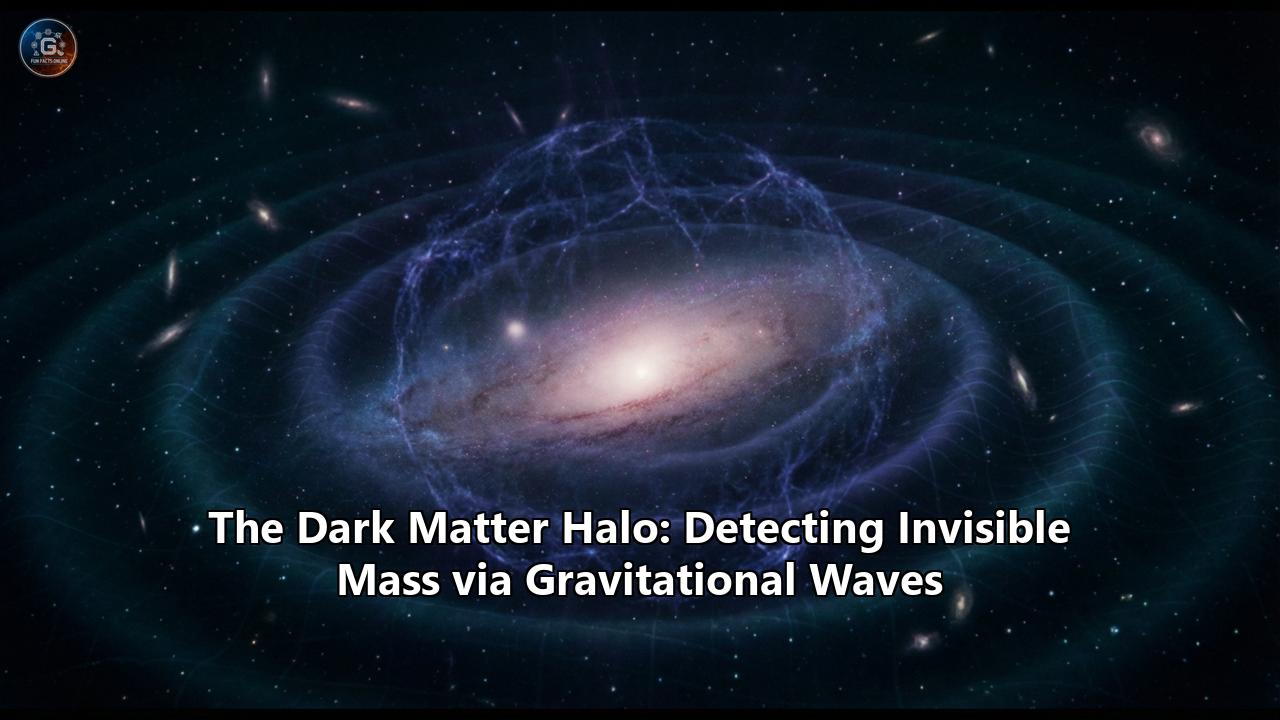
To understand how we hunt the invisible, we must first understand the quarry. Dark matter is not merely a "filler" in the universe; it is the foundation. Every galaxy we see, including our own Milky Way, is embedded within a massive, spherical cloud known as a Dark Matter Halo.
Imagine a galaxy not as a spinning disk of stars floating in emptiness, but as a small, glowing gem frozen in the center of a vast, invisible iceberg. This iceberg is the halo. It extends far beyond the visible spiral arms, composed of particles that do not reflect, absorb, or emit light. They interact only through gravity (and perhaps the weak nuclear force).
These halos are not smooth, featureless clouds. Computer simulations, such as those using the Navarro-Frenk-White (NFW) profile, suggest they have complex structures. They are densest at the center (the "cusp") and taper off towards the edges. They are also likely clumpy, filled with smaller sub-halos or "mini-halos" that swarm around the galactic center like bees around a hive.
For decades, we have mapped these halos using light—watching how stars on the outskirts of galaxies orbit too fast, held in place by the halo's invisible grip, or how the halo's gravity bends the light of distant galaxies (gravitational lensing). But these methods are static; they measure the halo's effect on things that are already there. Gravitational waves offer a dynamic probe—a way to measure how the halo interacts with matter in motion.
The Density Spike
One of the most exciting predictions of dark matter theory is the density spike. At the very heart of a galaxy often sits a Supermassive Black Hole (SMBH). As this black hole grows, its immense gravity pulls the surrounding dark matter halo inward, compressing it into an incredibly dense "spike" or "dress" surrounding the event horizon.
This region is the ultimate laboratory. Here, dark matter is compressed to densities trillions of times higher than in the solar neighborhood. If we could probe this region, we could unlock the secrets of what dark matter actually is. But light cannot escape the black hole, and the dark matter doesn't shine. This is where gravitational waves enter the stage.
Part II: The Symphony of Spacetime
Ripples in the Fabric
In 2015, the LIGO observatory made history by detecting the first gravitational waves—ripples in the fabric of spacetime caused by the merger of two black holes. Einstein predicted these waves a century ago, but their detection changed astronomy forever. Unlike light, which can be blocked by dust or gas, gravitational waves pass through everything. They are pristine carriers of information.
When two compact objects—like black holes or neutron stars—orbit each other, they churn spacetime, radiating energy in the form of gravitational waves. This loss of energy causes them to spiral inward, eventually colliding. The "waveform" of this signal (the shape of the wave over time) tells us the masses, spins, and distance of the objects.
But here is the key: The waveform also encodes the environment.
If two black holes merge in a perfect vacuum, the waveform follows a precise prediction from General Relativity. But if they merge inside a dense dark matter halo, the environment "drags" on them. The signal we receive on Earth will be slightly different—distorted, shifted, or dephased. By detecting these subtle anomalies, we can "weigh" the invisible medium they passed through.
Part III: The Dark Dress and Dynamical Friction
The most promising method for detecting dark matter halos via gravitational waves involves a scenario known as an Extreme Mass Ratio Inspiral (EMRI). This occurs when a stellar-mass black hole (perhaps 10 to 50 times the mass of our Sun) is captured by a Supermassive Black Hole (millions of times the mass of the Sun).
The Drag of the Dark
As the smaller black hole orbits the larger one, it travels through the dark matter spike—that ultra-dense dress of invisible particles we discussed earlier.
As the small black hole moves, it wakes the dark matter. Its gravity pulls the dark matter particles toward it, creating a wake of higher density behind it. This wake exerts a gravitational pull backward on the black hole, acting like a frictional drag force. This phenomenon is called Dynamical Friction.
Think of it like a spoon stirring honey. The honey resists the motion of the spoon. In the cosmos, the "honey" is the dark matter halo, and the "spoon" is the orbiting black hole.
The Dephasing Signature
This friction steals energy from the black hole's orbit. Consequently, the black hole spirals inward faster than it would in a vacuum. It merges sooner.
For a detector like LISA (Laser Interferometer Space Antenna), which is scheduled to launch in the 2030s, this effect is observable. LISA will watch these EMRIs for years, counting hundreds of thousands of orbits. If dynamical friction is present, the gravitational wave cycles will slowly drift out of phase with the vacuum prediction. Over a year of observation, the accumulated "dephasing" could amount to thousands of radians—a screamingly loud signal in the data.
By measuring this dephasing, scientists can calculate the density of the dark matter spike. If we find these spikes are common, it confirms the Cold Dark Matter model. If they are absent, it might imply that dark matter particles annihilate each other (destroying the spike) or interact in exotic ways, forcing us to rewrite physics.
Part IV: Gravitational Lensing of Gravitational Waves
While dynamical friction probes the dark matter inside the merger, Gravitational Lensing probes the dark matter between the merger and us.
The Lens
We are familiar with gravitational lensing of light—how a massive galaxy cluster bends the light of a background quasar, creating arcs or multiple images. Gravitational waves can be lensed too. If a wave from a distant merger passes near a massive dark matter halo on its way to Earth, its path will be bent.
Diffraction: Seeing the Mini-Halos
Light has a very short wavelength, so it treats halos like geometric lenses (ray optics). But gravitational waves have enormous wavelengths—sometimes thousands of kilometers long. When the wavelength of the gravitational wave is roughly the size of the lensing object, a phenomenon called Diffraction occurs.
This is similar to how ocean waves bend around a barrier or sound waves bend around a corner. If a gravitational wave encounters a small, compact dark matter halo (a "mini-halo" roughly $10^3$ to $10^6$ solar masses), it will diffract.
This diffraction creates an interference pattern in the signal received at Earth. As the frequency of the gravitational wave changes (chirps) during the merger, the interference pattern shifts. This allows us to probe sub-galactic dark matter structures that are completely invisible to telescopes.
Finding these mini-halos is crucial. The standard Cold Dark Matter theory predicts thousands of them should exist in our own galactic neighborhood. If we don't find them, dark matter might be "warm" (moving too fast to clump efficiently) or "fuzzy" (quantum mechanical waves on a galactic scale).
Microlensing and Echoes
If a gravitational wave passes a very dense, compact object—like a Primordial Black Hole or an ultra-dense dark matter core—the signal might be split into two. Because the two paths have different lengths, we would hear the "chirp" of the merger twice: the main signal, followed milliseconds or seconds later by a fainter "echo."
Detecting these echoes in LIGO or Virgo data would be a smoking gun for compact dark matter structures.
Part V: Primordial Black Holes – The Dark Matter Impostors?
There is a wilder hypothesis: What if dark matter isn't a particle at all? What if it is made of Primordial Black Holes (PBHs)?
These are hypothetical black holes formed in the first fraction of a second after the Big Bang, created not by dying stars but by the collapse of ultra-dense pockets of hot plasma. If they exist, they could constitute all or part of the dark matter.
The Merger Rate Clue
Gravitational wave detectors are the ultimate tool to test this. If dark matter is made of PBHs, these ancient black holes should be merging constantly.
- Sub-Solar Mass Mergers: Stars cannot collapse into black holes smaller than about 1.4 solar masses (the Chandrasekhar limit). If LIGO detects a merger involving a black hole with the mass of a planet or half a Sun, it must be a Primordial Black Hole. This would solve the dark matter mystery overnight.
- High Redshift Mergers: The Einstein Telescope (a planned third-generation detector) will be able to see mergers from the "Cosmic Dawn" (redshift $z > 20$), before the first stars formed. If we see black hole mergers happening before stars existed, they must be primordial.
The Eccentricity Signature
Black holes formed from stars usually orbit in circles. Primordial black holes, whizzing around in dark matter halos, would often capture each other in chaotic, highly elliptical orbits. Detecting a population of mergers with high "eccentricity" would strongly point toward a dark matter halo origin rather than a stellar origin.
Part VI: The Future – The Era of Precision Dark Matter Astronomy
We are standing on the precipice of a revolution. The current detectors—LIGO (USA), Virgo (Italy), and KAGRA (Japan)—are being upgraded. But the real game-changers are the next-generation observatories.
LISA (Laser Interferometer Space Antenna)
Launching in the mid-2030s, LISA will be a triangle of lasers spanning 2.5 million kilometers in space. It will be sensitive to low-frequency waves—exactly the frequency of Supermassive Black Holes and EMRIs.
- Target: Detecting the "Dark Dress" spikes around galactic centers.
- Promise: Measuring the particle mass of dark matter by how "fluffy" or "cuspy" the spike is.
Einstein Telescope (ET) and Cosmic Explorer
These are proposed underground detectors with arms tens of kilometers long. They will be ten times more sensitive than LIGO.
- Target: Detecting millions of mergers per year, back to the beginning of the universe.
- Promise: Mapping the distribution of mini-halos via gravitational lensing statistics and hunting for Primordial Black Hole populations.
Pulsar Timing Arrays (PTAs)
By watching the rhythmic ticking of pulsars (neutron stars), astronomers have recently detected the "hum" of the gravitational wave background. This background noise is likely caused by the slow inspiral of supermassive black holes merging throughout cosmic history. The shape of this background spectrum depends on the friction these giants experience—giving us a measure of the dark matter density on the largest scales of the universe.
Part VII: The Challenges of the Dark
While the prospects are thrilling, the path is difficult. The "signal" of dark matter is often a subtle distortion, and there are "impostors."
- Baryonic Matter: A regular accretion disk of gas around a black hole can also cause drag (dynamical friction). Disentangling the drag of gas from the drag of dark matter requires precise modeling. However, gas usually flattens into a disk, while dark matter stays spherical, leading to different orbital precession effects.
- Waveform Modeling: To detect a deviation from General Relativity, we need to know the predictions of General Relativity to incredible precision. Theorists are currently using supercomputers to calculate "template banks" of waveforms that include dark matter effects, so we know exactly what to look for.
Conclusion: Listening to the Shadows
For centuries, we have stared into the dark, trying to glimpse the invisible scaffolding of our universe. We have seen its shadow on the motion of stars and the bending of light. But now, the silence is broken.
The detection of invisible mass via gravitational waves represents a paradigm shift in cosmology. We are moving from inferring dark matter's existence to probing its material properties. Is it a fuzzy wave? A heavy particle? A swarm of ancient black holes?
The answers lie in the chirps, the echoes, and the dying breaths of colliding black holes. The dark matter halo, once a silent ghost, is about to speak. And when it does, it will tell us the story of the missing 85% of our universe.
We just have to keep listening.
Reference:
- http://www.elusives.eu/sites/default/files/outreach_entries/documents/primordial-black-holes-darkmatter-and-gravitational-waves.pdf
- https://diposit.ub.edu/dspace/bitstream/2445/201060/1/FERNANDEZ%20ESTEBAN%20JUAN%20ANTONIO_7934107-Juan.pdf
- https://ras.ac.uk/news-and-press/research-highlights/using-gravitational-waves-hunt-dark-matter
- https://arxiv.org/abs/2411.05065
- https://www.researchgate.net/publication/385700813_Gravitational_Waves_from_Primordial_Black_Hole_Dark_Matter_Spikes
- https://www.youtube.com/watch?v=N5zuZI1yHEg
- https://www.youtube.com/watch?v=LQ22jCD5aU0
- https://arxiv.org/pdf/2410.18657
- https://www.researchgate.net/publication/352424341_Dynamical_friction_from_scalar_dark_matter_in_the_relativistic_regime
- https://arxiv.org/html/2404.02808v1
- https://arxiv.org/abs/2207.00325
- https://en.wikipedia.org/wiki/Primordial_black_hole