
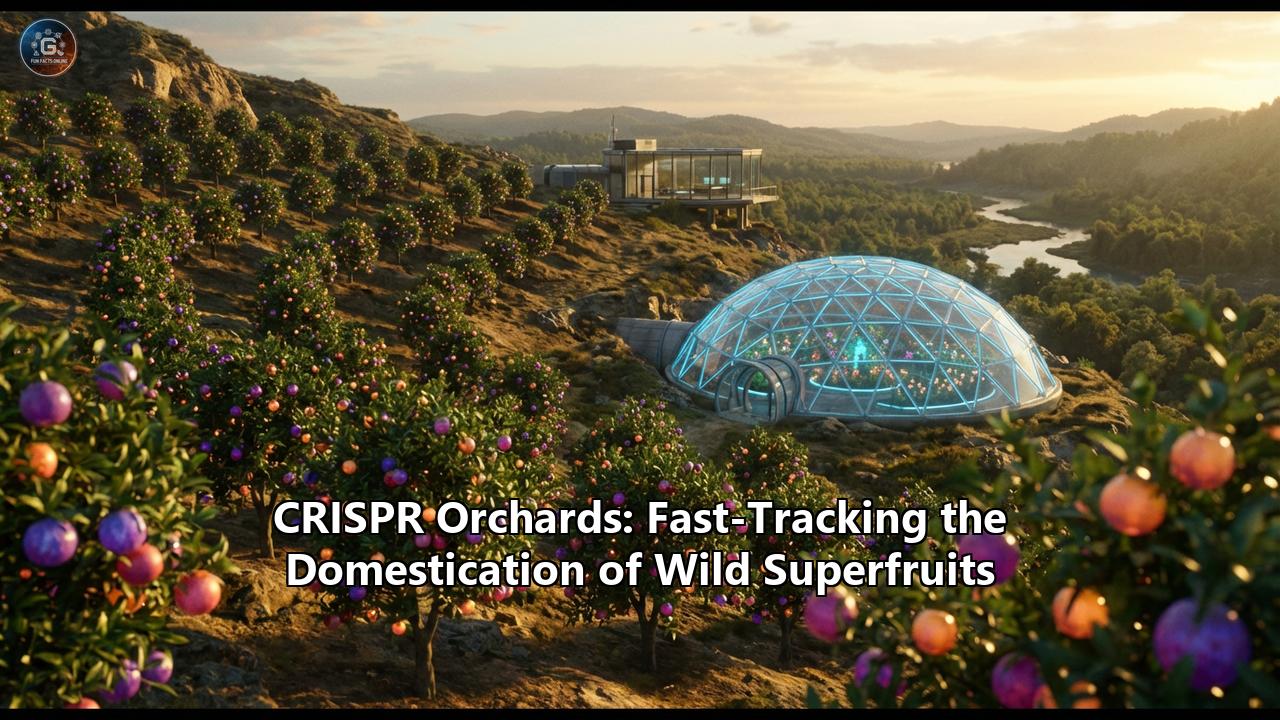
Imagine walking into a supermarket in the middle of January. Instead of the usual suspects—bland strawberries shipped from thousands of miles away, watery tomatoes, and rock-hard avocados—you are greeted by a vibrant array of fruits you’ve likely never seen before. There are golden, paper-husked berries that taste like a mix of pineapple and vanilla. There are grape-sized tomatoes that burst with an intensity of flavor lost to history. There are nutrient-dense African fruits, once rare, now piled high.
These aren’t exotic imports. They were grown a few miles away, inside a vertical farm, on compact, bush-like plants that look nothing like their sprawling wild ancestors. This is the promise of the "CRISPR Orchard": a new era of agriculture where gene editing allows us to domesticate wild plants in years rather than millennia, turning nature’s neglected "orphan crops" into the sustainable superfoods of the future.
The End of the Neolithic Waiting Game
For 10,000 years, humans have practiced agriculture the hard way. We found wild plants with potential, planted their seeds, and waited. We waited for random mutations to occur that made the fruit slightly bigger, the taste slightly sweeter, or the plant slightly easier to harvest. We saved those seeds and waited again. This process, known as domestication, turned the toxic, spindly ancestor of maize into the corn cobs we know today, and the tiny, bitter berries of the nightshade family into plump, juicy tomatoes.
But this process is agonizingly slow. It relies on chance and centuries of labor. Today, with a global population hurtling toward 10 billion and a climate that is becoming increasingly hostile to traditional farming, we don’t have centuries to wait.
Enter CRISPR-Cas9, the molecular scalpel that has revolutionized biology. By allowing scientists to make precise, targeted cuts to a plant’s DNA, CRISPR enables us to "fast-track" evolution. We can now look at the genetic blueprint of a wild plant, identify the specific genes that make it "wild" (e.g., sprawling vines, dropping fruit, small size), and edit them to behave like a domesticated crop.
This concept, known as de novo domestication, allows us to take a plant from the wild to the supermarket shelf in a fraction of the time—potentially just a few generations. It is not just about tweaking existing crops; it is about unlocking an entirely new catalog of food.
The Science: How to Tame a Wild Plant
To understand how CRISPR orchards work, we must first understand "domestication syndrome." When our ancestors domesticated crops, they unconsciously selected for a specific suite of traits. Regardless of the species, almost all useful crops share these characteristics:
- Determinate Growth: They stop growing at a certain height (compactness) rather than sprawling indefinitely.
- Non-Shattering: They hold onto their seeds or fruit even when ripe, rather than dropping them to the ground (which makes harvesting impossible).
- Gigantism: The edible parts (fruit, seeds, tubers) are significantly larger than in the wild.
- Reduced Dormancy: Seeds germinate quickly and uniformly.
In the past, achieving these traits required lucky mutations. Today, we know exactly which genes control them.
Multiplexing: The Speed of Light Breeding
The true power of CRISPR lies in "multiplexing"—the ability to edit multiple genes simultaneously. In a landmark breakthrough, researchers didn't just tweak one trait; they targeted up to six different genes at once in wild species.
For example, by targeting the SP (Self-Pruning) gene, scientists can turn a vining plant into a compact bush. By targeting SP5G, they can alter the plant's sensitivity to daylight, allowing it to flower and fruit earlier. By targeting CLV1 (CLAVATA1), they can increase the size of the fruit. In a single generation, a wild, unruly plant can be transformed into a compact, heavy-yielding crop ready for the modern farm.
The Stars of the New Orchard: Case Studies
The theory is exciting, but the real-world results are already growing in laboratories and pilot farms. The most advanced candidates for these CRISPR orchards belong to the Solanaceae family, cousins of the tomato and potato.
*1. The Groundcherry (Physalis pruinosa)
The groundcherry is the "poster child" of de novo domestication. Native to the Americas, this small, orange fruit is wrapped in a papery husk and has a unique, intoxicating flavor often described as a mix of pineapple, vanilla, and cherry tomato.
- The Problem: In the wild, groundcherries are an agricultural nightmare. They grow as sprawling, tangling vines that take up huge amounts of space. Worse, they have a trait called "abscission"—as soon as the fruit is ripe, it drops to the ground. This forces farmers to harvest them from the dirt, raising food safety concerns and labor costs.
- The CRISPR Fix: A team led by Zachary Lippman at Cold Spring Harbor Laboratory and Joyce Van Eck at the Boyce Thompson Institute used CRISPR to "fix" the groundcherry. They edited the SP gene to make the plant compact and bush-like. They targeted the CLV1 gene to boost fruit size by 24%. Crucially, they are working on the jointless gene to prevent the fruit from dropping, allowing for mechanical harvesting.
- The Result: A plant that fits perfectly into high-density rows, holds its fruit for easy picking, and yields significantly more food per acre.
2. The Goldenberry (Physalis peruviana)
Often called the "new blueberry," the goldenberry is a nutritional powerhouse packed with vitamins and antioxidants. However, like its cousin the groundcherry, it is wild and unwieldy.
- The Breakthrough: Recent work has focused on the ERECTA gene. By editing this gene, researchers created goldenberry plants with short, sturdy stems and a highly compact architecture. These "dwarf" goldenberries are perfect for urban vertical farms where ceiling height is a premium. They produce just as much fruit as their giant wild relatives but in a fraction of the space.
3. The "Urban Agriculture" Tomato
While tomatoes are already domesticated, their wild ancestor, Solanum pimpinellifolium, is incredibly resilient. It resists pests, diseases, and salt stress that wipe out modern commercial tomatoes.
- The Strategy: Instead of trying to breed disease resistance into a modern tomato (which is genetically messy), scientists took the wild tomato and used CRISPR to give it "domesticated" traits.
- The Innovation: They created a tomato plant that looks more like a bouquet of grapes. It is extremely compact, matures in under 40 days, and produces fruit in tight bunches. This "bunching" trait makes it ideal for robotic harvesting in indoor farms. It retains the intense, aromatic flavor and nutritional profile of the wild plant but behaves like a polite industrial crop.
The Infrastructure: Vertical Farms and Urban Ag
The term "CRISPR Orchard" is literal. These new crops are not designed for the vast, open monocultures of the Midwest. They are custom-engineered for the Controlled Environment Agriculture (CEA) of the 21st century.
The Vertical Fit
Vertical farming has long struggled with profitability. Growing lettuce and herbs is fine, but you can't feed the world on salad. To be viable, vertical farms need high-calorie, high-value fruit crops. But you can't grow a 6-foot tomato vine in a rack system with 18 inches of clearance.
CRISPR-edited compact crops solve this physics problem.
- Density: A "dwarfed" goldenberry or groundcherry plant can be stacked five or six levels high.
- Efficiency: Recent trials showed that CRISPR-edited tomatoes for vertical farms reduced space occupation by 85% while increasing effective yield by 180%.
- Robotics: The predictable, compact shape of these plants makes them easy for vision systems and robotic arms to harvest, removing the massive labor cost that plagues berry farming.
Growing in the Dark
One of the most radical frontiers is "heterotrophic" growth. Startups like Square Roots and research initiatives are exploring gene-edited plants that can bypass photosynthesis entirely, feeding on acetate in the water rather than light. This would eliminate the single biggest cost of vertical farming: electricity for LED lights. While still in early stages, CRISPR is the key to unlocking these metabolic pathways.
Global Impact: Beyond the Salad Bowl
While trendy berries for Western supermarkets are the "low-hanging fruit" (pun intended) of this technology, the humanitarian potential is vast.
African Orphan Crops
The African Orphan Crops Consortium (AOCC) is sequencing the genomes of 101 traditional African food crops—plants like Baobab, Marula, and Spider Plant. These crops are highly nutritious and adapted to local climates but suffer from low yields and difficult harvest traits.
- Baobab: Known as the "Tree of Life," its fruit has ten times the antioxidant level of oranges. But the trees are massive and slow-growing. CRISPR could potentially create dwarf, early-fruiting varieties that could be grown in orchards rather than harvested from the wild, providing a stable income for farmers and a reliable nutrient source for local communities.
- Teff & Millet: Gene editing is being used to prevent "lodging" (falling over) in these staple grains, a simple structural fix that could double yields without new fertilizers.
The Friction: Regulation, Money, and Trust
If the science is ready, why aren't these fruits in every store? The barrier is a mix of law, economics, and culture.
The Regulatory Thaw (2024-2025 Updates)
The regulatory landscape is shifting rapidly in favor of these crops, distinguishing them from traditional GMOs (which involve inserting foreign DNA, like bacteria genes).
- USA: As of late 2024, the USDA APHIS has significantly expanded its exemptions. Plants can now have up to 12 simultaneous genetic edits and still be exempt from GMO regulation, provided those edits could have occurred naturally. This is a game-changer for "stacking" traits like compactness, yield, and disease resistance in a single product.
- UK: The Genetic Technology (Precision Breeding) Act 2023 is now fully operational. It allows "precision bred" organisms to be fast-tracked for commercial sale, positioning the UK as a testing ground for these new foods.
- EU: Historically the strictest regulator, the EU is moving toward a landmark compromise. A provisional agreement creates a "Category 1" for NGT (New Genomic Techniques) plants that are equivalent to conventional breeding. These would be exempt from the arduous GMO labeling and authorization process, though patentability remains a fierce debate.
The Economic Case
The market for gene-edited crops is projected to surpass $19.9 billion by 2030. For farmers, the math is compelling:
- Lower Input: Disease-resistant wild traits mean fewer pesticides.
- Higher Output: Compact architecture means higher yield per square meter.
- New Markets: Unique "superfruits" like the groundcherry offer a premium product that competes with blueberries and raspberries, a multi-billion dollar segment.
The Consumer Factor
Will people eat it? The "Frankenfood" stigma of the 90s is fading, replaced by a more nuanced view.
- Benefit-Driven Acceptance: Surveys in 2024/2025 show that consumers are largely open to gene-edited foods if the benefit is clear. They are skeptical of modifications that just help the farmer (like herbicide tolerance) but are enthusiastic about modifications that help them (higher nutrition, better taste) or the planet* (reduced food waste, less chemical use).
- Transparency: Trust is fragile. Successful commercialization will depend on marketing these not as "engineered" foods, but as "restored" or "optimized" versions of nature's best works—bringing the resilience of the wild back to our plates.
Conclusion: A New Harvest
We are standing at the threshold of a second Green Revolution. The first was built on chemicals and heavy machinery. This one is built on information and precision.
CRISPR Orchards represent a fundamental shift in our relationship with nature. Instead of bending the environment to fit our crops (through irrigation, pesticides, and fertilizers), we can now bend our crops to fit the environment—whether that environment is a changing climate, a vertical farm in a skyscraper, or a smallholder plot in Africa.
The wild superfruits are waiting. We no longer have to wait 1,000 years to invite them to the table.
Reference:
- https://www.aphis.usda.gov/news/program-update/aphis-announces-final-notice-additional-exemptions-movement-organisms-modified
- https://www.rothamsted.ac.uk/news/precision-breeding-regulations-signed-law-uk-government
- https://www.farmersguide.co.uk/arable/legislation-allowing-cultivation-of-gene-edited-crops-now-in-force/
- https://www.managingip.com/article/2f2ucenjczxsplx8n5r7k/sponsored-content/eu-regulation-on-plants-from-new-genomic-techniques-green-shoots-of-progress
- https://www.gminsights.com/pressrelease/gene-editing-market