
For more than half a century, the global transition to renewable energy has rested primarily on the shoulders of one element: silicon. From the earliest space satellites to the sprawling, multi-gigawatt solar farms in the modern desert, crystalline silicon has been the undisputed king of photovoltaics. But silicon, despite its reliability and plummeting manufacturing costs, is bound by the unbreakable laws of physics. It has a hard ceiling—a maximum theoretical efficiency that no amount of engineering can bypass.
To truly decarbonize the global economy and bring energy independence to space-constrained urban environments, the world needs a solar technology that shatters this ceiling.
Enter the perovskite-silicon tandem solar cell.
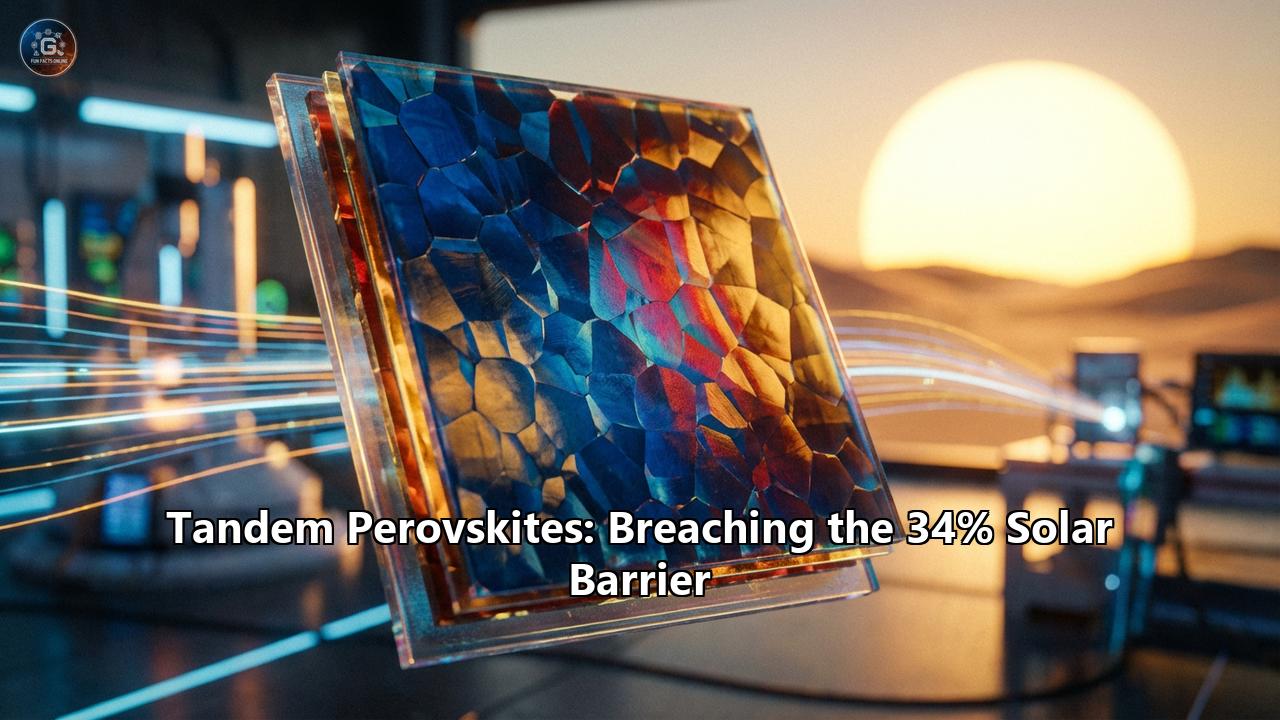
In a staggering leap for materials science, the solar industry has recently breached the once-mythical 34% efficiency barrier for photovoltaic conversion. Certified by the U.S. National Renewable Energy Laboratory (NREL), a two-terminal crystalline silicon-perovskite tandem solar cell developed by the solar technology giant LONGi recently achieved a world-record conversion efficiency of 34.85%. To put this into perspective, the absolute maximum theoretical limit for a standard single-junction silicon solar cell is just 33.7%. By combining the traditional workhorse of silicon with the miraculous light-absorbing properties of perovskite crystals, engineers have not just pushed the envelope—they have torn it open.
This is the story of how materials science bypassed a fundamental bottleneck of physics, how tandem solar cells work, the commercial scaling of this technology, and what a 34% efficient solar cell means for the future of global energy.
The Physics of the Plateau: Why Silicon Hit a Wall
To understand the magnitude of the 34.85% breakthrough, one must first understand the invisible barrier that has governed solar cell research since 1961: the Shockley-Queisser (SQ) limit.
Formulated by physicists William Shockley and Hans-Joachim Queisser, the SQ limit calculates the maximum theoretical efficiency of a solar cell using a single p-n junction. They discovered that a standard single-junction solar cell is fundamentally limited by the bandgap of its semiconductor material. The bandgap is the minimum amount of energy required to knock an electron loose and allow it to flow as electricity.
When sunlight hits a silicon solar panel, it arrives as a shower of photons carrying different amounts of energy across the electromagnetic spectrum. Silicon has a bandgap of 1.1 electron volts (eV).
- Too little energy: If a photon (like those in the infrared spectrum) hits the cell with less than 1.1 eV, it passes right through the silicon without generating electricity.
- Too much energy: If a highly energetic photon (like ultraviolet or blue light) hits the cell, it dislodges an electron, but any energy it carries above the 1.1 eV threshold is entirely wasted, dissipating into the panel as heat.
Because of these two factors—wasted low-energy photons and the thermalization of high-energy photons—Shockley and Queisser mathematically proved that a single-junction silicon cell could never convert more than approximately 33.7% of the sun's energy into electricity. In the real world, due to unavoidable losses from electrical resistance, shading from metal contacts, and reflection, top-tier commercial silicon panels have hovered around 22% to 25% efficiency, with lab-perfected monocrystalline silicon cells topping out just under 28%.
We have spent decades squeezing the last drops of efficiency out of silicon. To go further, scientists needed a second net to catch the light that silicon was wasting.
Enter the Magic Crystal: The Perovskite Revolution
Perovskite is not a specific element, but rather a family of materials that share a specific crystalline lattice structure—the same structure found in calcium titanate, which was discovered in the Ural Mountains in 1839 by Gustav Rose and named after Russian mineralogist Lev Perovski. The basic chemical formula for perovskite is ABX3, where 'A' and 'B' are cations of different sizes, and 'X' is an anion that bonds to both.
In 2009, Japanese researcher Tsutomu Miyasaka discovered that certain synthetic metal-halide perovskites were exceptionally good at absorbing light. What followed was the fastest technological advancement in the history of photovoltaics. In less than 15 years, the efficiency of single-junction perovskite solar cells skyrocketed from a meager 3.8% to over 26%.
Why are perovskites considered a "magic" material?
- Tunable Bandgap: Unlike silicon, which is rigidly stuck at 1.1 eV, the bandgap of perovskites can be engineered by tweaking their chemical composition. They can be formulated to perfectly absorb the high-energy blue and green light that silicon wastes.
- Incredible Absorption: Perovskites are highly efficient direct bandgap semiconductors. A perovskite layer less than 1 micrometer thick can absorb the same amount of sunlight as a thick silicon wafer.
- Low-Cost Manufacturing: Silicon requires massive, energy-intensive furnaces to grow pure ingots at over 1,400°C. Synthetic perovskites, on the other hand, can be created using low-temperature chemistry. They can be dissolved in solvents and quite literally printed onto a surface like ink on a newspaper, making the manufacturing process immensely cheaper and less carbon-intensive.
Despite these miraculous properties, early perovskites had one fatal flaw: they degraded rapidly when exposed to moisture, heat, or ultraviolet light, turning back into yellow, non-conductive lead iodide. The challenge for the last decade was stabilizing this crystal. But once researchers began successfully passivating the defects, the ultimate super-cell was born: the tandem.
The Power of Two: The Mechanics of Tandem Solar Cells
A tandem solar cell does not replace silicon; it upgrades it. By layering a specialized perovskite solar cell directly on top of a traditional silicon solar cell, engineers create a two-tiered optical trap.
Because perovskite is semi-transparent and its bandgap can be tuned to around 1.7 eV, it is placed on the front line to face the sun. The perovskite "top cell" happily devours the high-energy blue and ultraviolet photons, converting them into electricity at a much higher voltage than silicon ever could. Meanwhile, the lower-energy red and infrared photons pass straight through the perovskite layer, completely unhindered, and are absorbed by the silicon "bottom cell".
This division of labor effectively bypasses the Shockley-Queisser limit of silicon. By splitting the solar spectrum into two distinct bands and assigning a dedicated semiconductor to each, the theoretical maximum efficiency of a two-terminal (2T) perovskite-silicon tandem cell jumps from 33.7% to a staggering 43%.
The Race to 34%: Breaching the Barrier
The journey to surpassing 34% efficiency has been a fiercely contested race among elite global research institutions and tier-one solar manufacturers.
By the end of 2023, the industry was already knocking on the door of the SQ limit. In November 2023, the R&D team at LONGi achieved a tandem efficiency of 33.9%, effectively tying the theoretical maximum of standalone silicon. But the momentum did not slow down. In June 2024, LONGi pushed the record to 34.6%. Other major players like JinkoSolar reported tandem cells reaching 34.76%, confirmed by testing centers in China.
The defining milestone came in early 2025 when LONGi independently developed a two-terminal crystalline silicon-perovskite tandem solar cell that achieved a certified power conversion efficiency of 34.85% at the U.S. National Renewable Energy Laboratory (NREL).
Reaching these numbers required overcoming immense nanoscale engineering challenges. One of the primary hurdles was the physical mating of the two materials. Modern silicon solar cells are not perfectly flat; their surfaces are etched with microscopic pyramids. This "texturization" traps light by forcing photons to bounce back and forth between the microscopic peaks and valleys, increasing absorption.
However, trying to spin-coat or deposit an ultra-thin, uniform layer of liquid perovskite over a spiky, pyramidal mountain range of silicon is notoriously difficult. If the perovskite pools in the valleys and leaves the peaks exposed, the cell shorts out. To solve this, researchers utilized advanced deposition techniques. For instance, a joint effort by the King Abdullah University of Science and Technology (KAUST) and the Fraunhofer Institute for Solar Energy Systems ISE unlocked record-breaking efficiencies on textured silicon by using molecules like 1,3-diaminopropane dihydroiodide to passivate the uneven perovskite surface. This chemical treatment healed the microscopic defects at the interface, significantly reducing electron-hole recombination and increasing the open-circuit voltage to over 2.01 volts.
Another critical advancement has been the development of robust charge transport layers. In a tandem cell, electrons and holes must move seamlessly between the perovskite and the silicon without losing energy. Research has shown that utilizing sacrificial interface layers, such as PEDOT:PSS, alongside copper-doped nickel oxide (NiOx) hole transport layers, drastically improves the electrical contact and achieves a fill factor (a measure of cell quality) exceeding 81%.
Scaling Up: From Lab Records to Rooftop Reality
A lab record of 34.85% is a triumph of physics, but lab cells are often the size of a postage stamp—typically around 1 square centimeter. The true test of a solar technology is whether it can be scaled up to full-sized, commercially viable modules without suffering a massive drop in efficiency.
This is where the industry's shift from academic research to gigawatt-scale manufacturing becomes the focal point. Oxford PV, a spin-out from the University of Oxford and a pioneer in tandem cell commercialization, has been leading the charge in bringing this technology to the masses. In June 2024, Oxford PV debuted a residential-size tandem solar module with an unprecedented, independently certified efficiency of 26.9%.
While 26.9% is lower than the 34.85% lab record, it is a monumental leap for a commercial-sized module. Traditional commercial silicon panels average around 20-22%. Oxford PV's breakthrough 60-cell, double-glass module has a designated area of just over 1.6 square meters and weighs under 25 kg, making it a drop-in replacement for standard residential rooftop installations.
To manufacture these next-generation panels, Oxford PV established the world’s first volume manufacturing line for perovskite-on-silicon tandem cells in Brandenburg an der Havel, Germany. Operating on a 100 MW capacity line, the facility bridges the gap between lab innovation and industrial-scale rollout, utilizing proprietary perovskite deposition tools combined with high-efficiency silicon heterojunction (HJT) bottom cells.
The economic implications of a 26.9% commercial module are profound. According to Oxford PV, commercial and utility customers will benefit from upwards of 20% more power generation from the exact same footprint.
The Urban Energy Equation
This increase in power density is the silver bullet for the urban energy transition. In densely populated cities, the biggest barrier to rooftop solar isn't the cost of the panels—it's the lack of space. Most urban homes, apartment blocks, and small businesses have heavily constrained roof areas. Traditional silicon panels often cannot generate enough electricity in a small physical footprint to offset a significant portion of a building's energy consumption, leading to longer payback periods.
Tandem perovskites fundamentally alter this math. By generating significantly more power per square meter, tandem arrays allow homeowners to maximize their roofs. A roof that previously could only fit a 4-kilowatt silicon array can now host a nearly 5-kilowatt tandem array, generating enough excess power to charge an electric vehicle or run a heat pump through the winter. Furthermore, because a large portion of a solar installation's cost comes from the balance-of-system (BOS) components—such as the racking hardware, wiring, labor, and inverters—using fewer, highly efficient panels drastically reduces the overall Levelized Cost of Energy (LCOE).
The Durability Challenge: Surviving the Real World
If perovskites are so efficient and cheap to make, why aren't they already on every roof in the world? The answer lies in the harsh realities of the outdoor environment.
When researchers talk about solar cell stability, they are addressing a myriad of degradation mechanisms. Perovskites are highly sensitive to moisture; water molecules can easily penetrate the crystal lattice and cause it to dissolve. Furthermore, when exposed to high heat and intense UV radiation, the chemical bonds in hybrid organic-inorganic perovskites can break down, leading to the outgassing of volatile components like methylammonium.
To gain the trust of the utility sector and bankability from financial institutions, solar panels must survive outdoors for 25 to 30 years. This requires passing rigorous International Electrotechnical Commission (IEC) standard tests, such as IEC 61215, which subjects modules to thousands of hours of damp heat, thermal cycling, and UV soaking.
Recent breakthroughs have proven that perovskites can be tamed. Companies like GCL and Utmo Light in China have reported passing stringent IEC testing for their perovskite modules. By encapsulating the cells in highly impermeable advanced polymers and edge-sealants, engineers can physically lock moisture out. Internally, substituting volatile organic molecules in the perovskite structure with more stable inorganic elements, like cesium and formamidinium, has vastly improved the thermal resilience of the crystal. Furthermore, advanced surface defect passivation—which involves chemically "capping" the unbonded elements at the edges of the perovskite crystals—prevents degradation from starting in the first place.
Testing under ISOS (International Summit on Organic Photovoltaic Stability) protocols has shown stabilized perovskite solar cells operating for over 4,000 hours under continuous indoor illumination and extrapolating to beyond 20,000 hours in outdoor testing environments. The era of fragile perovskites is ending; the era of bankable, warrantied tandem panels is beginning.
Geopolitics and the Future of Manufacturing
The advent of the 34% tandem cell is not just a scientific curiosity; it is a geopolitical pivot point. Currently, the global solar supply chain is heavily centralized, with the vast majority of polysilicon refining, wafer slicing, and cell manufacturing concentrated in Asia.
Because perovskites can be synthesized from abundant, cheap precursors (like iodine, lead, and simple organic salts) without the need for multi-billion-dollar silicon smelting infrastructure, they offer an opportunity for localized energy manufacturing. Europe and the United States are aggressively funding perovskite research to build domestic solar manufacturing bases. Oxford PV’s backing from the Brandenburg state government with a $10 million injection highlights the strategic European push to reclaim a stake in the global PV market. Similarly, facilities in the United States and the UK are being scoped out for rapid expansion, leveraging the low capital expenditure required to set up a perovskite "printing" facility compared to a silicon foundry.
The Horizon: 40% and Beyond
The breach of the 34% barrier is a watershed moment, but the physics of perovskites suggest we are still just clearing our throats. The 43% theoretical limit for 2T silicon-perovskite tandems leaves plenty of runway for the next decade of research.
But why stop at two layers?
Materials scientists are already exploring triple-junction solar cells. By stacking a wide-bandgap perovskite, a medium-bandgap perovskite, and a narrow-bandgap silicon bottom cell, the theoretical efficiency limit leaps beyond 50%.
Furthermore, research is rapidly accelerating into "all-perovskite" tandems. By stacking two distinct layers of perovskite (one tuned for blue light, one tuned for red) and completely eliminating the rigid silicon bottom layer, manufacturers could produce highly efficient, flexible, lightweight solar foils. These could be manufactured on massive roll-to-roll printers, similar to printing currency or newspapers. All-perovskite tandems could be wrapped around the curved bodies of electric vehicles, integrated into the fabric of tents and backpacks, or seamlessly applied to the glass facades of skyscrapers.
The Dawn of Energy Abundance
For decades, the Shockley-Queisser limit was viewed as an immovable law of nature—a strict budget on how much power humanity could extract from the sun. The 34.85% efficiency record achieved by tandem perovskites represents humanity successfully renegotiating that budget.
We are witnessing the technological maturation of a true miracle material. What began as a delicate crystal that dissolved in humid air has been engineered into an industrial powerhouse capable of augmenting silicon, doubling power density, and accelerating the decarbonization of the global grid.
As gigawatt-scale factories spool up their production lines and residential modules exceeding 26% efficiency begin hitting the market, the narrative of solar power shifts. It is no longer a story about finding vast tracts of empty land to build sprawling arrays. It is about hyper-efficiency. It is about turning every sunlit rooftop, window, and surface into a high-octane generator. By breaching the 34% barrier, perovskite tandem solar cells have proved that the future of clean energy is not just brighter—it is infinitely more powerful.
Reference:
- https://www.google.com/search?q=time+in+DE
- https://www.universitywafer.com/what-is-the-shockley-queisser-limit.html
- https://energy.sustainability-directory.com/learn/what-is-the-shockley-queisser-limit-for-single-junction-silicon-solar-cells/
- https://en.wikipedia.org/wiki/Shockley%E2%80%93Queisser_limit
- https://ph.qmul.ac.uk/sites/default/files/u75/Solar%20cells_environmental%20impact.pdf
- https://pv-magazine-usa.com/2020/11/15/oxford-pvs-german-perovskite-solar-module-plant-backed-by-brandenburg-state-with-10-million/
- https://news.oregonstate.edu/news/crystal-structure-discovered-almost-200-years-ago-could-hold-key-solar-cell-revolution
- https://www.ossila.com/pages/what-is-perovskite-solar-cell
- https://www.mdpi.com/2072-666X/15/2/192
- https://www.perovskite-info.com/oxford-pv-completes-build-out-its-brandenburg-factory
- https://www.ossila.com/pages/history-and-evolution-of-perovskites
- https://fenix.ciencias.ulisboa.pt/downloadFile/1126037345799695/SQ%20limit.pdf
- https://www.oxfordpv.com/about-us
- https://www.solarpowerportal.co.uk/solar-pv/-all-options-are-open-on-new-solar-facility-location-for-oxford-pv-says-cto
- https://www.pv-magazine.com/2021/07/23/oxford-pv-completes-100-mw-factory-build-out/
- https://www.european-mrs.com/perovskite-solar-cells-surface-interface-and-materials-aspects-emrs