
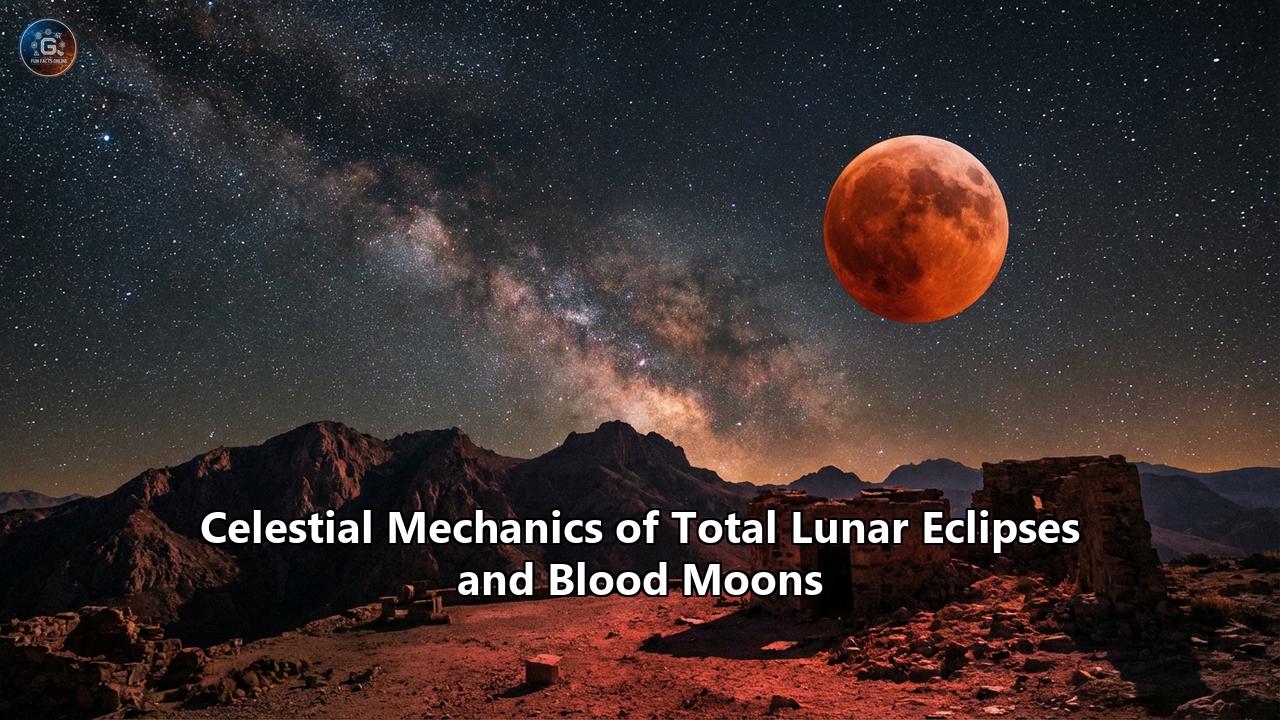
The night sky holds many spectacles, but few command the primal awe and quiet reverence of a total lunar eclipse. For hours, the familiar silver disc of the full moon is slowly consumed by an invisible shadow, only to reemerge not in darkness, but bathed in a haunting, coppery glow. Often referred to in popular culture as a "Blood Moon," this phenomenon has historically stopped battles, terrified emperors, and inspired mythologies across the globe. Today, while we no longer view a reddened moon as a cosmic omen, the exact celestial mechanics behind it reveal a clockwork universe of staggering elegance and atmospheric physics of profound beauty.
To truly appreciate a total lunar eclipse, one must look beyond the visual spectacle and understand the intricate orbital dance of the Earth, the Moon, and the Sun, as well as the unique optical properties of our own planet's atmosphere.
The Cosmic Ballet: Syzygy and Orbital Mechanics
At the heart of every lunar eclipse is a concept known as syzygy (derived from the ancient Greek syzygia, meaning "yoked together"). Syzygy occurs when three or more celestial bodies align in a straight line. In the case of a lunar eclipse, this alignment features the Sun, the Earth, and the Moon, in that exact order. The Earth blocks the direct rays of the Sun, casting a long shadow into space, and the Moon wanders precisely into this darkened corridor.
However, a logical question often arises: Since the Moon completes an orbit around the Earth approximately once every 29.5 days, bringing us a full moon every month, why don't we experience a total lunar eclipse every month?
The answer lies in the tilt of the Moon's orbit. The Moon does not orbit the Earth on the exact same plane that the Earth orbits the Sun (the ecliptic plane). Instead, the lunar orbit is tilted by about 5.1 degrees relative to the ecliptic. Because of this slight inclination, during most full moons, the Moon passes just above or just below the Earth's shadow, leaving its brilliant white surface fully illuminated by the Sun.
An eclipse can only occur when the full moon coincides with the Moon crossing the ecliptic plane. The two invisible points in space where the Moon's orbit intersects the ecliptic are called the "lunar nodes" (the ascending node and the descending node). When a full moon happens near one of these nodes, the three bodies achieve perfect syzygy, and a lunar eclipse is born. The sun's alignment with these nodes happens in roughly 34.5-day windows twice a year, known as "eclipse seasons," which is why eclipses always occur in pairs or trios of solar and lunar events.
The Anatomy of a Planetary Shadow: Penumbra and Umbra
When syzygy is achieved, the Moon must navigate the Earth's shadow. Because the Sun is not a single point of light but a massive, extended luminous sphere, the shadow cast by the Earth is not a uniform block of darkness. It is divided into two distinct regions: the penumbra and the umbra.
The Penumbra: This is the pale, outer part of the Earth's shadow. In this region, the Earth only partially blocks the Sun's disk. When the Moon first touches the penumbra, the eclipse officially begins, but the visual effect is incredibly subtle. To the naked eye, the Moon might just look a little less radiant, as if a thin, almost imperceptible veil of gray clouds has passed over it. Some observers describe it as a faint "tea-stain" on the lunar surface. The Umbra: This is the deep, dark inner core of the shadow, where the Earth blocks all direct sunlight from reaching the Moon. The Earth's umbral cone extends into space for about 1.4 million kilometers. Since the Moon orbits Earth at an average distance of about 384,000 kilometers, it falls comfortably within this zone. When the Moon's leading edge slips into the umbra, the partial phase of the eclipse begins. It looks as though a massive, curved bite is being taken out of the lunar disk.When the entire Moon is fully submerged within the umbra, "totality" is achieved. This is the crescendo of the celestial performance, lasting anywhere from a few minutes to over an hour and forty minutes, depending on whether the Moon crosses through the dead center of the umbra or merely grazes its edges.
The Physics of the Blood Moon: Rayleigh Scattering
If the Earth blocks all direct sunlight within the umbral shadow, one might assume the Moon should simply turn pitch black and vanish from the night sky. During a total solar eclipse, when the Moon blocks the Sun, we indeed experience profound darkness. Yet, during a total lunar eclipse, the Moon frequently bursts into spectacular shades of crimson, rust, and copper.
This breathtaking color palette is the result of the Earth's atmosphere acting as both a lens and a filter—a phenomenon explained by a principle called Rayleigh scattering.
Named after the 19th-century British physicist Lord Rayleigh, this principle describes how sunlight interacts with the gas molecules (primarily nitrogen and oxygen) in our atmosphere. Sunlight appears white, but it is actually a composite of all the colors of the rainbow, each traveling at different wavelengths. Colors like violet, blue, and green have shorter wavelengths, while yellow, orange, and red have longer wavelengths.
When sunlight strikes the Earth's atmosphere, the gas molecules scatter the shorter, bluer wavelengths in every direction (which is why our daytime sky appears blue). However, the longer wavelengths—the reds and oranges—are capable of passing straight through the thickest parts of our atmosphere without being scattered away.
During a total lunar eclipse, the sunlight passing through the very edges of the Earth's atmosphere is stripped of its blue light. The remaining red and orange light is then refracted, or bent, by the Earth's atmosphere inward, directing it straight into the umbral shadow and painting the lunar surface.
In a very real, poetic sense, the red glow illuminating a totally eclipsed moon is the projection of every sunrise and every sunset happening simultaneously across the entire circumference of the Earth. If you were standing on the surface of the Moon during totality, looking back at Earth, you would not see a bright blue marble. Instead, you would see the night side of our planet, enveloped in total darkness, ringed by a blinding, fiery halo of global twilight.
Occasionally, observant skywatchers will notice a fleeting band of turquoise or blue light on the very edge of the Moon just as it enters or exits totality. This is not Rayleigh scattering, but rather the result of sunlight passing through the upper stratosphere, where the Earth's ozone layer absorbs red light and lets blue light pass through. The combination of the ozone's blue fringe and the lower atmosphere's red glow makes the lunar surface a dynamic canvas of atmospheric chemistry.
Evaluating the Darkness: The Danjon Scale
Not all total lunar eclipses look the same. Some are bright and intensely orange, while others are so dark the Moon practically disappears from the sky. Because the light illuminating the Moon during totality is entirely dependent on the state of the Earth's atmosphere at that exact moment, the visual appearance of a lunar eclipse is a mirror reflecting our planet's atmospheric health and weather patterns.
To standardize the observation of these variations, French astronomer André-Louis Danjon created the Danjon Scale in 1921. This five-point scale (ranging from L=0 to L=4) is still used by astronomers and citizen scientists today to evaluate the luminosity and color of a lunar eclipse at mid-totality:
- L = 0 (Very Dark): The Moon is almost completely invisible, especially at mid-totality. The eclipse appears as a void in the sky.
- L = 1 (Dark): The Moon is a dark gray or brownish color. Lunar features are very difficult to distinguish.
- L = 2 (Deep Red / Rust): The central shadow is very dark, but the outer edge of the umbra is relatively bright. The Moon takes on the color of rusted iron.
- L = 3 (Brick Red): The Moon is a vibrant brick red, usually accompanied by a bright or yellowish rim. Surface features are easily visible.
- L = 4 (Bright Copper / Orange): A highly luminous, bright copper-red or orange eclipse. The umbral shadow often features a striking bluish, very bright rim.
What causes an eclipse to shift from a bright L=4 to a dark L=0? The primary culprits are volcanic eruptions, global cloud cover, and airborne particulates. When a major volcano erupts, it spews massive quantities of sulfur dioxide and ash high into the stratosphere. These aerosols act as an opaque filter, blocking even the red wavelengths of light from refracting through the atmosphere.
Following the massive eruption of Mount Krakatoa in 1883, the subsequent lunar eclipses were famously pitch black. More recently, the 1991 eruption of Mount Pinatubo in the Philippines dumped so much ash into the atmosphere that the total lunar eclipse of December 1992 was rated a perfect 0 on the Danjon Scale by many observers—it was described as a "missing moon." Today, submitting Danjon ratings during an eclipse remains a popular citizen science project, providing continuous data on the opacity of the Earth's atmosphere.
The March 2026 Total Lunar Eclipse: A Contemporary Spectacle
The precision of celestial mechanics allows us to predict these events with down-to-the-minute accuracy centuries in advance. Right now, in early March 2026, the world is preparing for a magnificent display of these mechanics. On Tuesday, March 3, 2026, a total lunar eclipse will grace the skies. Because this full moon occurs in March, it is historically known as the "Worm Moon," signaling the softening of the earth and the return of earthworms as spring approaches in the Northern Hemisphere.
This specific eclipse is uniquely positioned for a global audience, though the experience will vary wildly depending on longitude.
For observers in New Zealand and parts of Australia, the timing is absolute perfection. The event unfolds high overhead in the middle of the night, offering a prime, unobstructed view of the entire celestial sequence from start to finish. In New Zealand, the Moon begins moving into the Earth's shadow around 9:45 PM local time, achieving deep red totality by late evening and wrapping up the show in the early hours of the morning. Astronomers note that only an estimated 2% of the world's population is perfectly positioned to watch the eclipse from the very beginning to the very end during the dark of night, making this a rare treat for Oceania.
For North America, the March 2026 eclipse is a "Dawn Delight." The orbital timing dictates that the eclipse takes place in the early morning hours just before sunrise. On the Eastern Seaboard of the United States and Canada, totality begins at 6:04 AM EST, meaning the Moon will be setting low in the western horizon while the Sun is simultaneously rising in the east. This creates a stunning, albeit challenging, photographic opportunity: a blood-red moon sinking into the brightening dawn twilight. Observers in the western part of North America—like Denver or Vancouver—will have a better view, experiencing totality high enough in the dark sky to truly appreciate the ruddy hue before the Moon fully exits the umbra just before local sunrise.
This eclipse serves as a powerful reminder of our shared sky; a person shivering in the pre-dawn chill of a Canadian morning is looking at the exact same reddened sphere as someone enjoying a mild late-summer midnight in New Zealand.
The Architecture of Time: The Saros Cycle
If you watch the March 2026 eclipse and wonder when you might see its "twin," you must look to the Saros cycle—one of the most elegant mathematical rhythms in astronomy.
Ancient astronomers, notably the Chaldeans of Babylon over two millennia ago, lacked telescopes and Newtonian physics. Yet, through meticulous nightly record-keeping on clay tablets, they noticed a pattern. They realized that lunar and solar eclipses repeat themselves in a distinct cycle lasting precisely 18 years, 11 days, and 8 hours. This period is known as a Saros.
The Saros cycle is the result of a harmonious synchronization between three different lunar orbital periods:
- The Synodic Month: The time it takes for the Moon to go from full to full (approx. 29.53 days).
- The Draconic Month: The time it takes for the Moon to return to the same orbital node (approx. 27.21 days).
- The Anomalistic Month: The time it takes for the Moon to go from perigee (closest point to Earth) to perigee (approx. 27.55 days).
When you multiply these periods out, you find that 223 synodic months, 242 draconic months, and 239 anomalistic months all line up almost perfectly at roughly 6,585.3 days.
Because of that extra 8 hours (the 0.3 of a day) in the cycle, the Earth rotates an additional one-third of a turn before the next eclipse in the series occurs. This means that an eclipse belonging to a specific Saros series will repeat 18 years and 11 days later, but it will be visible one-third of the way around the globe. After three Saros cycles (54 years and 34 days), known as an exeligmos, the eclipse returns to the same geographic region of the Earth.
The total lunar eclipse of March 3, 2026, is part of a specific Saros family. Knowing this connects us not just to the cosmos, but to our ancestors. When we watch the umbra slide across the lunar surface, we are observing a cycle that has been turning like the gears of a cosmic clock for over a thousand years, a rhythm that early human civilizations tracked with nothing but the naked eye and a deep reverence for the night sky.
A Confluence of Myth and Science
Before the mechanics of syzygy, Rayleigh scattering, and Saros cycles were understood, the sudden, unannounced reddening of the Moon was a source of profound terror. In many ancient cultures, a Blood Moon was viewed as a disruption of the natural order.
Incan mythology held that a giant, celestial jaguar had attacked and eaten the Moon; the reddish color was the Moon's blood. Incan people would shout, shake their spears, and beat their dogs to make them howl, hoping the noise would drive the cosmic predator away. In ancient Mesopotamia, lunar eclipses were seen as direct assaults on the king. Because they could predict eclipses, Mesopotamians would temporarily place a substitute king on the throne during an eclipse to bear the brunt of the divine wrath, while the real king remained safely hidden.
Perhaps the most famous historical manipulation of a lunar eclipse occurred in 1504. Christopher Columbus, stranded in Jamaica with a hostile crew and failing provisions, used an astronomical almanac created by the German astronomer Regiomontanus to predict a total lunar eclipse. He told the local Arawak people that his God was angry with them for refusing to supply his men with food, and that as a sign of this anger, God would turn the Moon red. When the eclipse occurred exactly as Columbus had threatened, the terrified locals quickly provisioned his ships, and Columbus "prayed" to restore the Moon just as the eclipse was naturally ending.
The Modern Awe
Today, we no longer beat drums to scare away celestial jaguars, nor do we view the Blood Moon as a harbinger of doom. We know it is merely a shadow, a trick of light, a temporary alignment of ancient rock and burning gas.
Yet, the scientific reality of a total lunar eclipse takes nothing away from its majesty; if anything, understanding the celestial mechanics deepens the awe. When you stand outside under a darkening sky and watch the silver moon turn the color of dried roses, you are witnessing the relentless, perfect clockwork of the solar system. You are seeing the Earth's shadow cast upon a world nearly 400,000 kilometers away. You are looking at the refracted light of a thousand simultaneous sunsets.
Eclipses are a rare invitation to physically perceive our place in the universe. We are passengers on a rocky sphere, hurtling through a void, periodically aligning with our solitary, cratered companion. The mechanics of a total lunar eclipse are fixed, mathematical, and cold, but the experience of standing in the dark, watching the cosmos quietly align, remains one of the most deeply human and profoundly beautiful experiences our planet has to offer.
Reference:
- https://en.wikipedia.org/wiki/Danjon_scale
- https://www.nzherald.co.nz/bay-of-plenty-times/news/blood-moon-2026-when-and-where-to-watch-the-total-lunar-eclipse/LI7W6M6YCVAWLMDM7R4EBA2D74/
- https://skyandtelescope.org/astronomy-news/dawn-delight-total-lunar-eclipse-on-march-3rd/
- https://science.nasa.gov/solar-system/moon/march-2026-total-lunar-eclipse-your-questions-answered/
- https://eclipse.gsfc.nasa.gov/OH/OHres/Danjon.html
- https://www.scribd.com/document/917865058/Citizen-Science-Project-1-Observing-the-Total-Lunar-Eclipse-With-the-Danjon-Scale
- https://d2pn8kiwq2w21t.cloudfront.net/documents/lunareclipse_worksheet.pdf
- https://skyandtelescope.org/observing/useful-projects-for-a-lunar-eclipse/
- https://www.timeanddate.com/eclipse/lunar/2026-march-3