
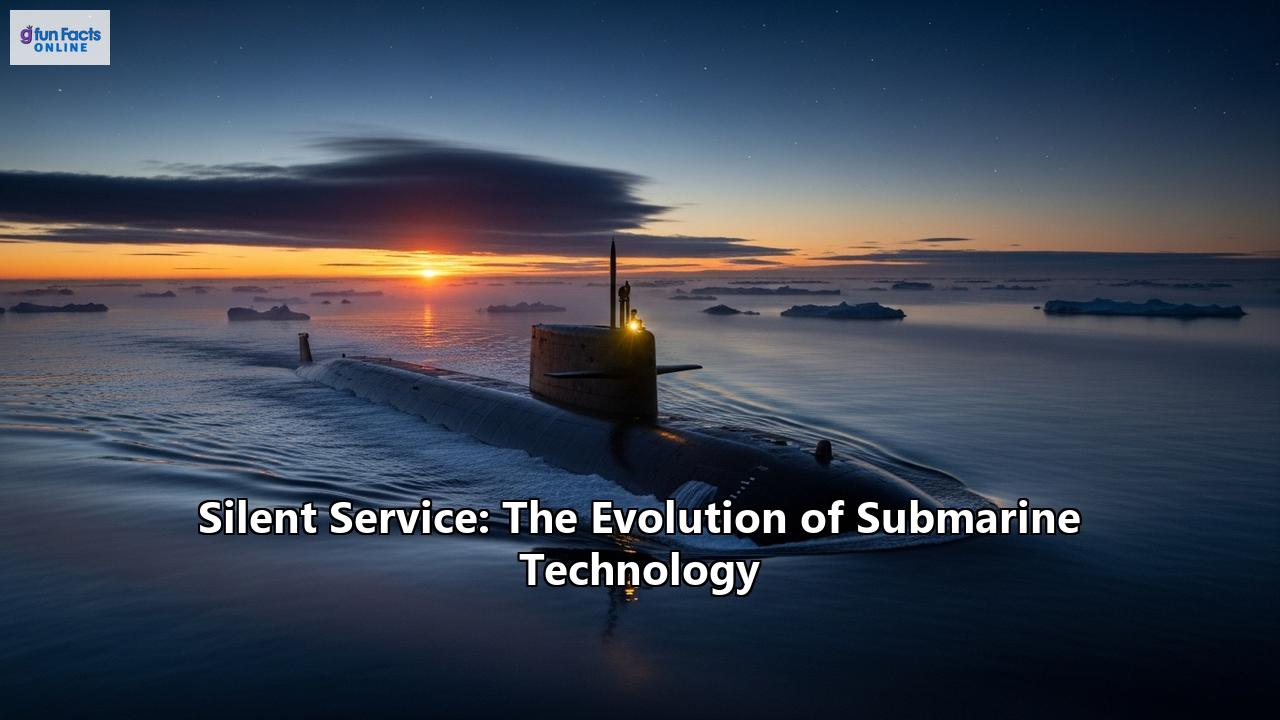
Silent Service: The Evolution of Submarine Technology
The deep, dark expanse of the world's oceans has long been a source of fascination and fear, a realm of immense power and mystery. For centuries, humanity gazed upon its surface, content with traversing its top layer. But the ambition to move beneath the waves, to operate in secret and command the undersea domain, has driven a remarkable and relentless technological journey. This is the story of the submarine, a vessel that evolved from a fantastical concept into one of the most complex and formidable machines ever created. It's a narrative of silent service, of incremental innovation and revolutionary leaps, and of the unceasing quest to master the depths.
The Dawn of a Daring Idea: Early Concepts and Human-Powered Submersibles
The dream of underwater navigation is not a modern one. Whispers of such concepts can be traced back to antiquity, with tales of Alexander the Great descending into the sea in a glass barrel to observe marine life. While perhaps more legend than fact, these stories underscore a long-held human desire to explore the unseen world beneath the waves.
The first tangible design for a submersible craft emerged from the mind of the brilliant Renaissance polymath Leonardo da Vinci around 1515. However, it was an English mathematician and former Royal Navy gunner, William Bourne, who in 1578 first published a design for a submarine. His work, "Inventions or Devises," outlined the fundamental principle of submergence that remains central to submarine operation today: changing the vessel's volume to alter its buoyancy. Bourne envisioned a wooden-framed vessel covered in waterproof leather. To submerge, the sides of the craft would be contracted using hand vises, decreasing its volume and causing it to sink. To surface, the process would be reversed.
It wasn't until the early 17th century that a functional submarine was constructed. Cornelius Drebbel, a Dutch inventor in the service of King James I of England, built what is widely considered the first practical submarine in 1620. Drebbel's creation was essentially a modified rowboat, covered in greased leather to be watertight. Propulsion was provided by oarsmen, with the oars protruding through waterproofed leather seals. Drebbel is said to have made several successful submerged journeys in the River Thames, at depths of 12 to 15 feet, even demonstrating his invention to King James I. One of the most intriguing aspects of Drebbel's submarine was his claimed method for replenishing the air supply. While the specifics are lost to history, it's believed he may have had a chemical means of generating oxygen, possibly by heating saltpetre (potassium nitrate).
The 18th century saw continued, albeit sporadic, interest in submarine design. By 1727, at least 14 patents for submersible boats had been granted in England. A significant conceptual leap came in 1747 when an inventor named Nathaniel Symons patented a design that used ballast tanks for submergence, a revolutionary idea. His craft featured leather bags that could be filled with water to submerge and then squeezed empty to resurface, a direct forerunner of the sophisticated ballast systems of modern submarines.
The first documented use of a submarine in combat occurred during the American Revolutionary War. In 1776, an American inventor and Yale graduate named David Bushnell designed and built the Turtle, a one-man, hand-powered submersible. This acorn-shaped vessel, constructed of oak and waterproofed with tar, was a marvel of 18th-century engineering. The operator would crank propellers by hand to move through the water and would submerge by allowing water into a ballast tank, which was then emptied with a hand pump to surface. The Turtle's mission was to covertly attach a time-delayed explosive charge to the hull of a British warship. On the night of September 6, 1776, Sergeant Ezra Lee of the Continental Army piloted the Turtle in an attempt to sink the HMS Eagle in New York Harbor. The mission, however, was unsuccessful as Lee was unable to attach the explosive to the warship's hull. Despite its failure, the Turtle marked a pivotal moment, demonstrating the potential of submarines as offensive weapons.
At the turn of the 19th century, another American inventor, Robert Fulton, who was then in France, designed the Nautilus. This submarine, built in 1800, featured a copper-sheeted hull over iron ribs and is often considered the first practical, modern submarine. The Nautilus incorporated several innovations, including a hand-cranked propeller for underwater movement and a sail for surface travel, the first known use of dual propulsion. It also featured diving planes for better control during descent and a rudimentary conning tower for observation. Fulton's submarine successfully demonstrated its ability to sink ships with its "carcass"—a towed explosive charge—but failed to gain the sustained support of either the French or the British navies.
The Industrial Revolution and the Dawn of Mechanical Propulsion
For all their ingenuity, these early submersibles were severely limited by their reliance on human power. The Industrial Revolution, with its explosion of new technologies and materials, would provide the key to unlocking the submarine's true potential. The development of the steam engine, in particular, offered the promise of sustained mechanical propulsion, a crucial step in transforming the submarine from a curiosity into a viable naval vessel.
The mid-19th century saw the first tentative steps towards mechanically powered submarines. In 1863, the French Navy launched the Plongeur, the first submarine not to be powered by its crew. This 140-foot vessel used a compressed air engine, with the air stored in large tanks. While a significant advancement, the Plongeur was plagued by instability and a limited air supply, and was eventually withdrawn from service.
A more sophisticated approach was taken by the Spanish inventor Narcís Monturiol with his Ictineo II. Launched in 1864, it was initially human-powered but was later converted to run on a revolutionary air-independent propulsion (AIP) system. Monturiol developed a chemical process that generated both heat for a steam engine and oxygen, allowing the submarine to operate its engine while submerged. This was a groundbreaking achievement, prefiguring the AIP systems that would become crucial for non-nuclear submarines in the late 20th century.
Steam power also saw experimentation. In the 1880s, the English clergyman George W. Garrett and the Swedish industrialist Thorsten Nordenfelt collaborated on steam-powered submarines. Their designs used a coal-fired boiler on the surface, with enough residual steam to power the vessel for a short distance underwater. However, the heat and the need to extinguish the boiler before diving made these submarines impractical and dangerous.
The true breakthrough in submarine propulsion came with the advent of electricity. The development of viable electric motors and storage batteries in the 1880s finally provided a reliable and safe means of underwater propulsion. This led to a flurry of innovation, with inventors like Stefan Drzewiecki in Russia, and Gustave Zédé in France, building some of the first electrically powered submarines.
It was the Irish-American inventor John Philip Holland who would synthesize these emerging technologies into the blueprint for the modern submarine. After several earlier prototypes, his Holland VI, launched in 1897, featured a dual propulsion system that would become the standard for decades: a gasoline engine for surface travel and for charging batteries, and an electric motor for submerged operations. The U.S. Navy, after initial skepticism, purchased the Holland VI in 1900, commissioning it as the USS Holland (SS-1), its first submarine. Holland's design, which combined a teardrop-like hull shape for efficient underwater movement with a reliable dual-propulsion system, was so successful that it became the model for the world's navies leading up to World War I.
A key rival to Holland was another American inventor, Simon Lake. While Holland focused on military applications, Lake was initially more interested in submarines for commercial purposes, such as salvage and underwater exploration. His submarines, like the Argonaut launched in 1897, featured wheels for traveling along the seabed and a diver's compartment for exiting the vessel underwater. Lake is also credited with numerous patents for crucial submarine technologies, including the development of even-keel hydroplanes for better depth control and the first practical periscope.
The periscope itself was a critical innovation. Early submarines were effectively blind when submerged, but the development of this optical instrument allowed a submerged submarine to see above the surface. Early versions used mirrors, but the substitution of prisms in the 1870s improved image quality. Sir Howard Grubb, an Irish optical scientist, is credited with perfecting the modern periscope, which was quickly adopted by the world's navies.
Another essential component of the modern submarine was its primary weapon: the self-propelled torpedo. The invention of the Whitehead torpedo in 1866 by British engineer Robert Whitehead provided submarines with a means to attack enemy ships from a safe distance. Driven by a compressed-air engine, the Whitehead torpedo was a vast improvement over the spar torpedoes of the past and became the standard armament for early submarines.
By the early 1900s, the key elements of the modern submarine were in place: a diesel-electric propulsion system, the periscope, and the self-propelled torpedo. France, Britain, Germany, and the United States all began to build submarine fleets, setting the stage for a naval arms race that would culminate in the First World War. The submarine, once a fanciful dream, was now a deadly reality, poised to change the face of naval warfare forever.
The Great War: Submarines Emerge as a Decisive Weapon
When the First World War erupted in 1914, the submarine was still a relatively new and unproven weapon. Many in the naval establishment viewed it with skepticism, considering it an "unethical" tool of war that didn't fit within the conventional rules of engagement. However, the German Imperial Navy, with its fleet of advanced Unterseeboote, or U-boats, would soon demonstrate the submarine's devastating potential.
At the outset of the war, Germany possessed around 20 combat-ready U-boats. These early diesel-electric submarines were more submersibles than true submarines, spending most of their time on the surface and only diving to attack or evade detection. They were armed with torpedoes and deck guns, and initially, U-boat commanders often adhered to "prize rules," surfacing to warn merchant ships and allowing their crews to evacuate before sinking them.
This changed as the war progressed. Faced with a powerful British naval blockade that was strangling its economy, Germany turned to its U-boats to strike back at Allied shipping. In February 1915, Germany declared the waters around the British Isles a war zone and began a campaign of unrestricted submarine warfare, attacking merchant ships without warning. This strategy culminated in the sinking of the British passenger liner RMS Lusitania on May 7, 1915, by the German U-boat U-20, an act that claimed nearly 1,200 lives, including 128 Americans, and helped to turn public opinion in the United States against Germany.
The U-boats of World War I were technological marvels of their time. The German Type U 19, for example, could travel over 7,600 miles on the surface and was armed with torpedoes and deck guns. Germany continued to improve its U-boat designs throughout the war, producing larger and more capable submarines that could lay mines and operate far out into the Atlantic. By 1917, Germany had 140 U-boats in service and they had destroyed about 30 percent of the world's merchant ships.
The Allies scrambled to counter the U-boat threat. This led to a technological cat-and-mouse game of anti-submarine warfare (ASW). Early ASW measures were often rudimentary, consisting of ramming surfaced U-boats or trying to snag them with nets. However, new technologies soon emerged. The development of the depth charge in 1916 provided a means of attacking submerged submarines. This was essentially a 300-pound bomb fitted with a hydrostatic fuse that would detonate at a pre-set depth.
Another crucial development was the hydrophone, an underwater listening device that could detect the noise of a submarine's motors. This allowed surface ships to hunt for submerged U-boats. The British also developed "Q-ships," which were warships disguised as harmless merchant vessels, designed to lure U-boats into a surface attack where they could be destroyed by hidden guns. Ultimately, the most effective countermeasure proved to be the convoy system, where merchant ships traveled in large, escorted groups, making it more difficult for U-boats to pick off individual targets.
By the end of the war, German U-boats had sunk nearly 5,000 merchant ships and killed approximately 15,000 Allied sailors. The submarine had proven itself to be a powerful and terrifying weapon, one that had a profound impact on the course of the war and would forever change the nature of naval warfare. The lessons learned in the cold, dark waters of the Atlantic would shape the next generation of submarines, setting the stage for an even deadlier undersea conflict two decades later.
The Second World War: A Global Undersea Battlefield
The interwar years saw continued, if uneven, development in submarine technology. The major naval powers, having witnessed the submarine's effectiveness in World War I, all invested in improving their undersea fleets. In the United States, the Navy, initially focused on coastal defense, began to develop long-range "fleet" submarines capable of accompanying surface warships across the vast expanses of the Pacific. These efforts led to the highly successful Gato and Balao classes of submarines that would play a pivotal role in World War II.
When war broke out again in 1939, the submarine once more took center stage, particularly in the Atlantic. The Battle of the Atlantic, the longest continuous military campaign of the war, pitted German U-boats against Allied convoys in a struggle for control of the vital shipping lanes between North America and Great Britain. At the beginning of the war, Germany's U-boat fleet was relatively small, but under the command of Admiral Karl Dönitz, it employed devastating "wolfpack" tactics, where groups of U-boats would converge on a convoy to overwhelm its escorts.
German U-boat technology had also advanced significantly. The Type VII and Type IX U-boats were the workhorses of the German fleet, capable of long-range patrols and armed with powerful torpedoes. However, it was the late-war Type XXI "Elektroboot" that represented a true leap forward. With a streamlined hull designed for high underwater speed and a massive battery capacity, the Type XXI was the first submarine designed to operate primarily submerged rather than on the surface. It was a true forerunner of the modern attack submarine.
Another key German innovation was the snorkel, a device that allowed a submarine to run its diesel engines while remaining submerged at periscope depth. This seemingly simple tube, which drew in air and expelled exhaust, was a game-changer, allowing U-boats to recharge their batteries without having to surface, where they were most vulnerable to attack.
The Allies, in turn, developed increasingly sophisticated ASW techniques. Airborne radar allowed aircraft to detect surfaced U-boats from great distances, even at night or in bad weather. Sonar (an acronym for Sound Navigation and Ranging), an evolution of the hydrophone, allowed surface ships to actively "ping" for submerged submarines. The breaking of the German Enigma codes by Allied intelligence provided crucial information on U-boat movements, allowing convoys to be routed away from danger. And new weapons, such as the forward-throwing "Hedgehog" mortar and air-dropped homing torpedoes, made attacks on U-boats more effective.
In the Pacific, the United States waged its own highly successful submarine campaign against Japan. American submarines, particularly the Gato and Balao classes, systematically destroyed Japan's merchant marine, crippling its war economy and starving its armies of supplies. These submarines were large, long-range vessels, designed to operate for extended periods far from their bases. The later Tench class submarines were an improvement on the Balao class, with a stronger hull and improved internal layout.
Japan, too, produced some remarkable submarine designs. The most notable of these was the I-400 class, the largest submarines built during the war. These massive vessels were designed as underwater aircraft carriers, each capable of carrying three Aichi M6A Seiran floatplane bombers. The plan was to use these submarines to launch surprise air attacks against the Panama Canal and even cities on the U.S. mainland. While a technological marvel, the I-400 class submarines were produced too late in the war to have any significant impact.
By the end of World War II, the submarine had evolved from a coastal defense weapon into a strategic instrument of war, capable of operating across the globe and projecting power in unprecedented ways. The lessons of the war—the importance of underwater speed, stealth, and endurance—would drive the next great revolution in submarine technology: the advent of nuclear power.
The Nuclear Age and the Cold War: The Rise of the True Submarine
The end of World War II ushered in a new era of global tension: the Cold War. This ideological struggle between the United States and the Soviet Union would fuel a technological arms race of unprecedented scale, and nowhere was this competition more intense than in the undersea realm. The development of nuclear power would fundamentally transform the submarine, finally unshackling it from the surface and creating the first true submersibles.
The driving force behind the development of the nuclear-powered submarine in the United States was Admiral Hyman G. Rickover, a brilliant and tenacious engineer who is widely regarded as the "Father of the Nuclear Navy." Rickover recognized that nuclear power, which required no air for combustion, was the ideal propulsion system for a submarine, offering the potential for virtually unlimited underwater endurance. Despite considerable skepticism within the naval establishment, Rickover's relentless efforts led to the creation of the world's first nuclear-powered submarine, the USS Nautilus (SSN-571), which was commissioned in 1954.
The Nautilus was a revolutionary vessel. On its maiden voyage in 1955, it traveled over 1,300 miles completely submerged, shattering all previous records for underwater speed and endurance. In 1958, it achieved the seemingly impossible, completing a submerged transit of the North Pole. The Nautilus demonstrated that nuclear-powered submarines could operate for months on end without needing to refuel or surface, making them far more capable and harder to detect than their diesel-electric predecessors.
The advent of nuclear power was coupled with another key innovation: the teardrop hull. The USS Albacore (AGSS-569), an experimental diesel-electric submarine launched in 1953, was the first to feature this revolutionary hull shape, which was designed for optimal underwater performance. The teardrop hull, combined with nuclear propulsion in the Skipjack-class submarines, resulted in vessels that were significantly faster and more maneuverable underwater than any that had come before.
The Cold War also saw the submarine evolve into a key component of nuclear deterrence. The development of the submarine-launched ballistic missile (SLBM) transformed the submarine from a tactical weapon into a strategic one. The United States deployed its first SLBM, the Polaris missile, on the USS George Washington (SSBN-598) in 1960. This created the first ballistic missile submarine, or SSBN, a vessel capable of launching nuclear-armed missiles from the concealment of the deep ocean, providing a survivable second-strike capability that became a cornerstone of Cold War deterrence.
The Soviet Union, not to be outdone, embarked on its own massive submarine-building program. While their early nuclear submarines were often noisier and less technologically advanced than their American counterparts, they were produced in vast numbers and featured innovative designs, including titanium hulls and liquid-metal-cooled reactors on some classes, such as the high-speed Alfa-class. The Soviets also developed their own fleet of SSBNs, including the massive Typhoon-class, the largest submarines ever built, which carried 20 long-range ballistic missiles.
The Cold War became a silent, high-stakes game of cat and mouse beneath the waves. The United States invested heavily in anti-submarine warfare (ASW), deploying a global network of underwater hydrophones called the Sound Surveillance System (SOSUS) to track Soviet submarines. This, in turn, drove a relentless quest for acoustic stealth. Both sides poured enormous resources into making their submarines quieter, developing new propulsion systems, sound-dampening materials, and advanced propeller designs to reduce their acoustic signatures. This underwater arms race, a testament to the strategic importance of the submarine, continued until the very end of the Cold War.
The Modern Era and the Future of the Silent Service
The end of the Cold War brought a shift in the role of the submarine. With the decline of the threat of a global thermonuclear war, the focus of submarine operations began to change. While the strategic deterrence mission remains crucial for the world's nuclear powers, modern submarines are increasingly multi-mission platforms, tasked with a wide range of duties, from intelligence gathering and special operations support to land-attack and anti-surface warfare.
A key development in the post-Cold War era has been the proliferation of Air-Independent Propulsion (AIP) systems for non-nuclear submarines. These technologies, which include Stirling engines, fuel cells, and closed-cycle steam turbines, allow conventional submarines to remain submerged for weeks at a time, significantly enhancing their stealth and endurance and closing the gap with their nuclear-powered counterparts.
Modern submarines, such as the U.S. Navy's Virginia-class attack submarines, the Royal Navy's Astute-class, and Russia's Yasen-class, are among the most technologically advanced machines on Earth. They are packed with sophisticated sensors, including advanced sonar arrays and photonics masts that have replaced traditional periscopes. Their combat systems are highly automated, integrating data from multiple sources to provide unparalleled situational awareness. And they are armed with a fearsome array of weapons, including advanced torpedoes, anti-ship missiles, and land-attack cruise missiles.
The future of submarine technology promises even more remarkable advancements. The development of unmanned underwater vehicles (UUVs), which can be launched and recovered by submarines, will extend the reach and capabilities of these undersea platforms, allowing them to conduct missions in high-risk environments without endangering the host submarine. Research is also underway on new materials, such as advanced composites, that could lead to stronger, lighter, and stealthier hulls. And the integration of artificial intelligence and machine learning into submarine combat systems will further enhance their autonomy and decision-making capabilities.
From the leather-clad rowboat of Cornelius Drebbel to the nuclear-powered giants of the modern era, the evolution of the submarine has been a testament to human ingenuity and our unceasing desire to push the boundaries of technology. For over four centuries, the silent service has operated in the shadows, a hidden but powerful force shaping the course of history. As technology continues to advance, the submarine will undoubtedly evolve in ways we can only begin to imagine, remaining a critical, and often unseen, component of naval power for the foreseeable future. The silent service, it seems, is destined to remain at the forefront of technological innovation, a silent sentinel in the deep.
Reference:
- https://en.wikipedia.org/wiki/Nuclear_submarine
- https://en.wikipedia.org/wiki/Submarine-launched_ballistic_missile
- https://library.fiveable.me/key-terms/united-states-history-since-1945/submarine-launched-ballistic-missiles-slbms
- https://irp.fas.org/program/collect/sosus.htm
- https://www.marinersmuseum.org/2022/09/harnessing-the-atom-hyman-g-rickover-and-the-birth-of-the-nuclear-navy/
- http://large.stanford.edu/courses/2014/ph241/reid1/
- https://manoa.hawaii.edu/indopacificaffairs/article/maritime-security-and-underwater-surveillance-technology-lessons-from-the-cold-war/
- https://www.google.com/search?q=time+in+Southeastern+Connecticut+Planning+Region,+US
- https://liboatingworld.com/pioneer-of-the-modern-submarine-teardrop-hull-uss-albacore-ssn-569/
- https://man.fas.org/dod-101/sys/ship/docs/cold-war-asw.htm
- https://charlesyang.substack.com/p/how-hyman-rickover-built-the-nuclear
- https://www.ebsco.com/research-starters/history/hyman-g-rickover
- https://archive.navalsubleague.org/2007/remembering-the-sound-surveillance-system-sos-us-part-i-of-ii-parts
- https://ussnautilus.org/uss-albacore-agss-569-the-submarine-in-a-ditch/
- https://www.britannica.com/technology/nuclear-submarine
- https://en.wikipedia.org/wiki/Ballistic_missile_submarine
- https://www.usni.org/magazines/proceedings/2019/october/sub-vs-sub-asw-lessons-cold-war
- https://en.wikipedia.org/wiki/Hyman_G._Rickover
- https://ahf.nuclearmuseum.org/ahf/profile/hyman-g-rickover/
- https://www.defensemedianetwork.com/stories/the-shape-of-things-to-come-uss-albacore-was-forerunner-to-the-future/
- https://americanhistory.si.edu/subs/const/anatomy/sovietsubs/
- https://www.aps.org/apsnews/2024/08/worlds-first-nuclear-powered-submarine
- https://www.warhistoryonline.com/guest-bloggers/the-invention-of-the-first-nuclear-powered-submarine-uss-nautilus-was-so-important-that-it-could-be-compared-with-the-first-human-flight-to-the-moon.html
- https://www.britannica.com/technology/submarine-launched-ballistic-missile
- https://www.usni.org/magazines/naval-history-magazine/2020/october/diesel-nuclear-submarine-revolution-revisited
- https://www.asme.org/about-asme/engineering-history/landmarks/209-uss-albacore
- https://nuclearcompanion.com/data/united-states-submarine-launched-ballistic-missiles-slbm/
- https://www.reddit.com/r/AskHistorians/comments/dcspca/during_the_cold_war_did_the_ussr_make_any/
- https://dosits.org/people-and-sound/history-of-underwater-acoustics/the-cold-war-history-of-the-sound-surveillance-system-sosus/
- https://www.reddit.com/r/AskHistorians/comments/3bzekv/what_were_the_primary_differences_between_soviet/
- https://www.reddit.com/r/AskHistorians/comments/6ovmm1/fluid_mechanics_was_an_established_field_of/
- https://en.wikipedia.org/wiki/USS_Nautilus_(SSN-571))
- https://ussnautilus.org/history-of-uss-nautilus/
- https://archive.navalsubleague.org/2011/the-rise-of-the-submarine-based-ballistic-missile-a-brief-history
- https://www.navygeneralboard.com/russias-massive-typhoon/
- https://www.reddit.com/r/WarCollege/comments/12ey5k2/how_were_us_subs_so_much_quieter_than_ussr_subs/
- https://spp.fas.org/eprint/snf03221.htm