
Introduction: The Invisible Crisis of Cooling
We are living in a paradox of thermodynamics. As the planet warms, our demand for cooling accelerates. By 2050, the global demand for air conditioning is expected to triple. Yet, the very technology we use to cool ourselves—vapor-compression refrigeration—is contributing to the heat. It is a century-old cycle trapped in a feedback loop: we burn fossil fuels to power compressors that pump refrigerant gases, which, if leaked, possess a Global Warming Potential (GWP) thousands of times higher than carbon dioxide.
For decades, material scientists have hunted for a "solid-state" alternative—a way to pump heat without fluids, compressors, or volatile gases. They looked at magnets (magnetocalorics) and electric fields (electrocalorics). But the solution may lie in something far more visceral: mechanical force.
Enter Elastocaloric Cooling. It is a technology that mimics the mechanics of a muscle and the physics of a steam engine, all trapped inside a lattice of super-elastic metal. By simply stretching or squashing a piece of metal, we can generate intense cold. It promises a future where our air conditioners are made not of pipes and pumps, but of shape-shifting alloys that breathe heat in and out, offering efficiencies that could finally break the vapor-compression stranglehold.
This is the comprehensive story of how "metal muscles" are poised to replace Freon, the physics that makes it possible, and the engineering race to build the first solid-state fridge.
Part 1: The Physics of the "Metal Muscle"
To understand how a solid metal can cool a room, we must abandon our intuitive understanding of metals as rigid, static objects. In the world of Shape Memory Alloys (SMAs), metal is a dynamic, living crystal.
1.1 The Elastocaloric Effect (eCE)
The elastocaloric effect is a thermodynamic phenomenon where a material shows a significant change in temperature under the application or removal of mechanical stress. Unlike the gas in your current AC, which cools when it expands, these metals cool when they are allowed to relax.
The process is cyclic:
- Loading (Stress Application): You take a piece of elastocaloric metal (like a wire or cylinder) and stretch or compress it. This mechanical work forces the crystal lattice to reorganize. This reorganization releases energy in the form of heat. The metal instantly becomes hot.
- Heat Rejection: You let that heat dissipate into the environment (or a heat sink), while keeping the metal under stress. The metal returns to room temperature, but it is still "loaded."
- Unloading (Relaxation): You release the stress. The crystal lattice snaps back to its original, chaotic state. To do this, the lattice must absorb energy (entropy) from its own atomic vibrations. The result? The metal’s temperature plummets instantly.
- Cooling Delivery: This cold metal is now exposed to the air or fluid you want to cool, absorbing heat and completing the cycle.
1.2 The Austenite-Martensite Transformation
The magic happens at the atomic level, in a reversible phase transformation between two crystal structures: Austenite and Martensite.
- Austenite (The High-Temperature Phase): Think of this as the "relaxed" state. The atomic structure is highly symmetric (usually cubic) and stable. In this state, the atoms have more freedom to vibrate; the material has high entropy (disorder).
- Martensite (The Low-Temperature/Stressed Phase): When you stress the metal, you force the atoms to shear and align into a less symmetric, more ordered structure. This is the Martensite phase. Because this state is more "ordered" (lower entropy), the excess energy must go somewhere. It is ejected as latent heat.
When you release the stress, the material "wants" to return to the high-entropy Austenite phase. It sucks thermal energy from its surroundings to fuel this atomic reshuffling, creating a cooling effect. This is the latent heat of transformation, the solid-state equivalent of boiling and condensing a liquid refrigerant.
Part 2: The Material Contenders
Not all metals can do this. If you stretch a steel bar, it heats up slightly due to thermoelasticity, but the effect is negligible. Elastocaloric cooling requires superelasticity—the ability to undergo massive reversible strain (up to 10%) without permanent deformation.
2.1 Nitinol (NiTi): The Titan of Transformation
The gold standard for elastocalorics is Nickel-Titanium (NiTi), also known as Nitinol.
- Performance: NiTi alloys can achieve an adiabatic temperature change (how much the temperature spikes/drops) of up to 25°C to 30°C in a single cycle. This is massive. It creates a temperature lift sufficient for refrigeration and air conditioning.
- History: Originally discovered by the Naval Ordnance Laboratory (hence Ni-Ti-NOL), it was famous for being "indestructible" spectacle frames. Now, it is the heart of the cooling revolution.
- The Downside: Titanium is difficult to process, and Nickel is expensive. Furthermore, standard Nitinol has a functional fatigue limit—eventually, the crystal structure "forgets" its shape if not engineered perfectly.
2.2 Copper-Based Alloys (Cu-Zn-Al, Cu-Al-Mn)
For mass adoption, we need cheaper materials. Copper-based shape memory alloys are the budget-friendly contenders.
- Pros: Much cheaper raw materials and easier to machine than NiTi. Some single-crystal copper alloys demonstrate huge latent heat capacities.
- Cons: They are generally more brittle. While NiTi can withstand millions of cycles of squashing, copper alloys tend to crack (intergranular fracture) sooner. However, recent advances in adding elements like Manganese (Mn) and using single-crystal growth techniques have improved their durability significantly.
2.3 The New Frontier: 3D Printed Lattice Structures
The most exciting development in 2024-2025 is the marriage of Additive Manufacturing (3D Printing) and elastocalorics.
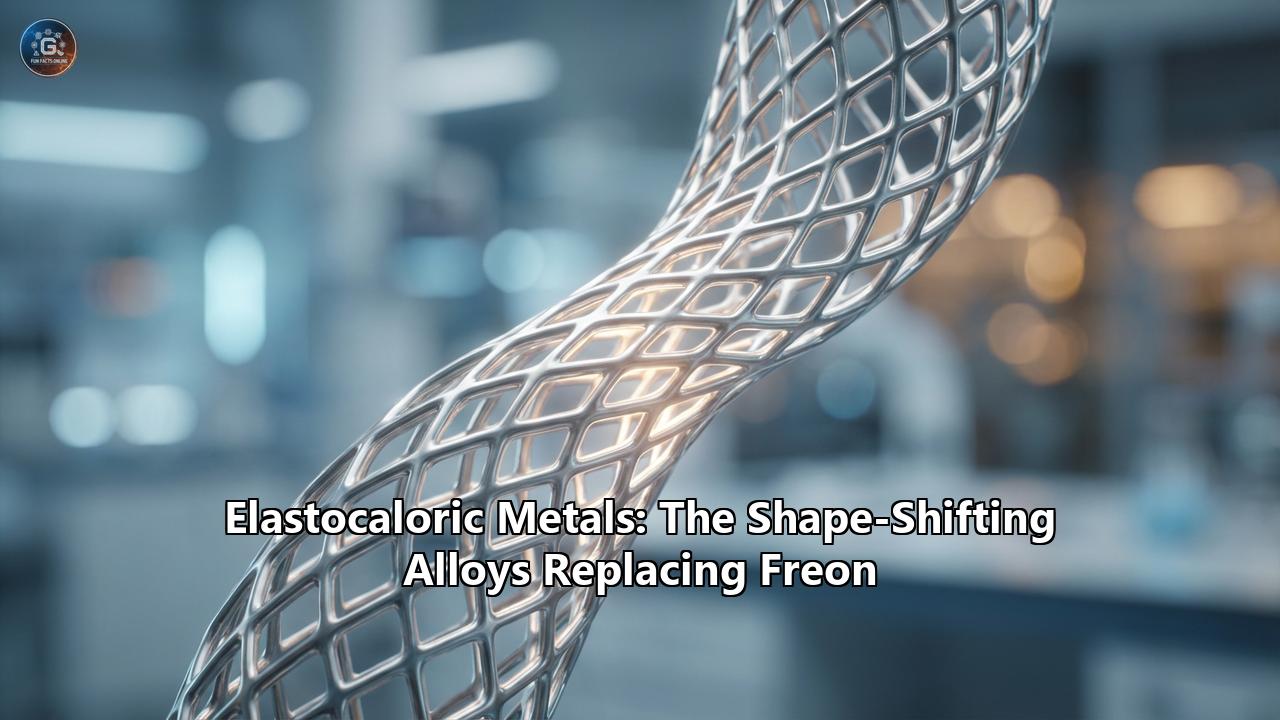
In the past, we were limited to wires and tubes. Now, researchers (including teams at the University of Maryland and Fraunhofer Institute) are printing intricate honeycomb and lattice structures out of NiTi powder.
- Why Lattices? They maximize the surface-area-to-volume ratio. A solid block of Nitinol would take too long to transfer its heat to the air. A micro-lattice allows air or water to flow through the metal "sponge," exchanging heat instantly. This solves the "heat transfer bottleneck" that plagued early prototypes.
Part 3: Engineering the "Solid Fridge"
Knowing the physics is one thing; building a machine is another. How do you design a fridge that needs to stretch metal thousands of times a day?
3.1 The Architecture of Actuation
A vapor compression fridge uses a compressor to move gas. An elastocaloric fridge needs a driver to move metal. This is the primary engineering challenge: designing an efficient mechanical actuator.
- Compression vs. Tension: Early designs stretched wires (tension). However, wires can snap, and fatigue cracks grow quickly under tension. The industry has shifted toward compression. Squashing a NiTi tube or cylinder is much safer; if a crack forms, the compressive force keeps it closed rather than tearing it open.
- The Actuator: Designers use cam-drives, hydraulic pistons, or piezoelectric motors to apply the force. To maintain high efficiency (COP), the system must employ work recovery. When one piece of metal expands (unloads), it releases mechanical energy. A smart system uses that release to help compress the next piece of metal, recycling the mechanical work just as a hybrid car regenerates braking energy.
3.2 Active Magnetic vs. Active Elastocaloric Regeneration (AER)
To get a temperature drop of 20°C, you can use a single cycle. But to freeze food at -20°C in a 30°C room (a 50°C span), you need Active Regeneration.
- The Concept: Imagine a fluid (usually water or a glycol mix) pumping back and forth through the elastocaloric metal structure.
- The Cycle:
1. Fluid flows right as the metal heats up (rejecting heat).
2. Fluid flows left as the metal cools down (absorbing heat).
3. This establishes a temperature gradient along the length of the metal. The left side gets colder and colder, while the right side stays hot.
This "thermal ladder" allows elastocaloric systems to achieve temperature spans far greater than the capability of a single piece of wire. Recent prototypes have shattered records, achieving lifts of over 75 Kelvin using multi-stage cascade architectures.
Part 4: The Environmental & Efficiency Case
Why go through the trouble of reinventing the fridge? The answer lies in two metrics: COP (Coefficient of Performance) and GWP (Global Warming Potential).
4.1 Efficiency: Beating the Carnot Limit
Vapor compression is mature; it has been optimized for 100 years. Yet, it is hitting a theoretical wall.
- Elastocalorics: Theoretical studies suggest elastocaloric materials can achieve 60% to 80% of the Carnot limit (the maximum theoretical efficiency allowed by physics). Traditional AC units typically operate at 40-50% of this limit.
- The Reason: The phase transition in solids involves very little entropy loss compared to gas compression. It is a more "ordered" way to move heat.
4.2 Zero GWP: The End of "Super-Pollutants"
The most compelling argument is environmental.
- Current Refrigerants: R-410A and R-32 are better than the old Freon (R-12), but they are still potent greenhouse gases. A typical AC leak contributes as much to global warming as driving a car for months.
- Elastocaloric Refrigerant: It is a piece of metal. It has a GWP of zero. It cannot leak. It is fully recyclable. If a Nitinol core breaks, you melt it down and recast it.
Part 5: The "Achilles Heel" – Fatigue and Durability
For years, the skepticism surrounding elastocalorics could be summed up in one question: "Won't the metal break if you bend it millions of times?"
5.1 The Fatigue Life Breakthrough
In standard metallurgy, metal fatigue is the enemy. However, Nitinol is unique. It is designed to phase-transform.
- The 70-Million Cycle Milestone: In a landmark study (circa 2023-2024), researchers demonstrated ultra-high fatigue life in NiTi cylinders. By operating under partial transformation modes and optimizing the microstructure (grain size), they achieved over 70 million cycles with negligible degradation.
- Context: A domestic fridge cycles roughly 20,000 to 30,000 times a year. 70 million cycles represents centuries of operation. The "fatigue problem" is rapidly moving from a showstopper to a solved engineering constraint.
5.2 Hysteresis Losses
Hysteresis is the "thermal friction" of the phase change. When you load and unload the material, the stress-strain curve doesn't perfectly overlap; it forms a loop. The area inside that loop represents lost energy (heat generated that doesn't contribute to cooling).
- Solution: Developing narrow-hysteresis alloys. By doping NiTi with Copper, Cobalt, or Iron, material scientists have created "slim loop" alloys that require less force to activate and waste less energy, drastically boosting the COP.
Part 6: Recent Breakthroughs (2024-2025 Landscape)
The field is moving fast. Here are the key developments defining the current state of the art:
6.1 The HKUST Cascade System
Researchers at the Hong Kong University of Science and Technology (HKUST) recently unveiled a multi-material cascade elastocaloric cooling device. By using different alloys optimized for different temperature ranges (e.g., one alloy works best at 30°C, another at 10°C, another at -10°C) and stacking them, they achieved a record-breaking temperature lift of 75 K. This proved that solid-state cooling isn't just for mild air conditioning; it can handle deep freezing.
6.2 The University of Maryland (UMD) High-Power Prototype
UMD has long been a leader in this field. Their recent prototypes have moved beyond "lab bench curiosities" to functional systems. They demonstrated a system delivering 260 Watts of cooling power—comparable to a small compact refrigerator—using compact bundles of NiTi tubes. This was a critical proof-of-concept that elastocalorics can scale up to useful power levels.
6.3 WEF Top 10 Technology
In 2024, the World Economic Forum named Elastocalorics one of the "Top 10 Emerging Technologies." This recognition signals a shift in funding and commercial interest. We are seeing the transition from pure academic research to startup incubation and venture capital interest.
Part 7: The Path to Commercialization
When will you buy an elastocaloric AC?
7.1 The Early Adopters: Niche Markets
Don't expect a whole-house AC unit immediately. The technology will likely appear first in applications where efficiency and compactness outweigh cost:
- Electric Vehicles (EVs): Range anxiety is real. Current EV heating/cooling systems drain the battery significantly (especially in winter). Elastocaloric heat pumps are more efficient and compact, potentially extending EV range by 5-10%.
- Space & Defense: NASA and aerospace companies are interested because these systems work in zero-gravity (no fluids to settle) and are rugged.
- Micro-Cooling: Cooling high-performance chips or batteries in electronics where liquid cooling is risky.
7.2 Retrofitting the Industry
The HVAC industry is conservative. However, regulatory pressure (like the EU's F-Gas regulation and the Kigali Amendment) is forcing a move away from HFCs. Elastocalorics offers a "leapfrog" technology.
Major manufacturers (like Haier, Gree, Daikin) are monitoring this closely. We are currently in the "Valley of Death"—the gap between a working university prototype and a mass-manufactured product. Bridging this requires developing the supply chain for high-quality, low-cost elastocaloric alloys.
Conclusion: The Shape of Cool
We are standing on the brink of a thermal revolution. For a century, we have relied on the compression of gases—a brute-force, chemically hazardous method—to keep our civilization cool. Elastocaloric cooling represents a return to the elegance of solid mechanics.
By harnessing the atomic "memory" of metals, we can build refrigerators that are silent, refrigerant-free, and hyper-efficient. The "metal muscles" of Nitinol and its cousins are strong enough to carry the weight of our cooling demands. While engineering challenges in actuation and cost remain, the physics is sound, and the prototypes are proving the skeptics wrong. The question is no longer if solid-state cooling will happen, but how soon it will render the hiss of the Freon compressor a sound of the past.
Reference:
- https://kids.frontiersin.org/articles/10.3389/frym.2025.1575501
- https://en.wikipedia.org/wiki/Elastocaloric_materials
- https://www.youtube.com/watch?v=bBZ6WSNt0ZY
- https://iee.psu.edu/research/projects/additive-manufacturing-elastocaloric-cooling-shape-memory-alloy-materials-and
- https://impact.ornl.gov/en/publications/elastocaloric-cooling-a-pathway-towards-future-cooling-technology/
- https://www.caloricool.org/area/elastocaloric-effect
- https://www.researchgate.net/publication/366087941_Additive_manufactured_thermoplastic_elastomers_for_low-stress_driven_elastocaloric_cooling
- https://www.iieta.org/download/file/fid/3883
- https://www.econsight.com/wef-emerging-technology-2024-7-elastocalorics/
- https://www.db-thueringen.de/servlets/MCRFileNodeServlet/dbt_derivate_00039316/ilm1-2017iwk-046.pdf
- https://www.quora.com/What-is-the-phenomenon-of-elastocaloric-effect-How-does-it-work
- https://heatpumpingtechnologies.org/elastocaloric-cooling/
- https://mse.umd.edu/news/story/elastocalorics-named-1-of-10-emerging-technologies-addressing-global-challenges
- https://www.sciencedaily.com/releases/2015/03/150324120607.htm
- https://newatlas.com/shape-memory-alloy-nitinol-heating-cooling/58837/
- https://www.azom.com/news.aspx?newsID=63534