
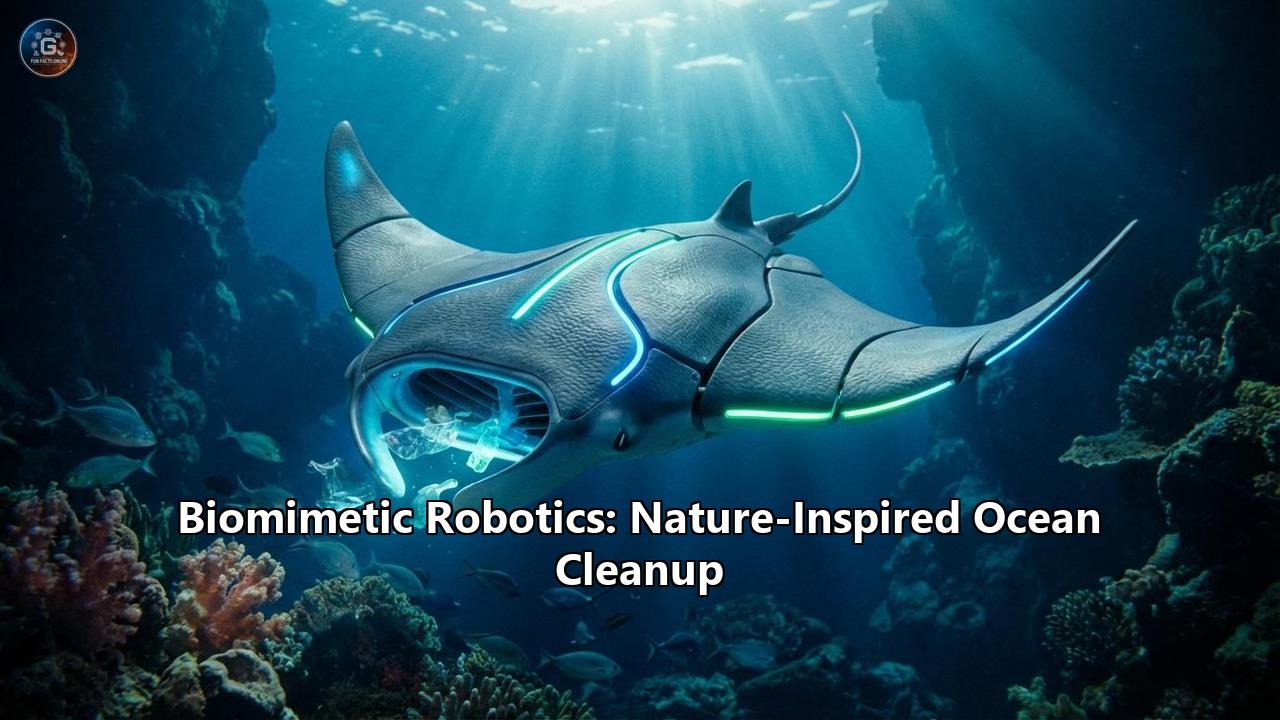
For decades, human engineering has approached the crisis of ocean pollution with brute-force mechanics. We have deployed massive trawling nets, deployed sprawling boom systems across ocean gyres, and launched diesel-guzzling skimmer ships to scoop up the estimated 11 to 14 million metric tons of plastic that hemorrhage into our marine ecosystems annually. Yet, these traditional methods are often fraught with unintended consequences. Massive nets snare unintended marine life (bycatch), heavy ships emit greenhouse gases and acoustic pollution that disorient whales and dolphins, and rigid machines clumsily destroy the very coral reefs they are meant to protect.
Furthermore, our most insidious enemy is invisible to the naked eye: microplastics. These tiny fragments—shed from car tires, synthetic clothing, and breaking down from larger debris—infiltrate the deepest oceanic trenches, the stomachs of zooplankton, and eventually, the human bloodstream. You cannot catch a microplastic particle with a standard net.
Faced with a problem of this magnitude and complexity, scientists and roboticists have realized that human ingenuity alone is not enough. Instead, they are turning to the ultimate research and development laboratory—one with a 3.8-billion-year track record of evolutionary success: Mother Nature.
Welcome to the era of biomimetic marine robotics.
Biomimicry is the practice of learning from and mimicking the strategies found in nature to solve human design challenges. In the context of ocean cleanup, it means looking at how a manta ray filters water without clogging its gills, how a jellyfish propels itself with barely a whisper of energy, or how a whale shark glides through the water to consume vast quantities of microscopic matter. By translating marine biology into engineering, researchers are developing an astonishing new generation of robots. These machines are soft, stealthy, autonomous, and designed to heal the oceans without leaving a footprint of their own.
The Microplastic Hunters: The Bionic Fish of Sichuan
To catch a microscopic pollutant, you need a microscopic predator. In 2022, a team of researchers at the Polymer Research Institute of Sichuan University unveiled a marvel of soft robotics: a bionic robotic fish specifically designed to "eat" microplastics. Measuring a mere 1.3 centimeters (about half an inch) in length, this tiny robotic swimmer looks less like a machine and more like a shimmering, translucent sliver of life.
The design of this robotic fish is a masterclass in material biomimicry. Traditional soft robots built from hydrogels or silicone are notoriously fragile in turbulent, highly saline aquatic environments. To solve this, the Chinese researchers looked to the inside of a clam shell. They mimicked the structure of nacre, or mother-of-pearl, which is built in microscopic, overlapping layers. By layering nanosheets of specific molecules—including sulfonated graphene and polyurethane latex—they created a sliding, chemical gradient structure that gives the robot incredible flexibility without sacrificing durability.
Under the surface, the robo-fish operates without heavy batteries or clunky mechanical motors. Instead, it is propelled by light. When an infrared laser is shined on its tail, the material reacts by bending and flapping, allowing the fish to swim in all directions at a speed of up to 2.67 body lengths per second—a speed comparable to the natural drift of plankton, and vastly outperforming most artificial soft robots.
But the true genius of the robot lies in its "appetite." The robot does not have a mechanical mouth; rather, its very skin is the cleanup mechanism. The materials composing the fish's body are lined with negatively charged molecules. Because many microplastics—along with the heavy metals, organic dyes, and antibiotic residues that cling to them in the wild—carry a positive charge, the robot attracts these pollutants through strong electrostatic interactions and chemical bonds. As the fish swims, microplastics naturally latch onto its body. Once fully coated, the robots can be retrieved, allowing scientists to analyze the toxicity and composition of the collected plastics before recycling the machine for another run.
Remarkably, just like a living organism, the Sichuan robo-fish possesses regenerative abilities. If the robot is cut or damaged by debris in rough waters, it can heal itself and recover up to 89% of its original swimming and absorbing capabilities. Furthermore, if a real predatory fish accidentally swallows the robot, its biocompatible materials ensure it can be safely digested without harming the animal. While currently a surface-level proof of concept, this technology hints at a future where swarms of tiny, self-healing robotic fish patrol our waterways, silently pulling toxins out of the water column.
The Filter Feeders: Stealing the Manta Ray’s Blueprint
While the robo-fish relies on chemical attraction, another line of biomimetic robotics focuses on physical filtration. One of the greatest challenges in engineering water filters is the "clogging" problem. If you pass dirty water through a fine mesh, the mesh quickly cakes with debris, requiring immense pressure and energy to push more water through, and frequent pauses for cleaning.
Enter the giant manta ray (Mobula birostris). These majestic leviathans spend their lives gliding through the ocean, funneling millions of liters of water through their gaping mouths to feed on tiny plankton. Yet, their gills never clog. How?
The secret lies in a fluid dynamics phenomenon known as cross-flow filtration. Inside the manta ray's mouth are arrays of leaf-like lobes called gill rakers. As water flows over these rakers, it creates a series of microscopic whirlpools and eddies. These swirling vortices act like physical bouncers; they bounce the solid particles (plankton, or in our case, microplastics) away from the pores and keep them suspended in the center of the flow, funneling them straight down the ray's throat, while the clean water escapes out the sides.
Engineers have successfully translated this biological mechanism into microplastic filtration technology. Researchers like Tim Robertino Baumann have developed filter systems inspired by giant manta rays that operate entirely passively. By perfectly matching the dimensions of the artificial filter channels to the size of microplastic particles, these systems achieve remarkable efficiency—removing over 80% of microplastics from the water without any mechanical wear parts and absolutely zero clogging. The faster the flow of water (or the faster a robot swims), the more efficient the filtration becomes.
This concept has captured the imagination of engineers worldwide. In the internationally acclaimed "Natural Robotics Contest," the winning design by Eleanor Mackintosh was a biomimetic robotic fish featuring a 3D-printed gill structure modeled entirely around this filter-feeding mechanism. Her open-source robot design swims through the water, passively filtering microplastics through its artificial gills, proving that adapting the manta ray's ancient evolutionary tricks could be the key to designing low-energy, zero-maintenance ocean Roombas.
The Gentle Touch: Jellyfish Bots and Soft Robotics
While the open ocean requires endurance, coastal environments—particularly coral reefs and seagrass meadows—demand a delicate touch. Coral reefs are the nurseries of the ocean, but they are also highly fragile. Sending rigid, propeller-driven robots equipped with heavy thrusters into a reef to clean up entangled plastic bags or monitor water quality can cause disastrous damage. The acoustic noise alone from propellers can disorient marine life, while the turbulent wake can rip apart delicate polyps.
To solve this, roboticists at institutions like the Max Planck Institute for Intelligent Systems have turned to one of the ocean's most ancient and alien creatures: the jellyfish.
Moon jellyfish (Aurelia aurita) are a compelling model for robotics because they possess the lowest "cost of transport" (mass-specific energy input per distance traveled) of any animal on Earth. A jellyfish swims by contracting its bell to push water out, and then relaxing its muscles to let the bell spring back into shape. During this relaxation phase, it creates "stopping vortices"—swirling rings of water that provide an extra push of forward thrust without requiring any additional metabolic energy. This is a phenomenon known as passive energy recapture.
Biomimetic jellyfish robots replicate this using flexible actuators made from electroactive polymers or shape-memory alloys. When a small electrical current is applied, artificial "muscles" contract. When the current stops, the soft silicone bell springs back, propelling the robot forward in utter silence. Max Planck's jellyfish robots consume as little as 100 milliwatts of power, allowing for long battery life. More importantly, because they lack rigid joints, propellers, or loud motors, they do not cause acoustic pollution or disruptive wakes.
These robotic jellyfish can be equipped with non-invasive tentacles that act like a gentle net. They can descend into the intricate, jagged architecture of a coral reef, delicately wrapping their soft arms around a sunken plastic bag or a ghost net, and floating it to the surface without snapping a single branch of coral. Furthermore, companies like IADYS have developed commercial "Jellyfishbots"—small, highly maneuverable remote-controlled units deployed in marinas, ports, and harbors to scoop up macro-plastics and oil spills in tight spaces where larger vessels simply cannot fit.
The Spill Skimmers: Sea Urchins and the "Electronic Dolphin"
Plastic is not the only toxin choking our waterways; oil and chemical spills pose catastrophic threats to marine biodiversity. The traditional methods for cleaning oil spills involve chemical dispersants that can be as toxic as the oil itself, or highly flammable in-situ burning techniques.
In early 2026, a groundbreaking solution emerged from the School of Engineering at RMIT University in Australia: the "Electronic Dolphin." Designed by Dr. Ataur Rahman and his team, this remote-controlled minibot, about the size of a sneaker, represents a stunning leap forward in treating oil spills through biomimicry.
The Electronic Dolphin's true innovation lies not just in its streamlined, wave-piercing shape, but in its specialized snout filter. The researchers needed a way to separate oil from water perfectly, without the use of chemicals. For inspiration, they looked to the sea urchin.
Under an electron microscope, a sea urchin's spines are covered in microscopic, jagged spikes. The engineers replicated this texture, creating a superwetting nanosheet-based interface. When arrayed at a microscopic level, these spikes trap microscopic pockets of air. The resulting material has a paradoxical "dual personality"—it is simultaneously oleophilic (highly oil-attracting) and hydrophobic (highly water-repelling).
As the robotic dolphin patrols the surface of an oil slick, an internal pump pulls the contaminated liquid through this biomimetic filter. Because of the sea-urchin spike structure, the water literally rolls off the surface and is expelled back into the sea, while the oil instantly sticks to the material and is funneled into a collection chamber. This allows the robot to hoover up kerosene and heavy oils with near-perfect efficiency. By deploying fleets of these dolphin minibots, emergency responders can quickly contain and extract oil spills in sensitive environments, such as mangrove forests and shallow turtle nesting habitats, where human intervention is often too risky or damaging.
The Macro Collectors: Whale Sharks and the Swarm
While micro-robots and soft-bodied jellyfish focus on the intricate and the microscopic, the sheer volume of macro-plastics (bottles, tires, styrofoam) entering the ocean from major rivers requires heavy lifters. However, even these heavy lifters are taking their cues from biology.
One of the most successful commercial applications of biomimicry in ocean cleanup is the "WasteShark," developed by the Dutch technology company RanMarine. The WasteShark is an autonomous, electric surface vessel designed to patrol harbors, ports, and estuaries—the choke points where urban plastic funnels into the sea. Its design was directly inspired by the whale shark, the largest fish in the world, which swims near the surface with its massive mouth wide open to skim food.
The WasteShark features a similar forward-facing "mouth" situated between a catamaran-style double hull. As it glides quietly across the water's surface, it continuously swallows plastic debris, alien vegetation, and toxic algae. Emitting zero greenhouse gases and operating silently, a single WasteShark can collect up to 500 kilograms of marine litter per day. Equipped with LiDAR, cameras, and water-quality sensors, it acts as a mechanical apex predator of trash, returning to its docking station to disgorge its stomach of plastics before autonomously heading back out on the hunt.
Building upon this concept, another major player is Clearbot, an initiative born out of Hong Kong. Clearbot takes biomimicry into the realm of behavior rather than just physical shape. Specifically, Clearbot utilizes artificial intelligence to mimic the schooling and swarm intelligence of fish.
In nature, a single fish has a limited field of view, but a school of fish operates as a synchronized super-organism, efficiently sharing data to locate food or evade predators. Clearbot applies this logic to marine robotics. These autonomous electric boats use advanced visual AI to identify, classify, and track floating garbage. By communicating with one another, a swarm of Clearbots can triangulate the heaviest densities of pollution, surround a sprawling trash vortex, and systematically dismantle it. Like a flock of starlings or a school of sardines, if one robot reaches full capacity or runs low on battery, it signals the swarm, and another unit seamlessly takes its place in the formation.
This swarm approach is entirely transforming marine debris recovery. Because the system utilizes AI models trained on thousands of images of floating trash, it can differentiate between a plastic bottle, a clump of invasive water hyacinth, and a living sea turtle. This eliminates the bycatch problem entirely.
The Technological Marvels Under the Hood
The realization of these biomimetic concepts relies heavily on converging advancements across several distinct scientific fields.
1. Materials Science and Soft Robotics:We are moving away from the era of iron, steel, and gears in marine robotics. The integration of hydrogels, dielectric elastomer actuators (DEAs), and shape-memory alloys (SMAs) allows robots to mimic the undulation of fish fins or the contraction of jellyfish bells. These materials are incredibly resilient. They can withstand the crushing hydrostatic pressure of deep waters and the corrosive nature of saltwater, all while remaining pliable.
2. Propulsion and Kinematics:Traditional rotary propellers are horribly inefficient at slow speeds and create massive turbulence. Biomimetic robots utilize Body and/or Caudal Fin (BCF) propulsion—meaning they swim by wiggling their bodies and tail fins, much like a trout or a shark. This undulatory motion provides superior acceleration, greater maneuverability in tight spaces, and highly efficient cruising over long distances, drastically reducing the required battery payload.
3. Artificial Intelligence and World Models:To survive in the chaotic environment of the ocean, biomimetic robots are increasingly equipped with "Digital Twins" and AI. A digital twin is a virtual simulation of the robot and its physical environment. By using massive datasets—from wave height predictions to real-time tidal shifts—AI allows these robots to adapt their swimming gaits in real-time, diagnose internal anomalies, and optimize their path planning to intercept migrating patches of plastic waste.
Challenges, Limitations, and the Ecological Paradox
Despite the awe-inspiring potential of biomimetic robotics, this field is not without its hurdles.
Scaling up remains the primary logistical challenge. While the WasteShark and Clearbot are finding massive success in constrained, relatively calm environments like harbors and canals, deploying microscopic robotic fish or soft-bodied jellyfish into the turbulent, unpredictable expanses of the Great Pacific Garbage Patch is a different story. Deep-ocean environments present extreme challenges regarding data transmission; radio and GPS signals do not travel well underwater, making autonomous swarm communication highly complex.
Furthermore, there is a deep philosophical and ecological paradox inherent in this technology. Environmental sociologists and media scholars have pointed out the irony of building machines that mimic sea creatures to save the sea from the harm we have done to sea creatures. Some critics argue that relying heavily on "techno-species" serves as a form of "circumventive remediation". In other words, creating robotic fish to eat our microplastics might give industrial polluters a psychological free pass to continue manufacturing disposable plastics, secure in the belief that an AI-driven, robotic ecosystem will clean up the mess.
To truly solve the ocean crisis, biomimetic robotics must be viewed not as a cure-all, but as an emergency tourniquet. They are vital tools for mitigating the damage already inflicted, buying humanity the necessary time to transition to a circular economy, phase out single-use plastics, and halt pollution at the source.
There is also the question of the robots' own life cycles. What happens when a robotic manta ray or jellyfish bot breaks down and is lost at sea? If it is built from traditional plastics and rare earth metals, it simply becomes another piece of e-waste. Recognizing this, the bleeding edge of the industry is heavily focused on biodegradable robotics. Researchers are experimenting with biopolymers and edible components so that, should a robot be permanently lost, it will safely dissolve into the ecosystem, feeding the biological marine life it was designed to protect.
A Hopeful Horizon
We stand at a critical juncture in the history of our oceans. The waters that birth the weather, regulate the climate, and feed billions are choking on the detritus of modern human convenience. The invention of plastic revolutionized human civilization, but its permanence is breaking the biosphere.
Yet, looking at the advancements in biomimetic robotics offers a profound sense of hope. By humbling ourselves to the genius of evolution, we are learning to interact with the natural world not as conquerors, but as students.
From the half-inch robotic fish swimming through Sichuan laboratories, capturing microscopic poisons with a nacre-inspired resilience, to the silent, ghostly pulsations of jellyfish bots navigating the neon labyrinths of coral reefs; from the sea-urchin spiked snouts of dolphin-drones slurping up toxic oil spills, to the gaping maws of WasteSharks patrolling city harbors—humanity is forging a new, symbiotic alliance with nature.
We are teaching machines to move like fish, filter like rays, and hunt like whales. In doing so, we are not just deploying technology into the ocean; we are deploying an extension of the ocean’s own immune system. Through biomimicry, the technosphere and the biosphere are finally learning to speak the same language—one of balance, efficiency, and profound restoration.
Reference:
- https://www.scubadiving.com/scientists-unveil-robotic-fish-that-consumes-microplastics
- https://www.ecowatch.com/robotic-fish-microplastics.html
- https://www.floraandfauna.com.au/blogs/ecohub/scientists-develop-a-bionic-robot-fish-that-removes-microplastics-from-oceans
- https://www.iotworldtoday.com/robotics/robotic-fish-tackle-ocean-pollution
- https://learningenglish.voanews.com/a/scientists-develop-robotic-fish-to-eat-microplastics/6656102.html
- https://www.investableoceans.com/products/manta-rays-inspire-new-device-to-filter-microplastics
- https://www.k-online.com/en/media_news/k-mag/science/science-developments/microplastics-filter
- https://zentara.blog/2026/02/21/top-10-most-innovative-approaches-to-cleaning-our-oceans/
- https://nieonline.com/brainerdecho/videooftheweek.cfm?id=579
- https://qmro.qmul.ac.uk/xmlui/bitstream/handle/123456789/86121/Zhang%20The%20Natural%20Robotics%202023%20Accepted.pdf?sequence=2
- https://www.researchgate.net/publication/368986718_The_Natural_Robotics_Contest_Crowdsourced_biomimetic_design
- https://hellofuture.orange.com/en/environment-bio-inspired-robots-to-clean-up-the-ocean-floor/
- https://www.mdpi.com/2313-7673/5/4/64
- https://www.mdpi.com/2076-3417/10/20/7160
- https://www.iadys.com/press/
- https://en.futuroprossimo.it/2026/03/un-robot-delfino-copia-i-ricci-di-mare-per-pulire-gli-oceani/
- https://www.chemeurope.com/en/news/1188282/sea-creature-minibot-hoovers-up-oil-spills.html
- https://jarlhalla.no/wasteshark-revolutionizing-marine-cleanup-with-robotics/
- https://www.youthstem2030.org/youth-stem-matters/read/the-role-of-emerging-technologies-in-ocean-conservation
- https://news.microsoft.com/source/asia/features/this-ai-enabled-robotic-boat-cleans-up-harbors-and-rivers-to-keep-trash-out-of-the-ocean/
- https://biocatalystme.com/clearbot-robotics/
- https://innowings.engg.hku.hk/clearbot2019/
- https://blogs.nvidia.com/blog/clearbot-autonomously-cleans-ai/
- https://www.science.gov/topicpages/b/biomimetic+underwater+robot
- https://www.scribd.com/document/941868922/Translating-Marine-Biology-Into-Engineering-a-Review-of-Biomimicry-and-Its-Applications
- https://arxiv.org/html/2601.01321v1
- https://www.researchgate.net/publication/356514175_Ocean_Surface_Cleaning_Autonomous_Robot_OSCAR_using_Object_Classification_Technique_and_Path_Planning_Algorithm
- https://www.researchgate.net/publication/388492454_The_White_Amur_and_the_WasteShark_Hungry_machines_and_circumventive_remediations_of_waste