
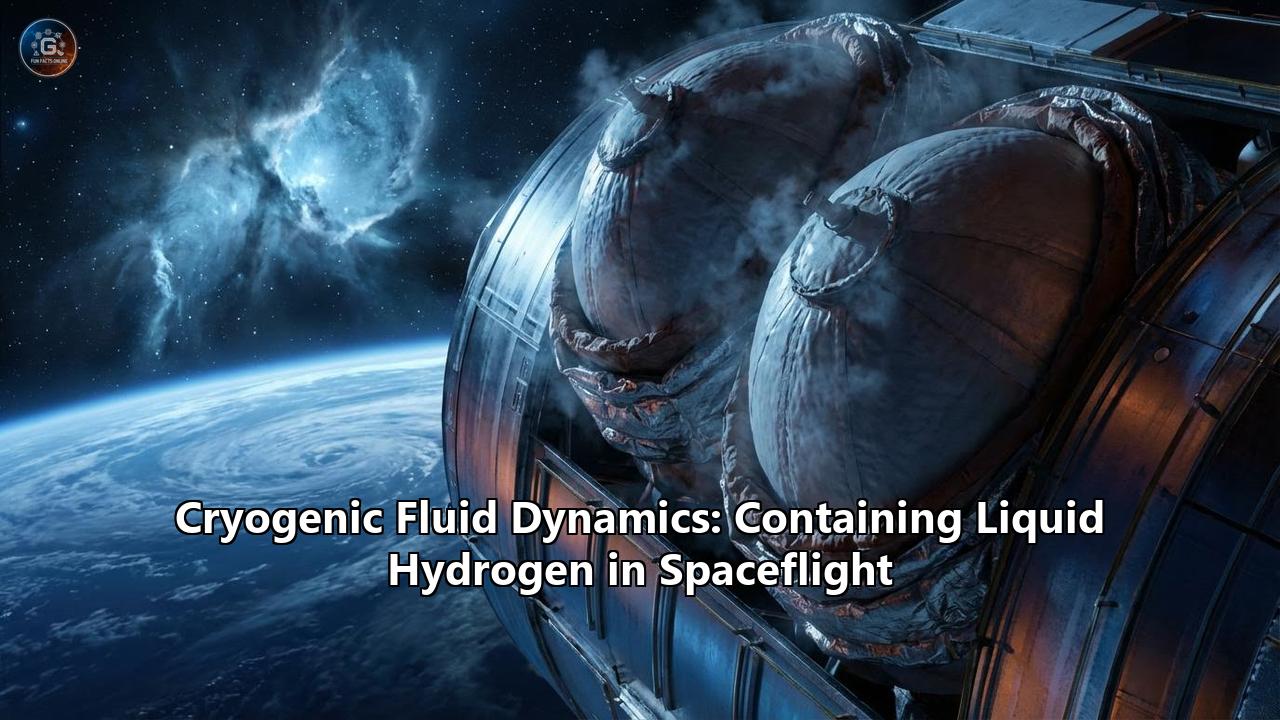
When humanity looks toward the stars, the imagination immediately leaps to roaring engines, sleek spacecraft, and the profound silence of the cosmic void. Yet, beneath the cinematic romance of spaceflight lies a grueling, unforgiving battle against the laws of thermodynamics and fluid mechanics. For decades, the ultimate bottleneck in deep space exploration has not been the lack of powerful rockets, but a deceptively simple question: How do you store the coldest, most volatile, and most efficient fuel in the universe while floating in the zero-gravity vacuum of space?
The answer lies in the highly specialized and fascinating field of Cryogenic Fluid Dynamics (CFD). Specifically, the containment, management, and utilization of liquid hydrogen (LH2) in microgravity environments is the keystone technology that will dictate whether humanity successfully establishes a sustained presence on the Moon, ventures onward to Mars, or remains tethered to Low Earth Orbit (LEO).
As we enter the Artemis era and look toward crewed interplanetary missions, mastering the tempestuous behavior of liquid hydrogen in space is no longer just a theoretical pursuit—it is an absolute, mission-critical necessity.
The Beautiful Beast: Why Liquid Hydrogen?
To understand the immense effort poured into cryogenic fluid dynamics, one must first understand why engineers are so obsessed with liquid hydrogen. In the realm of rocket propulsion, efficiency is measured by "specific impulse" (Isp), a metric that dictates how much thrust is generated per unit of propellant consumed. When combusted with liquid oxygen (LOX), liquid hydrogen yields the highest specific impulse of any practical chemical bipropellant system known to science. It was the lifeblood of the Saturn V’s upper stages, the Space Shuttle Main Engines, and is now the primary propellant for NASA’s Space Launch System (SLS) and various next-generation heavy-lift architectures.
Furthermore, liquid hydrogen is the sole propellant required for Nuclear Thermal Propulsion (NTP), a revolutionary technology planned for future Mars transfer vehicles, which uses a nuclear reactor to heat and expand hydrogen to generate thrust without combustion.
But liquid hydrogen comes with a staggering caveat: it is a cryogenic extremity. To keep hydrogen in a liquid state, it must be chilled to a bone-numbing 20 Kelvin (-253°C or -423°F). At these temperatures, the ambient warmth of deep space, the heat radiating from the spacecraft's own electronics, and the thermal reflection of Earth or the Moon are enough to violently boil the fluid.
On top of its temperature requirements, liquid hydrogen is the lightest liquid in the universe. Its incredibly low density requires massive storage tanks. It is highly pervasive, leaking through microscopic atomic gaps in metals, and it causes hydrogen embrittlement, weakening the very structures designed to contain it. Taming this beautiful beast on Earth is hard enough; taming it in the weightlessness of space is one of the most complex engineering challenges of the 21st century.
The Physics of Microgravity: When Up and Down Disappear
If you boil a pot of water on Earth, the physics are predictable. Gravity provides a distinct "up" and "down." The heavier, denser liquid settles at the bottom of the pot, while the lighter, heated vapor bubbles rise to the top due to buoyancy. This separation of liquid and gas makes extracting fuel from a tank on Earth relatively simple: you place a drain hole at the bottom.
In the microgravity environment of orbital spaceflight, this intuitive reality completely breaks down. Without gravity to separate fluids by density, buoyancy ceases to exist. The gas ullage (the empty vapor space in a tank) no longer sits neatly at the top. Instead, surface tension, capillary forces, and intermolecular adhesion take over as the dominant physical forces shaping the fluid.
In a spacecraft's fuel tank, liquid hydrogen tends to cling to the tank walls due to capillary action, while the gaseous vapor forms a massive, free-floating spherical bubble—or worse, a chaotic matrix of thousands of smaller bubbles distributed unpredictably throughout the liquid.
This creates a terrifying scenario for a rocket engine. Turbopumps, which feed propellant into the combustion chamber at ferocious speeds, are designed to pump liquid. If they ingest a pocket of gaseous hydrogen, the pump can cavitate, over-speed, and violently explode, destroying the spacecraft. Therefore, knowing exactly where the liquid is, and ensuring only pure liquid reaches the engine, is a problem that requires masterful fluid dynamics.
The Menace of Slosh Dynamics
Spacecraft are not static objects; they maneuver, rotate, dock, and experience thruster firings. Every time a spacecraft moves, the thousands of gallons of liquid hydrogen inside its tanks move with it. This phenomenon, known as sloshing, represents a massive headache for aerospace engineers.
In terrestrial vehicles, sloshing is mitigated by gravity quickly dampening the fluid's motion. In microgravity, a disturbed fluid can continue oscillating for a long time, driven by its own inertia and the lack of gravitational damping. This internal movement of mass can aggressively shift the spacecraft's center of gravity, causing attitude control systems to overcompensate, potentially sending the spacecraft into an uncontrollable spin.
Furthermore, slosh dynamics actively sabotage thermal management. When the cold liquid hydrogen splashes against the warmer, upper sections of the tank wall (which are usually exposed to solar radiation), it rapidly absorbs heat. This process, known as slosh-induced thermodynamic phase change, dramatically accelerates the evaporation of the liquid into gas, raising the internal pressure of the tank. Recent computational fluid dynamics (CFD) models and microgravity experiments—such as those utilizing drop towers and parabolic flights—have been essential in understanding these complex, non-linear fluid behaviors, revealing that even minor sinusoidal excitations can cause massive interface disruptions.
The Boil-Off Dilemma: Bleeding Fuel in the Void
Even if a spacecraft is perfectly still, the slow, creeping ingress of heat is inevitable. No insulation is perfect. As heat from the sun or the spacecraft’s subsystems leaks through the tank walls, it warms the liquid hydrogen.
On Earth, natural convection would cause the warmer liquid to rise, creating a relatively uniform temperature distribution. In space, the lack of convection leads to aggressive thermal stratification. Deep pockets of cold liquid remain at the center of the tank, while a superheated layer of liquid forms right against the tank walls and at the liquid-vapor interface. This superheated boundary layer rapidly evaporates, increasing the gaseous pressure inside the tank.
This self-pressurization creates a ticking time bomb. If the pressure exceeds the structural limits of the tank, the vessel will rupture. Historically, the only way to prevent this was to open a valve and vent the excess hydrogen gas into space. While this keeps the tank safe, it means the spacecraft is continuously bleeding its own fuel.
For short missions, such as the Apollo lunar voyages or the Space Shuttle flights, venting was an acceptable compromise. The missions were brief enough that the fuel lost to "boil-off" was factored into the margins. But for the modern era of deep space exploration, venting is an absolute mission-killer.
Consider a crewed mission to Mars. To successfully reach the Red Planet and return, a spacecraft might require around 38 tons of cryogenic fuel. Using traditional Apollo-era venting systems, a spacecraft could lose up to 18 tons of liquid hydrogen per year simply to boil-off. By the time the crew arrives at Mars, their return fuel would have literally vanished into the ether. Carrying an extra 38 tons of fuel just to compensate for the loss is financially unfeasible and mathematically ruinous to the rocket equation.
The Holy Grail: Zero Boil-Off (ZBO) Technology
To conquer the deep solar system, NASA, ESA, and private aerospace entities are pursuing the holy grail of cryogenic fluid management: Zero Boil-Off (ZBO) technology. The goal of ZBO is to create a closed-loop thermodynamic system where not a single drop of propellant is lost to evaporation, no matter how long the mission lasts.
Achieving ZBO requires a synergistic combination of passive and active thermal management systems:
1. Passive Defenses: Multi-Layer Insulation (MLI) and Sun ShieldsThe first line of defense is passive. Tanks are wrapped in dozens of layers of Multi-Layer Insulation (MLI)—mylar sheets coated in aluminum, separated by non-conductive netting, operating in the vacuum of space to eliminate radiative and convective heat transfer. Furthermore, advanced spacecraft architectures utilize the vehicle's own geometry to shade the fuel tanks from the sun. Specialized low-conductance composite struts are used to physically attach the cold tank to the warm spacecraft, minimizing the conductive heat leak.
2. Active Defenses: Cryocoolers and Broad Area CoolingWhile passive systems slow the heat leak, active systems are required to reverse it. ZBO systems utilize mechanical cryocoolers—essentially ultra-high-tech, space-rated refrigerators. These devices pump a refrigerant gas (like helium) through a network of tubes wrapped around the hydrogen tank, known as a Broad Area Cooling (BAC) shield. The cryocooler literally extracts the heat that has leaked into the tank and radiates it out into deep space via exterior thermal radiators. Recent architectural studies for Nuclear Thermal Propulsion vehicles indicate that utilizing a two-stage 20-Kelvin class ZBO cryocooler system could completely eliminate the 16,500 kg of boil-off that would otherwise occur over a 720-day orbital loiter period.
3. Jet Mixing and DestratificationBecause microgravity prevents natural convection, simply chilling the walls of the tank isn't enough; the cold fluid must be actively mixed with the warm fluid. This is achieved through Thermodynamic Vent Systems (TVS) and active jet mixing. A pump draws cold liquid from the heart of the tank and sprays it as a high-velocity jet through the ullage gas and against the tank walls. This forced convection breaks up the thermal stratification, condensing the hot vapor back into a liquid and lowering the overall tank pressure without venting.
To perfect these systems, researchers like Dr. Mohammad Kassemi at Case Western Reserve University have led groundbreaking experiments aboard the International Space Station (ISS). The Zero Boil-Off Tank (ZBOT) experiments utilize small-scale tanks filled with simulant fluids to precisely map how fluid jets interact with the strange, spherical liquid-vapor interfaces found in microgravity. The latest iteration, ZBOT-NC, adds non-condensable gases (like helium, often used to pressurize fuel systems) into the mix, measuring how they alter the evaporation and condensation dynamics of the fuel.
Propellant Management Devices (PMDs): Taming the Fluid
While ZBO handles the temperature, engineers still need to ensure that the engine pumps only swallow liquid hydrogen, not gas. Enter the Propellant Management Device (PMD).
PMDs are intricate, static, internal metal structures built directly into the fuel tanks. Because they have no moving parts, they are incredibly reliable. PMDs rely entirely on the physics of capillary action and surface tension to manipulate the fluid. By carefully designing geometric vanes, galleries, and titanium sponges, engineers can create a capillary "wicking" effect that intentionally draws liquid hydrogen toward the engine drain port, while simultaneously repelling gaseous bubbles.
One of the most critical components of a PMD is the capillary sieve or screen. These microscopic meshes utilize the surface tension of the liquid hydrogen to create a barrier. Liquid can easily flow through the mesh, but once the mesh is wet, the surface tension prevents gaseous bubbles from penetrating it.
During the historic Artemis I mission, the Orion spacecraft’s European Service Module utilized highly advanced PMD sieves developed by John Crane and ArianeGroup. These bespoke sieves were engineered to separate the liquid and gas phases inside the propellant tanks, enduring brutal vibration tests and ensuring unrestricted, pure liquid flow when the spacecraft needed to execute vital maneuvers around the Moon.
For future architectures handling massive volumes of cryogens, static PMDs might not be enough. Advanced active concepts are currently in development, such as the DynaSwirl® Cryogenic Phase Separator. This device utilizes rotational fluid dynamics to artificially induce a localized centrifugal gravity field within a pipe. As the fluid swirls, the heavier liquid hydrogen is forced to the outside of the tube, while the lighter vapor bubbles are pushed to the center, allowing the pure liquid to be cleanly extracted.
The Artemis Era and In-Orbit Refueling
The ultimate test of cryogenic fluid dynamics is on the immediate horizon. To land massive payloads on the Moon and eventually Mars, rocket equations dictate that we cannot launch a fully fueled deep-space vehicle directly from Earth. We must launch the hardware, and then separately launch the fuel.
This introduces the concept of the Orbital Propellant Depot—a cosmic gas station floating in Low Earth Orbit. Spacecraft, such as SpaceX's Starship Human Landing System (HLS), will launch into orbit nearly empty. Following this, a fleet of tanker spacecraft will rendezvous with the depot or the HLS to transfer hundreds of tons of liquid hydrogen and liquid oxygen in microgravity.
Transferring cryogenic liquids in space is a violent and chaotic process. When the ultra-cold liquid hydrogen at 20K hits the relatively warm transfer pipes and receiver tank of a new spacecraft, the liquid instantly boils upon contact, violently flashing into gas. This process, known as "chill-down," can cause massive pressure spikes and vapor locks that block the flow of propellant.
To achieve "no-vent filling" in microgravity, automated fluid dynamics models must flawlessly orchestrate the transfer. The receiving tank must be slowly pre-chilled, and thermodynamic vent systems must carefully manage the pressure without exhausting the precious hydrogen into the void. Successfully demonstrating cryogenic in-orbit ship-to-ship refueling is the single most critical technological hurdle standing between humanity and a sustainable lunar economy.
Conclusion: Mastery Over the Elements
The dream of a multi-planetary future is not just written in the fire of rocket engines, but in the silent, invisible dance of sub-zero fluids floating in the dark. Cryogenic Fluid Dynamics is a discipline where quantum mechanics, thermodynamics, and astrophysics collide.
Every time a thruster fires perfectly in the deep vacuum of space, it is the result of decades of agonizing research into slosh dynamics, capillary forces, and microgravity phase changes. By building orbital fuel depots, perfecting Zero Boil-Off cryocoolers, and weaving intricate capillary sieves, engineers are literally rewriting the rules of how fluids behave.
Taming liquid hydrogen is an engineering marathon of epic proportions. But as we look toward the Artemis lunar landings, and cast our eyes further outward to the rusted sands of Mars, one thing is certain: whoever controls the ice-cold heartbeat of the spacecraft, controls the solar system.
Reference:
- https://www.researchgate.net/publication/379112784_Cryogenic_propellant_management_in_space_open_challenges_and_perspective
- https://cdn.wildapricot.com/237408/resources/Documents/C20/439.pdf?version=1543686496000&Policy=eyJTdGF0ZW1lbnQiOiBbeyJSZXNvdXJjZSI6Imh0dHBzOi8vY2RuLndpbGRhcHJpY290LmNvbS8yMzc0MDgvcmVzb3VyY2VzL0RvY3VtZW50cy9DMjAvNDM5LnBkZj92ZXJzaW9uPTE1NDM2ODY0OTYwMDAiLCJDb25kaXRpb24iOnsiRGF0ZUxlc3NUaGFuIjp7IkFXUzpFcG9jaFRpbWUiOjE3NzI5NDQzNTZ9LCJJcEFkZHJlc3MiOnsiQVdTOlNvdXJjZUlwIjoiMC4wLjAuMC8wIn19fV19&Signature=I-xuxeiXi12PMt58n6nX-U6eb0NGj184C32L8zPNsmVsXgc5ihGLLNGp18Gt-ILgqNxINmn6ClttRAosHYGA4AKMwJZ7crapJFqwq-OUVB4KNmZ-TVXHXgwOYgwbh5Gy8CUGScde19Mg68Sw~eJJfbi-q30DE4Dtsq6AGsf7yuF-sjFpH48bn0hFKB2lTQopcIgm-l3Pt9k09n2lUOcQ8KKLsLIw~zudJ05dW313FX7BNcbPZ-82Hi-PZ9MtlSE3edtD0mqkpW~Txkd52le8ueM4o1vE5ttM3AeuV69cMgVyeATAFdBS8dWeLba8I4zSyMMp6tjGgki6TIO3fF8oiA__&Key-Pair-Id=K27MGQSHTHAGGF
- https://pmc.ncbi.nlm.nih.gov/articles/PMC10954726/
- https://case.edu/news/cwru-researcher-leads-nasa-experiment-iss-advance-long-duration-spaceflight
- https://overlookhorizon.com/nasa-aims-to-keep-fuel-cool-under-pressure-with-zero-boil-off-experiment-on-ng-23/
- https://www.mdpi.com/1996-1073/18/20/5362
- https://www.researchgate.net/publication/332583483_Fluid_sloshing_dynamic_performance_in_a_liquid_hydrogen_tank
- https://www.researchgate.net/publication/323347090_A_Study_on_the_Micro_Gravity_Sloshing_Modeling_of_Propellant_Quantity_Variation
- https://www.researchgate.net/publication/280982267_Passive_zero-boil-off_storage_of_liquid_hydrogen_for_long-time_space_missions
- https://ntrs.nasa.gov/citations/20230017529
- https://www.johncrane.com/en/about/news/press-releases/2022/john-crane-provides-critical-components-for-nasa-artemis-i-mission-and-orion-spacecraft
- https://techport.nasa.gov/projects/113186
- https://www.science.gov/topicpages/c/cryogenic+storage+technology.html
- https://www.researchgate.net/publication/222513087_Cryogenic_fluid_transfer_for_exploration