
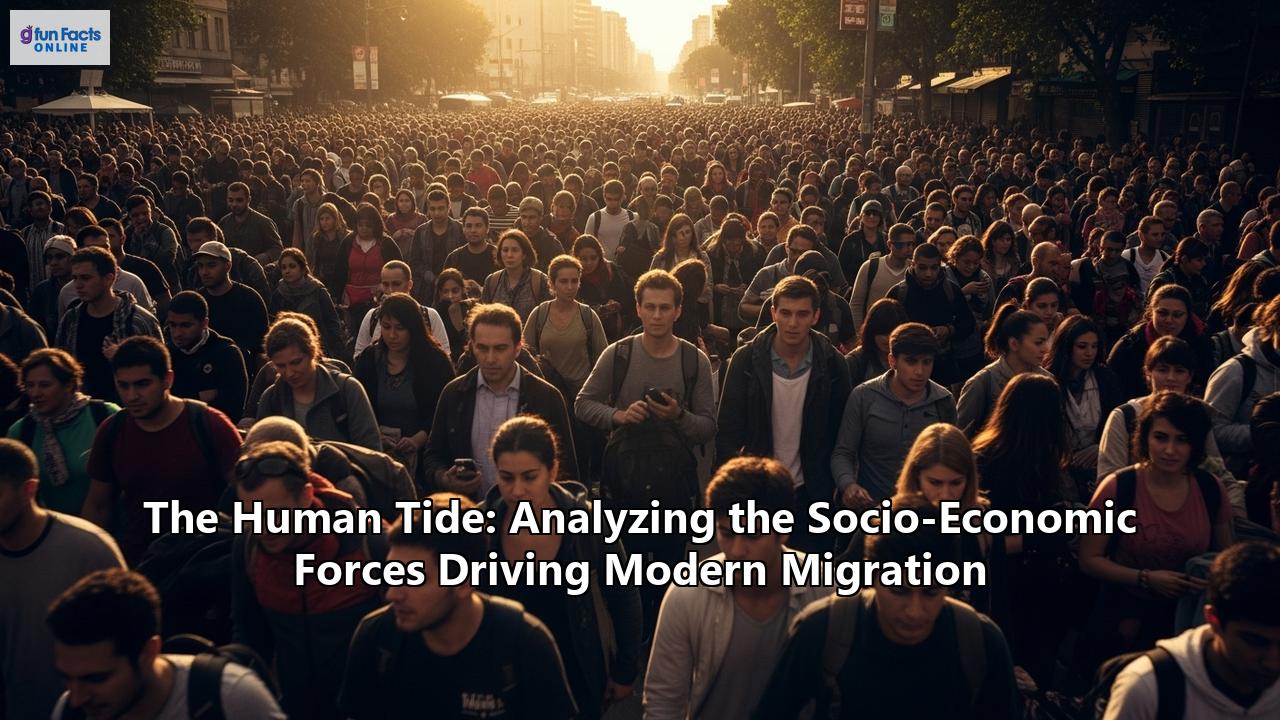
The Unceasing River: Deconstructing the Socio-Economic Currents of Modern Migration
Introduction: A World in MotionHumanity is, and has always been, a species in motion. From the earliest hominids venturing out of Africa to the voyagers who crossed vast oceans, migration is an indelible thread in the tapestry of our shared history. Yet, the 21st century is witnessing a surge and complexity of movement unprecedented in its scale and scope. This modern exodus, what can be termed 'The Human Tide', is not a random drift but a powerful current propelled by a complex interplay of deep-seated and often overlapping socio-economic forces. To understand this global phenomenon is to understand the core challenges and opportunities of our time: the stark realities of inequality, the disruptive tremors of conflict and environmental decay, and the enduring, universal aspiration for a better life.
Migration is rarely a simple choice. It is a decision forged in the crucible of circumstance, a calculation of risks and rewards where the push from home becomes stronger than the pull of the unknown. As of early 2024, an estimated 117.3 million people worldwide were forcibly displaced, a stark testament to the powerful forces uprooting individuals, families, and entire communities. Beyond these staggering numbers of those forced to flee, millions more undertake journeys for reasons that, while often voluntary, are no less compelling. This article will embark on a comprehensive analysis of the intricate socio-economic machinery driving this modern migration, dissecting the primary engines of this human tide—economic disparities, social imperatives, political upheavals, and environmental pressures—and examining the profound impacts on the nations and people it touches.
The Economic Engine: The Quest for Prosperity and Stability
At the heart of most migration stories lies a powerful economic calculus. The global economy, for all its interconnectedness, is a landscape of stark contrasts, a world of deep valleys of poverty and towering peaks of prosperity. It is this fundamental imbalance that fuels the most significant driver of modern migration: the search for economic opportunity.
The Great Divide: Inequality and Wage Differentials
The most potent "push" factor is the chasm in economic well-being between nations. While global inequality between countries has seen a moderate decline, vast gaps in income and opportunity persist. Unskilled workers in wealthy nations often earn wages that are ten times higher than their counterparts in developing countries. This "place premium" means that a worker's location can have a far greater impact on their earning potential than their intrinsic skills or effort. Research estimates that for migrants moving from developing countries to the United States, the real wage gap for observably equivalent workers can be, on average, a factor of 5.7, and for some countries, this ratio skyrockets to over 16. This differential represents an immense potential monetary gain, creating a powerful and logical incentive to move.
Migration, in this context, becomes one of the most effective strategies for poverty reduction available to an individual. It is not necessarily the poorest of the poor who migrate internationally, as the journey itself requires resources—financial capital for travel and fees, and human capital in the form of skills and education. Often, it is those from lower-middle and middle-income developing countries who have both the incentive and the means to undertake an international move. This dynamic highlights a crucial paradox: in some cases, initial economic development in a poorer country can actually increase emigration, as it provides more people with the resources needed to migrate.
Higher inequality within a destination country can, paradoxically, also act as a pull factor, as it may signal the potential for high social mobility and reward. However, for those who are risk-averse or value social justice, high inequality can be a deterrent. The decision is therefore a complex one, weighing the potential for immense gain against the risks of an uncertain economic landscape.
The Youth Bulge and The Specter of Unemployment
In many parts of the developing world, particularly in Sub-Saharan Africa and the Middle East, demographic trends have created a "youth bulge"—a large cohort of young people entering the workforce. When this demographic dividend is not met with sufficient job creation, it leads to high rates of youth unemployment, a potent driver of emigration. In 2016, with a staggering 71 million young people unemployed globally, the search for work became a primary reason for youth migration.
Labor market rigidity in some regions can exacerbate this problem. Strict employment protection legislation, for instance, can make it difficult for young "outsiders" to enter the job market, pushing them to seek opportunities elsewhere. Studies within the EU have shown a very strong correlation between the strictness of employment protection laws, youth unemployment rates, and the number of young people emigrating. The combination of limited job prospects at home and the possibility of free movement, as within the EU, creates a powerful impetus for young, mobile individuals to leave.
The dynamic plays out differently across income levels. In low- and middle-income countries like India, Indonesia, and the Philippines, an influx of migration can sometimes increase unemployment, suggesting competition for limited jobs. Conversely, in higher-income nations, migration often fills labor shortages, particularly in sectors that native-born populations, who are increasingly better educated, are less willing to enter, such as agriculture, construction, and services. As of 2022, over two-thirds of all international migrant workers were concentrated in high-income countries, highlighting this global labor flow.
The Two-Sided Coin: Brain Drain and Brain Gain
One of the most debated consequences of skilled migration is the phenomenon of "brain drain," where a developing country loses its most educated and skilled professionals to wealthier nations. This can be detrimental, depleting the human capital necessary for innovation, governance, and economic growth. For instance, increased corruption in a country can reduce the returns on education, prompting skilled workers like physicians to emigrate.
However, a more nuanced perspective has emerged, proposing the concept of "brain gain." The very prospect of migrating for better opportunities can incentivize more people in the origin country to pursue higher education and acquire in-demand skills. Research on India's IT sector, for example, showed that increased access to H-1B visas in the U.S. not only boosted the earnings of Indian migrants but also increased IT employment within India itself by 5.8%, as more people invested in relevant training.
Furthermore, the "brain drain" is not always a permanent loss. Migrants often maintain strong ties with their home countries, creating diaspora networks that facilitate trade, investment, and knowledge transfer. Return migration brings back individuals with new skills, international connections, and capital, who can then connect domestic firms to global supply chains and spur innovation. Therefore, whether emigration results in a net "drain" or "gain" often depends on the origin country's ability to create an environment that can capitalize on these new skills and connections, including having the necessary infrastructure for training and education.
The Lifeline of Remittances
For the countries they leave behind, migrants are not just a loss of labor but also a vital source of income through remittances—the money they send back home. On a global scale, these financial flows are enormous. In 2019, officially recorded remittances reached $548 billion, a sum more than three times the volume of official development assistance and comparable in size to total foreign direct investment. In some countries, these inflows are a cornerstone of the national economy, reaching as high as 30-40% of GDP in nations like Tonga and Haiti.
The impact of this capital is profound and multi-faceted. At the most basic level, remittances are a direct lifeline for families, used to buy food, access healthcare, and pay for education. This has a significant and well-documented effect on poverty reduction. Studies have shown that a 10% increase in the share of international migrants in a country's population can lead to a 1.9% decline in the number of people living in extreme poverty. Similarly, a 10% increase in remittances as a share of GDP is associated with a 1.6% drop in the poverty rate.
Beyond immediate consumption, remittances fuel broader economic development. They provide capital for small entrepreneurs in credit-constrained environments, fostering business growth. In Sri Lanka, children in households receiving remittances have been found to have higher birth weights, and in El Salvador, they have lower school dropout rates, indicating investment in health and education. At the macroeconomic level, these flows provide a stable source of foreign currency, helping countries pay for essential imports and improve their access to international capital markets.
However, the impact is not uniformly positive. There are concerns that remittances can create a culture of dependency, discouraging labor force participation if the external income surpasses potential local earnings. Some studies also point to the risk of "Dutch disease," where large inflows of foreign currency can lead to an appreciation of the local currency, making other exports less competitive. Despite these potential downsides, the overwhelming evidence points to remittances as a powerful force for poverty alleviation and a critical economic benefit of migration for origin countries.
The Social Fabric: Networks, Family, and Education
Migration is not merely an economic decision; it is a deeply social one. The threads of family, community, and culture stretch across borders, creating powerful channels that guide and sustain migratory flows. These social drivers often determine not just whether someone will migrate, but where they will go and how successful their journey will be.
The Power of Networks: Paving the Way for Others
Migrant networks—the web of family, friends, and community members already living in a destination country—are one of the most important facilitators of migration. These networks drastically lower the costs and risks of moving. They act as conduits of vital information about job opportunities, housing, and the intricacies of navigating a new society. They also provide crucial social and economic support upon arrival, from a place to stay to help in finding initial employment.
The impact of these networks is quantifiable. Research using large-scale mobile phone data has shown a direct, linear relationship between the size of an individual's social network in a potential destination and their likelihood of migrating there. The probability of moving roughly doubles as the number of contacts in the destination doubles. This confirms a long-held hypothesis: people move to places where they already know people. Interestingly, this research also reveals that migrants tend to derive more benefit from "interconnected" networks (dense clusters of contacts that provide strong social support) than from "extensive" networks (wider, sparser contacts that are more efficient for information transmission).
The rise of social media has amplified the power of these networks. Platforms like Facebook, Twitter, and WhatsApp allow for the instantaneous sharing of information and maintain strong social ties across vast distances, reinforcing the connections that encourage and facilitate migration. Digital trace data from Facebook has shown that long-term migration accounts for a significant portion of international friendships on the platform, with migrants acting as crucial bridges that decrease the social distance between countries.
The Unifying Pull: Family Migration and Reunification
The desire to live with one's family is a fundamental human impulse and a major driver of migration. Family migration, which includes the reunification of separated families as well as the formation of new ones across borders, constitutes a substantial portion of global movements. In 2023, family reasons accounted for 43% of all new permanent-type migration to OECD countries, representing 2.5 million people. In the EU in 2023, around 374,000 children were issued their first residence permits for family reasons, making up 63% of all first permits granted to minors.
Policies in destination countries play a critical role in shaping these flows. The right to family life is a protected principle in many legal frameworks, but countries are increasingly placing restrictions on family reunification, such as income requirements for sponsors, which can make it difficult for migrants to bring their loved ones. Despite these hurdles, family remains a primary motivation. The migration of one family member often sets the stage for "chain migration," where relatives follow over time, utilizing the support of the established social network.
This form of migration has distinct demographic characteristics. Over 90% of people who enter the UK as the families of refugees, for example, are women and children. Furthermore, migrants who arrive on family visas, or work visa holders who bring their dependents, are often more likely to settle permanently in the host country compared to those who arrive alone for work or study.
The Global Classroom: Migration for Education
The pursuit of educational opportunities is another significant social driver of migration, creating a global flow of students and scholars. This "international student mobility" has grown exponentially with globalization, rising from 0.6 million students enrolled outside their home countries in 1975 to 6.36 million in 2020. The motivations are clear: access to higher quality education, prestigious institutions, specialized fields of study, and the enhanced career prospects that come with an international degree.
For students from developing countries with limited capacity in their own higher education systems, studying abroad is often the only path to advanced training. For host countries, international students are a significant economic boon, contributing billions through tuition fees and living expenses. They also enrich the academic environment and represent a pool of high-skilled talent that may remain after graduation, contributing to a "brain gain."
The policies of destination countries are a powerful pull factor. Aggressive recruitment strategies, the availability of scholarships, streamlined visa processes, and clear pathways to post-graduation work opportunities are key tools used by countries like Australia, Canada, the UK, and the US to attract global talent. This competition for students is a reflection of the broader global competition for skilled labor. The decision for a student to migrate is thus influenced by a combination of the "push" of limited opportunities at home and the "pull" of academic excellence and career potential abroad.
The Political Push: Conflict, Persecution, and Governance
While economic and social factors often involve a degree of choice, political drivers frequently compel people to move, turning migration into a desperate act of survival. Conflict, persecution, political instability, and poor governance are powerful forces that push people from their homes, often creating large-scale, sudden, and traumatic displacement.
Fleeing the Fire: War and Violent Conflict
War and armed conflict are among the most potent drivers of forced migration. The violence, destruction, and collapse of state authority leave citizens with no choice but to flee for their lives. The Syrian Civil War, which began in 2011, is a devastating modern example. The conflict has resulted in one of the largest displacement crises of our time, forcing millions to flee their homes. Many became internally displaced, while millions of others sought refuge in neighboring countries like Turkey, which hosts the world's largest refugee population at 3.6 million, as well as in Lebanon, Jordan, and increasingly, in Europe.
Similarly, decades of conflict and instability in Afghanistan have generated waves of refugees and asylum seekers. Following the political upheavals, Afghans have consistently been among the top nationalities seeking asylum globally. In both Syria and Afghanistan, the majority of the population did not flee, highlighting the fact that even in the most extreme circumstances, migration is a complex decision influenced by resources, networks, and the ability to move. However, the sheer scale of displacement underscores the undeniable link between violent conflict and mass migration. The conflict in Sudan that began in April 2023, for instance, had already displaced 2.6 million people internally and pushed over 738,000 into neighboring countries by July of that year alone.
Seeking Sanctuary: Persecution and Human Rights Abuses
Beyond open warfare, people are also forced to migrate due to persecution based on their ethnicity, religion, political beliefs, or membership in a particular social group. Authoritarian regimes that suppress dissent and violate human rights create an environment of fear that drives citizens to seek asylum elsewhere. Countries with poor human rights records, such as Iran and Eritrea, are major sources of asylum seekers.
The violence perpetrated by non-state actors, such as organized criminal gangs, can be just as compelling a reason to flee. In the Northern Triangle countries of El Salvador, Guatemala, and Honduras, widespread gang violence, extortion, and a climate of impunity have made life untenable for many, forcing them to undertake perilous journeys north. These situations often fall into a gray area of international law, as the perpetrators are not state agents, but the level of danger and lack of state protection is comparable to that of a war zone.
The Rot Within: Poor Governance and Corruption
The quality of governance in a country of origin is a crucial, if sometimes overlooked, driver of migration. Corruption, weak rule of law, and a lack of institutional trust can cripple economic development, stifle social mobility, and erode the social contract between a state and its citizens. Research has found that dissatisfaction with public services and poor governance can be stronger drivers of the aspiration to migrate than poverty or even conflict.
Corruption acts as both a push factor and an enabler of irregular migration. As a push factor, it creates an environment of inequality and hopelessness, where success is determined by connections rather than merit, prompting people to seek a more just and predictable life elsewhere. Studies have shown a direct correlation: a one-unit increase in a country's corruption level is associated with an 11% increase in emigration. This effect is particularly pronounced for the highly educated, whose skills are portable and who may be more sensitive to the lack of transparency and meritocracy.
As an enabler, corruption can facilitate irregular migration by creating a market for fraudulent documents and bribed officials, making it easier for smuggling networks to operate. This highlights the paradox where the very institutional decay that pushes people to leave also provides the illicit means to do so. Conversely, low levels of corruption in a destination country act as a powerful pull factor, with migrants showing a clear preference for countries with stable, transparent, and accountable institutions.
The Environmental impetus: A Changing Planet and Displaced Populations
A new and increasingly powerful force is reshaping the landscape of modern migration: environmental change. The impacts of climate change, from sudden and catastrophic disasters to slow, creeping degradation, are threatening livelihoods, rendering lands uninhabitable, and displacing millions of people. This environmental impetus often intersects with and exacerbates existing economic and political vulnerabilities, creating a complex web of drivers that is projected to grow in significance throughout the 21st century.
The Sudden Shock: Disasters and Displacement
Sudden-onset natural disasters, such as floods, storms, earthquakes, and wildfires, can trigger massive and immediate displacement. In 2023 alone, disasters were responsible for 56% of all new internal displacements globally, amounting to 26.4 million movements. Events like the devastating floods in Pakistan and cyclones in Bangladesh have forced millions to flee their homes in a matter of days.
While terrifying and disruptive, most displacement from sudden-onset disasters tends to be internal and temporary. People flee to nearby safe areas and often return to rebuild once the immediate danger has passed. The Internal Displacement Monitoring Centre (IDMC) reports that while millions are displaced by disasters each year, a smaller number remain displaced in the long term. However, the increasing frequency and intensity of these extreme weather events, supercharged by climate change, are making recovery more difficult. When disasters recur, they can erode community resilience and exhaust resources, eventually leading people to decide to move permanently, sometimes across international borders.
The Slow Creep: Climate Change and Long-Term Migration
Potentially more consequential in the long run is migration driven by slow-onset environmental processes. These include desertification, sea-level rise, land degradation, and changes in temperature and precipitation patterns. Unlike sudden disasters, these changes unfold over years or decades, gradually undermining the viability of agriculture, fishing, and other traditional livelihoods.
The World Bank's Groundswell report projects a sobering future, estimating that without significant action on climate change, up to 216 million people could be forced to move within their own countries by 2050 due to these slow-onset impacts. Sub-Saharan Africa and the Asia-Pacific region are expected to be the epicenters of this internal climate migration. The Syrian drought from 2006 to 2011, which caused catastrophic crop failures and drove many farming families into urban centers, is often cited as a case where environmental pressures contributed to the social and economic tensions that preceded the civil war.
Migration in the face of slow-onset change is often a coping strategy rather than a last resort. It can be circular or seasonal, with family members moving to find work elsewhere during a drought and returning when conditions improve. However, this form of migration is difficult to quantify because the decision to move is rarely based on environmental factors alone. It is almost always interwoven with economic need, social opportunities, and other personal factors, making it a prime example of "mixed migration."
The Complexity of "Mixed Migration"
The reality for many people on the move today is that their motivations do not fit neatly into a single category. The United Nations High Commissioner for Refugees (UNHCR) uses the term "mixed movements" or "mixed migration" to describe flows of people traveling together along the same routes, but for a variety of reasons. A single group of people crossing a border may include refugees fleeing conflict, asylum seekers escaping persecution, economic migrants searching for work, and those displaced by environmental disaster.
This complexity poses a significant challenge for international law and policy, which traditionally draws a firm line between refugees, who are entitled to international protection, and economic migrants, who are not. In a world where a farmer is pushed from their land by a combination of drought (environmental), lack of government support (political), and inability to find other work (economic), these categories begin to blur. A person's journey can also evolve; someone who leaves for economic reasons may become a victim of trafficking or face persecution en route, thereby becoming in need of international protection. Recognizing and responding to the multifaceted needs within these mixed flows is one of the most pressing challenges in modern migration governance.
Ripple Effects: The Socio-Economic Impacts on Nations
The global tide of migration leaves a profound and lasting mark on both the countries that send and those that receive migrants. The socio-economic impacts are complex, generating a wide spectrum of outcomes that are often the subject of intense public and political debate. A balanced analysis reveals a landscape of challenges and opportunities, costs and benefits, that varies significantly depending on the context, the characteristics of the migrants, and the policies in place.
The Transformation of Host Countries
For destination countries, immigration is a powerful agent of demographic and economic change. One of the most significant impacts is on the labor market. Migrants often fill crucial labor shortages, particularly in sectors with demanding or low-paying jobs that may not be attractive to the native-born workforce, as well as in highly skilled, specialized fields. As of 2022, migrant workers constituted 4.7% of the global labor force, with a heavy concentration in the high-income countries of Europe and North America. By taking on these roles, they can boost economic growth and productivity. An analysis of 14 OECD countries found that a 1% increase in immigration increases total GDP by about 1%, without negatively affecting average native wages.
However, the impact on wages and inequality within host countries is complex. The influx of low-skilled migrants can increase labor competition at the lower end of the wage spectrum, potentially putting downward pressure on the wages of low-skilled native workers. Conversely, it can complement the skills of higher-skilled workers and lower the cost of services, creating broader economic benefits. Most empirical studies find that the overall effect of immigration on native wages and inequality is small, suggesting that economies adapt and other factors often compensate for these labor supply shifts.
Beyond the labor market, migrants contribute to host societies in numerous ways. They are often entrepreneurial, starting businesses at higher rates than native populations. They contribute to innovation and research, particularly high-skilled migrants in STEM fields. Through taxes, they support public services and, in countries with aging populations, they are essential to sustaining social security and pension systems.
Nevertheless, integration presents significant challenges. Social cohesion can be strained by cultural differences and perceived competition for resources. Concerns about the fiscal impact of migration—whether migrants contribute more in taxes than they consume in public services—are a common feature of public debate, even if studies often show a net positive or neutral fiscal impact over the long term. The successful integration of migrants, which depends on factors like language acquisition, educational attainment, and access to the labor market, is crucial for maximizing the benefits of migration and fostering inclusive, diverse societies.
The Enduring Connection to Countries of Origin
For sending countries, the departure of their citizens creates a different set of socio-economic ripples. The most immediate and tangible benefit, as previously detailed, is the inflow of remittances, which serves as a vital source of income, reduces poverty, and fuels local investment.
The phenomenon of brain drain remains a significant concern, as the loss of skilled workers can hamper development in critical sectors like healthcare and technology. However, this is increasingly viewed through the more optimistic lens of "brain gain" and "brain circulation." Diaspora networks have become powerful conduits for trade, investment, and knowledge transfer, linking the home country to the global economy. Return migrants bring back capital, skills, and new ideas that can foster entrepreneurship and innovation. The potential for emigration itself can stimulate human capital formation at home.
Emigration can also have political consequences for the home country. It can act as a "safety valve," reducing political pressure on authoritarian regimes by providing an exit for disaffected and unemployed citizens, particularly young men. This can lead to a decrease in both violent and non-violent political contestation. However, when migrants move to democratic countries, they can be exposed to different political norms and values, potentially fostering support for democratic change back home.
The long-term impact on a country's development trajectory is therefore a mixed ledger. While the loss of human capital is a real cost, the benefits of remittances, diaspora engagement, and the potential for a "brain gain" can create significant opportunities for economic and social advancement. The ultimate outcome often hinges on the ability of the origin country to implement policies that harness these benefits and create an environment to which skilled migrants may one day wish to return.
Conclusion: Navigating the Inevitable Tide
The human tide of the 21st century is not a crisis to be halted, but a fundamental feature of our interconnected world to be understood and managed. The forces propelling it—the vast economic chasms between nations, the enduring bonds of family and community, the violent upheavals of conflict and persecution, and the escalating pressures of a changing climate—are deep-rooted and unlikely to subside. Migration is a complex and often messy process, a collection of millions of individual stories of aspiration, desperation, courage, and resilience.
To analyze these socio-economic forces is to confront the core paradoxes of our time. It is to see how development can sometimes fuel migration before it curtails it; how the loss of a nation's "best and brightest" can, in time, become a source of strength; and how the same forces of globalization that create unprecedented wealth can also exacerbate the inequalities that push people to move.
There are no simple solutions. For destination countries, the challenge is to manage borders with fairness and humanity while developing robust integration policies that harness the immense economic and cultural contributions of immigrants. This requires moving beyond polarized debates and focusing on evidence-based strategies that foster social cohesion and shared prosperity. For origin countries, the goal must be to address the root causes of desperate and forced migration—by promoting good governance, creating economic opportunities, and building resilience—while also engaging with their diasporas as powerful agents of development.
Ultimately, the story of modern migration is the story of a world grappling with profound and rapid change. It is a reflection of our shared vulnerabilities and our collective aspirations. Navigating this human tide will require not only smarter policies and greater international cooperation but also a deeper sense of empathy and a recognition of the shared humanity that connects us all, whether we stay or we go.
Reference:
- https://www.migrationpolicy.org/programs/data-hub/charts/refugee-and-asylum-seeker-populations-country-origin-and-destination
- https://medium.com/@ecosystemforpeace/addressing-the-silent-crisis-the-impact-of-slow-onset-environmental-change-on-human-mobility-ee8904f95c7c
- https://www.google.com/search?q=time+in+District+de+Tadmor,+SY
- https://earth.org/extreme-weather-events-in-2024-led-to-highest-number-of-new-displacements-since-2008/
- https://asylumineurope.org/reports/country/united-kingdom/statistics/
- https://www.migrationdataportal.org/themes/family-migration-new
- https://www.unhcr.org/what-we-do/protect-human-rights/asylum-and-migration
- https://openknowledge.worldbank.org/server/api/core/bitstreams/8aef7d43-0474-4739-a8d9-9c99fb8f9fa2/content
- https://www.unrefugees.org/news/how-climate-change-impacts-refugees-and-displaced-communities/
- https://www.refugeecouncil.org.uk/stay-informed/explainers/top-facts-from-the-latest-statistics-on-refugees-and-people-seeking-asylum/
- http://www.maggiepeters.com/uploads/8/3/0/8/83081968/emigration_and_political_contestation.pdf
- https://mixedmigration.org/wp-content/uploads/2020/10/UNHCR-Background-Note-to-Policy-Workshop.pdf
- https://knowledgehub.transparency.org/assets/uploads/helpdesk/Literature_review_corruption_and_migrations.pdf
- https://migrationnetwork.un.org/sites/g/files/tmzbdl416/files/resources_files/workplan_climate_change_and_migration_final.pdf
- https://www.emerald.com/insight/content/doi/10.1108/jes-04-2022-0219/full/pdf
- https://www.emerald.com/insight/content/doi/10.1108/jes-04-2022-0219/full/html
- https://www.internal-displacement.org/focus-areas/displacement-disasters-and-climate-change/
- https://www.google.com/search?q=time+in+%D9%86%D8%A7%D9%88%D8%B1+%D9%88%D9%84%D8%B3%D9%88%D8%A7%D9%84%DB%8D,+AF
- https://refugees.org/wp-content/uploads/2021/06/Understanding-Corruption-Migration-USCRI-brief-May2021.pdf
- https://www.migrationdataportal.org/themes/environmental_migration_and_statistics_old
- https://www.jblumenstock.com/files/papers/migration_networks.pdf
- https://academic.oup.com/restud/advance-article-pdf/doi/10.1093/restud/rdad113/55117707/rdad113.pdf
- https://ingmarweber.de/wp-content/uploads/2023/04/Augmentig-Migration-Statistics-Using-Social-Media.pdf
- https://www.migrationdataportal.org/data-sources/social-media
- https://escholarship.org/uc/item/6rs5n7jq
- https://desapublications.un.org/policy-briefs/un-desa-policy-brief-no-133-migration-trends-and-families
- https://ec.europa.eu/eurostat/statistics-explained/index.php?title=Children_in_migration_-_residence_permits_for_family_reasons
- https://migrationobservatory.ox.ac.uk/resources/briefings/family-migration-to-the-uk/
- https://www.ebsco.com/research-starters/anthropology/international-student-mobility
- https://www.diva-portal.org/smash/get/diva2:518603/fulltext01.pdf
- https://www.emerald.com/insight/content/doi/10.1108/jarhe-05-2023-0195/full/html
- https://www.iesalc.unesco.org/en/articles/new-insights-countries-objectives-promote-international-student-mobility
- https://www.researchgate.net/publication/387431024_Research_on_the_Impact_of_International_Student_Policies_on_Students'_Choice_and_Mobility_of_Studying_Abroad
- https://www.unrefugees.org/refugee-facts/statistics/
- https://digitalrepository.unm.edu/cgi/viewcontent.cgi?article=1027&context=nsc_research
- https://www.aljazeera.com/news/2024/11/22/mapping-the-impact-of-climate-change-on-global-displacement
- https://www.u4.no/topics/migration/basics
- https://www.migrationdataportal.org/themes/environmental-migration
- https://www.migrationpolicy.org/article/climate-migration-101-explainer
- https://wol.iza.org/articles/climate-change-natural-disasters-and-migration/long
- https://snis.ch/wp-content/uploads/2019/12/2009_Koubi_Working-Paper-2.pdf
- https://worldmigrationreport.iom.int/sites/g/files/tmzbdl1691/files/documents/Ch9-key-findings_final.pdf
- https://www.acnur.org/sites/default/files/2023-10/Mixed%20Movements%20Monitoring%20Q1%202023%20-%20UNHCR-WFP.pdf
- https://www.onlinelibrary.iihl.org/wp-content/uploads/2023/03/2022-UNHCR-Introduction-to-Mixed-Movements.pdf
- https://eca.iom.int/sites/g/files/tmzbdl666/files/documents/toolkit-integrating-migration-governance-interventions.pdf