
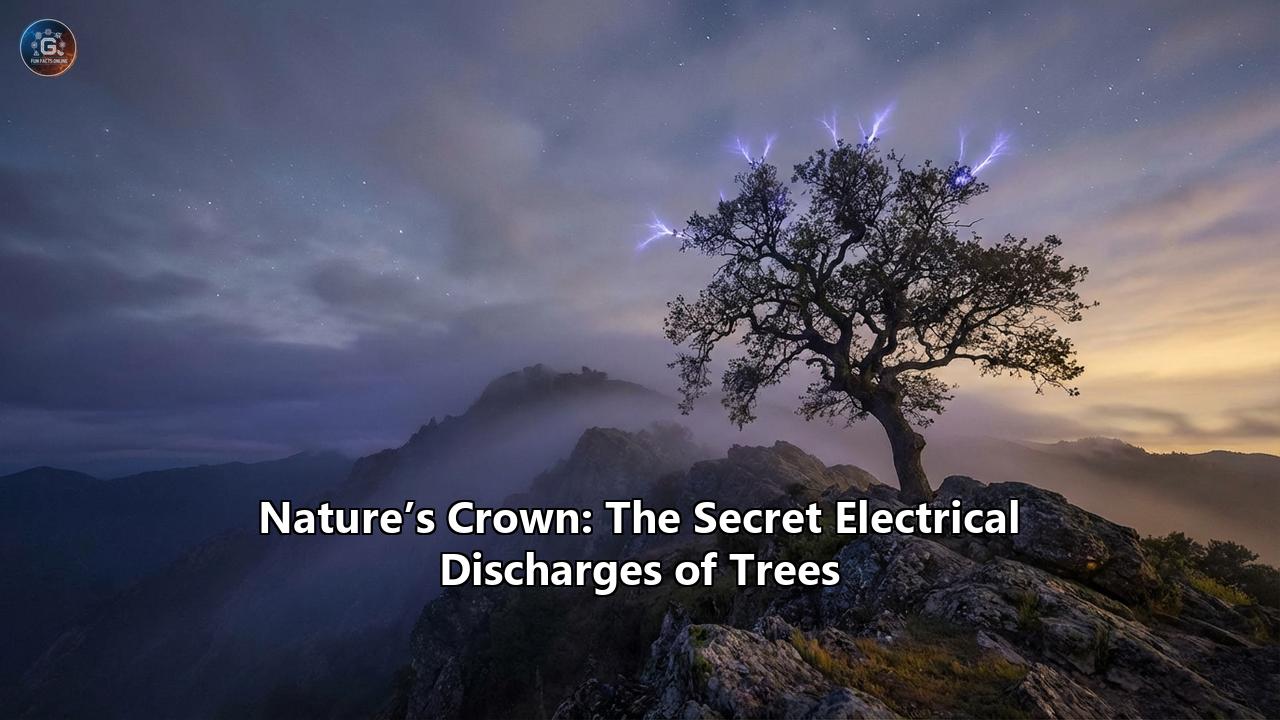
When we walk through a forest, we perceive trees as the ultimate symbols of stillness. Rooted deep within the soil, wrapped in rugged bark, and swaying only when the wind insists, they seem like passive observers of the world around them. But invisible to the naked human eye, a spectacular and chaotic hidden reality exists. Trees are not just biological pillars of wood and leaves; they are Earth’s living antennae. They constantly hum with internal bioelectrical currents, actively communicate across vast distances, and, during thunderstorms, literally erupt into millions of microscopic, glowing electrical sparks.
For centuries, the idea that trees could act as electrical conduits or that they possessed an intricate internal electrical life was relegated to the fringes of folklore and theoretical physics. Today, cutting-edge science has caught up with these ancient intuitions. We now know that the forest canopy is a dynamic, scintillating crown of electricity that helps clean our atmosphere, guides the evolution of plant life, and allows ancient forests to operate with a synchronized, almost conscious intelligence.
The Glowing Canopy: Discovering the Forest’s Secret Fire
For almost a hundred years, atmospheric physicists theorized that thunderstorms might induce weak electrical discharges on the tips of plant leaves. When a massive storm cloud builds overhead, the base of the cloud is heavily charged. Because nature abhors an imbalance, this immense electrical field induces an opposite charge in the ground below. This ground charge frantically seeks a way to reach the cloud, following the path of least resistance. In a forest, that path goes straight up the trunks of trees, traveling through the sap and water-rich vessels, right to the very tips of the canopy.
Because of a phenomenon known as the "point effect," electrical fields concentrate at sharp geometric structures—like the pointed tips of leaves or the sharp needles of conifers. When the electric field at these tips exceeds the ionization threshold of the surrounding air, it strips electrons away from nitrogen and oxygen molecules, creating a localized plasma. The electricity discharges into the air, producing what is known as a corona discharge.
Historically, humans have witnessed a similar phenomenon on the sharp masts of ships or church spires during stormy weather, famously calling it St. Elmo’s Fire. But proving that millions of tree leaves were quietly sizzling with St. Elmo's Fire during every passing thunderstorm remained impossible. The faint, violet-blue light emitted by a corona discharge is incredibly weak—dimmer than a sliver of moonlight—and is easily washed out by daylight or the ambient brightness of a stormy sky.
That was until the summer of 2024, when a team of researchers led by Penn State meteorologist Patrick McFarland finally captured the elusive phenomenon in the wild. To do this, the team had to get creative. They took a 2013 Toyota Sienna minivan, took a jigsaw to the roof, and cut a twelve-inch hole to mount a custom-built, "solar-blind" ultraviolet observing system. This UV-sensitive telescope was explicitly tuned to wavelengths that are normally blocked by Earth's ozone layer, allowing it to filter out background light and focus entirely on the invisible electrical flashes.
Driving their mobile laboratory into the heart of a raging thunderstorm in Pembroke, North Carolina, the scientists pointed their UV camera at the canopy of a sweetgum tree. What they saw on their monitors was nothing short of magical. Dozens of brief, glowing corona events flickered to life, dancing and hopping among the leaves as the branches swayed in the wind. They went on to chase storms from Florida to Pennsylvania, documenting the exact same sparkling discharges on loblolly pines and other tree species.
If human beings possessed superhuman vision capable of seeing in the ultraviolet spectrum, a forest under a thunderstorm would not look dark and ominous. Instead, as McFarland noted, we would see "a swath of glow on the top of every tree under a thunderstorm, like thousands of UV-flashing fireflies".
The Ecological Detergent: How Sparking Trees Clean the Sky
The discovery of widespread corona discharges across forest canopies is not just a visual marvel; it has profound implications for the Earth's climate and atmospheric chemistry.
Unlike a lightning strike, which superheats the air to tens of thousands of degrees, corona discharges are relatively cold, raising the temperature only slightly above the ambient air. However, these tiny, understated sparks are chemical powerhouses. When the electricity ionizes the air, the resulting reactions produce extreme amounts of the hydroxyl (OH) radical.
Hydroxyl radicals are incredibly reactive molecules often referred to as the atmosphere's "detergent" or main oxidizer. They relentlessly hunt down and break apart greenhouse gases, airborne pollutants, and volatile organic compounds. According to scientific estimates, the corona discharges happening at the top of a tree produce thousands of times more hydroxyl radicals than all other known natural sources combined. Every time a thunderstorm rolls over a forest, the millions of sparking leaves are actively scrubbing the sky, initiating mass atmospheric cleanup reactions that help maintain the chemical balance of our planet.
But this atmospheric cleaning service comes at a cost to the trees themselves. Laboratory studies have shown that the electrical current flowing through the tree and the resulting ultraviolet radiation can physically damage the leaves. The weak electrical fires subtly singe the leaf tips, breaking down cell membranes and destroying the chloroplasts that the tree relies on for photosynthesis. While a single storm might only cause microscopic damage, researchers now believe that the cumulative effect of these discharges over millennia may have actively shaped the evolution of forest canopies, forcing trees to develop specific leaf shapes, cuticle layers, and sap compositions to survive the relentless electrical stress.
The Lightning Trees: Indigenous Knowledge Meets Modern Physics
The interaction between trees and atmospheric electricity is not entirely new to human awareness. Long before UV cameras and mobile laboratories, indigenous cultures observed and respected the electrical nature of specific trees.
In South Africa, the local indigenous populations have long associated the Lavender tree (Heteropyxis natalensis) with lightning strikes, treating it with a mixture of reverence and caution. Modern science has recently uncovered the breathtaking physics behind this traditional ecological knowledge.
The Lavender tree is a highly efficient emitter of Volatile Organic Compounds (VOCs), especially on hot, stormy summer afternoons when the aromatic oils in its leaves vaporize into the humid air. Simultaneously, trace amounts of radioactive radon gas seep from the rocky soils where these trees grow. As the radon decays, it forms positively charged "radon daughters." The thick cloud of VOCs hovering around the canopy of the Lavender tree acts as an aggregation site, trapping these charged radioactive particles and creating highly concentrated clusters of positive ions.
When a thundercloud moves overhead, its immense electric field electrostatically pulls these positively charged ion clusters directly onto the sharpest, topmost leaves of the Lavender tree. This turns the tree into a highly primed biological lightning rod. The local concentration of ions triggers aggressive point discharges—sometimes visible to the naked eye as the ghostly glow and rustling hiss of St. Elmo's Fire. This intense upward stream of charged particles effectively reaches out to the sky, serving as the exact point where an upward electrical leader meets a downward leader from the cloud, triggering a catastrophic lightning strike. The indigenous wisdom that recognized the Lavender tree as a "lightning tree" was a perfectly accurate observation of advanced atmospheric physics.
The Sentient Forest: Bioelectrical Communication and the Solar Eclipse
If the external canopy of a tree acts as a lightning rod and an atmospheric scrubber, the internal network of the tree is equally electric. We have long known about the "Wood Wide Web"—the symbiotic underground network of mycorrhizal fungi that connects the roots of trees, allowing them to share nutrients and chemical signals. But recent discoveries have unveiled an entirely different, faster, and more mysterious method of forest communication: bioelectricity.
Just as the human body relies on electrical impulses traveling through our nervous system to make our hearts beat and our muscles move, trees possess an "electrome". Charged molecules travel through their cellular tissues, transmitting vital environmental data from the roots to the leaves and from one tree to another.
In a groundbreaking study published in May 2025 in the journal Royal Society Open Science, an international team of scientists set out to observe this electrome in action during one of nature's most profound celestial events: a solar eclipse. The researchers, including Professor Monica Gagliano from Southern Cross University and Professor Alessandro Chiolerio from the Italian Institute of Technology, deployed rugged, custom-built quantum sensors across a forest of spruce and birch trees in the Dolomite Mountains of Italy.
Because eclipses dramatically disrupt the cycles of light and dark, causing rapid drops in temperature and solar radiation, they induce collective behavioral changes in animals. The scientists wanted to know: do trees react to the cosmos, too?
The data they captured shattered our understanding of plant intelligence. The trees did not just react to the sudden darkness of the eclipse; they anticipated it. Up to 14 hours before the moon's shadow even touched the forest canopy, the internal electrical activity of the trees began to shift. Using the language of quantum field theory and complex dynamics, the researchers watched as the bioelectrical signals of individual trees suddenly began to synchronize.
Instead of functioning as millions of isolated wooden pillars, the forest unified into a single, coordinated living system. The bioelectrical pulses synchronized across the entire ecosystem, essentially acting as a forest-wide broadcast telling the trees to "batten down the hatches" and conserve energy to minimize the shock of the impending environmental disruption.
Most astonishingly, this synchronization process was not random. The data explicitly showed that the oldest trees in the forest were the ones leading the charge. These ancient sentinels—some holding centuries of environmental memory—were the first to alter their electrical rhythms, broadcasting the warning signals that guided the younger, inexperienced saplings.
The researchers likened this behavior to the sentient, ancient "Ents" from J.R.R. Tolkien's The Lord of the Rings. "The fact that older trees respond first, potentially guiding the collective response of the forest, speaks volumes about their role as memory banks of past environmental events," noted Professor Gagliano. The study proved that communication within a forest does not rely solely on the slow exchange of chemicals through soil fungi; it operates on a phase-synchronized electrical frequency, independent of physical matter exchanges. It is the wisdom of age, transmitted via bioelectricity.
Rethinking the Crown of Nature
From the microscopic, ultraviolet fires that dance across sweetgum leaves in a roaring thunderstorm, to the deep, silent electrical rhythms that ancient spruces use to warn their kin of a darkening sun, trees are masters of electricity.
They are the active mediators between the earth and the sky. By drawing up the electric charge of the soil to their uppermost crowns, they alter the very chemistry of the air we breathe, actively purging pollutants from the atmosphere through thousands of invisible coronas. By maintaining internal bioelectrical networks, they hold the memories of the Earth, passing down survival strategies from ancient giants to the fragile new growth on the forest floor.
The next time you find yourself standing in a forest, especially as the skies bruise purple with an approaching storm, look up at the swaying canopy. You are not just looking at wood and leaves. You are looking at nature's crown—a massive, sparking, thinking, and highly electric organism that is deeply connected to the planet, the atmosphere, and the cosmos itself.
Reference:
- https://news.agu.org/press-release/thunderstorms-conjure-ghostly-coronae-in-treetops-observed-outdoors-for-the-first-time/
- https://noticiasambientales.com/science/invisible-electrical-discharges-in-trees-reveal-an-atmospheric-phenomenon-with-potential-ecological-impacts/
- https://www.zmescience.com/science/news-science/trees-are-sparkling-with-invisible-blue-electricity-during-every-thunderstorm/
- https://www.onoff.gr/blog/en/space/corona-effect-trees-thunderstorm/
- https://www.vice.com/en/article/trees-glow-during-thunderstorms-and-scientists-finally-caught-it-on-camera/
- https://wildhunt.org/2026/03/the-purple-glow-of-forests-researchers-observe-electrical-discharges-from-trees-for-the-first-time.html
- https://www.indiatoday.in/science/story/scientists-capture-electric-sparkles-on-trees-100-years-after-it-was-theorised-2874092-2026-02-25
- https://www.researchgate.net/publication/400719395_Corona_Discharges_Glow_on_Trees_Under_Thunderstorms
- https://www.sci.news/biology/thunderstorm-tree-coronae-14586.html
- https://nationaltoday.com/us/pa/state-college/news/2026/03/02/invisible-electric-sparks-discovered-emanating-from-trees-during-storms/
- https://journals.co.za/doi/pdf/10.10520/EJC-1aaa3fea0e
- https://scitechdaily.com/forests-talk-before-a-solar-eclipse-study-reveals-mysterious-electrical-communication/
- https://www.goodnewsnetwork.org/trees-synchronize-their-bio-electrical-signals-during-a-solar-eclipse-the-wood-wide-web-in-action/
- https://newatlas.com/biology/trees-knowledge-eclipse/
- https://www.discoverwildlife.com/environment/trees-communicate-during-solar-eclipse
- https://www.newsweek.com/scientists-discover-trees-communicate-like-tolkiens-ents-during-eclipse-wisdom-age-2067482