
The Enigmatic Fuegian Dog: Unraveling the Tale of a Tamed Fox
In the windswept archipelago of Tierra del Fuego, at the southernmost tip of South America, lived an unusual canid that defied simple classification. For centuries, it was known as the Fuegian dog, a loyal companion to the indigenous Selk'nam and Yaghan peoples. However, modern science has peeled back the layers of this creature's identity, revealing a fascinating truth: the Fuegian dog was not a dog at all, but a unique, now-extinct form of a tamed fox.
This is the story of a remarkable human-animal relationship, a creature caught between the wild and the domestic, and its ultimate, tragic demise with the changing of an era.
A Canine Conundrum: Unraveling the Genetic Identity
For a long time, the exact origin of the Fuegian dog remained a subject of scientific debate. Early European explorers and settlers in the 18th and 19th centuries provided conflicting accounts. French navigator Louis-Ferdinand Martial, who led a scientific expedition in 1883, described it as "ugly, with long tawny hair and a sharp snout, it looks quite like a fox". Others hypothesized it was a hybrid of a domestic dog and a fox, or perhaps a descendant of dogs brought by Europeans.
The mystery began to unravel in 2013 when a genetic investigation was conducted by Romina Petrigh and Martín Fugassa. They analyzed DNA from hair samples of a taxidermized specimen at the Fagnano Regional Museum. The results were startling. The DNA of the Fuegian dog showed a much greater similarity to the culpeo fox (Lycalopex culpaeus), a native South American canid, than to the domestic dog (Canis lupus familiaris). The identity percentage between the Fuegian dog and the culpeo was a staggering 97.57%, while the similarity to a domestic dog was only 88.93%.
This genetic evidence strongly suggests that the Fuegian dog was not a breed of dog in the traditional sense, but rather a domesticated or, more accurately, a "tamed" culpeo fox. The culpeo itself, while often called a fox due to its appearance, belongs to a separate genus from true foxes and is genetically closer to wolves and jackals. This unique instance represents an atypical domestication event, where hunter-gatherers formed a bond with a local wild canid, a process distinct from the domestication of the gray wolf that gave rise to all modern dogs.
More recent research from 2023, by Fabián Jaksic and Sergio Castro, has introduced another layer of complexity. They proposed that the term "Fuegian dog" might have been used to describe two different animals. One, which they label the "Patagonian dog," was this tamed culpeo, used by inland groups like the Selk'nam and Aonikenk. The other, the "Fuegian dog," may have been a true domestic dog descended from ancient populations brought across the Bering Strait, primarily associated with coastal peoples like the Yaghan, Chonos, and Kawesqar. This theory attempts to reconcile the varying historical descriptions.
A Creature of the Wild: Appearance and Behavior
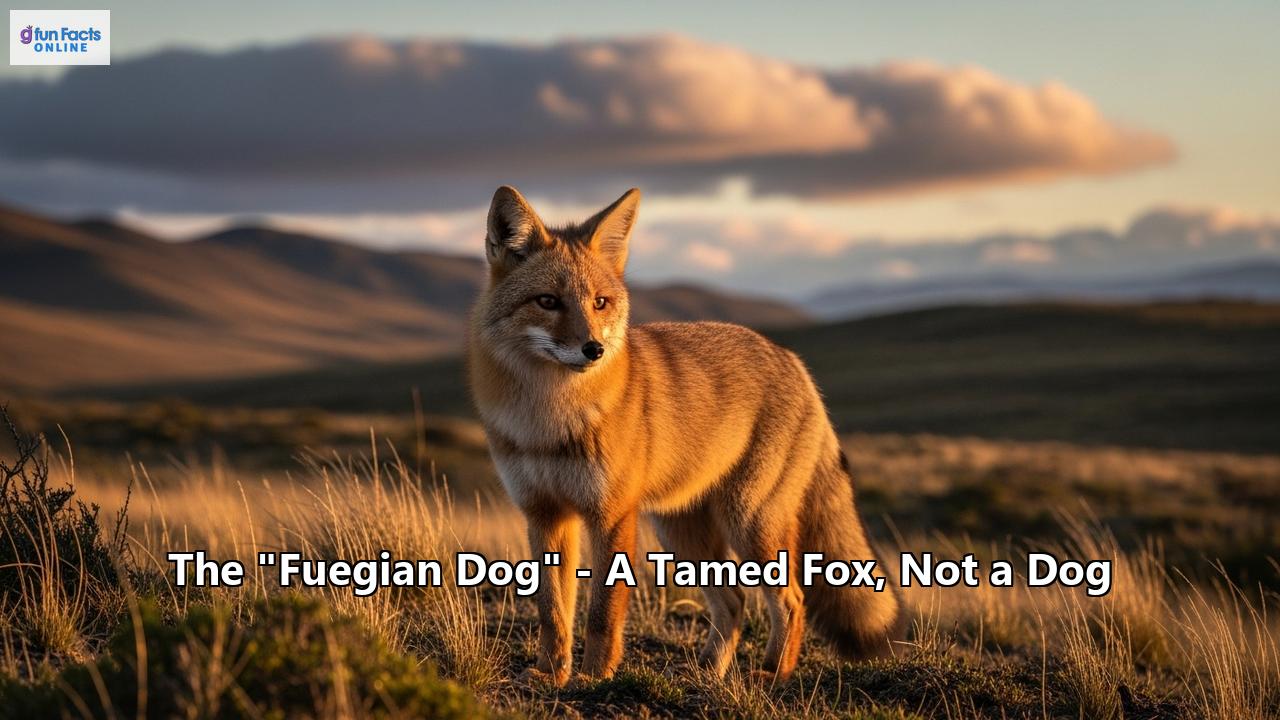
Surviving descriptions and a few precious photographs paint a picture of an animal that retained much of its wild essence. The Fuegian dog had erect ears, a sharp snout, a thick tail, and a coat of long, tawny-colored or sometimes entirely white fur. Its size was comparable to that of a wild culpeo, weighing between 5 to 13.5 kg (11 to 30 lbs), similar to a modern Shetland Sheepdog. Gauchos, the skilled horsemen of the region, tellingly referred to them as "maned dogs" due to their resemblance to the maned wolf. Author Lucas Bridges described them as looking like "a stunted cross between an Alsatian police dog and a wolf".
Despite its long association with humans, the Fuegian dog was never fully domesticated in the way we understand it today. It was often described as aloof, independent, and not particularly loyal. Julius Popper, one of the primary perpetrators of the Selk'nam genocide, wrote with a chilling detachment, "I never saw them, no matter how large their number, take an aggressive attitude or defend their masters when these were in danger". This suggests a relationship more akin to a partnership of convenience than the deep, protective bond often seen between humans and domestic dogs.
These animals were known to have a high prey drive and a tendency to wander, making them a potential threat to smaller animals. Their behavior was often compared to that of a dingo, a wild animal that lives in proximity to humans without being fully dependent on them. They would hunt on their own but also share the lives and spaces of their human companions.
A Unique Partnership: The Role of the Tamed Fox
The relationship between the indigenous peoples of Tierra del Fuego and their canid companions was multifaceted and deeply woven into the fabric of their daily lives. The Yámana language, for instance, contains over 160 words and phrases related to the 'dog', highlighting its cultural significance.
One of their primary uses was in hunting. While too small to take down large prey like guanaco, historical accounts from Antonio Coiazzi and even a mention in Charles Darwin's The Voyage of the Beagle confirm their effectiveness in hunting otters. They were also reportedly used to hunt tuco-tucos (a small rodent) and to drive fish into nets.
Perhaps their most crucial function was providing warmth. In the harsh, cold climate of Tierra del Fuego, the Fuegian dogs served as living blankets. The Selk'nam and Yaghan people would sleep surrounded by their canids, who would huddle tightly against them. Popper, in his writings, noted this, stating, "...my opinion is that the Fuegian dogs are only useful to complete the defective garment of the Indian, or better, as the Ona's heating furniture". This symbiotic relationship was vital for survival in a land of biting winds and frigid nights.
An Inevitable Extinction: A Story of Conflict and Loss
The arrival of European settlers in the late 19th and early 20th centuries spelled doom for both the indigenous peoples of Tierra del Fuego and their unique companions. The introduction of sheep and goat farming created a direct conflict with the Fuegian dog.
Thomas Bridges, a missionary in the 1880s, noted that the canids attacked his mission's goats. This "fierce" nature, an inherent trait of a partially wild animal, made them a perceived threat to the settlers' livestock. As ranchers expanded their territories, a systematic extermination of the Fuegian dog began. They were hunted down by European ranchers and headhunters, a tragedy that mirrored the concurrent genocide of the Selk'nam people.
When Silesian missionary Martin Gusinde visited the Yaghan people in 1919, he was struck by the absence of the dogs that had been so well-documented by earlier visitors. When he inquired about their whereabouts, he was told that the entire population had been exterminated, deemed "dangerous to men and cattle".
The last of the Fuegian dogs disappeared around the early 20th century, their extinction a direct consequence of colonization and the clash between a traditional way of life and the encroaching modern world. What had been a unique partnership spanning perhaps thousands of years was erased in a matter of decades.
Legacy of a Lost Canid
Today, all that remains of the Fuegian dog are a few taxidermized specimens in museums, including one at the Museo Salesiano Maggiorino Borgatello in Chile and another at the Fagnano Regional Museum in Argentina. These silent relics, combined with historical accounts and modern genetic analysis, are the only windows into the story of this enigmatic creature.
The tale of the Fuegian dog is a poignant reminder of the complex and varied relationships that can exist between humans and animals. It challenges our modern definition of "domestication" and reveals a different kind of partnership, one built on mutual benefit rather than complete subjugation. It is also a cautionary tale of extinction, illustrating how swiftly a unique species, and the culture intertwined with it, can vanish from the face of the Earth. The tamed fox of Tierra del Fuego may be gone, but its story continues to fascinate and educate, a ghost from the end of the world.
Reference:
- https://en.wikipedia.org/wiki/Fuegian_dog
- https://www.wikiwand.com/en/articles/Fuegian_dog
- https://patagoniamonsters.blogspot.com/2018/07/more-on-fuegian-dog-actually-fox.html
- https://dogell.com/en/dog-breed/fuegian-dog
- https://alchetron.com/Fuegian-dog
- https://www.sciencenews.org/article/fuegian-dog-fox
- https://strangeanimalspodcast.blubrry.net/tag/fuegian-dog/
- https://www.researchgate.net/publication/393670717_Foxes_as_pets_Case_study_of_the_Fuegian_Dog_and_its_relationship_to_extinct_Indigenous_cultures
- https://www.citedrive.com/en/discovery/foxes-as-pets-case-study-of-the-fuegian-dog-and-its-relationship-to-extinct-indigenous-cultures/
- https://www.reddit.com/r/Awwducational/comments/7brjms/the_fuegian_dog_was_a_domesticated_culpeo_the/
- https://www.youtube.com/watch?v=isR4BcEiTAo
- https://www.reddit.com/r/todayilearned/comments/ezzuxm/til_of_the_fuegian_dog_the_only_dog_naturally/
- https://core.tdar.org/document/509957/the-origin-of-the-fuegian-dog-reassessment-of-taxonomic-identity-and-domestication-process-using-whole-genome-sequencing