
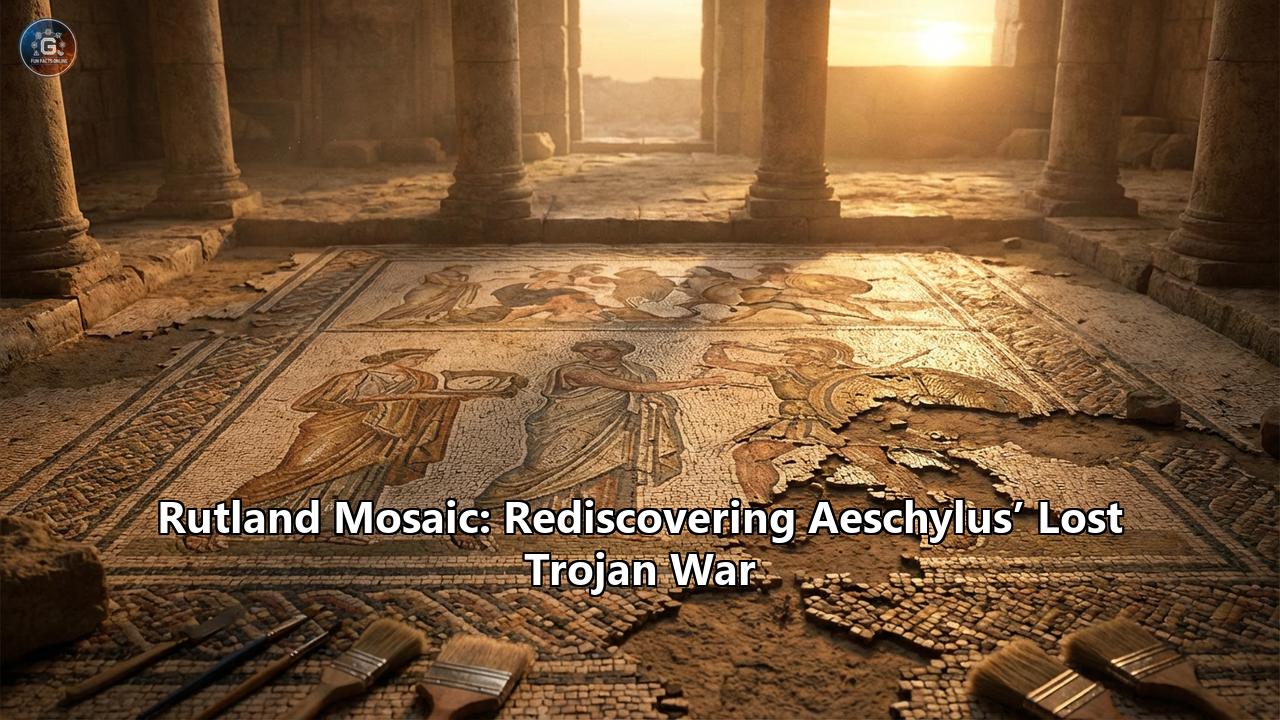
It was a discovery that began not with a grand expedition, but with a humble family walk across a windswept field in the English East Midlands. In the quiet solitude of the 2020 COVID-19 lockdown, Jim Irvine, the son of a local landowner, stumbled upon a scatter of pottery shards in a wheat field in Rutland. He could not have known then that beneath his boots lay one of the most significant archaeological finds of the century: a vibrant, bustling, and intellectually complex masterpiece of Roman art that would rewrite our understanding of classical culture in Britain.
Buried for nearly 1,700 years was a spectacular mosaic floor, depicting the climax of the Trojan War. But this was no ordinary illustration of Homer’s Iliad. As archaeologists and classicists would soon discover, the Rutland Mosaic told a different story—a "lost" version of the myth derived from the tragedies of Aeschylus, vanished plays that have not been seen in their entirety for two millennia.
This article explores the rediscovery of the Rutland Mosaic, its stunning artistic narrative, and the profound revelation it offers: that the elite of Roman Britain were not merely wealthy provincials, but sophisticated intellectuals plugged into the deep currents of Greco-Roman literature, keeping alive stories that history would eventually forget.
Part I: The Accidental Discovery
The story of the mosaic’s recovery is a testament to curiosity. In 2020, the United Kingdom was at a standstill. With the world paused by the pandemic, Jim Irvine took to walking the fields of his father’s land in Rutland, a small, landlocked county known for its reservoirs and rolling countryside rather than ancient monuments.
Irvine noticed something unusual in a field of wheat: a scatter of ceramic fragments—some unmistakably Roman—and oyster shells, which were a telltale sign of Roman dining habits, far from the sea. Intrigued, he consulted satellite imagery of the area. There, ghosted into the landscape, was a distinct crop mark—a clearly defined rectangular outline where the wheat grew differently due to stone walls beneath the soil. It looked like a building.
Driven by an amateur’s enthusiasm and a engineer's eye for detail, Irvine dug a small test pit. He did not hit a wall, but something flat and hard. Clearing away the dark earth, he revealed a flash of color: a guilloche border (a braided ribbon pattern) and the tessellated figure of a man.
Realizing the magnitude of what he had found, Irvine contacted the archaeological team at Leicestershire County Council. The professionals were initially skeptical—Roman villas are known in the area, but spectacular figural mosaics are incredibly rare. However, when the images were sent to the University of Leicester Archaeological Services (ULAS) and Historic England, the skepticism vanished. A team was rapidly assembled.
What they uncovered was the floor of a triclinium (dining room) measuring 11 meters by 7 meters. The preservation was extraordinary. Unlike many mosaics that are fragmented by centuries of plowing, large sections of this floor were intact, their colors vibrant, the narrative clear. It was the first Roman mosaic depicting the Trojan War ever found in the United Kingdom, and one of only a handful in the entire world.
Part II: The Mosaic Unveiled
The Rutland Mosaic is not a static decorative carpet; it is a graphic novel in stone. It is designed to be read, likely by guests reclining on dining couches (triclinia) arranged around the room’s perimeter. The central area, which would have been visible to all diners, features three distinct panels that narrate the conclusion of the Trojan War, specifically the duel between the Greek hero Achilles and the Trojan prince Hector.
Panel One: The Duel
The uppermost panel sets the scene of the conflict. It depicts the battle at the gates of Troy. We see the two great champions mounted in chariots, a detail that is historically interesting as it reflects a Romanized view of the combat or perhaps an archaic Greek artistic convention, as Homeric heroes usually dismounted to fight. The horses are rendered with dynamic energy, their legs churning, capturing the kinetic violence of the encounter.
Panel Two: The Desecration
The central panel is gruesome and heart-rending. It depicts the immediate aftermath of the duel. Achilles, having slain Hector, has attached the prince’s lifeless body to the back of his chariot. The mosaic captures the moment of desecration as Achilles whips his horses, dragging the corpse of his enemy through the dust. This scene is pivotal in the myth, showcasing the menis (rage) of Achilles—a rage so consuming it violates the sacred laws of respecting the dead. The artist has not shied away from the brutality, using the medium of stone to convey the raw emotional weight of the tragedy.
Panel Three: The Ransom
The third and most controversial panel is located at the bottom of the sequence. It depicts the resolution of the rage. King Priam, the elderly father of Hector, has come to the Greek camp to ransom his son’s body.
In the center stands a large set of weighing scales. On one side of the scale sits the body of Hector. On the other, a pile of gold is being heaped up. King Priam is visible, distinguishable by his Phrygian cap (a visual shorthand in Roman art for "Trojan" or "Easterner"). He is pleading or overseeing the transaction. Sitting opposite him is Achilles, watching the scales tip.
It was this specific detail—the scales—that made scholars pause. In Homer’s Iliad, which is the standard text for the Trojan War, this scene plays out differently. In Book 24 of the Iliad, Priam brings a vast ransom, but it is never weighed against the body. The ransom is a gift to soothe Achilles' anger, an exchange of honor. The weighing of the body against gold does not happen in Homer.
So, where did the artist of the Rutland Mosaic get this idea?
Part III: The Ghost of Aeschylus
The answer lies in the lost library of antiquity. While Homer was the bedrock of education, he was not the only voice. The 5th-century BC Athenian playwright Aeschylus, known as the "Father of Tragedy," wrote a trilogy of plays about the Trojan War known as the Achilleis. The trilogy consisted of The Myrmidons, The Nereids, and The Phrygians (also known as The Ransom of Hector).
These plays were immensely popular in antiquity but were lost during the collapse of the Roman Empire. Today, they survive only in fragments—a few lines quoted by other ancient authors or descriptions in lexicons.
However, we know one crucial detail about The Phrygians. Ancient commentators, specifically a scholiast (a writer of marginal notes) on the Iliad, mentioned that in Aeschylus’s version of the story, the ransom was not merely a gift. Aeschylus dramatized the scene with high theatricality: Hector’s body was placed on one side of a great scale, and Priam was forced to pile gold on the other side until it balanced the weight of his dead son.
This dramatic device—the "weighing of the soul" or body—literalized the value of the life lost. It emphasized the cruelty of Achilles, who in Aeschylus's version was perhaps colder and more transactional than the weeping, conflicted hero of Homer’s final book.
The Rutland Mosaic is a rare visual survival of this Aeschylean tradition. It proves that the "variant" myth was not only known but celebrated enough to be permanently installed in the floor of a wealthy home in Britannia.
This discovery forces a re-evaluation of the intellectual life of Roman Britain. For decades, traditional narratives suggested that Britain, on the periphery of the Empire, was a cultural backwater. The assumption was that the elite might own copies of Virgil or Homer, but deep knowledge of classical Greek tragedy—specifically lost plays of Aeschylus—was unexpected.
The owner of the Rutland villa was likely a person of paideia—the Greek term for a cultured, educated upbringing. By choosing this specific scene, they were signalling their sophistication to their guests. One can imagine a dinner party in the 4th century AD: the host, reclining with a goblet of wine, gestures to the floor and explains, "You, of course, know Homer’s telling. But have you seen how Aeschylus imagined the scene? Look at the scales..."
Part IV: The Villa and Its Context
The mosaic does not exist in a vacuum. The ULAS excavations revealed that the villa surrounding it is a massive complex, comparable in scale to the most famous villas in Britain, such as Chedworth or Fishbourne.
The ComplexGeophysical surveys and trenching have identified a sprawling estate. The main villa building was surrounded by a host of ancillary structures:
- Aisled Barns: Massive agricultural and industrial buildings, suggesting the estate was a major economic hub, likely producing grain or wool for the Roman market.
- Bath House: A private thermal suite, essential for any Roman of status, complete with hot and cold rooms (caldarium and frigidarium).
- Circular Structures: Interestingly, the site includes circular buildings, which may hint at a fusion of Roman architecture with local British Iron Age traditions, or perhaps shrines.
The villa appears to have been at its peak in the late 3rd and 4th centuries AD. This was a "Golden Age" for Roman villas in Britain. While the continent was often ravaged by barbarian incursions and civil wars, Britain remained relatively stable and prosperous during this period. The wealthy elite—both Roman officials and Romanized British nobility—invested heavily in their country estates, transforming them into palaces of culture.
The DemiseLike all great Roman sites, the Rutland villa eventually fell into silence. Excavations showed evidence of fire damage and later reuse. In the post-Roman period (the so-called "Dark Ages"), the mosaic was covered over, but the site was not abandoned. Archaeologists found human burials inserted into the rubble layers above the villa, suggesting the location retained a significance or "memory" in the landscape long after the villa’s roof had collapsed.
Part V: Artistic Connections and Craftsmanship
The Rutland Mosaic is not a crude provincial imitation; it is a work of high artistic merit. The style suggests it may have been created by a workshop of mosaicists who traveled, perhaps bringing pattern books from the continent.
Scholars have noted parallels between the Rutland imagery and other classical artifacts. The "weighing of Hector" scene appears on a few rare sarcophagi and, most notably, on a silver skyphos (cup) from the Berthouville Treasure found in France, and a relief in the Borghese collection.
However, the specific composition in Rutland is unique in Britain. The borders are intricate, featuring guilloche plaits and lotus motifs that frame the violent narrative with geometric order. The use of color is deliberate: the tesserae (cubes of stone) were carefully chosen from local limestone and sandstone, as well as fired ceramics (for reds) and glass paste (for brighter blues and greens), to create depth and shadow.
The presence of this specific iconography in Britain suggests a "shared culture" across the Roman Empire. A wealthy landowner in Rutland shared the same visual language and literary references as a senator in Rome or a merchant in Antioch. The "Aeschylean" version of the Trojan War was part of a pan-Mediterranean cultural currency.
Part VI: Preservation and the Future
Upon the conclusion of the major excavations in 2021 and 2022, a difficult decision had to be made. While the public appetite to see the mosaic was enormous, leaving a Roman mosaic exposed to the damp, freezing English weather is a recipe for destruction.
To preserve the artwork for future generations, Historic England and the landowners decided to re-bury the site. The mosaic was carefully covered with sand and geotextile membranes, then the soil was replaced. It returned to the darkness that had protected it for 1,700 years.
However, the site has been granted the highest level of protection as a Scheduled Monument. This ensures that no unauthorized digging or plowing can damage it.
The University of Leicester has since been working on detailed digital recreations. Using photogrammetry and high-resolution scanning taken during the excavation, they are creating virtual models that will allow the public to explore the villa floor by floor. This digital preservation allows the story of the Rutland Mosaic to be told without risking the physical integrity of the stones.
Conclusion: A Message from the Past
The Rutland Mosaic is more than just a pretty floor. It is a time capsule of storytelling. It reminds us that the myths we think we know—like the Iliad—were once fluid, living stories with many variations.
For the Roman owner of the villa, this floor was a declaration of identity. In a province far from the Mediterranean sun, they laid down a pavement that connected them to the heart of Greek culture. They chose to depict not the glorious victory of Achilles, but the tragic, transactional, and human moment of a father weighing gold for his son’s body—a scene of pathos derived from a play that has been lost to the winds of time.
Thanks to the sharp eyes of Jim Irvine and the work of modern archaeology, we have reclaimed a fragment of that lost library. The Rutland Mosaic stands as a vibrant testament to the enduring power of the Trojan War, a story that has captivated humanity from the fires of the Bronze Age to the wheat fields of 21st-century England.
Reference:
- https://the-past.com/news/return-to-rutland-roman-villa/
- https://www.sciencedaily.com/releases/2021/11/211130121655.htm
- http://the-history-girls.blogspot.com/2022/03/rutland-roman-villa-story-of-remarkable.html
- https://historicengland.org.uk/whats-new/news/rutland-roman-villa-mosaic-protected/
- https://archaeologymag.com/2025/12/ketton-mosaic-in-rutland-roman-britain/
- https://rutlandcountrylife.substack.com/p/jim-irvine-how-i-found-rutland-roman
- https://www.youtube.com/watch?v=2jDVSGnt03E
- https://ulasnews.com/2021/11/25/encounters-with-achilles/
- https://ulasnews.com/2021/11/25/the-rutland-roman-villa/
- https://www.labrujulaverde.com/en/2025/12/the-roman-mosaic-discovered-in-the-roman-villa-of-rutland-contains-a-lost-version-of-the-trojan-war-that-does-not-appear-in-the-iliad/
- https://le.ac.uk/news/2025/december/rutland-mosaic-long-lost-troy-story
- https://www.theoi.com/Text/AeschylusFragments2.html
- https://en.wikipedia.org/wiki/Phrygians_(play))
- https://news.ssbcrack.com/ancient-mosaic-reveals-uncommon-trojan-war-narrative-distinct-from-homers-iliad/
- https://www.discovermagazine.com/an-800-year-old-design-reveals-a-lost-trojan-tale-in-a-roman-mosaic-48367
- https://www.heritagegateway.org.uk/Gateway/Results_Single.aspx?uid=1477234&resourceID=5