
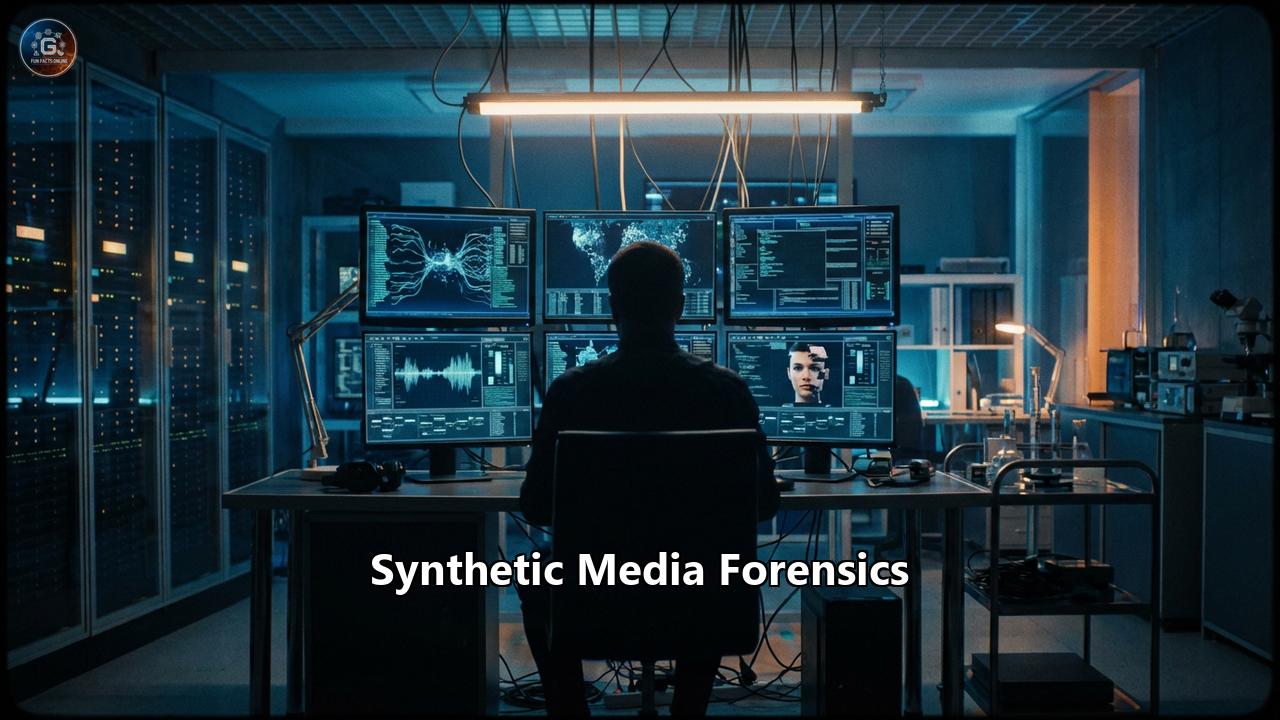
The era of "seeing is believing" has abruptly ended. We have entered a time where our eyes and ears—the primary senses we have relied upon for millennia to navigate reality—can be deceived with terrifying ease. A video of a world leader declaring war, a voice message from a panicked relative asking for money, or a photograph of a crime that never happened; all of these can now be conjured from the digital ether by artificial intelligence.
This is the age of synthetic media. And standing as the bulwark against this tide of digital deception is the rapidly evolving, high-stakes field of Synthetic Media Forensics.
This is not merely about spotting a bad Photoshop job. This is a scientific arms race, a battle waged in the invisible spectrums of pixel data, audio frequencies, and biological signals. It is a discipline that combines computer vision, signal processing, criminal psychology, and legal theory. It is the most critical new science of the 21st century.
The Death of Reality: How We Got Here
To understand the solution, we must first understand the problem. The manipulation of media is as old as media itself. In the 19th century, photographers manipulated negatives to create "spirit photography," claiming to capture ghosts. In the 20th century, Stalin's regime famously airbrushed purged officials out of photographs, leaving behind only empty spaces and the faint shadow of history rewriting itself.
But these were manual, labor-intensive processes. They required skill, time, and access to physical negatives.
The digital revolution of the 1990s and 2000s introduced tools like Adobe Photoshop, making manipulation easier but still requiring human artistry. A skilled forensic analyst could often spot the "cloning" of pixels or the mismatch in lighting shadows.
Then came the GAN (Generative Adversarial Network) in 2014. Invented by Ian Goodfellow, this machine learning framework changed everything. A GAN consists of two neural networks pitted against each other: a "Generator" that creates fake data, and a "Discriminator" that tries to detect it. The Generator learns from its mistakes, getting better and better until the Discriminator can no longer tell the fake from the real. It was automation applied to deception.
From GANs, we moved to Diffusion Models (like those powering Midjourney and DALL-E) and Large Language Models (like GPT). Suddenly, creating a photorealistic image of the Pope in a Balenciaga puffer jacket or a video of Tom Cruise playing golf didn't require a special effects studio. It required a text prompt and a few seconds of computing time.
The barrier to entry dropped to zero. The volume of synthetic media skyrocketed. And the forensic community realized that human intuition was no longer enough.
The Taxonomy of the Fake
Synthetic media forensics is not a monolith; it is a collection of specialized disciplines, each targeting a different type of fabrication.
1. Deepfakes (Face Swaps and Re-enactment)
The most famous category. Deepfakes replace the face of one person with another (face swap) or manipulate the facial expressions of a target to say things they never said (lip-syncing/re-enactment).
- The Forensic Challenge: These are often video-based, meaning the analyst has temporal data to work with. The flaw is often in the movement over time.
2. Entirely Synthetic Persons (GAN Faces)
Websites like "ThisPersonDoesNotExist.com" generate faces of people who have never been born.
- The Forensic Challenge: These images are often perfect in the center but fall apart at the edges. Backgrounds are often surreal, and accessories (like earrings) may be mismatched.
3. Text-to-Image / Text-to-Video (Generative AI)
Tools like Sora or Midjourney create scenes from scratch.
- The Forensic Challenge: These engines struggle with the laws of physics. Reflections might not match the object, fingers might be snarled (though this is improving), and text in the background is often gibberish.
4. Audio Cloning (Voice Synthesis)
AI can now clone a person's voice with just three seconds of reference audio.
- The Forensic Challenge: The human ear is easily fooled, but the machine is not. Synthetic voices often lack the subtle "micro-tremors" of human vocal cords and the natural breathing patterns of a biological speaker.
The Science of Detection: How Forensics Works
If AI is the criminal, Synthetic Media Forensics is the detective. But unlike Sherlock Holmes looking for footprints, these detectives look for mathematical artifacts.
Visual Forensics: The Invisible Clues
1. Biological Signals (The Heartbeat in the Pixels)One of the most fascinating breakthroughs in forensics is Photoplethysmography (PPG). When your heart beats, it pumps blood into your face. This causes a microscopic change in the color of your skin—too subtle for the human eye to see, but visible to a camera.
Real video contains this "pulse signal." The skin gets slightly redder, then paler, in perfect rhythm with a heartbeat.
- The Flaw: Most deepfakes are generated frame-by-frame or by mapping texture onto a mesh. They do not simulate a cardiovascular system. A forensic tool like Intel’s FakeCatcher looks for this heartbeat. If the subject in the video has no pulse, they are a digital ghost.
In the early days of deepfakes, the algorithms didn't know how often humans blinked. The result was unblinking, stare-y faces. While this has been corrected, gaze convergence is still a weak point.
When a real person looks at a camera, their eyes converge on a specific focal point. In deepfakes, the eyes are often generated independently. A geometric analysis often reveals that the left eye is looking at a different point in space than the right eye, creating a subtle "divergence" that the brain registers as "uncanny" but the computer registers as "fake."
3. Frequency Analysis (The Fourier Transform)An image is just data. We usually view it in the "spatial domain" (pixels arranged in rows and columns). But forensic analysts can convert the image into the Frequency Domain.
Real cameras leave a specific "noise fingerprint" based on their sensor (PRNU - Photo Response Non-Uniformity). Generative AI leaves a different kind of fingerprint.
In the frequency spectrum, upscaling artifacts (checkerboard patterns) often appear because GANs generate images at low resolution and then upscale them. These distinct patterns are invisible to the naked eye but glow like a neon sign in a frequency histogram.
4. Lighting and Physics ConsistencyThe real world obeys the laws of physics. Light travels in straight lines. Reflections in the eyes (corneal reflections) must match the environment.
Forensic experts analyze the specular highlights in the eyes. If the reflection in the left eye shows a window, the right eye must also show that window, distorted correctly by the curvature of the cornea. Generative AI often "paints" eyes that look realistic individually but don't match each other or the scene's lighting source.
Audio Forensics: The Ghost in the Machine
Audio deepfakes (voice cloning) are arguably more dangerous than video because we are less critical of what we hear, especially over the phone.
1. Spectral AnalysisHuman speech covers a specific range of frequencies. However, many telephone lines and compression algorithms cut off high frequencies (above 8kHz).
AI models, when generating audio, often struggle to replicate the "noise floor" (the silence between words) or the high-frequency harmonics of real speech. A spectrogram (a visual representation of audio frequencies over time) can reveal "cuts" where the audio phase doesn't line up, or "robotic" smoothness in frequencies that should be chaotic.
2. Breathing and Pause PatternsHumans need to breathe. We take micro-breaths between sentences. We pause to think. Our pitch rises when we are stressed and lowers when we are calm.
Early AI voices were too perfect—they never breathed. Modern AI adds breathing sounds, but often in the wrong places (e.g., in the middle of a phrase rather than at a comma). Forensic linguists analyze the prosody (rhythm and intonation) to catch these unnatural cadences.
The Arms Race: The Cat and Mouse Game
The field of forensics is not static; it is reactive. Every time a forensic researcher publishes a paper on how to detect deepfakes, the creators of deepfakes read it and update their models to hide that flaw.
- Round 1: Forensics noticed deepfakes didn't blink.
Counter: Deepfake creators trained models on blinking datasets.
- Round 2: Forensics noticed the lack of a heartbeat (PPG).
Counter: Newer diffusion models are beginning to simulate subsurface scattering and skin texture variations that mimic blood flow.
- Round 3: Forensics noticed frequency artifacts in the background.
Counter: Attackers now apply "Gaussian noise" or re-compress the video to scrub these high-frequency artifacts, a technique known as Anti-Forensics.
This has led to the development of Adversarial Training. Forensic detectors are now being used during the creation process of deepfakes to tell the generator, "I can spot you, try again," until the generator produces something undetectable.
This cycle implies a frightening truth: Passive detection eventually fails. We cannot rely solely on analyzing the pixels. We need a new approach.
The Societal Impact: Why Forensics Matters
The stakes of this technology extend far beyond spotting a fake celebrity video.
1. Democracy and Elections
The 2024 global election cycle saw the first major deployment of weaponized synthetic media.
In Slovakia, just days before an election, a fake audio recording was released where a candidate appeared to discuss rigging the vote. It went viral during a "media blackout" period, meaning the candidate couldn't legally go on TV to debunk it. He lost the election.
In New Hampshire, a robocall mimicking Joe Biden told voters to stay home.
Forensics is the only shield preventing the complete hijacking of the democratic process. The ability to quickly verify or debunk a video within hours is now a matter of national security.
2. The "Liar's Dividend"
This is a perverse side effect of deepfakes. As the public becomes aware that anything can be faked, real evidence loses its power.
A politician caught on tape accepting a bribe can simply shrug and say, "It's a deepfake." This is the Liar's Dividend: the benefit dishonest actors get from the existence of synthetic media.
Forensics is needed not just to expose the fake, but to authenticate the real. We need to be able to prove, mathematically, that a video is* genuine, to prevent truth from being dismissed as fiction.
3. The CEO Fraud and Financial Crime
In 2024, a finance worker in Hong Kong was tricked into transferring $25 million to scammers. He was suspicious at first, but then he joined a video conference call. He saw his Chief Financial Officer and several other colleagues. They looked real. They sounded real.
They were all deepfakes. The worker was the only real person on the call.
This "Social Engineering 2.0" renders traditional security training obsolete. You can't tell employees to "verify with a call" if the voice on the call can be cloned. Forensic tools must now be integrated into communication platforms like Zoom and Microsoft Teams to flag synthetic video in real-time.
4. The Legal System
Courts rely on video evidence. Dashcam footage, body cams, CCTV.
If a defendant produces a video showing them at a restaurant during the time of a murder, how does the jury know it's real? If a prosecutor produces a recording of a confession, is it admissible?
Legal forensics is booming. Expert witnesses are no longer just analyzing bullet trajectories; they are analyzing video compression artifacts. We are moving toward a future where every piece of digital evidence must come with a "chain of custody" certificate to be accepted in court.
The Future of Trust: Provenance and Watermarking
Since detection is a losing battle (because AI will eventually become perfect), the industry is pivoting toward Provenance.
Instead of trying to detect if an image is fake, we should try to verify if it is real.
C2PA and Content Credentials
The Coalition for Content Provenance and Authenticity (C2PA) is a major industry standard supported by Adobe, Microsoft, Intel, and the BBC.
The idea is "digital nutrition labels." When a photo is taken, the camera cryptographically signs the file. This signature records the date, time, location, and the fact that it was captured by a sensor, not generated by an algorithm.
If you edit the photo in Photoshop, that edit is recorded in the history.
When a user sees the image online, they can hover over a "CR" (Content Credentials) icon to see the entire history of the image. If the signature is broken or missing, the user knows to be skeptical.
Invisible Watermarking
Companies like Google (SynthID) and Meta are developing techniques to embed invisible watermarks into AI-generated content.
These aren't stamps on the image; they are statistical patterns woven into the pixels or the audio waveform. Even if you crop, rotate, or change the color of the image, the watermark remains detectable by software.
However, this requires the cooperation of the AI companies. Open-source models (which anyone can run in their basement) will not voluntarily add these watermarks, leaving a massive loophole.
Conclusion: The Guardian of Truth
Synthetic Media Forensics is not a magic wand. It is a shield that requires constant maintenance.
We are moving into a "Zero Trust" world for media. In the past, we assumed a photo was real until proven fake. In the future, we must assume digital content is synthetic until proven authentic.
The forensic analysts, the algorithm hunters, and the provenance architects are the new guardians of our shared reality. Their work is the difference between a society grounded in facts and one lost in a hallucination. As AI grows more powerful, the forensic lens must grow sharper. The war for truth has only just begun.
Reference:
- https://www.realitydefender.com/insights/history-of-deepfakes
- https://en.wikipedia.org/wiki/Synthetic_media
- https://www.brennancenter.org/our-work/research-reports/regulating-ai-deepfakes-and-synthetic-media-political-arena
- https://www.coherentmarketinsights.com/industry-reports/deepfake-technology-market
- https://www.eset.com/blog/en/home-topics/cybersecurity-protection/how-to-detect-deepfakes/
- https://www.cjr.org/tow_center/what-journalists-should-know-about-deepfake-detection-technology-in-2025-a-non-technical-guide.php
- https://www.researchgate.net/publication/395329220_Deepfake_Detection_and_Multimedia_Forensics_Investigating_Synthetic_Media_Image_Forgery_and_Video_Manipulation_in_Cybercrime_Cases
- https://constitutionaldiscourse.com/synthetic-media-and-politics-deepfakes-misinformation-and-the-future-of-democracy-part-i/
- https://www.media.mit.edu/projects/detect-fakes/overview/
- https://www.zerofox.com/intelligence/brief-detecting-and-countering-synthetic-media/
- https://www.ongota.com/evolving-landscape-deepfake-detection-current-challenges-strategic-imperiatives/