
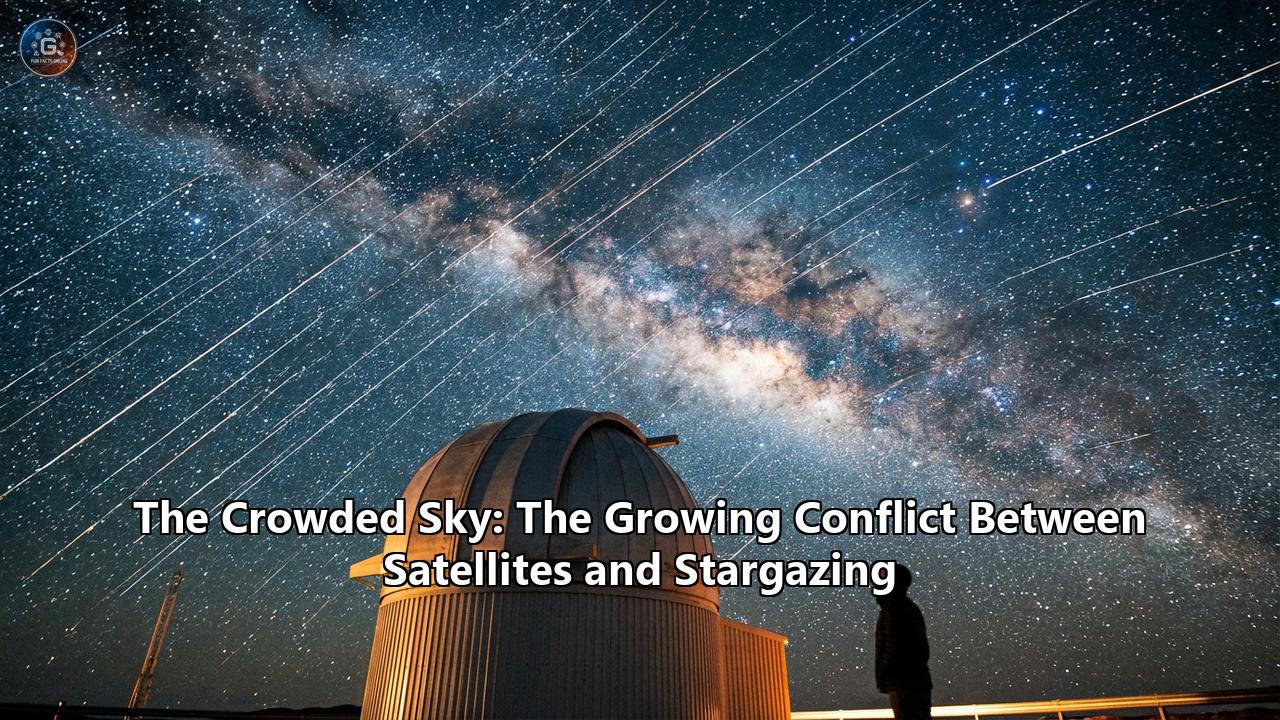
The night sky is no longer what it was a decade ago. If you stand in a dark field tonight, away from the city lights, and look up, your eyes might still trace the ancient patterns of Orion or the Great Bear. But if you wait long enough, you will see something else: a silent, steady point of light moving in a straight line, defying the rotation of the stars. Then another. Then perhaps a whole train of them, marching across the zenith like pearls on a string.
These are not meteors, nor are they alien visitors. They are the new architects of our orbital environment—mega-constellations of satellites designed to beam high-speed internet to every corner of the globe. While they promise a revolution in connectivity, they have sparked an unprecedented conflict that pits the future of global telecommunications against the oldest of human sciences: astronomy.
This is the story of the crowded sky—a crisis of light, data, and debris that threatens to close our window to the universe forever.
Part I: The New Space Race
For over half a century, "space" was the domain of governments. Satellites were large, expensive, and relatively few in number. In 2010, there were only about 1,000 active satellites orbiting Earth. They were invisible to the naked eye, silently handling our GPS, weather forecasting, and military communications.
Then came the private space revolution.
Driven by reusable rockets and the miniaturization of electronics, companies like SpaceX, OneWeb, Amazon (Project Kuiper), and AST SpaceMobile began a race to colonize Low Earth Orbit (LEO). Their goal was noble in principle: to provide low-latency, high-speed internet to the 3 billion people on Earth who currently lack reliable access. To do this, however, requires physics that dictates a new approach.
Old-school communications satellites sit in Geostationary Orbit (GEO), 35,000 kilometers away. That distance creates a time lag—latency—that makes things like video calls or gaming frustrating. To eliminate that lag, the new satellites must orbit much closer, between 300 and 1,200 kilometers. But at that low altitude, a single satellite can only "see" a small patch of Earth. To cover the whole planet, you don't need one satellite; you need thousands.
The Numbers GameThe scale of this expansion is difficult to comprehend.
- Pre-2019: Humanity had launched roughly 9,000 objects into space in total since Sputnik in 1957.
- 2024-2025: SpaceX alone has launched over 7,000 Starlink satellites.
- The Future: Filings with the International Telecommunication Union (ITU) and the FCC suggest plans for over 100,000 satellites in the coming decade.
This is not linear growth; it is an exponential explosion. We are encasing our planet in a shell of moving metal and silicon. And while the engineers looked at latency and bandwidth, they failed to account for one crucial factor: sunlight.
Part II: The Erasure of the Dark
In May 2019, the first "train" of 60 Starlink satellites was deployed. Amateur astronomers and casual stargazers were stunned to see a bright line of lights traversing the sky. It was a viral sensation, but for the professional astronomical community, it was a wake-up call that rang like a fire alarm.
The Optical ThreatAstronomers rely on "long exposure" photography. To see the faint light of a distant galaxy formed shortly after the Big Bang, a telescope must stare at the same spot of sky for minutes or even hours, gathering photons like a bucket gathers rain.
When a satellite passes through the field of view of a telescope during a long exposure, it doesn't just appear as a dot; it draws a bright, solid streak across the image. It is equivalent to someone shining a flashlight into your camera lens while you try to take a photo of a firefly.
- Saturation: The streak is often so bright that it saturates the telescope's detector, creating "ghost images" and electronic cross-talk that ruins not just the pixels under the streak, but the entire data set.
- The Twilight Zone: Satellites are most visible just after sunset and just before sunrise—the exact times when they reflect sunlight down to a dark Earth. Crucially, this is also the only time astronomers can hunt for Near-Earth Objects (NEOs)—asteroids that orbit between Earth and the Sun. These "city-killer" asteroids can only be spotted in the twilight. A sky crowded with moving bright spots makes spotting these faint, moving rocks significantly harder, potentially blinding our planetary defense systems.
The poster child for this conflict is the Vera C. Rubin Observatory in Chile. Set to begin operations soon, this massive telescope is designed to photograph the entire southern sky every three nights. It has an incredibly wide field of view. Simulations suggest that by 2030, 30% to 40% of all images taken by the Rubin Observatory during twilight could be marred by satellite streaks. The "Legacy Survey of Space and Time," a project designed to unravel the mysteries of dark energy and dark matter, is being vandalized before it even begins.
BlueWalker 3: The New StarIf Starlink was a concern, BlueWalker 3 was a shock. Launched by AST SpaceMobile, this prototype satellite features a massive 64-square-meter antenna array. When it unfurled in orbit, it became one of the brightest objects in the night sky, outshining 99% of the visible stars. It demonstrated that without regulation, commercial entities could launch objects that rival the brightness of the planets, fundamentally altering the appearance of the constellations themselves.
Part III: The Broken Silence
The threat is not just visible; it is audible.
Radio astronomers listen to the universe. They tune into frequencies so faint that the energy collected by all radio telescopes in history is less than the energy of a falling snowflake. To do this, they build massive dishes in "Radio Quiet Zones"—remote areas where cell phones and Wi-Fi are banned.
But you cannot build a wall high enough to block a satellite flying overhead.
"Leaky" ElectronicsSatellite constellations beam internet data down to Earth using specific radio frequencies. However, recent studies using the LOFAR telescope in Europe revealed a disturbing finding: Starlink satellites were "leaking" unintended electromagnetic radiation. Their onboard electronics—power inverters, clocks, and processors—were humming with radio noise that drifted into protected astronomy bands.
For a radio telescope, a satellite passing overhead is like a roaring jet engine flying over a library. It deafens the sensitive instruments. As these constellations grow, the "radio quiet" zones will become extinct. The search for the faint whisper of hydrogen from the early universe, or the techno-signatures of extraterrestrial civilizations (SETI), could be drowned out by the noise of our own internet usage.
Part IV: Astrocolonialism and the Stolen Sky
The loss of the night sky is not just a scientific loss; it is a cultural theft. For millennia, the sky has been the canvas for human mythology, navigation, and timekeeping.
Indigenous Sky KnowledgeFor Indigenous peoples, the sky is often as important as the land. The Aboriginal Australians, for example, look for the "Emu in the Sky"—a constellation defined not by bright stars, but by the dark clouds of dust within the Milky Way. When thousands of satellites illuminate the background sky (a phenomenon known as "orbital skyglow"), the contrast needed to see these dark constellations vanishes.
Critics have termed this "Astrocolonialism." Just as colonial powers once claimed Indigenous lands without consent, private corporations and a few wealthy nations are now claiming the sky. They are unilaterally altering a global commons—the view of the universe that belongs to every human being—for the benefit of subscribers in the Northern Hemisphere. A child born in the Andes or the Outback in 2030 may never see a pristine night sky, their view forever scarred by a grid of moving artificial lights.
Part V: The Kessler Syndrome and the Prison Earth
The conflict extends beyond observation to physical safety. The sheer density of traffic in Low Earth Orbit is creating a minefield.
The Chain ReactionIn 1978, NASA scientist Donald Kessler proposed a terrifying scenario. If the density of objects in orbit gets high enough, a single collision between two satellites could generate thousands of pieces of debris. Those pieces would then smash into other satellites, creating a cascading chain reaction of destruction.
This is the Kessler Syndrome.
We are already seeing the warning signs.
- Near Misses: Automated collision avoidance systems on Starlink satellites are now triggered thousands of times a day. They are dodging debris and other satellites in a chaotic orbital dance.
- The Debris Cloud: In 2021, Russia destroyed one of its own satellites in a missile test, creating a cloud of debris that forced astronauts on the International Space Station to shelter in their escape pods.
- The Result: A full-blown Kessler event would turn LEO into a shredding machine. It would destroy our GPS, weather, and telecommunications infrastructure. Worse, the debris belt would act as a barrier, making it too dangerous to launch rockets through it. We would be trapped on Earth, imprisoned by a cage of our own junk.
There is a second, often overlooked environmental threat. LEO satellites are designed to be "disposable." They burn up in the atmosphere after 5 years. But they don't just disappear. They vaporize into aluminum oxide and other chemical particulates. Scientists warn that depositing tons of aluminum into the upper atmosphere could trigger unpredictable geo-engineering effects, potentially damaging the ozone layer or altering the Earth's albedo (reflectivity) and climate.
Part VI: The Search for Solutions
Is the situation hopeless? Not necessarily. The astronomical community, rather than just protesting, has moved to diplomacy and engineering.
1. Engineering the SatellitesFollowing the outcry over the first Starlink launch, SpaceX began working with astronomers. They developed "DarkSat" (using dark coatings) and "VisorSat" (using sunshades) to block sunlight from reflecting off the antennas. While these measures helped reduce brightness, they didn't solve the problem entirely. Visors interfered with laser links, and the sheer number of satellites still creates a collective glow. However, it proved that the industry can adapt if pressured.
2. Software MitigationAstronomers are developing AI algorithms to "clean" images, identifying and subtracting satellite streaks. This works for bright streaks, but it introduces noise and cannot recover the data hidden behind the streak. It is a band-aid, not a cure.
3. The Regulatory VacuumThe root of the problem is legal. The Outer Space Treaty of 1967 was written when only two nations could launch rockets. It did not anticipate mega-constellations. Currently, the Federal Communications Commission (FCC) in the US grants licenses based on radio interference, not light pollution. There are no binding international laws that limit how bright a satellite can be.
The International Astronomical Union (IAU) has established the Centre for the Protection of the Dark and Quiet Sky from Satellite Constellation Interference. They are lobbying the UN Committee on the Peaceful Uses of Outer Space (COPUOS) to treat the dark sky as a protected environment, much like Antarctica or the High Seas. They argue for "Space Traffic Management"—a global air traffic control for orbit.
Conclusion: A Choice of Heritage
We stand at a crossroads.
On one path lies a hyper-connected world where high-speed internet is a universal utility, democratizing information and education.
On the other path lies the preservation of our cosmic heritage—the ability to look up and see the universe as it truly is, and the ability of science to warn us of threats and answer the deepest questions of our existence.
It is a false dichotomy to say we must choose one. We can have internet and astronomy, but only if we abandon the "Wild West" mentality of the current space race. We need strict limits on satellite brightness. We need mandatory debris removal plans. We need to reserve orbital shells for science. And we need to recognize that the sky is not a resource to be mined by the first company to get there, but a global commons that belongs to us all.
If we fail to act, the next generation will not look up and wonder at the stars. They will look up and see only a mirror of ourselves, a ceiling of moving lights shutting us in, alone in the dark.
Reference:
- https://nasaspacenews.com/2025/01/urgent-warning-kessler-syndrome-could-collapse-modern-technology/
- https://indiandefencereview.com/kessler-syndrome-unfolding-earths-orbit/
- https://www.sea-astronomia.es/sites/default/files/070_galadi_constellationoped_mar20_des.pdf
- https://www.space.com/bluewalker-3-satellite-interference-worries-astronomers
- https://www.skyatnightmagazine.com/space-science/astronomy-affected-by-satellite-mega-constellations
- https://cps.iau.org/news/un-meeting-features-satellite-impact-on-astronomy/
- https://kivi.nl/communities/vakafdelingen/telecommunicatie/nieuws/radio-waves-leaking-from-large-satellite-constellations-could-jeopardize-astronomical-exploration
- https://space4peace.org/the-environmental-impact-of-starlinks-satellite-constellation/
- https://www.slashgear.com/1410210/giant-satellite-causing-problems-bluewalker-3-explained/
- https://worldcrunch.com/opinion-analysis/space-biodiversity/
- https://astrobackyard.com/satellite-constellations/
- https://en.wikipedia.org/wiki/Kessler_syndrome
- https://floridamedianow.com/2025/10/the-growing-risk-above-how-space-junk-threatens-the-future-of-orbit/
- https://aasnova.org/2020/04/13/astronomy-impacts-of-satellite-megaconstellations/
- https://bigthink.com/starts-with-a-bang/technology-save-astronomy-light-pollution/
- https://medium.com/starts-with-a-bang/can-technology-save-astronomy-from-light-pollution-53ea85192f22