
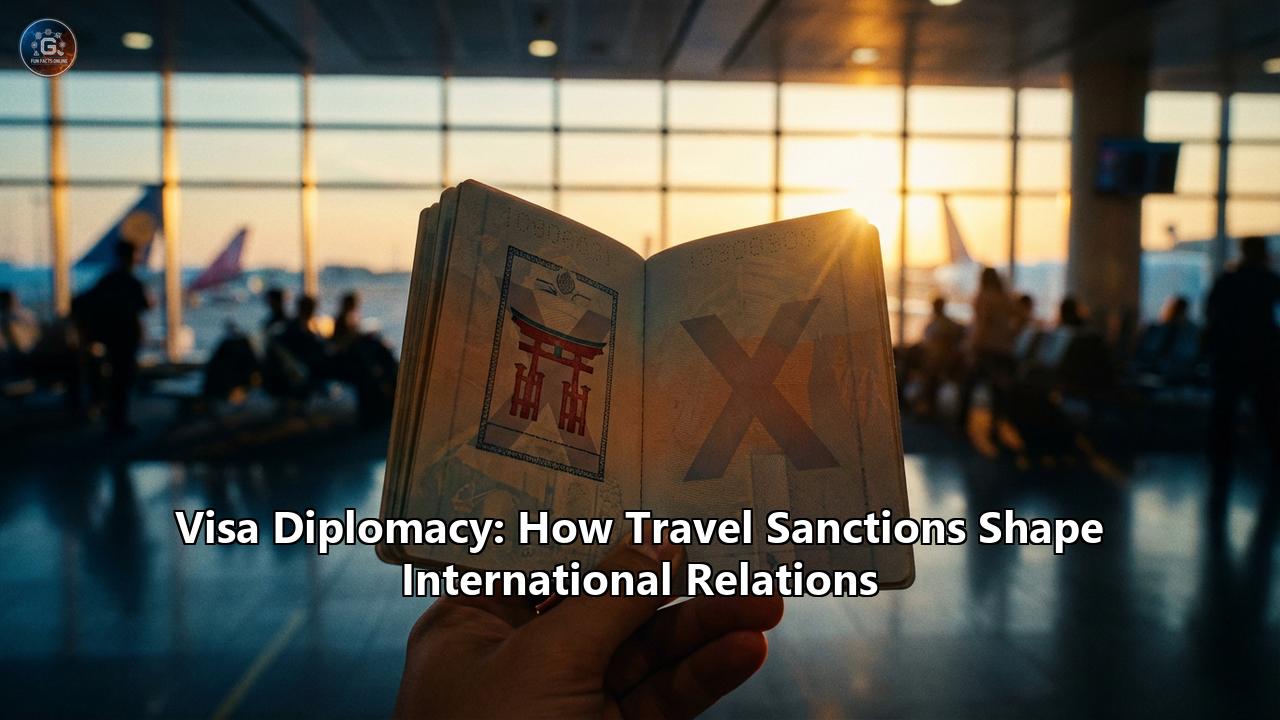
Chapter I: The Weaponization of the Stamp
In the freezing dawn of January 1, 2026, the world woke up to a new reality of borders. It wasn’t a reality built of concrete and razor wire, nor was it defined by the physical presence of soldiers at checkpoints. It was a digital reality, silent and instantaneous, enacted by the stroke of a pen in Washington D.C. and the updating of servers in Brussels, Beijing, and London.
When Presidential Proclamation 10998 took effect at 12:01 a.m. EST, effectively suspending visa issuance for nationals of 19 countries, it did not just strand thousands of travelers; it signaled the definitive maturation of a new era in international relations: the era of Visa Diplomacy.
For decades, the visa was viewed largely as a bureaucratic administrative tool—a “permission slip” to enter a foreign territory, designed to manage flow and screen for security risks. But in the post-2020 world, and specifically in the volatile geopolitical landscape of 2026, the visa has transcended its administrative roots. It has become a primary weapon of statecraft, a lever of economic coercion, a shield of national identity, and a blunt instrument of retaliation.
Today, the ability to cross a border is no longer merely a matter of buying a ticket and packing a bag. It is a privilege calculated by algorithms, traded in diplomatic backrooms, and sold to the highest bidder through “Golden Visa” schemes. As physical wars rage in Eastern Europe and tensions simmer in the Indo-Pacific, the “Paper Wall” has become as formidable as the Iron Curtain ever was. This article explores the intricate machinery of this new world order, examining how travel sanctions are reshaping alliances, crushing economies, and redefining what it means to be a global citizen.
Chapter II: The Historical Arc—From Open Roads to Closed Servers
To understand the shock of the 2026 bans, one must look back at the anomaly of the pre-1914 world. Before the First World War, passports were rare, often considered optional. A traveler could theoretically move from London to Moscow or Paris to Constantinople with little more than a train ticket and a calling card. Borders were porous membranes, not sealed barriers.
The “temporary” war measures of 1914 introduced the modern passport system, a mechanism intended to control espionage and manage manpower. As with many temporary government programs, it became permanent. Yet, for the latter half of the 20th century, the trend appeared to be toward liberalization. The Schengen Agreement in Europe dismantled internal borders; the U.S. Visa Waiver Program expanded; and globalization promised a "borderless world."
That trajectory fractured on September 11, 2001. The subsequent security architecture turned the visa from a travel document into a dossier of biometric and intelligence data. But it was the 2020s that weaponized it.
The turning point was arguably the Russian invasion of Ukraine in 2022. The European Union’s decision to suspend visa facilitation agreements and, in the case of the Baltic states and Poland, to ban Russian tourists entirely, broke a taboo. It established the precedent that citizens could be collectively punished for the actions of their government via travel bans. It stripped the visa of its "neutrality."
By 2026, this logic has metastasized. The "tit-for-tat" expulsions of diplomats have been replaced by "tit-for-tat" visa suspensions. When a nation feels slighted, it does not just recall an ambassador; it shuts its digital doors to the rival’s students, tourists, and business leaders. The "border" is no longer a line on a map; it is a policy decision made thousands of miles away, often before the traveler even leaves their house.
Chapter III: The Geopolitical Battlefield of 2026
As we survey the globe in February 2026, three distinct theaters of Visa Diplomacy have emerged, each defined by its own strategic logic.
1. The American Fortress: Proclamation 10998
The United States has long used visa policy as a security filter, but the recent escalation under the current administration marks a shift toward using it as a tool of comprehensive deterrence. The suspension of visas for 19 nations—including conflict zones like Sudan and Syria, but also expanding to nations with "unreliable information sharing protocols"—is a doctrine of risk elimination.
The logic, as outlined by the White House, is that if a country cannot provide 100% verifiable criminal and terrorist background data on its citizens, the U.S. will simply turn off the tap. This "Guilty Until Proven Verifiable" approach has sent shockwaves through the diplomatic community. It has effectively severed people-to-people ties with significant portions of the Global South, creating a vacuum that rival powers are eager to fill.
2. The European Paradox: Digital Walls and Golden Gates
Europe in 2026 is a study in contradiction. On one hand, the Schengen Area has become a digital fortress. The full rollout of the ETIAS (European Travel Information and Authorization System) and the digitalization of the visa application process have created a "pre-crime" screening layer. The new EU Visa Strategy, unveiled in late January 2026, explicitly links visa policy to "hybrid attacks" and "migration weaponization."
On the other hand, Europe remains the playground of the Golden Visa. While a Sudanese doctor may wait 18 months for a conference visa, a crypto-millionaire can purchase residency in Hungary, Greece, or Italy for an investment of €250,000 to €500,000. These "Citizenship by Investment" (CBI) programs have become a flashpoint. They are viewed by security hawks as backdoors for money launderers and spies, yet they are fiercely defended by Finance Ministries addicted to the foreign capital. The commodification of the border is complete: access is denied to the needy but sold to the wealthy.
3. The African Ultimatum: "Deportation Diplomacy"
Perhaps the most cynical development of 2026 is the "Visa Blackmail" scandal involving the United Kingdom and several African nations, including Angola, Namibia, and the DRC. Faced with a domestic migration crisis, London weaponized its visa regime not to keep people out, but to force other nations to take people back.
By threatening to suspend all visa issuance for the "elites"—politicians, diplomats, and business leaders—of these African nations, the UK forced their governments to accept charter flights of deportees. This strategy targets the decision-makers directly. A government minister in Kinshasa may not care if a charter flight lands, but they care deeply if their own children cannot return to university in London or if they cannot visit their property in Kensington. This personalized targeting of the ruling class represents a ruthless, effective evolution of visa diplomacy.
Chapter IV: The Economics of Exclusion
The economic collateral damage of these policies is staggering, measured in the hundreds of billions of dollars. Visa restrictions function as non-tariff trade barriers, choking off the flow of human capital that lubricates the global economy.
The Tourism Deficit
The tourism industry is the canary in the coal mine. In the wake of the U.S. Proclamation 10998, the U.S. Travel Association has already forecast a $7 billion loss in revenue for 2026 alone. Every rejected visa is a hotel room not booked, a Broadway ticket not sold, and a meal not eaten.
We see a similar phenomenon in the UK. Post-Brexit friction and the removal of ID card entry for EU citizens decimated school group travel. By 2026, the cumulative loss is palpable. Meanwhile, countries with open visa regimes are harvesting the surplus. Destinations like Turkey, Thailand, and Malaysia, which have aggressively liberalized their visa requirements for Chinese, Indian, and Russian tourists, are seeing double-digit growth. Visa openness is the new competitive advantage in global tourism.
The Scientific "Iron Curtain"
A quieter, yet more dangerous crisis is brewing in the laboratories and universities of the West. Science is inherently collaborative, yet the "Visa Curtain" is severing the arteries of knowledge exchange.
Reports from 2025 and early 2026 highlight a "collaboration crisis" in American and European academia. Conferences in Boston or Berlin are increasingly devoid of voices from the Global South, not because of a lack of expertise, but because of a lack of visas. When top researchers from Iran, China, or India face 12-month administrative processing delays, they stop applying. They take their knowledge, their patents, and their students to Singapore, Dubai, or Toronto.
The long-term cost of this is incalculable. Innovation thrives on diversity. By homogenizing the pool of researchers allowed inside the "fortress," Western nations risk stagnating their own technological edge. The cure for the next pandemic or the breakthrough in fusion energy might be stuck in a "Administrative Processing" pile at a consulate in Lagos.
Chapter V: The Human Cost—The "Emotional Tax"
Behind the geopolitics and the economic data lies the profound human toll of visa diplomacy. For the holder of a "weak" passport—a concept meticulously tracked by the Henley Passport Index—the world is not a global village; it is a series of locked rooms.
The Waiting Room Psychology
Sociologists have coined the term "mobility anxiety" to describe the chronic stress faced by citizens of the Global South. The process of applying for a visa in 2026 is an exercise in vulnerability. It demands the surrender of biometric data, financial records, social media history, and private correspondence.
Applicants describe a sense of "guilty until proven innocent." The interview process is often adversarial, designed to catch the applicant in a lie. The "Emotional Tax" is the burden of constantly having to prove one’s worthiness to move. For a Nigerian entrepreneur or a Pakistani student, a visa rejection is not just a cancelled trip; it is a permanent mark on their record, a "scar" that will trigger automated flags in every future application to any allied nation.
Family Separation and the "Limbo"
The 2026 restrictions have exacerbated the crisis of family separation. With the suspension of visas for nationals of countries like Sudan and Iran, families are torn apart. Grandparents cannot meet grandchildren; spouses are stranded on opposite sides of an ocean.
The mental health impact is severe. Studies published in late 2025 confirm that "visa insecurity" correlates strongly with PTSD and depression. The state of "limbo"—waiting months or years for a decision that may never come—is a form of psychological torture. The "right to family life," enshrined in international human rights conventions, is systematically eroded by the "sovereign right to control borders."
Chapter VI: The Machinery of Control—Algorithms and Biometrics
In 2026, the consular officer behind the glass window is becoming a relic. The real decision-maker is often an algorithm.
Algorithmic Bias
Nations are increasingly deploying Artificial Intelligence to triage visa applications. Systems like the EU’s risk assessment tools or the U.S. vetting protocols analyze thousands of data points to assign a "risk score" to an applicant.
The danger, as highlighted by civil rights groups, is algorithmic discrimination. An AI trained on historical data will learn that applicants from certain regions or with certain profiles have higher refusal rates, and it will reinforce that bias, flagging valid applicants as "high risk" simply because they fit a pattern. This creates a feedback loop of exclusion that is nearly impossible to appeal because the "reason" for rejection is buried in a proprietary "black box" code.
The Biometric Panopticon
The entry into force of interoperable databases (like the EU’s Common Identity Repository) means that a traveler’s face and fingerprints are instantly cross-referenced against criminal, immigration, and terrorism databases across the continent. There is no such thing as a "fresh start." A visa overstay in 2015 in France will flag an alert in 2026 in Estonia.
This "Externalization of the Border" means the border check happens before you even board the plane. Airlines, threatened with massive fines, have become the enforcement arm of the state, denying boarding to anyone whose digital credentials don't show a "green light" from the destination country's server.
Chapter VII: The Future—Blockchain, Climate, and the End of the Sticker
As we look toward the latter half of the decade, three trends will define the future of visa diplomacy.
1. Self-Sovereign Identity (SSI) and Blockchain
The paper visa sticker is dying. The future is Decentralized Identity. Pilot programs in 2026 are testing blockchain-based "digital wallets" where travelers hold their own verified credentials (vaccination status, university degrees, bank solvency).
In theory, this gives the user control. They can prove they have sufficient funds without revealing their entire bank statement. However, it also creates a digital divide. Those without access to secure digital infrastructure—or those from nations whose digital credentials are not "trusted" by the West—will fall further behind.
2. The Rise of the "Climate Visa"
As climate change accelerates, the concept of the "refugee" is being stretched. By 2030, millions will be displaced not by war, but by heat and rising seas. Visa diplomacy will face its ultimate test: will nations create legal pathways for "climate mobility," or will they build higher digital walls? Early signs in 2026 suggest the latter, with "Climate Resilience" clauses appearing in border security strategies, framing migration as a threat to be managed rather than a humanitarian crisis to be solved.
3. The Fragmentation of the Internet and Travel
We are moving toward a "Splinternet" of travel. The world is dividing into blocs: a US/EU/Five Eyes bloc, a China/Russia/Global South bloc, and a non-aligned middle. Travel between these blocs will become increasingly difficult, expensive, and surveilled. We may see a return to Cold War-style restrictions where a stamp from "Region A" in your passport automatically disqualifies you from entering "Region B."
Conclusion: The Paradox of the Connected World
We live in a world of paradoxes. We have the technology to beam a face from New York to Nairobi in milliseconds, yet the physical movement of that face is harder than it has been in decades.
Visa Diplomacy has revealed the uncomfortable truth of our globalized era: globalization was for goods and capital, not for people. Money can move instantly across borders; human beings cannot.
As we navigate 2026, the visa has become the ultimate symbol of state sovereignty. It is the velvet rope that separates the "trusted" global elite from the "risky" global majority. For the diplomat, it is a lever of power. For the economist, it is a barrier to growth. But for the family separated by an ocean and a rejected application, it is a tragedy.
The "Paper Wall" is invisible, but for millions of people, it is the most solid thing in the world. And as international relations grow colder, that wall is only getting higher.
Reference:
- https://repository.graduateinstitute.ch/nanna/record/319950/files/Mobile%20Working%20Paper%20Series_55.pdf?withWatermark=0&withMetadata=0®isterDownload=1&version=1
- https://nysba.org/automation-nation-what-happens-when-algorithms-decide-entry-for-immigrants-and-refugees/
- https://re-state.co.uk/test/blockchain-future-passport/