
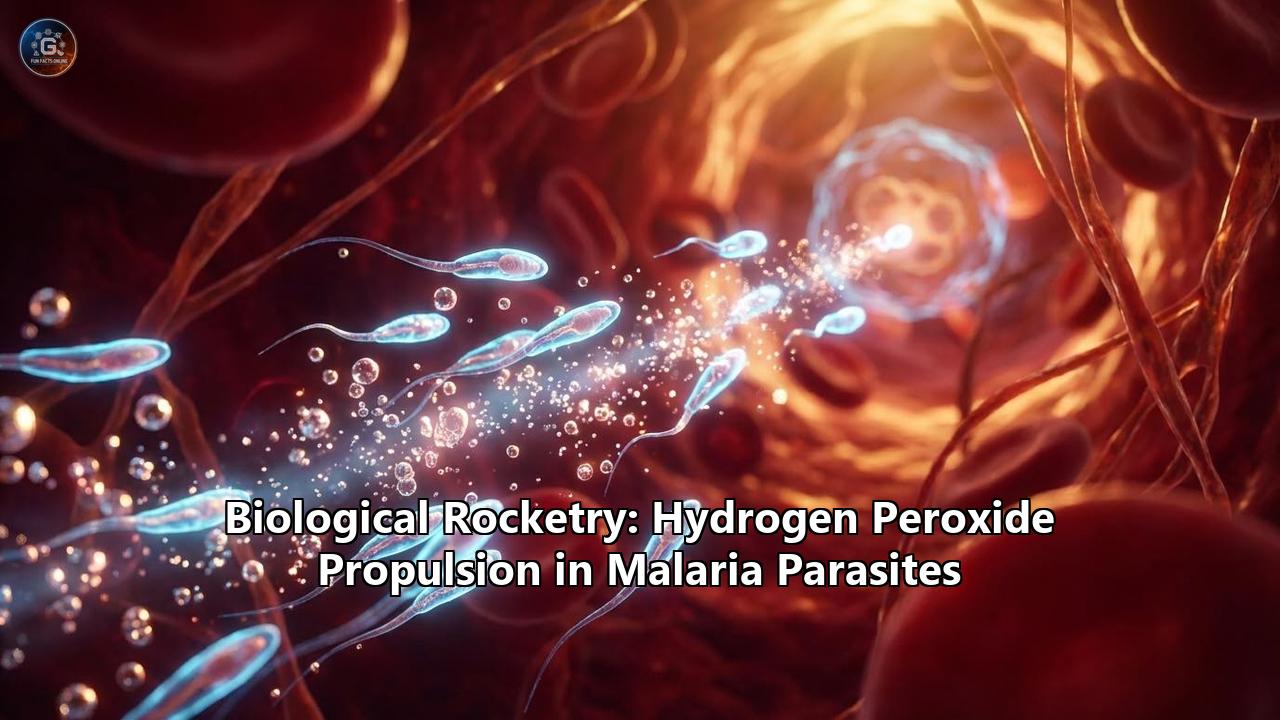
Imagine the deafening roar and blinding light of a spacecraft launching from a launchpad. To propel thousands of tons of steel and human ingenuity into the cold vacuum of space, aerospace engineers rely on highly volatile chemical reactions. One of the classic, time-tested methods of aerospace propulsion involves hydrogen peroxide. When passed over a specialized catalyst, this chemical violently decomposes into water and oxygen gas, releasing a massive burst of kinetic energy. It is a brilliant, explosive application of chemistry that has helped maneuver satellites and power rocket engines for decades.
Now, scale that exact same violent, propulsive energy down to a fraction of the width of a human hair. Deep inside the human bloodstream, a microscopic assassin is utilizing the very same rocket fuel to stay alive.
The organism is Plasmodium falciparum, the deadly, single-celled parasite responsible for the most severe forms of malaria. For centuries, this pathogen has been one of the greatest scourges of human history, and even today, it continues to devastate populations across the globe. But behind its lethal efficiency lies a microscopic biology so bizarre and technologically parallel to human engineering that it has left scientists completely stunned. Researchers have discovered that the malaria parasite contains a built-in fleet of microscopic rocket engines, powered by the exact same hydrogen peroxide chemical propulsion used in aerospace engineering.
This is not a metaphor. It is a literal, biological blueprint for chemical rocketry, functioning inside a living cell.
The Century-Old Mystery of the Jittering Crystals
To understand this phenomenon, we must first look at how the malaria parasite survives inside the human body. When an infected mosquito bites a human, the Plasmodium falciparum parasites eventually invade the host's red blood cells. Red blood cells are rich in hemoglobin, the protein responsible for transporting oxygen. To the growing parasite, this hemoglobin is an all-you-can-eat buffet. The parasite sets up a specialized, highly acidic microscopic compartment inside itself—known as a food vacuole—where it continuously digests the host's hemoglobin to fuel its own replication.
But this gluttony comes with a massive biochemical risk. As the parasite breaks down hemoglobin, it releases a molecular byproduct called free heme. In its free state, heme is highly toxic to the parasite. If left unchecked, it would quickly destroy the organism's cellular membranes and spell its doom. To survive its own toxic waste, the parasite employs a brilliant defense mechanism: it rapidly binds the toxic heme molecules together, stacking them into inert, microscopic, iron-based crystals known as hemozoin.
For over a century, scientists peering through microscopes at live malaria parasites have observed these dark hemozoin crystals inside the organism. However, there was something deeply unsettling and perplexing about them. As long as the parasite was alive, the microscopic iron crystals danced. They spun, jolted, bounced, and ricocheted off one another in their tiny liquid bubble, a chaotic motion that researchers have compared to "change in an overclocked washing machine".
The movement was frenetic, continuous, and far too rapid and deliberate to be explained by standard thermal diffusion—the natural, random jiggling of microscopic particles known as Brownian motion. Yet, the moment the malaria parasite died, the crystals abruptly stopped moving.
"People don't talk about what they don't understand, and because the motion of these crystals is so mysterious and bizarre, it's been a blind spot for parasitology for decades," noted Paul Sigala, an associate professor of biochemistry in the Spencer Fox Eccles School of Medicine at the University of Utah.
The hemozoin crystals have long been known to be vital for the parasite’s survival, and they are already a primary target for many famous antimalarial drugs. But their relentless, jittering motion remained an unexplained biological enigma—until modern biochemical forensics revealed their explosive secret.
Uncovering the Biological Rocket Fuel
A research team led by Paul Sigala and Erica Hastings, a postdoctoral fellow in biochemistry at the University of Utah Health, finally cracked the code of the dancing crystals. Their groundbreaking findings, published in the prestigious journal PNAS (Proceedings of the National Academy of Sciences), fundamentally rewrote our understanding of parasite biology by introducing a concept previously unknown in the natural world: biological rocketry.
The researchers began by analyzing the chemical environment inside the parasite's food vacuole. When Plasmodium falciparum digests host hemoglobin and converts the toxic heme into hemozoin crystals, the chemical reaction involves oxygen and naturally produces another highly dangerous byproduct: hydrogen peroxide ($H_2O_2$).
Hydrogen peroxide is a potent oxidizing agent. In human households, a diluted version is used to bleach hair or disinfect wounds because it destroys cellular walls. Inside the microscopic confines of the parasite's food vacuole, high concentrations of hydrogen peroxide constitute a lethal, cytotoxic threat. Interestingly, unlike many other organisms, malaria parasites do not possess the specific enzyme (catalase) typically used to safely break down and degrade this dangerous chemical.
This abundance of hydrogen peroxide stood out to the research team as a potential chemical fuel. Could the parasite be using its own toxic waste to power the motion of the crystals?
To test this hypothesis, the scientists took the hemozoin crystals out of the parasite entirely. They purified the iron-based crystals and placed them in a simple solution of hydrogen peroxide. The results were instantaneous and undeniable: the isolated crystals immediately began to spin and propel themselves through the liquid, requiring absolutely no biological input from the parasite.
Next, they observed the living parasites under altered conditions. The researchers grew the malaria parasites in an environment with unusually low oxygen levels. Because oxygen is required for the parasite to generate hydrogen peroxide during digestion, this oxygen-starved environment drastically lowered the amount of peroxide the parasites could produce. As the hydrogen peroxide levels dropped, the spinning crystals inside the food vacuole decelerated to about half their normal speed—even though the parasites themselves remained otherwise entirely healthy.
The conclusion was astonishing. The hemozoin crystals were not just inert blocks of crystallized waste; they were "catalytically active nanoparticles" acting as miniature, self-contained rocket engines.
The Physics of Microscopic Propulsion
How exactly does a crystal act like a rocket? The answer lies in the striking similarities between aerospace engineering and surface chemistry.
In the aerospace industry, hydrogen peroxide is prized as a "monopropellant." Unlike traditional rocket fuels that require the mixing of two different liquids (a fuel and an oxidizer) to create an explosion, a monopropellant requires only a catalyst to release its energy. When highly concentrated hydrogen peroxide comes into contact with a catalytic metal—like silver or platinum—it instantly and violently breaks down into water ($H_2O$) and oxygen gas ($O_2$). This chemical decomposition releases a tremendous amount of kinetic and thermal energy, providing the thrust needed to launch satellites or steer spacecraft in orbit.
Deep inside the malaria parasite, the exact same chemical decomposition is taking place.
The hemozoin crystals are made of an iron-based compound. The surface-exposed iron metals on the exterior of these crystals act as a biological catalyst. As the toxic hydrogen peroxide builds up in the food vacuole, it comes into contact with the iron surface of the hemozoin. The iron instantly triggers the catalytic breakdown of the hydrogen peroxide into harmless water and oxygen.
This rapid chemical reaction releases sudden bursts of kinetic energy right at the surface of the crystal, giving it the propulsive "kick" it needs to spin, tumble, and shoot across the microscopic cellular compartment. The crystals are literally jetting themselves around the vacuole by leaving a tiny wake of water and oxygen behind them.
"This hydrogen peroxide decomposition has been used to power large-scale rockets," explained Dr. Erica Hastings. "But I don't think it has ever been observed in biological systems."
The research team's discovery marks the first time that this specific mechanism of chemical propulsion has been identified in biology, establishing the hemozoin crystal as a biological example of an "endogenous self-propelled nanoparticle".
A Matter of Life and Death: The Evolutionary Advantage
Evolution is the ultimate pragmatist. A biological system as complex and energy-intensive as a fleet of rocket-powered crystals does not develop by accident. The researchers quickly realized that the frenetic motion of the hemozoin is not merely a fascinating quirk of chemistry—it is a critical, dual-purpose survival mechanism that keeps the deadly parasite alive.
First, the spinning crystals serve as a vital detoxification engine. Because the malaria parasite lacks the standard cellular machinery to safely dispose of the highly reactive hydrogen peroxide generated during its feeding frenzy, it is in constant danger of succumbing to oxidative stress. If the peroxide levels climb too high, the resulting chemical reactions would fatally damage the parasite from the inside out.
By acting as catalysts, the moving crystals "burn off" the excess toxic peroxide. The parasite is essentially using the explosive energy of its own toxic waste to neutralize the threat, converting a deadly chemical into harmless water and oxygen before it can inflict catastrophic damage.
Second, the rocket-powered spinning serves a crucial role in space management and efficiency. As the parasite continuously devours the host's hemoglobin, it must rapidly and continuously sequester the newly formed toxic heme into the hemozoin crystals. If the crystals were stationary, the natural sticky properties of these particles would cause them to quickly clump together into a single, massive, solid lump.
When objects clump together, their overall exposed surface area decreases dramatically. A large, singular clump of hemozoin would simply not have enough available exterior surface area to accommodate the continuous, rapid attachment of new toxic heme molecules.
The chaotic, ricocheting motion prevents this from happening. By continuously bouncing off each other, the crystals refuse to clump. This ensures that the parasite maintains a massive fleet of small, highly separated crystals, maximizing the total available surface area. This allows the parasite to continue safely and efficiently storing toxic waste as quickly as it produces it, keeping the organism alive as it ravages the host's red blood cells.
A New Vulnerability in the Fight Against Malaria
Understanding the secret of the malaria parasite's internal rocket engines is not just a triumph of basic biology; it represents a profound new frontier in the global fight against one of the world's most persistent killers.
Despite decades of medical advancement, malaria remains a devastating global health crisis, responsible for hundreds of thousands of deaths every year, primarily among young children in sub-Saharan Africa. The parasite's ability to mutate and develop resistance to existing therapies is a constant threat to modern medicine. Historically, the formation of hemozoin crystals inside the food vacuole has been the Achilles' heel of the parasite, serving as the primary target for classic antimalarial drugs like chloroquine. These drugs work by interfering with the parasite's ability to form the crystals, causing it to die from its own toxic heme.
However, with drug-resistant strains of Plasmodium falciparum on the rise, scientists are in desperate need of new vulnerabilities to exploit. The discovery of this kinetic detoxification process provides exactly that.
By reframing the hemozoin crystals not as inert waste dumps, but as highly active nanomotors essential for burning off toxic peroxide, scientists now have a brand-new physiological mechanism to target. If researchers can design a drug that "jams the engines"—perhaps by coating the iron surface of the crystals to prevent them from catalyzing the peroxide, or by artificially flooding the food vacuole with more peroxide than the spinning crystals can handle—they could force the parasite to drown in its own toxic waste. This discovery opens entirely new, unexplored avenues for pharmaceutical intervention that could bypass the parasite's current evolutionary defenses.
Inspiring the Future of Microscopic Robotics
Beyond the realm of medicine and parasitology, this discovery is sending shockwaves through the fields of nanotechnology and materials science.
For years, engineers have dreamed of creating microscopic robots—nanobots—that could swim through the human bloodstream to deliver targeted cancer drugs, break up blood clots, or perform microscopic surgeries. One of the greatest hurdles in microscopic robotics is the issue of propulsion. You cannot put a conventional battery inside a machine the size of a red blood cell. Synthetic "nanomotors" have been designed in laboratories that use hydrogen peroxide and chemical catalysis to move, but figuring out how to make these systems efficient, self-sustaining, and biologically compatible remains a massive engineering challenge.
The malaria parasite has just handed engineers a perfect, naturally evolved blueprint.
Plasmodium falciparum has already solved the problem of microscopic propulsion. It has successfully created an endogenous, self-propelled nanoparticle system that generates its own fuel from its environment, utilizes an integrated catalytic surface, and operates perpetually without the need for external power sources. By studying exactly how the hemozoin crystals optimize their surface area and efficiently convert chemical waste into kinetic thrust, engineers can extract these biological principles to design the next generation of synthetic nanobots. The very same mechanisms that allow a deadly parasite to thrive may soon be harnessed to create microscopic medical devices that save lives.The Universal Laws of Motion
The discovery of biological rocketry inside the malaria parasite serves as a profound reminder of the universality of the physical world. The laws of chemistry and physics do not care about scale. The exact same catalytic decomposition of hydrogen peroxide that provides the explosive thrust necessary to launch a human-engineered satellite into the freezing void of Earth's orbit is being utilized, right now, on a scale invisible to the naked eye, inside the warm bloodstream of human beings.
It is a stunning convergence of biology and engineering. For decades, the jittering, dancing crystals inside the malaria parasite were dismissed as an inexplicable curiosity. Today, they stand as a testament to the sheer ingenuity of evolution—a microscopic masterclass in chemical engineering, waste management, and survival.
As researchers continue to unravel the secrets of these tiny, spinning rocket engines, they are not only finding new ways to defeat an ancient and deadly disease. They are also peering into a microscopic world that proves, once again, that nature's technological prowess consistently rivals, and often precedes, our own.
Reference:
- https://www.sciencedaily.com/releases/2026/03/260318033111.htm
- https://healthcare.utah.edu/newsroom/news/2025/10/malaria-parasites-are-full-of-wildly-spinning-iron-crystals-scientists
- https://timesofindia.indiatimes.com/science/scientists-discover-rocket-engines-inside-malaria-parasites-what-are-they-and-how-do-they-work/articleshow/129696516.cms
- https://attheu.utah.edu/science-technology/malaria-parasites-are-full-of-wildly-spinning-iron-crystals-scientists-finally-know-why/
- https://www.pnas.org/doi/10.1073/pnas.2513845122