
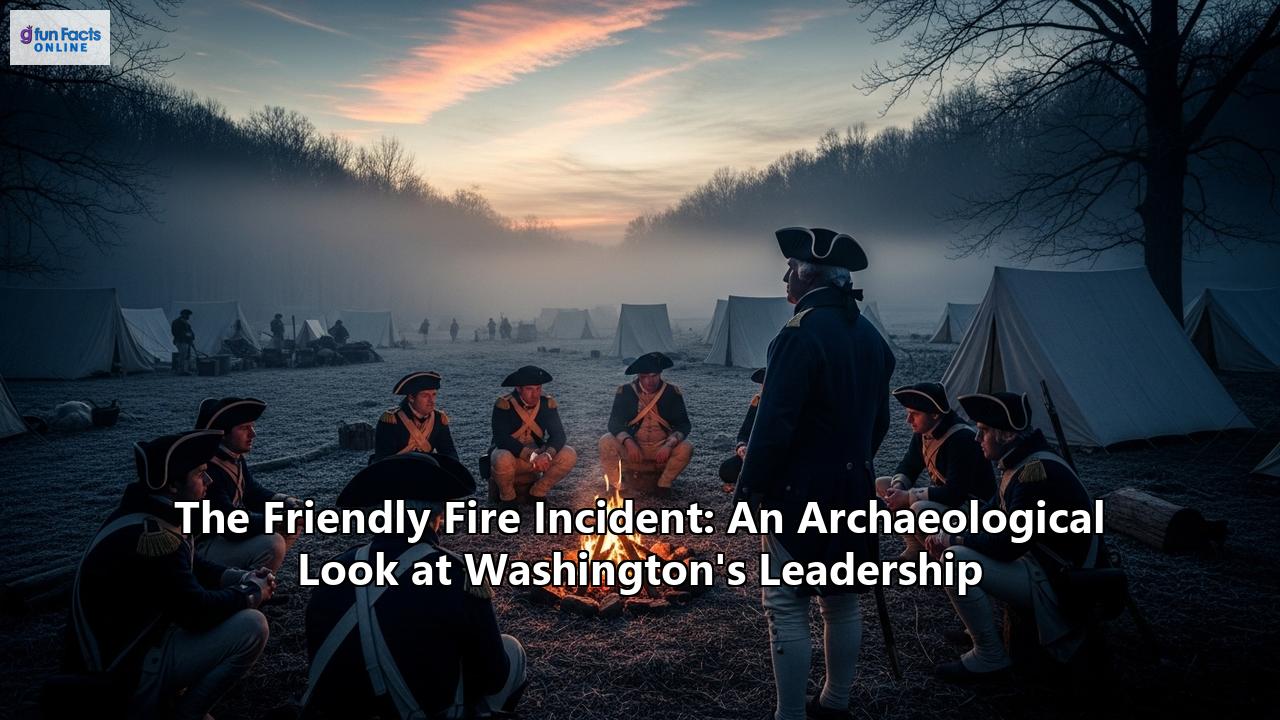
The Crucible of Command: An Archaeological Look at Washington's Encounters with Friendly Fire
In the annals of American history, George Washington often appears as a figure of stoic resolve and infallible leadership, the steady hand that guided a nascent nation to victory. Yet, beneath this marble facade lies a man forged in the crucible of conflict, a commander who learned some of his most profound lessons not in the glory of triumph, but in the chaotic, smoke-filled confusion of battle where the enemy was not always who it seemed. The French and Indian War, the sprawling global conflict that ignited the forests of the Ohio Valley, was Washington's military academy, and its curriculum was often brutal. It was here, amidst the tangled wilderness and the clash of empires, that a young and ambitious Virginia officer first confronted the specter of friendly fire, a recurring nightmare for any commander. These incidents, largely forgotten footnotes in the grand narrative of his career, have been brought to life in recent years through the meticulous work of archaeologists, offering a fresh perspective on the development of Washington's leadership. By digging into the very soil where these tragic events unfolded, we can unearth a more human, more complex, and ultimately more compelling portrait of the man who would become the nation's first president.
The Spark of War and a Fateful First Shot: Jumonville Glen, 1754
The story begins in the spring of 1754, in the contested backcountry of western Pennsylvania. A 22-year-old Lieutenant Colonel George Washington, driven by a thirst for military renown, led a small contingent of Virginia militiamen and their Mingo allies into the wilderness. Their mission: to assert British authority in a region increasingly dominated by the French. On the morning of May 28th, guided by the Seneca chief Tanacharison, also known as the Half-King, Washington's party surrounded a small French encampment nestled in a rocky ravine.
What happened next would be debated for centuries. A shot rang out – who fired first remains a mystery – and in the ensuing 15-minute skirmish, the French commander, Ensign Joseph Coulon de Villiers de Jumonville, and a number of his men were killed. The French would later claim that Jumonville was on a diplomatic mission, and that his death was an assassination, a charge that would follow Washington and become a major international incident, fanning the flames of the French and Indian War.
For years, the narrative of the Jumonville Glen skirmish focused on this diplomatic controversy. But a recently unearthed eyewitness account, discovered by historian David Preston, has added a new layer of complexity to the event, suggesting that the chaos of the brief battle may have claimed a British casualty in a tragically ironic twist of fate. An account from a chief warrior who was present at the skirmish reveals that in the confusion of the fight, the Virginians "unluckily shot their own Man," who had moved ahead of their lines. This detail, overlooked for centuries, suggests that Washington's very first command experience was marred by a friendly fire incident.
Archaeological investigations at Jumonville Glen, part of the Fort Necessity National Battlefield, have begun to corroborate the historical accounts of this pivotal event. A four-week investigation in 2023, a partnership between the National Park Service and organizations like the American Veterans Archaeological Recovery, has verified the location of the skirmish. The discovery of 18th-century ballistics and other artifacts has provided tangible evidence of the fight that ignited a world war. Analysis of these artifacts, including the caliber of the musket balls, has helped to confirm the presence of both British and French forces at the site. While archaeological evidence of the specific friendly fire casualty is elusive, the findings have provided a deeper understanding of the chaotic nature of the engagement, a "15-minute skirmish that occurs here will change the world," as described by Fort Necessity's Chief of Interpretation, Brian Reedy. The ongoing analysis of the recovered artifacts promises to shed even more light on the positioning of the combatants and the sequence of events in this brief but momentous clash.
The Ultimate Test of Leadership: The Friendly Fire Incident of 1758
Four years after the fateful encounter at Jumonville Glen, Washington, now a seasoned 26-year-old colonel in command of the Virginia Regiment, found himself in a far more terrifying friendly fire incident, one that he would later describe as the most perilous moment of his life. The event occurred on November 12, 1758, during the Forbes Expedition, a massive British undertaking to capture the strategic French stronghold of Fort Duquesne at the Forks of the Ohio River.
Near the newly constructed British outpost of Fort Ligonier, a French and Native American raiding party attacked a herd of British horses. In response, two Virginia regiments were dispatched to repel the enemy. One was led by Washington, and the other by his fellow Virginian, Colonel George Mercer. As dusk settled, a thick fog descended upon the dense woods, creating a scene of utter confusion. In the dim light and swirling mist, Washington's and Mercer's men mistook each other for the enemy.
A heavy exchange of fire erupted between the two Virginia regiments. In his own words, written years later for a biography by his friend, Colonel David Humphreys, Washington described the chaos: "it being near dusk and the intelligence not having been fully dissiminated among Colo. Mercers Corps, and they taking us, for the enemy who had retreated approaching in another direction commenced a heavy fire upon the releiving party which drew fire in return in spite of all the exertions of the Officers one of whom & several privates were killed and many wounded before a stop could be put to it."
In this moment of supreme crisis, Washington's leadership was put to the ultimate test. As his men fired upon their own comrades, Washington galloped his horse between the two lines, using his sword to knock up the presented muskets and desperately shouting for a ceasefire. He later recalled that his life was in "as much jeopardy as it had ever been before or since." The tragic incident resulted in the deaths of two officers and at least 13 soldiers, with some estimates as high as 40 casualties.
For centuries, the exact location of this harrowing event was lost to time. But in recent years, a dedicated team of archaeologists, led by Jonathan Burns of Juniata College, has rediscovered the battlefield on private land a few miles from Fort Ligonier. Using a combination of historical accounts, metal detectors, and ground-penetrating radar, the team has unearthed a trove of over 350 artifacts that have pinpointed the site of the tragic encounter.
The Ground Truth: What the Archaeology Reveals
The artifacts recovered from the Ligonier friendly fire site offer a tangible connection to the soldiers who experienced the terror of that foggy November evening. Uniform buttons, buckles, musket balls, and even a French officer's pocket watch key with a fleur-de-lis have been carefully excavated and cataloged. These are not just inanimate objects; they are the remnants of lives lived and lost in the service of an empire.
The distribution of these artifacts across the battlefield is particularly revealing. Archaeologists, including volunteers from the Veterans Archaeology Program who bring their own combat experience to the interpretation of the site, have been able to map the positions of the two Virginia regiments. This spatial analysis helps to reconstruct the chaotic sequence of events and understand the moment-to-moment decisions made by the soldiers in the fog of war. The discovery of ornate sock garter buckles far from the main road, for instance, suggests that some of Washington's men may have sought higher ground during the firefight.
The analysis of the musket balls themselves is also crucial. Advanced techniques, such as isotope testing, can help to verify the presence of both British and French forces on the battlefield, corroborating the historical accounts of the initial French raid that triggered the entire incident. While both Virginia regiments would have been using similar British muskets, the patterns of fired and unfired shot can provide clues about the intensity and direction of the firefight.
The discovery of the battlefield and the ongoing analysis of its artifacts serve to humanize the soldiers who fought and died there. As archaeologist Jonathan Burns has stated, "This is not just an archaeological discovery. This is an emotional, human story about leadership, confusion, loss—and a moment that changed history." Some of the unearthed items are now on display at Fort Ligonier, alongside Washington's own handwritten account of the incident, offering visitors a powerful and poignant glimpse into this often-overlooked chapter of his life.
The Lasting Impact on a Future Leader
The friendly fire incidents of the French and Indian War, particularly the harrowing experience near Fort Ligonier, left an indelible mark on George Washington. These were not just isolated tragedies; they were profound learning experiences that shaped his approach to leadership and command for the rest of his career.
The chaos and confusion of these encounters underscored the critical importance of clear communication, reconnaissance, and battlefield discipline – lessons he would carry with him into the American Revolution. The French and Indian War was a brutal education in the realities of warfare, particularly in the unforgiving American wilderness. Washington learned from the tactics of his Native American allies and the formal strategies of his British superiors, synthesizing these disparate approaches into his own unique style of command.
The friendly fire incidents also revealed Washington's own fallibility. He was a young, ambitious, and at times, impetuous commander. The mistakes made under his watch, however, were not sources of shame but rather opportunities for growth. His willingness to learn from his failures, to adapt his strategies, and to take personal responsibility for the well-being of his men were hallmarks of his leadership.
The 1758 incident, in particular, showcases a crucial aspect of his character: his physical courage and his unwavering commitment to his soldiers. In a moment when panic and confusion reigned, Washington did not hesitate to place himself in mortal danger to save his men. This act of heroism would have undoubtedly earned him the respect and loyalty of his troops.
Interestingly, the tragic friendly fire incident of 1758 had an unforeseen strategic benefit. The capture of several French soldiers during the confusion provided General Forbes with critical intelligence: Fort Duquesne was vulnerable and undermanned. This information prompted Forbes to press his advantage, and the British were able to capture the fort without a major battle, achieving the primary objective of the expedition.
Shortly after the successful conclusion of the Forbes Expedition, Washington resigned his commission and returned to his life as a Virginia planter. He would not command troops again until the outbreak of the American Revolution. The lessons learned in the crucible of the French and Indian War, however, would prove invaluable. The young officer who had inadvertently started a war at Jumonville Glen and who had stared death in the face amidst the friendly fire at Ligonier had been transformed into a seasoned and resilient leader, ready to face the monumental challenges that lay ahead.
In conclusion, the archaeological discoveries at Jumonville Glen and near Fort Ligonier have opened a new window into the formative years of George Washington's military career. They remind us that history is not just found in dusty archives and faded manuscripts, but also in the very soil beneath our feet. By unearthing the physical remnants of these friendly fire incidents, we gain a more nuanced and human understanding of the challenges Washington faced and the leadership qualities he developed. These events, born of confusion and tragedy, were instrumental in shaping the commander who would one day lead the Continental Army to victory and secure the birth of a new nation. They are a testament to the idea that leadership is forged not in the absence of adversity, but in the heart of it.
Reference:
- https://www.thenmusa.org/class/george-washington-and-the-1758-forbes-campaign/
- https://www.nps.gov/articles/jumonville-glen.htm
- https://www.ausa.org/articles/washingtons-development-revolutionary-leader
- https://www.smithsonianmag.com/history/when-young-george-washington-started-war-180973076/
- https://www.smithsonianmag.com/smart-news/archaeologists-discover-site-where-george-washington-stopped-a-friendly-fire-incident-by-blocking-muskets-with-his-sword-180987008/
- https://www.worldhistory.org/article/2512/george-washington-in-the-french-and-indian-war/
- https://digitalcommons.liberty.edu/cgi/viewcontent.cgi?article=1966&context=masters
- https://www.mountvernon.org/library/digitalhistory/digital-encyclopedia/article/forbes-expedition
- https://arkeonews.net/friendly-fire-lost-battlefield-from-1758-found-near-fort-ligonier/
- https://allthatsinteresting.com/pennsylvania-french-and-indian-war-battlefield
- https://www.cbsnews.com/pittsburgh/news/fort-ligonier-french-and-indian-war-george-washington-history/
- https://www.pbs.org/newshour/nation/long-unfortunate-history-friendly-fire-accidents-u-s-conflicts
- https://www.nps.gov/common/uploads/teachers/lessonplans/Student%20Resources%20Unit%204%20BGW%20(508).pdf.pdf)
- https://en.wikipedia.org/wiki/George_Washington_in_the_French_and_Indian_War
- https://books.google.com.hk/books/about/George_Washington_Remembers.html?id=mDqQmwEACAAJ&redir_esc=y
- https://triblive.com/local/westmoreland/researchers-zero-in-on-site-where-george-washington-had-brush-with-friendly-fire-unveil-artifacts/
- https://www.popularmechanics.com/science/archaeology/a65426000/lost-site-george-washington-friendly-fire/