
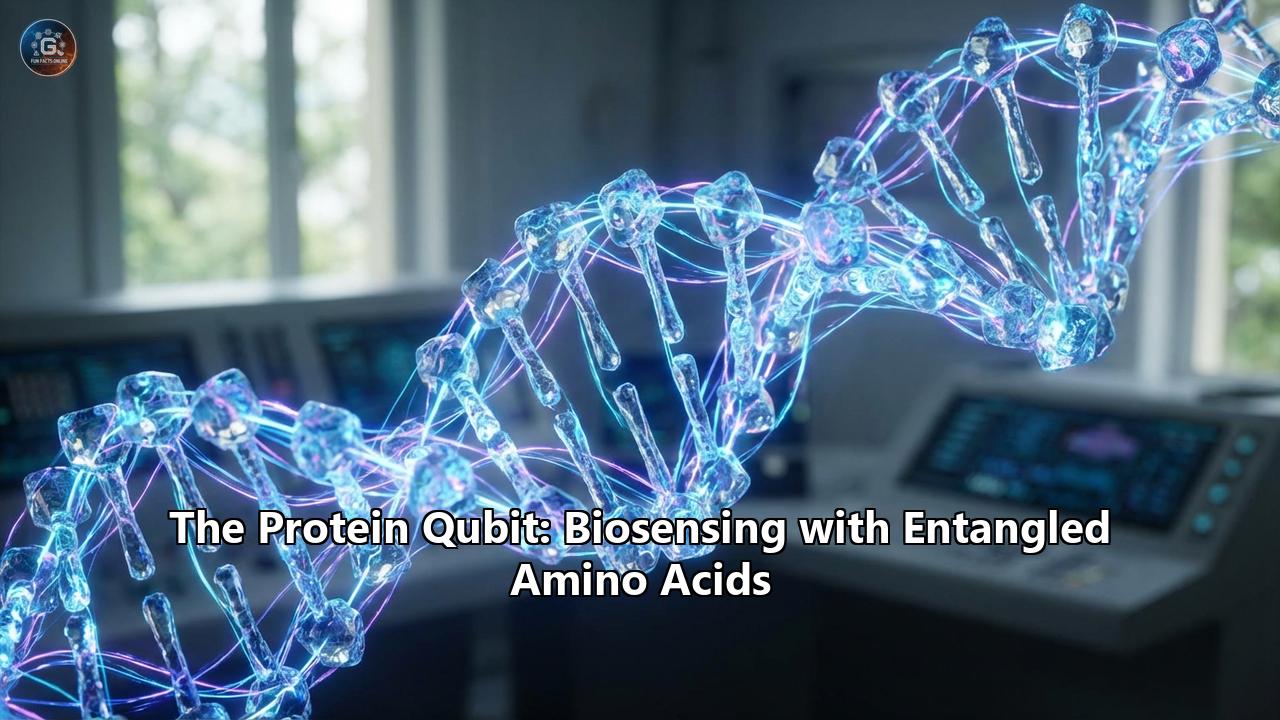
In the early months of 2026, the boundaries between quantum physics and biological life were irrevocably blurred. The successful demonstration of a "protein qubit"—a functioning quantum bit encoded not in silicon or superconducting circuits, but within the organic architecture of a fluorescent protein—marked a paradigm shift in both quantum technology and the life sciences. This article explores the emergence of the protein qubit, delving into the quantum mechanical phenomena of "entangled amino acids" that make it possible. We examine the roles of tryptophan mega-networks, Chiral Induced Spin Selectivity (CISS), and quantum superradiance in biological systems. Furthermore, we investigate the revolutionary applications of this technology in biosensing, where living cells act as their own quantum sensors, offering unprecedented sensitivity to metabolic, electrical, and thermal changes. Finally, we consider the profound implications of this technology for our understanding of consciousness and the potential for a future of "living quantum computers."
Part I: The Genesis of the Organic Qubit
1.1 The Silicon Wall and the Biological KeyFor decades, the quest for quantum computing was defined by a specific aesthetic: dilution refrigerators humming in stark white rooms, gold-plated chandeliers of superconducting wire, and chips made of silicon, diamond, or trapped ions. The challenge was always "isolation." Quantum states are notoriously fragile; thermal noise, electromagnetic interference, and the chaotic vibrations of atoms (phonons) can cause a qubit to "decohere," collapsing its delicate superposition of 0 and 1 into a mundane classical state. To combat this, physicists built freezers that reached temperatures colder than deep space and vacuum chambers emptier than the void between galaxies.
Biology, by contrast, is warm, wet, and messy. It is a storm of constant molecular motion, a cacophony of chemical reactions that seemed, to the classical physicist, to be the absolute antithesis of a quantum environment.
However, nature had a secret. While human engineers were fighting to isolate qubits from their environment, evolution was designing systems that thrived because of their interaction with it. The breakthrough came not from rejecting the "noise" of biology, but from understanding how life harmonizes with it.
In August 2025, a team at the University of Chicago Pritzker School of Molecular Engineering shattered the "thermal barrier." They didn't build a qubit; they grew one. Using a genetically modified version of a fluorescent protein—similar to the Green Fluorescent Protein (GFP) derived from jellyfish—they created a molecular structure that could host a coherent spin state at room temperature.
This "Protein Qubit" was not a passive crystal of diamond; it was a dynamic, foldable, genetically encodable machine. It represented the first operational quantum bit that could be synthesized by the very cells it was meant to measure.
1.2 The Anatomy of a Protein QubitTo understand the protein qubit, one must look beyond the ribbon diagrams of standard biology and see the protein as a landscape of electron densities and spin states.
The core of the technology lies in the fluorophore—the specific chemical structure within the protein that absorbs and emits light. In standard GFP, this is a barrel-shaped cage of beta-sheets protecting a central chromophore formed by the cyclization of three specific amino acids: Serine, Tyrosine, and Glycine.
The researchers modified this structure to stabilize a "triplet state." In quantum mechanics, electrons usually pair up with opposite spins (up and down), cancelling each other out to form a "singlet" state. However, under the right excitation conditions (using specific wavelengths of laser light), an electron can be kicked into a higher energy orbit and, crucially, flip its spin. This creates a pair of electrons with parallel spins—a triplet state.
This triplet state acts as the qubit. It has three sublevels (spin -1, 0, +1) that can be manipulated using microwaves. Because the protein's "beta-barrel" structure acts as a Faraday cage, shielding the chromophore from the chaotic water molecules outside, the spin state can maintain coherence for microseconds—an eternity in the quantum realm, and long enough to perform logic operations or precise sensing measurements.
But the true magic wasn't just in the single fluorophore; it was in the environment provided by the surrounding amino acids. This brings us to the concept that transformed a single sensor into a network: Entangled Amino Acids.
Part II: The Architecture of Quantum Life
2.1 Tryptophan Mega-Networks: The Fiber Optics of the CellWhile the engineered protein qubit was the headline, the underlying physics revealed a deeper truth about biological design. Proteins are not merely structural scaffolds; they are conductive wires for quantum information.
The amino acid Tryptophan plays a starring role in this narrative. Tryptophan is unique among the standard twenty amino acids. It possesses a large, double-ringed "indole" structure that is highly aromatic. In organic chemistry, "aromatic" means it has a delocalized cloud of pi-electrons floating above and below the ring.
When multiple tryptophan residues are arranged in a specific geometry—like a stack of coins or a spiral staircase—their electron clouds can interact via dipolar coupling. If the spacing and orientation are just right, they stop behaving as individual molecules and start behaving as a single quantum entity.
Recent studies have shown that in structures like microtubules (the skeleton of the cell) and specialized protein wires, these tryptophan networks exhibit a phenomenon called superradiance.
2.2 Superradiance and Collective StatesImagine a stadium full of people. If everyone claps randomly, you hear a chaotic noise (the "decoherence" of standard biology). But if everyone claps in perfect unison, the sound is amplified exponentially, becoming louder than the sum of the individual claps.
Superradiance is the quantum equivalent of this applause. When a network of tryptophan molecules is excited, they can form a "collective state" where the excitation is shared across the entire network simultaneously. The network absorbs and emits photons not as individuals, but as a giant "mega-molecule."
This collective behavior protects the quantum state. If one amino acid is "kicked" by a thermal vibration, the energy is instantly redistributed across the others, preventing the information from being lost. This is how "entangled amino acids" survive the warm, wet environment of the cell. They find safety in numbers and geometry.
The "Protein Qubit" utilizes this principle by engineering the amino acids surrounding the central fluorophore to act as a "quantum antenna," funneling energy and information to the central spin state while shielding it from noise.
2.3 The Gatekeeper: Chiral Induced Spin Selectivity (CISS)If Tryptophan networks are the wires, then Chirality is the filter.
Biology is homochiral: life uses almost exclusively "left-handed" (L-type) amino acids and "right-handed" (D-type) sugars. For years, this was considered an evolutionary quirk. We now know it is a functional requirement for quantum efficiency.
The Chiral Induced Spin Selectivity (CISS) effect dictates that when an electron moves through a chiral (helical) molecule, its spin becomes coupled to its momentum. In simple terms: a right-handed helix might only allow "spin-up" electrons to pass, acting as a highly efficient spin filter.
In the context of the protein qubit, the helical structure of the protein acts as a built-in initializer. It ensures that the electrons entering the fluorophore are already polarized (all spinning the same way). This removes the need for the massive external magnets usually required to align qubits in classical quantum computers. The protein's own geometry does the heavy lifting.
Part III: Biosensing with Entangled States
3.1 The "Trojan Horse" SensorThe most immediate application of the protein qubit is in biosensing. Traditional quantum sensors, like Nitrogen-Vacancy (NV) centers in diamonds, are powerful but invasive. Inserting a diamond nanorod into a living cell is like tossing a brick into a washing machine; it disrupts the very system you are trying to measure.
The protein qubit, however, is genetically encoded. Scientists can splice the DNA sequence for the protein qubit into the genome of a cell (e.g., a neuron or a T-cell). The cell's own ribosomes then manufacture the sensor and place it exactly where it is needed—attached to a cell membrane, inside a mitochondrion, or wrapped around DNA.
This is a "Trojan Horse" strategy. The cell recognizes the protein as one of its own, allowing the sensor to operate without triggering an immune response or stress reaction.
3.2 Sensing Fields and TemperatureOnce inside, the protein qubit acts as a spy. Its "triplet spin state" is extremely sensitive to magnetic and electric fields.
- Nanoscale MRI: By measuring the shift in the spin frequency of the protein qubit, researchers can detect the magnetic fields generated by the firing of a single neuron. This allows for "network level" mapping of brain activity with single-cell resolution, a feat impossible with current fMRI technology.
- Electric Field Mapping: The voltage across a cell membrane (membrane potential) is the battery of life. Protein qubits embedded in the membrane can measure these electric fields with varying sub-millisecond precision, offering a real-time view of how cells communicate and how drugs affect ion channels.
- Intracellular Thermometry: Quantum states are sensitive to temperature. The protein qubit can measure temperature changes of less than 0.001 degrees Celsius within a specific organelle. This has revealed that mitochondria (the power plants of the cell) run "hot"—significantly hotter than the rest of the cell—implying that biological thermodynamics is far more complex than previously thought.
One of the limitations of fluorescence microscopy is photodamage. To get a bright signal, you have to blast the cell with high-intensity laser light, which creates toxic free radicals and eventually kills the cell.
"Entangled Amino Acids" offer a solution through Entangled Two-Photon Absorption (ETPA).
In classical two-photon microscopy, a molecule must be hit by two separate photons simultaneously to be excited. This is a rare event, so you need a massive number of photons (high intensity) to make it happen.
However, if you use entangled photons—partners that are quantum mechanically linked—they arrive at the molecule together, like a pair of dancers holding hands. The probability of them both being absorbed is exponentially higher. This means you can get the same bright image using a fraction of the light intensity.
The protein qubit is designed to be a "super-absorber" of these entangled photons. By using an entangled light source to interrogate the protein, scientists can film biological processes for hours or days without damaging the delicate sample. This "quantum light" microscopy is unveiling the long-term behaviors of stem cells and cancer metastasis that were previously invisible.
Part IV: The Frontier – Quantum Biology and Consciousness
4.1 The Microtubule DebateNo discussion of quantum biology is complete without addressing the "Orch-OR" theory (Orchestrated Objective Reduction), proposed by physicist Roger Penrose and anesthesiologist Stuart Hameroff. They hypothesized that consciousness arises from quantum computations occurring within microtubules inside brain neurons.
For decades, this theory was dismissed by mainstream science because microtubules were considered too "noisy" to maintain quantum states.
The discovery of the protein qubit and the superradiant tryptophan networks has reignited this debate. We now have experimental proof that protein structures can maintain quantum coherence at physiological temperatures. The tryptophan networks in microtubules are strikingly similar to the engineered arrays in protein qubits.
While we are far from proving that the brain is a quantum computer, the "impossibility" argument has evaporated. If a simple fluorescent protein can act as a qubit, a complex, highly ordered structure like a microtubule—which contains millions of tryptophan molecules arranged in a crystalline lattice—is a prime candidate for a biological quantum processor.
4.2 Anesthesia and Quantum SpinFurther evidence comes from the study of anesthetics. How does a gas like xenon or a molecule like propofol switch off consciousness without killing the brain?
Recent experiments using protein qubits have shown that many anesthetics bind specifically to the "hydrophobic pockets" in proteins where tryptophan networks reside. When they bind, they disrupt the electronic environment, effectively "detuning" the quantum network.
If the brain relies on superradiant quantum channels for ultra-fast information processing (consciousness), and anesthetics disrupt these channels (decoherence), then the loss of consciousness is literally a "quantum crash." The protein qubit provides the tool to test this hypothesis directly, allowing us to watch the "lights go out" in the quantum network of a neuron as anesthesia takes effect.
Part V: Future Horizons – The Bio-Quantum Internet
5.1 Living Quantum ComputersWe are moving from "reading" biology to "writing" with it. The next phase of this technology, predicted to mature by the late 2020s, is the Living Quantum Computer.
Instead of building a quantum computer chip and connecting it to a classical computer, we could engineer a bacterial colony where each bacterium contains a protein qubit. These bacteria could be connected via "photonic nanowires" (bioluminescent proteins) or simply by the entanglement of their emitted photons.
Such a system would be a massive, self-replicating, self-repairing quantum processor. It wouldn't be fast in the sense of clock speed, but it would be massively parallel. A test tube of "qubit bacteria" could model complex protein folding problems or simulate chemical reactions because it is a chemical reaction.
5.2 The Internet of Living ThingsThe ultimate vision is the integration of biological and silicon quantum systems. Protein qubits are "optically addressable," meaning they can talk to light. We already have fiber optic networks that carry quantum information (quantum internet).
Imagine a medical implant containing protein qubits that monitors your blood chemistry with quantum precision. It entangles its state with a photon and sends that photon out through the skin to a wearable device, which teleports the information to a medical quantum computer for analysis.
This "Bio-Quantum Internet" would allow for real-time, non-invasive monitoring of health at the molecular level. It could detect a single cancer cell or a viral infection hours after it begins, long before any symptoms appear.
Conclusion
The Protein Qubit is more than just a sensor; it is a bridge. For the first time, we have a technology that speaks the native language of both quantum physics (spin, entanglement, superposition) and biology (folding, mutation, metabolism).
By harnessing the "entangled amino acids" that nature has spent billions of years refining, we are unlocking a new era of science. We are learning that life is not just a chemical process, but a quantum one. And in doing so, we are not only building better sensors; we are beginning to understand the fundamental quantum spark that animates the machine. The protein is no longer just the building block of life; it is the building block of the future's information technology.
Reference:
- https://www.news-medical.net/news/20240429/Quantum-biologys-new-frontier-Tryptophan-networks-and-brain-disease-defense.aspx
- https://www.youtube.com/watch?v=8PMK8L2gICg
- https://www.frontiersin.org/journals/physics/articles/10.3389/fphy.2024.1387271/full
- https://www.pnas.org/doi/10.1073/pnas.2307719120
- https://www.spiedigitallibrary.org/conference-proceedings-of-spie/13618/136180B/Entangled-two-photon-absorption-cross-section-measurements-for-biologically-important/10.1117/12.3071149.short