
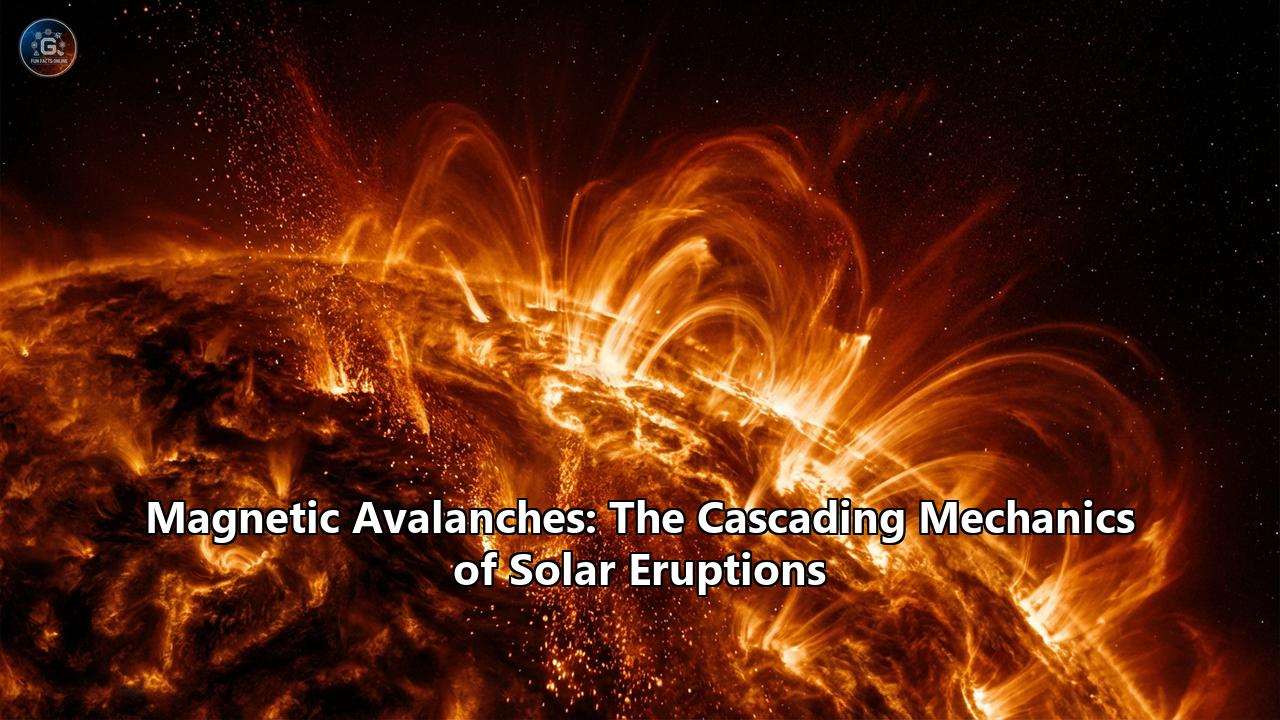
The sun is not a silent, burning ball of gas; it is a roaring, turbulent ocean of plasma, governed by the violent and invisible hand of magnetism. For centuries, humanity basked in its warmth, oblivious to the chaotic storms raging across its surface—storms capable of unleashing energy equivalent to billions of atomic bombs in a matter of minutes. We called them solar flares, bright flashes that occasionally disrupted our telegraphs or painted the sky with auroras. But for decades, the mechanism behind these cataclysms remained a tantalizing puzzle. How could a system appear stable for weeks, only to suddenly, violently collapse into an explosion of light and matter?
The answer, revealed by the latest generation of daring spacecraft and cutting-edge theoretical physics, lies in a concept both terrifying and elegant: the Magnetic Avalanche.
This is the story of that discovery. It is a journey that takes us from the sub-atomic dance of ions to the frozen darkness of the outer solar system, from the Victorian era’s first observations to the trillions of dollars at risk in our modern, electrified world. It is a story of how the sun’s magnetic field, like a snow-laden mountain slope, builds up tension until a single, imperceptible grain triggers a cascade that can shatter the calm of the entire solar system.
Part I: The Invisible Web
To understand a magnetic avalanche, one must first understand the medium in which it occurs. The sun is composed of plasma—a state of matter so energetic that electrons are stripped from their atomic nuclei, creating a soup of charged particles. Unlike a gas, which moves simply by pressure differences, plasma is electrically conductive. This means it is enslaved to magnetic fields.
In the sun, these magnetic fields are not static lines like those around a bar magnet. They are twisted, sheared, and tangled by the sun’s differential rotation. The solar equator spins faster than the poles, dragging magnetic field lines around the star, winding them up like a rubber band on a toy airplane. Over days and weeks, these field lines become taut, filled with potential energy. They rise through the convective zone, piercing the surface to form sunspots—dark, planet-sized islands of intense magnetism.
Above these sunspots lies the corona, the sun’s tenuous outer atmosphere. Here, the magnetic canopy is complex, a "rug" of woven field lines. This is where the energy for a flare is stored. But storage is not release. For years, physicists struggled with the "trigger problem." What cuts the rubber band? What causes the sudden release?
The breakthrough came with the application of a theory known as Self-Organized Criticality (SOC). Originally developed to explain piles of sand, SOC suggests that complex systems naturally evolve toward a critical state. Imagine dropping grains of sand one by one onto a pile. For a long time, the pile grows steadily. But eventually, it reaches a critical angle of repose. The next grain dropped doesn’t just sit there; it triggers a small slide. Or perhaps, it triggers a massive landslide that collapses the entire side of the pile.
The sun’s magnetic field operates on a similar principle. As the turbulent surface shuffles the "footpoints" of the magnetic arches, the fields above become more and more tangled. They reach a critical state of complexity. They are teetering on the edge of stability. A magnetic avalanche is not one single event, but a cascading failure. A small reconnection event—a "snap" of a minor magnetic thread—destabilizes its neighbor, which snaps and destabilizes two more, then four, then a million. In a fraction of a second, the entire magnetic cathedral collapses, converting stored magnetic energy into heat, light, and kinetic motion. This is the solar flare.
Part II: The Sentinels of the Sun
The confirmation of this "avalanche" theory didn't happen on a blackboard. It required eyes on the sun—eyes capable of seeing the invisible and enduring the heat. We entered a golden age of heliophysics with a fleet of spacecraft that have rewritten the textbooks.
The Solar Orbiter: The PhotographerLaunched by the European Space Agency (ESA) with NASA participation, Solar Orbiter was designed to go where no camera had gone before: close. In late 2024 and throughout 2025, it performed a series of daring perihelion passes, skimming closer to the sun than Mercury. Its suite of instruments, particularly the Extreme Ultraviolet Imager (EUI) and the SPICE spectral imager, provided the "smoking gun" evidence for magnetic avalanches.
In a landmark observation of a flare in September 2024, Solar Orbiter didn't just see a flash. Its high-speed cameras, snapping images every two seconds, resolved the texture of the eruption. It watched as a tiny, insignificant brightening in the solar corona—a "nanoflare"—failed to cool down. Instead, it triggered a neighboring loop to snap. The release of energy propagated through the magnetic arcade like a line of falling dominoes. The "dark filament" of cool plasma that had been suspended by these magnetic forces suddenly lost its support, not all at once, but in a stuttering, violent chain reaction. This was the first direct visual confirmation of the avalanche mechanism.
Parker Solar Probe: The TouchWhile Solar Orbiter watched from a distance, NASA’s Parker Solar Probe (PSP) did the unthinkable: it touched the sun. Diving into the corona itself, PSP sampled the plasma and magnetic fields directly. It discovered a phenomenon that complements the avalanche theory: Magnetic Switchbacks.
Switchbacks are sudden, S-shaped reversals in the magnetic field. Imagine driving a boat on a calm sea and suddenly being hit by a wave that is vertical, or even breaking backwards, before returning to calm. PSP found the solar wind is riddled with these magnetic zig-zags.
Initially a mystery, switchbacks are now understood as the "shrapnel" of the magnetic wars below. They are likely formed by "interchange reconnection"—a specific type of magnetic avalanche where a closed loop of magnetic field (one that arches up and back down to the sun) explosively reconnects with an "open" field line (one that stretches out to the planets). This violent handshake releases a burst of energy and a kink in the magnetic line that travels out into the solar system like the crack of a whip. These switchbacks are the fossilized remains of small-scale avalanches, carrying the history of the sun's surface turbulence out to the planets.
The Inouye Solar Telescope: The MicroscopeOn the ground, atop the Haleakalā volcano in Maui, the Daniel K. Inouye Solar Telescope (DKIST) opened its eye. With a mirror four meters across, it acts as a microscope for the sun. It revealed that the "magnetic loops" we see in space are actually composed of incredibly thin strands, some only 20 to 50 kilometers wide. This "braiding" is crucial for the avalanche model. The finer the strands, the more complex the tangle, and the easier it is for a small slip to cascade into a catastrophe.
Part III: Anatomy of a Disaster
Let us reconstruct a "perfect storm," a massive X-class flare and Coronal Mass Ejection (CME), driven by the mechanics of a magnetic avalanche.
The Buildup (The Loading Phase):It begins weeks in advance. A massive active region, a cluster of sunspots many times the size of Earth, rotates onto the solar disk. Beneath the surface, the sun’s dynamo is churning, pushing up new magnetic flux. On the surface, the plasma is boiling (convection), shuffling the bases of these magnetic field lines. The lines twist. They shear. The energy stored in the corona climbs to $10^{32}$ ergs—enough to power humanity for millions of years. The system is now "critical." The sandpile is steep.
The Trigger (The First Grain):Somewhere in the complex canopy of loops, a small instability occurs. Perhaps a small loop of magnetic flux emerges from below and pushes against an existing loop. The magnetic pressure becomes too great for the "current sheet"—a thin layer separating opposing magnetic fields—to withstand. The fields break and reconnect. This initial event is tiny, perhaps releasing only a microscopic fraction of the total energy. In a stable system, it would end there.
The Cascade (The Avalanche):But the system is not stable. The shockwave and the rearrangement of magnetic stress from that first snap transfer the load to the neighboring field lines. They were already at their breaking point. They snap too. The process accelerates exponentially. The reconnection zone—the "X-line"—unzips across the entire active region.
The Flash (The Flare):As the magnetic fields snap back to a lower energy state, they accelerate particles to near the speed of light. Electrons spiral down the magnetic field lines, slamming into the denser chromosphere below. This impact releases a blinding flash of X-rays and extreme ultraviolet light. The lower atmosphere boils instantly, sending "evaporation flows" of hot plasma rushing back up into the loops. This is the flare we see.
The Eruption (The CME):Above the flare, the magnetic cage holding back billions of tons of plasma is destroyed. The "flux rope"—a twisted bundle of magnetic fields holding the dark filament—is suddenly untethered. It erupts outward, accelerating into space at millions of miles per hour. This is the Coronal Mass Ejection. It is a bullet of magnetized plasma, and the barrel of the gun was the magnetic avalanche.
Part IV: The Carrington Echo
The physics of magnetic avalanches is not just an academic curiosity; it is a sword of Damocles hanging over our technological civilization. We have been struck before, but we were smaller then.
The Year 1859In late August 1859, a massive sunspot group caught the eye of British astronomer Richard Carrington. On September 1st, he saw two patches of intensely bright white light erupt from the sunspots. He had witnessed a magnetic avalanche of historic proportions.
Hours later, the CME arrived. It slammed into Earth’s magnetic field, compressing it violently. The resulting geomagnetic storm was apocalyptic. Auroras were so bright that gold miners in the Rocky Mountains woke up and began preparing breakfast, thinking it was dawn. In Cuba and Hawaii, the sky turned blood red.
But the most telling effect was on the "internet" of the Victorian age: the telegraph. The changing magnetic fields induced massive electrical currents in the long copper wires. Telegraph operators reported sparks flying from their equipment. Some were shocked. In several stations, the equipment caught fire. Even when operators disconnected the batteries, the "celestial current" was strong enough to send messages.
The Near MissesWe have not seen a Carrington-level event hit Earth since, but the sun has fired them. In July 2012, a super-CME tore through Earth's orbit. It missed our planet by just nine days. If Earth had been in that position, we would still be recovering today.
In March 1989, a much smaller storm hit Quebec. In 90 seconds, the magnetic avalanche on the sun translated into a grid collapse on Earth. Six million people lost power. It was a warning shot.
Part V: The Modern Nightmare
If a magnetic avalanche the size of the Carrington event were to strike today, the consequences would be unlike anything in human history. We are no longer a species of telegraphs; we are a species of silicon, satellite, and grid.
The Grid KillersThe primary weapon of a solar storm is Geomagnetically Induced Current (GIC). When the CME strikes Earth's magnetosphere, it causes it to ring like a bell. This fluctuating magnetic field induces electrical currents in any long conductor on the ground. The most vulnerable conductors are the high-voltage transmission lines that span continents.
These currents seek a path to the ground. They find it through the neutral windings of giant transformers—the multimillion-dollar backbones of our power grid. These transformers are designed for alternating current (AC). The solar storm introduces a massive spike of direct current (DC). This "DC offset" overheats the transformer cores, melting the copper windings and boiling the cooling oil.
In a Carrington-class event, hundreds of these extra-high-voltage transformers could be destroyed simultaneously across the United States, Europe, and Asia. These are not items you buy at a hardware store; they are custom-built, weigh hundreds of tons, and have lead times of 12 to 18 months.
The result? A "black start" scenario. No power for months, perhaps years, in major population centers. No water pumping. No refrigeration for food or medicine. No gas stations (pumps need electricity). The fabric of society would fray within days.
The Internet ApocalypseWhile fiber optic cables are immune to GIC (they carry light, not current), the repeaters that boost the signal every 50-100 kilometers are not. Furthermore, the undersea cables that connect continents rely on power fed from the shores. A global storm could fry these repeaters, effectively severing the internet connection between continents. We would be back to a world of isolated information islands.
The Orbital GraveyardAbove our heads, thousands of satellites would be under siege. The influx of energy from the flare causes Earth’s atmosphere to expand, puffing up like a marshmallow in a microwave. Satellites in Low Earth Orbit (LEO)—including the International Space Station and mega-constellations like Starlink—would suddenly find themselves flying through denser air. The drag would increase drastically. Without massive fuel burns to boost their orbits, they would tumble and burn up.
Simultaneously, the radiation from the storm (high-energy protons) would penetrate satellite electronics, flipping bits, frying processors, and blinding sensors. GPS would likely fail or become wildly inaccurate, crippling aviation, maritime shipping, and financial transactions that rely on precise timing.
Part VI: The Future of Prediction
Understanding the "magnetic avalanche" mechanism is our best hope for defense. If we know how the avalanche starts, we might be able to predict it before the mountain falls.
SolarFlareNet and AIThe sheer volume of data from Solar Orbiter and SDO is too vast for human eyes. Enter Artificial Intelligence. Models like SolarFlareNet are being trained on the physics of magnetic avalanches. They analyze the "texture" of the magnetic field in active regions, looking for the tell-tale fractal patterns that indicate the system is reaching self-organized criticality. These AI models are beginning to predict flares up to 72 hours in advance with accuracy that outperforms human forecasters.
The Vigil MissionThe European Space Agency is preparing a new mission called Vigil. Unlike other probes that orbit Earth or the sun, Vigil will fly to Lagrange Point 5 (L5), a gravitational parking spot 60 degrees behind Earth in its orbit. From this side-view vantage point, Vigil will see solar storms before they rotate to face Earth. It will give us the "profile view" of the magnetic avalanche, allowing for much more accurate estimates of the speed and density of the incoming plasma.
Forecasting the "Big One"The ultimate goal is to move from "probabilistic" forecasting (e.g., "30% chance of an X-flare") to "deterministic" forecasting (e.g., "An X20 flare will occur at 14:00 UTC"). By understanding the critical thresholds of the magnetic field—the exact angle of the sandpile—we hope to provide grid operators enough warning to decouple transformers, lower grid loads, and put satellites into safe mode.
Part VII: Living in the Atmosphere of a Star
The discovery of the magnetic avalanche mechanism is a triumph of human curiosity. It connects the microscopic behavior of ions to the macroscopic fate of civilizations. It reminds us that stability is often an illusion—a temporary balance in a system constantly seeking a lower energy state.
We live in the outer atmosphere of a variable magnetic star. The "switchbacks" that buffet our probes, the auroras that light our skies, and the blackouts that threaten our grids are all symptoms of the same fundamental physics. The sun is shedding its magnetic tension, one avalanche at a time.
As we build a world more dependent on delicate electronics and interconnected webs of power, we must respect the mechanics of these celestial storms. We cannot stop the avalanche, but with the eyes of Solar Orbiter, the touch of Parker Solar Probe, and the mind of AI, we can learn to see the first falling stone—and prepare for the landslide that follows.
Reference:
- https://www.nesdis.noaa.gov/news/when-solar-storms-attack-space-weather-and-our-infrastructure
- https://www.spacedaily.com/reports/New_theory_explains_how_magnetic_switchbacks_form_in_the_solar_wind_999.html
- https://clasp.engin.umich.edu/2024/12/19/when-solar-probes-align/
- https://www.esa.int/Science_Exploration/Space_Science/Solar_Orbiter/Solar_Orbiter_solves_magnetic_switchback_mystery
- https://en.wikipedia.org/wiki/Carrington_Event
- https://www.strategic-risk-global.com/esg-risks/understanding-the-economic-impact-of-space-weather-risks/1419210.article