The measurement of the cosmos has reached a critical impasse. For decades, astrophysicists have attempted to pin down the precise rate at which space itself is stretching apart, a metric known as the Hubble constant ($H_0$). Instead of converging on a single, unified number, the data has aggressively splintered into two distinct, irreconcilable values. This discrepancy, known as the Hubble tension, represents one of the most severe challenges in modern astrophysics. It forces a stark realization: either the foundational models of cosmology are missing a fundamental piece of physics, or the measurement tools relied upon for a century possess hidden, systematic flaws.
Resolving this tension requires a completely independent ruler—a method untainted by the complex astrophysical assumptions woven into traditional observations. This necessity has driven the development of a highly analytical, entirely novel approach to cosmology. The theoretical framework that lets colliding black holes measure universe expansion offers a profound alternative, utilizing the pure geometry of gravitational waves to bypass the fractured cosmic distance ladder entirely.
The Cosmological Crisis: A Universe Expanding in Two Directions
The core problem stems from the methodology used to calculate $H_0$. Cosmologists currently deploy two entirely different strategies to measure the expansion of space, and these strategies yield incompatible results.
The first approach looks at the early universe. By analyzing the Cosmic Microwave Background (CMB)—the residual thermal radiation from the Big Bang—astronomers can measure the acoustic oscillations that rippled through the primordial plasma. The European Space Agency’s Planck satellite provided the most precise map of these temperature fluctuations. Using the standard $\Lambda$CDM (Lambda Cold Dark Matter) cosmological model, researchers project these early-universe conditions forward over 13.8 billion years to predict what the expansion rate should be locally. The Planck data dictates a Hubble constant of $67.4 \pm 0.5$ kilometers per second per megaparsec (km/s/Mpc).
The second approach measures the late, local universe directly. This involves observing standard candles—astronomical objects with known intrinsic luminosities. By comparing how bright these objects appear to how bright they actually are, astronomers calculate their distance. By measuring the redshift of the galaxies hosting these objects, they determine how fast those galaxies are receding. The Supernova $H_0$ for the Equation of State (SH0ES) collaboration, led by Nobel laureate Adam Riess, uses Hubble Space Telescope and James Webb Space Telescope (JWST) observations of Cepheid variable stars to calibrate the distances to Type Ia supernovae. The SH0ES measurements consistently return a Hubble constant of $73.2 \pm 1.3$ km/s/Mpc.
The statistical gulf between $67.4$ and $73.2$ is roughly 5-sigma. In particle physics and astronomy, a 5-sigma discrepancy represents a near-certainty that the difference is not a statistical fluke. The two ends of the universe do not match.
The Structural Failures of the Cosmic Distance Ladder
To understand why previous attempts to resolve this tension have failed, one must dissect the vulnerabilities of the cosmic distance ladder. The local measurement of $H_0$ is not a single calculation but a precarious stack of calibrations.
Astronomers cannot measure the distance to a galaxy hundreds of millions of light-years away directly. Instead, they build a ladder. They use geometric parallax to measure the distance to nearby Cepheid variables—pulsating stars whose rhythmic dimming and brightening directly correlate with their absolute luminosity. They then find Cepheids in slightly more distant galaxies that also happened to host a recent Type Ia supernova. Because Type Ia supernovae are immensely bright and have consistent peak luminosities (driven by runaway carbon fusion when a white dwarf accretes critical mass), they serve as the next rung on the ladder. Astronomers use the Cepheids to calibrate the supernovae, and then use supernovae deep in the Hubble flow to measure the expansion of the universe.
Every rung on this ladder introduces systemic vulnerabilities. Dust extinction alters the apparent brightness of stars, mimicking the effects of distance. The metallicity of a Cepheid—its heavy element content—can subtly shift its period-luminosity relationship. Furthermore, the crowding of stars in distant galaxies blends the light of multiple sources, a problem known as photometric blending.
Recent attempts to audit the distance ladder have only deepened the confusion. In 2024 and 2025, Wendy Freedman of the University of Chicago led a team utilizing JWST to analyze not just Cepheids, but also the Tip of the Red Giant Branch (TRGB) stars and Carbon-Rich Asymptotic Giant Branch (JAGB) stars. JWST’s infrared capabilities pierce through interstellar dust and provide sharper resolution, mitigating the crowding effect. Freedman's group calculated an $H_0$ value closer to $70$ km/s/Mpc, seemingly bridging the gap. Yet, the SH0ES team, looking at their own JWST data, maintained their higher reading. The teams now agree on the distances to nearby galaxies, but the divergence at deeper cosmological distances persists.
On the other side of the tension, the CMB measurements are entirely dependent on the $\Lambda$CDM model remaining perfectly intact. If early dark energy existed in the moments before recombination, or if the properties of neutrinos differ from our current standard model of particle physics, the extrapolation from the CMB to the modern expansion rate is fundamentally flawed.
Both methods are trapped by their inherent dependencies. The distance ladder relies on complex stellar astrophysics. The CMB relies on assumptions of early-universe physics. To break the deadlock, cosmology requires an observable phenomenon that depends on neither.
Gravitational Waves: The Pure Geometry of Spacetime
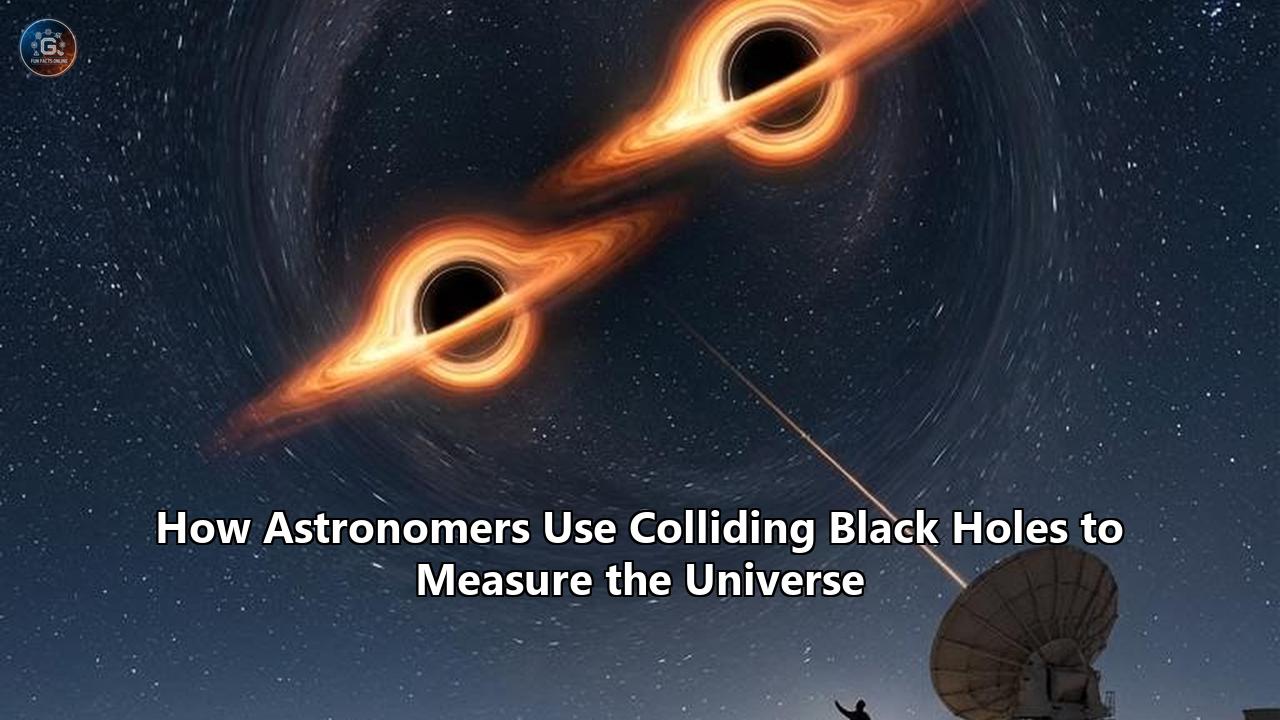
In 1986, physicist Bernard Schutz published a paper proposing that gravitational waves could act as "standard sirens". When two compact objects, such as neutron stars or black holes, spiral inward and merge, they release violent ripples in the fabric of spacetime. The mechanics of this emission are governed entirely by Albert Einstein’s General Relativity.
The collision of binary black holes occurs in three distinct phases: the inspiral, the merger, and the ringdown. During the inspiral, the two masses orbit each other, radiating orbital energy as gravitational waves. As they lose energy, they draw closer, and their orbital frequency increases. This results in a "chirp" signal—a waveform that increases in both amplitude and frequency until the exact moment of collision.
The analytical brilliance of the standard siren lies in the quadrupole formula. The amplitude of the gravitational wave strain ($h$) detected on Earth depends strictly on the masses of the merging objects, the orbital frequency, and the luminosity distance ($D_L$) to the source. By analyzing the rate at which the frequency of the chirp increases over time, physicists can directly calculate the "chirp mass" of the binary system. Once the chirp mass is known, the absolute, intrinsic amplitude of the gravitational wave emitted at the source is perfectly determined.
By comparing this intrinsic amplitude to the significantly weaker strain amplitude measured by laser interferometers like LIGO, Virgo, and KAGRA, astronomers can calculate the exact luminosity distance to the collision.
This calculation requires no intermediate steps. It requires no Cepheid variables, no supernovae, no corrections for interstellar dust, and no assumptions about stellar metallicity. It is a direct, geometric measurement of distance based on the rigid mathematical laws of spacetime. The black holes serve as an absolute ruler, completely independent of the electromagnetic distance ladder.
The Missing Variable: The Degeneracy of Redshift in Dark Sirens
Despite the elegance of the standard siren, calculating the Hubble constant requires two parameters: the distance to the object, and its recession velocity (redshift). While gravitational waves provide a pristine measurement of distance, they face a severe limitation regarding redshift.
The expanding universe stretches gravitational waves just as it stretches light. When a gravitational wave is stretched by the expansion of space, its frequency drops. However, a highly massive black hole binary merging nearby will produce the exact same low-frequency waveform as a lighter black hole binary merging much further away. General relativity dictates that the equations governing black hole mergers are scale-invariant. The redshift is perfectly degenerate with the total mass of the system. The detector on Earth measures the redshifted mass—the source mass multiplied by $(1+z)$, where $z$ is the redshift.
Without an independent way to measure $z$, the Hubble constant remains locked out of reach.
For binary neutron star mergers, this problem is solved via multi-messenger astronomy. When two neutron stars collide, they generate gravitational waves and a massive electromagnetic explosion known as a kilonova. This was demonstrated perfectly in 2017 with the event GW170817. LIGO and Virgo detected the distance via the gravitational chirp, while traditional telescopes detected the flash of light, allowing spectroscopists to measure the redshift of the host galaxy, NGC 4993. This single "bright siren" yielded an independent $H_0$ measurement of $70.0^{+12.0}_{-8.0}$ km/s/Mpc.
However, binary black hole mergers do not emit light. They occur in the dark, leaving no optical counterpart to measure. They are "dark sirens". Because black hole mergers make up the vast majority of detections in the gravitational wave catalogs, astronomers had to engineer completely new mathematical architectures to extract redshift data from them.
The quest to have black holes measure universe properties forced the development of two cutting-edge solutions: the statistical cross-correlation method and the spectral siren mass-gap method.
Solution Architecture I: Statistical Cross-Correlation with Galaxy Catalogs
The first solution treats the absence of an optical counterpart not as a dead end, but as a probabilistic constraint. While a black hole merger emits no light, it must occur within a host galaxy. If astronomers can map the volume of space from which the gravitational wave originated, they can catalog all the potential host galaxies within that localized three-dimensional volume.
This is the statistical dark siren method. When a gravitational wave sweeps across the Earth, it hits the distinct detectors in the global network at slightly different times. By analyzing the time delay between the LIGO detector in Hanford, Washington, the LIGO detector in Livingston, Louisiana, and the Virgo detector in Italy, physicists triangulate the signal on the sky. Combined with the luminosity distance derived from the wave's amplitude, this triangulation generates a 3D localization volume.
Researchers then cross-reference this localized region with comprehensive astronomical databases, such as the Dark Energy Survey (DES) or the DESI Legacy Imaging Survey. These surveys contain the photometric redshifts of millions of galaxies.
Instead of isolating a single redshift, the statistical method applies Bayesian inference. Every galaxy within the localization volume is treated as a potential host. The redshift of each galaxy is fed into the Hubble equation alongside the precise gravitational-wave distance. This produces a probability distribution for $H_0$ for that specific merger.
A single dark siren event produces a very broad, uninformative constraint on $H_0$ because there might be thousands of galaxies in the localized volume. The statistical power emerges through aggregation. As dozens, and eventually hundreds, of black hole mergers are detected, the probability distributions from all the distinct localization volumes are multiplied together. The incorrect host galaxies will yield random, scattered values for $H_0$. However, the true host galaxies—even if their specific identity remains unknown—will consistently vote for the true Hubble constant. Over time, the random noise cancels out, and a sharp peak emerges at the correct expansion rate.
The effectiveness of this method was first proven using GW170814, a binary black hole merger detected during LIGO/Virgo's second observing run. The localization volume contained over 77,000 potential host galaxies mapped by the Dark Energy Survey. By itself, GW170814 yielded an $H_0$ of $75^{+40}_{-32}$ km/s/Mpc. The error bars were massive, but the mathematical architecture functioned perfectly.
Recent advancements have significantly refined this technique. In 2026, researchers applied this method to the latest data from the fourth observing run (O4a) of the LIGO-Virgo-KAGRA network. By selecting highly localized dark sirens and weighting the probability of host galaxies based on their r-band luminosity (the assumption being that brighter, more massive galaxies are more likely to host black hole mergers), the precision tightened. Using 17 well-localized dark sirens, the team constrained $H_0$ to $78.2^{+12.0}_{-11.0}$ km/s/Mpc. When combined with the single bright siren (GW170817), the measurement dropped to $69.9^{+4.1}_{-4.0}$ km/s/Mpc, a highly competitive figure that sits squarely between the Planck and SH0ES measurements.
Solution Architecture II: The Spectral Siren and the Black Hole Mass Gap
The statistical cross-correlation method relies heavily on external galaxy catalogs, which inherently introduces some reliance on the electromagnetic observations the standard siren method was meant to avoid. The second solution is far more radical. It utilizes the intrinsic astrophysics of the black holes themselves to extract the redshift directly from the gravitational wave signal, requiring zero electromagnetic cross-referencing.
This approach is known as the spectral siren method, or the mass-distribution method. It hinges on the concept that black holes in the universe do not exist in a flat, random distribution of masses. The laws of stellar evolution impose strict limits and recognizable features on the population of black holes.
The most prominent feature is the upper mass gap, created by a phenomenon known as Pair-Instability Supernovae (PISN) and Pulsational Pair-Instability Supernovae (PPISN). When a highly massive star (between 130 and 250 solar masses) reaches the end of its life, the core becomes incredibly hot. The photons exerting outward radiation pressure against the crush of gravity possess so much energy that they spontaneously convert into electron-positron pairs.
This conversion suddenly removes the outward radiation pressure. The core undergoes catastrophic collapse, igniting explosive oxygen fusion. The resulting detonation is so violently energetic that it completely obliterates the star, leaving absolutely no remnant behind—no neutron star, no black hole. For stars slightly less massive, they undergo violent pulsations (PPISN) that shed vast amounts of mass before finally collapsing into black holes.
The consequence of this stellar physics is a stark cutoff in the astrophysical black hole mass spectrum. Theoretical models dictate a pile-up of black holes around $35$ to $45$ solar masses, followed by a steep drop-off, creating a "mass gap" where stellar-mass black holes simply should not exist.
This mass gap is the key to letting black holes measure universe expansion. Researchers like Maya Fishbach, Will Farr, and Daniel Holz realized that this mass gap serves as a standard mass scale.
When a gravitational wave detector captures a signal, it measures the redshifted mass of the black holes. If the universe contains a sharp peak in the actual black hole population at $35$ solar masses, and LIGO detects a peak in the population at $50$ solar masses, the difference between the source mass and the observed mass is entirely due to redshift. By analyzing a large population of binary black hole mergers and identifying where the PISN mass gap sits in the detector data, physicists can infer the average redshift of the population.
This completely breaks the distance-redshift degeneracy. The amplitude of the waves provides the distance. The shifting of the mass gap provides the redshift.
The effectiveness of the spectral siren method relies heavily on the abundance of data. In 2024, researchers utilized the GWTC-3 catalog (containing 90 events) to model the black hole mass function. By isolating the sub-populations of black holes formed from stellar collapse and those formed from prior hierarchical mergers, they identified the lower edge of the upper mass gap at approximately $84 M_\odot$.
However, the spectral siren method is highly sensitive to the astrophysical assumptions regarding the mass distribution. If the peak of the mass distribution evolves with redshift—for instance, if black holes formed in the early universe at lower metallicities have a fundamentally different mass gap than black holes forming locally—the $H_0$ calculation will be heavily biased. Current studies exploring the GWTC-3 and GWTC-4 catalogs have found that heavy black hole features uniquely anchor the Hubble constant, with spectral siren estimates from the latest catalogs yielding $H_0 = 78.8^{+19.0}_{-15.3}$ km/s/Mpc.
Real-World Efficacy: Analyzing GWTC-3 and GWTC-4 Data
The ability to deploy these dark siren methodologies has scaled directly with the exponential growth in gravitational wave detections. The transition from proof-of-concept to rigorous cosmological probe is documented in the Gravitational-Wave Transient Catalogs (GWTC).
During the first two observing runs (O1 and O2), the network detected only 10 binary black hole mergers. By the end of the third observing run (O3), GWTC-3 contained 90 compact binary coalescences. The fourth observing run (O4), utilizing upgraded laser squeezing technology to drastically reduce quantum noise in the detectors, has pushed the candidate detections past 200 events.
When astronomers look to black holes measure universe parameters, the precision of the output is heavily scrutinized. Analyzing the GWTC-3 catalog using the statistical galaxy-catalog method yielded an $H_0$ of $68^{+8}_{-6}$ km/s/Mpc. This result represented a 42% improvement in precision over the GWTC-1 results.
However, deeper statistical scrutiny revealed dependencies that must be mitigated. The tight constraint heavily relied on a single exceptionally well-localized event: GW190814. This event featured a 23-solar-mass black hole merging with a 2.6-solar-mass object (either the lightest black hole or the heaviest neutron star ever observed). Because the mass ratio was so asymmetric, the gravitational wave signal emitted strong higher-order harmonics—overtones beyond the primary quadrupole frequency.
These higher harmonics allowed physicists to break another critical degeneracy: the inclination angle. Gravitational waves emit more strongly along the axis of the binary's rotation. A binary merging face-on to Earth at a large distance looks identical in amplitude to a binary merging edge-on at a closer distance. The higher harmonics present in GW190814 broke this viewing-angle degeneracy, allowing for an incredibly precise distance measurement. This singular precision is what drove the tightened $H_0$ constraint in GWTC-3.
The introduction of GWTC-4 data in 2025 and 2026 has expanded the playing field. Incorporating heavy black holes into the population models, researchers applied both the dark siren statistical method and the spectral siren method. Joint inference across 142 high-confidence binary black hole collisions yielded $H_0 = 82.5^{+16.8}_{-14.3}$ km/s/Mpc for the dark siren method, and $78.8^{+19.0}_{-15.3}$ km/s/Mpc for the spectral method.
While these figures currently lean higher, mirroring the SH0ES Type Ia supernova data rather than the Planck CMB data, the statistical error bars remain large. The uncertainties currently sit around 15-20%, whereas the SH0ES and Planck measurements have error margins of around 1-2%. Gravitational wave cosmology has successfully validated its theoretical architecture, but it has not yet gathered enough data to independently break the Hubble tension.
Multi-Band Observatories and the Future of Cosmological Measurement
The current limitations of gravitational wave cosmology are primarily functions of instrument sensitivity and frequency bandwidth. The ground-based detectors (LIGO, Virgo, KAGRA) are sensitive only to high-frequency gravitational waves (roughly 10 Hz to 1000 Hz). They only hear the final seconds or fractions of a second of a black hole merger. This brief observation window limits the precision of the localization volume and the measurement of the orbital inclination angle.
The future of standard siren cosmology requires tracking the evolution of a binary black hole system across multiple frequency bands over months or years.
This multi-band architecture will be realized with the launch of the Laser Interferometer Space Antenna (LISA) and the proposed Taiji network. Operating in the vacuum of space with laser arms millions of kilometers long, LISA will detect millihertz gravitational waves. At these frequencies, LISA will detect intermediate-mass black hole binaries (IMBHBs) and stellar-mass black hole binaries months or even years before they finally merge.
By observing an inspiral for months as the space-based detector orbits the Sun, the Doppler shifting of the gravitational wave signal will provide sub-degree sky localization. LISA will pinpoint the exact coordinates of the binary system. Years later, as the frequency of the chirp climbs out of the millihertz band and into the hectohertz band, the signal will pass into the detection range of third-generation ground-based detectors like the Einstein Telescope (ET) in Europe and Cosmic Explorer in the United States.
These third-generation terrestrial detectors will feature 10-kilometer to 40-kilometer laser arms installed deep underground to negate seismic noise. When the signal transitions from LISA to the Einstein Telescope, the combined data will yield absolute distance measurements with less than 1% uncertainty.
Furthermore, the specific physics of intermediate-mass black hole binaries and precessing stellar-mass binaries will shatter current limitations. When the orbital plane of a binary system wobbles or precesses—often caused by the misalignment of the individual black holes' spins—the gravitational waveform gains intense modulations. This precession breaks the inclination-distance degeneracy entirely. Recent simulations demonstrate that identifying precessing black holes in third-generation detectors enhances distance measurement precision by an order of magnitude.
When multi-band observations and orbital precession are combined, the localization volume of a dark siren will shrink so drastically that it will often encompass only a single galaxy. The statistical guessing game of the current dark siren method will vanish. The host galaxy will be identified with absolute certainty, its optical redshift measured by terrestrial telescopes, and the pure geometric distance extracted from the multi-band gravitational wave chirp.
The Hubble tension forces astrophysics to confront the limits of traditional observation. The electromagnetic distance ladder, brilliant in its historical construction, is bogged down by the complexities of stellar physics, dust extinction, and systemic calibration errors. The CMB measurements remain shackled to the assumptions of early-universe expansion models.
The integration of general relativity into cosmological measurements provides the exact independent ruler required. Gravitational waves are indifferent to interstellar dust. They do not rely on standard candle calibrations. By mapping the statistical distribution of host galaxies, and by reading the redshift directly encoded into the astrophysical mass gaps of collapsing stars, the methods by which black holes measure universe expansion are evolving from theoretical curiosities into the most rigorous probes in astrophysics. As the catalog of spacetime ripples grows from dozens to thousands, the pure geometry of black hole collisions stands positioned to definitively calculate the expansion rate of reality.
Reference:
- https://www.space.com/space-exploration/hubble-space-telescope/hubble-tension-is-now-in-our-cosmic-backyard-sending-cosmology-into-crisis
- https://www.mdpi.com/2075-4434/13/3/65
- https://www.sciencenews.org/article/cosmology-expansion-universe
- https://cerncourier.com/a/the-hubble-tension/
- https://arxiv.org/pdf/2310.13629
- https://academic.oup.com/mnras/article/538/2/711/8029887
- https://astrobites.org/2022/01/04/gw-cosmo/
- https://www.researchgate.net/publication/403032783_Improved_constraint_on_the_Hubble_constant_from_dark_sirens_with_LIGOVirgoKAGRA_O4a
- https://arxiv.org/abs/1712.06531
- https://escholarship.org/uc/item/9pc3638f
- https://www.researchgate.net/publication/399727576_Constraining_the_nonstandard_propagating_gravitational_waves_in_the_cosmological_background_with_GWTC-3
- https://zenodo.org/records/11242245
- https://arxiv.org/abs/1911.05882
- https://arxiv.org/abs/2601.03257
- https://arxiv.org/html/2603.13080v1