
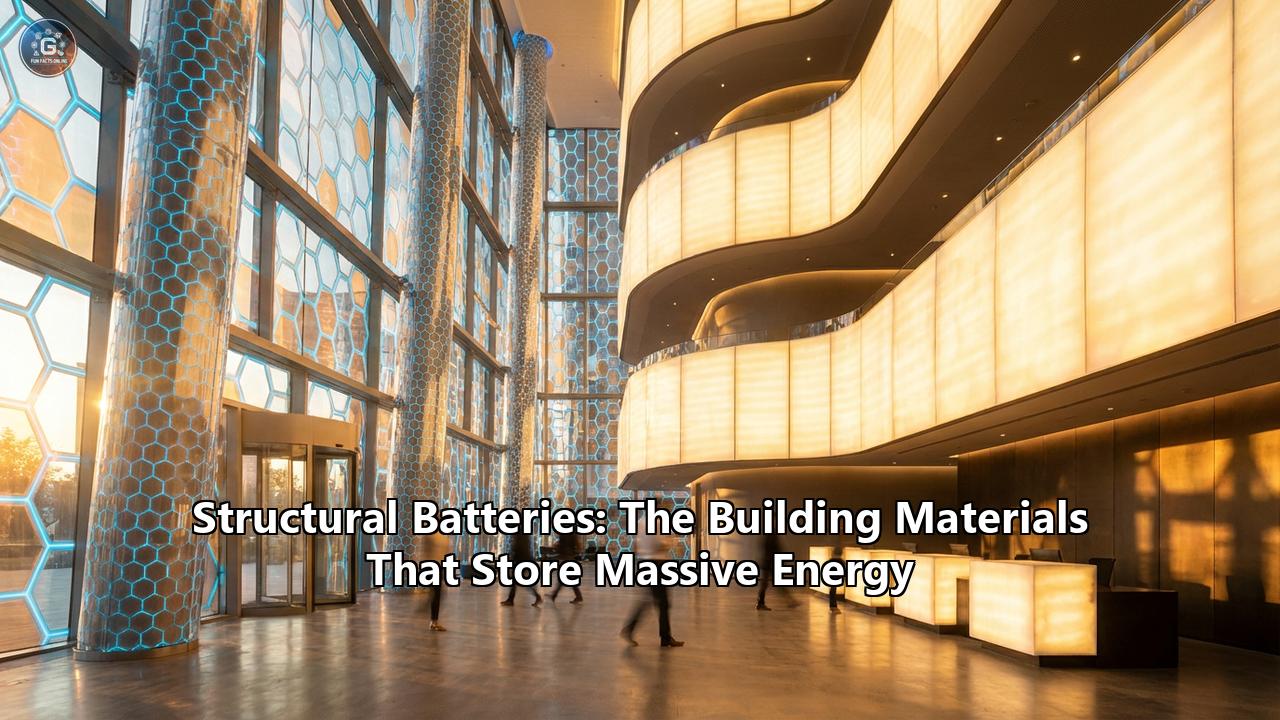
The future of energy storage is not just about better batteries; it is about making the battery disappear entirely.
The Invisible Revolution: How Structural Batteries Will Power the World Without Weight
Imagine an electric vehicle (EV) that can drive 70% further on a single charge, not because it has a larger battery pack, but because it has no battery pack at all. Imagine a laptop that is as thin as a credit card and never needs a heavy lithium-ion brick to power it. Imagine an electric aircraft that can finally carry passengers across oceans because the fuselage itself holds the energy.
This is not science fiction. It is the dawn of Structural Battery Composites, a technology that promises to turn the very materials we build with—the steel, aluminum, and carbon fiber—into active energy storage devices.
For over a century, engineering has been locked in a battle against "parasitic mass." In every car, plane, and gadget, the battery is dead weight. It adds mass without contributing to the structural integrity of the device. It is a passenger that must be carried, consuming energy just to move itself. Structural batteries flip this equation on its head. They create "massless" energy storage, where the energy source is the structure.
This comprehensive guide dives deep into the science, the players, the manufacturing hurdles, and the revolutionary potential of the building materials that store massive energy.
1. The Core Concept: What Is a Structural Battery?
To understand why this technology is revolutionary, we must first redefine what a battery is. A traditional battery is a chemical sandwich: a cathode, an anode, and a liquid electrolyte, all wrapped in a heavy steel or aluminum casing to protect it. It is fragile, heavy, and chemically volatile.
A structural battery is different. It is a multifunctional composite material that serves two masters simultaneously: mechanical load-bearing and electrochemical energy storage.
The Chemistry of the Skeleton
The magic ingredient in most structural batteries is carbon fiber. You likely know carbon fiber as the lightweight, high-strength material used in Formula 1 cars and Boeing Dreamliners. But carbon fiber has a hidden talent: it is an excellent conductor of electricity.
In a structural battery composite:
- The Negative Electrode (Anode): The carbon fibers themselves act as the host for lithium ions. They carry the mechanical load (keeping the car stiff) while storing electrons.
- The Positive Electrode (Cathode): Usually an aluminum foil coated with lithium iron phosphate (LFP), wrapped in fiberglass for insulation.
- The Electrolyte: This is the critical breakthrough. Instead of a liquid that would slosh around, structural batteries use a structural polymer electrolyte. This is a semi-solid plastic that can transfer lithium ions between electrodes and transfer mechanical loads (shear stress) between fibers.
Essentially, the "bones" of the device become the battery. The hood of your car, the wings of a drone, or the casing of your tablet store the energy.
2. The Two Paths: "Massless" Composites vs. Cell-to-Chassis
It is vital to distinguish between two technologies often confused in the media: True Structural Composites and Structural Integration.
Path A: Cell-to-Chassis (The Tesla/BYD Approach)
Companies like Tesla (with their 4680 cells) and BYD (with the Blade Battery) are pioneering structural battery packs.
- How it works: They take standard battery cells and glue them together into a giant block. This block is so rigid that it replaces the floor of the car. The seats bolt directly onto the battery.
- The Benefit: It saves weight by removing the metal modules and separate floor pans.
- The Limit: The battery cells are still distinct objects. If you took the chemistry out, the car would collapse. It is efficient, but it is not "massless."
Path B: Structural Battery Composites (The "Massless" Approach)
This is the radical leap being developed by institutions like Chalmers University of Technology and startups like Sinonus.
- How it works: There are no "cells." The material of the car body is the battery. You cannot remove the battery without removing the car's door or roof.
- The Benefit: This is true "massless" energy storage. The battery weight effectively vanishes because you would have needed that material for the car body anyway. Even if the energy density is lower than a Tesla cell, the system efficiency skyrockets because the vehicle is drastically lighter.
3. The Science of "Massless" Energy
The term "massless energy" sounds like a violation of physics, but it is a clever accounting trick.
Let’s do the math on an electric aircraft.
- Current State: You build a 1,000 kg aluminum plane. You add 500 kg of batteries. Total weight: 1,500 kg. The batteries are "parasitic" mass.
- Structural State: You build the plane out of structural battery composites. The material weighs 1,000 kg, just like the aluminum, but it holds the energy inside it. Total weight: 1,000 kg.
- The Result: You have effectively saved 500 kg. From a system perspective, the energy storage came at "zero" added mass penalty.
Researchers at Chalmers University have achieved a stiffness of 70 Gigapascals (GPa)—roughly the same as aluminum—and an energy density of 30 Wh/kg.
- Wait, isn't 30 Wh/kg low? A standard Tesla battery is ~260 Wh/kg. Yes, the density is lower. But because the battery is the structure, you don't need the high density to achieve the same range, because you aren't dragging thousands of pounds of dead weight.
4. Revolutionizing Industries: Where Will We See It First?
Structural batteries will not appear in everything at once. They will infiltrate markets where weight is the enemy.
Aerospace: The Holy Grail
Electric aviation is currently stuck. Jet fuel has 40x the energy density of batteries. To make a plane fly, you need so many batteries that the plane becomes too heavy to lift off.
Structural batteries are the key to unlocking eVTOLs (Electric Vertical Take-Off and Landing) aircraft. If the wings, fuselage, and seats store power, an electric plane could double its range without adding a gram of weight. Airbus and NASA are heavily investing in this "multifunctional fuselage" concept.
Consumer Electronics: The Paper-Thin Era
Imagine an iPhone where the glass back and the aluminum frame are the battery. Device thickness is currently dictated by the battery pouch. With structural composites, laptops could become thin rigid sheets, and wearables could become truly seamless.
Automotive: The Range Anxiety Killer
For cars, the roof, doors, and bonnet are ideal candidates. They are large surface areas that don't take the brunt of a crash (unlike the front bumper). Replacing a steel roof with a carbon fiber battery roof could save 50kg and add 20 miles of range—a double win.
5. The Manufacturing Frontier: Why Isn't It Here Yet?
If the science works, why aren't we driving structural battery cars? The challenge lies in scaling from the lab to the factory.
- The Curing Dilemma: Carbon fiber composites are "baked" in ovens to harden. Batteries, however, hate heat. Finding a way to cure the structural resin without destroying the delicate chemical electrolyte is a massive engineering hurdle.
- Consistency: A structural component must be reliable. If a car door has a "weak spot" in its carbon weave, it's a safety risk. If it has a "weak spot" in its conductivity, it's a fire risk. Achieving perfect uniformity in mass production is difficult.
- The Connector Nightmare: How do you wire a car door? In a standard battery, you have two tabs (plus and minus). In a structural hood, you have thousands of conductive fibers. Collecting that current efficiently without creating hot spots (resistive heating) requires novel electrical engineering.
6. The Safety & Sustainability Paradox
Structural batteries introduce a fascinating conflict between safety and sustainability.
The Good News: SafetyStructural electrolytes are solid or semi-solid. They do not leak, and they are far less flammable than the liquid solvents in current Li-ion batteries. Furthermore, because they have lower energy density spread over a huge surface area (the whole car body), a puncture in one spot is less likely to cause a catastrophic explosion compared to piercing a dense, pressurized battery cell.
The Bad News: The Recycling NightmareRecycling is the Achilles' heel of this technology.
- Current Recycling: We crush batteries and separate the metals. We crush cars and melt the steel.
- Structural Recycling: You now have a material where carbon fiber, plastic resin, aluminum, and lithium salts are fused at the molecular level. You cannot easily melt it down or separate it. We risk creating a generation of "monstrous hybrids"—materials that are fantastic to use but impossible to unmake. Developing a chemical process to separate the fiber from the electrolyte is a critical area of research that must be solved before mass adoption.
7. Conclusion: The Invisible Future
We are witnessing the end of the "component" era. For centuries, we have built machines by bolting distinct parts together: a frame, an engine, a fuel tank. Structural batteries herald the age of integration, where matter itself becomes intelligent and energetic.
While we are likely 5 to 10 years away from seeing a fully structural battery car in a showroom, the transition has already begun in high-end drones and satellites. As the technology matures, our devices will not just get smaller or lighter; they will fundamentally change in form. The bulky battery brick will be resigned to history, replaced by the elegant invisibility of energy stored within the very fabric of our world.
Reference:
- https://www.youtube.com/watch?v=7rJf_n3bc0I
- https://coinsbench.com/the-end-of-the-battery-pack-how-structural-composites-are-changing-everything-we-own-8f109d448ad2
- https://www.futurebridge.com/industry/perspectives-mobility/massless-energy-storage-revolutionize-future-battery/
- https://www.topspeed.com/massless-batteries-future-of-evs/
- https://www.youtube.com/watch?v=DZSFf5vJ1fQ
- https://cleantechnica.com/2020/10/10/teslas-new-structural-battery-pack-its-not-cell-to-pack-its-cell-to-body/
- https://promwad.com/news/structural-battery-composites-electronics-transportation
- https://www.laserax.com/blog/structural-batteries
- https://www.sciencedaily.com/releases/2024/09/240910121001.htm
- https://www.weforum.org/publications/top-10-emerging-technologies-of-2025/in-full/structural-battery-composites/