
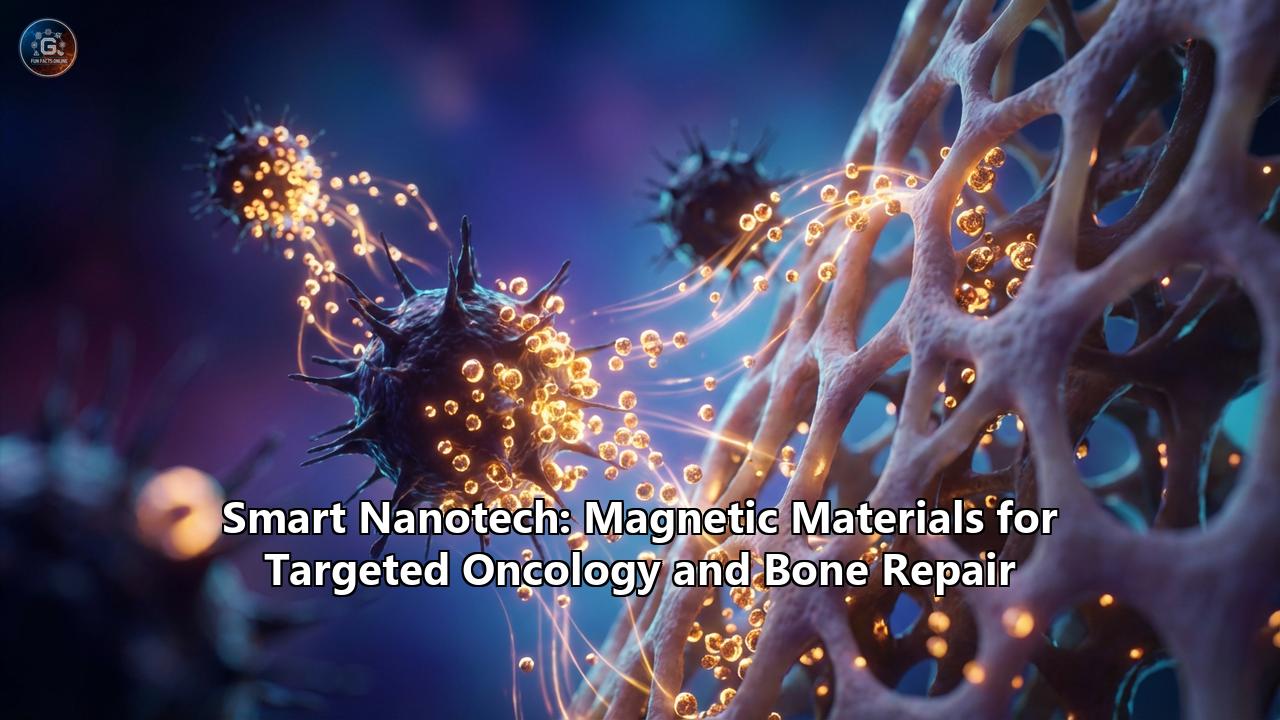
The convergence of oncology and regenerative medicine represents one of the most sophisticated frontiers in modern biomedical engineering. For decades, these two fields operated in isolation: oncologists focused on destroying malignant tissues, often at the cost of healthy surrounding structure, while tissue engineers focused on repair, often without the tools to address the complex microenvironments of post-cancerous defects. Today, a new class of "smart" nanotechnologies is bridging this gap. At the heart of this revolution lies a material that is both ancient and futuristic: magnetic nanoparticles.
By harnessing the unique physical properties of superparamagnetic iron oxide nanoparticles (SPIONs) and integrating them into bioactive scaffolds, scientists are developing "theranostic" platforms capable of a dual mandate: seek and destroy bone tumors, then guide and repair the skeletal destruction they leave behind. This article explores the science, mechanisms, and clinical potential of these magnetic materials, detailing how they are reshaping the future of orthopedic oncology.
Part I: The Clinical Paradox of Bone Cancer and Metastasis
To understand the necessity of smart magnetic materials, one must first appreciate the clinical battlefield. Primary bone cancers (like osteosarcoma) and metastatic bone disease (spread from breast, prostate, or lung cancer) present a brutal paradox. The treatment—often surgical resection combined with aggressive chemotherapy or radiation—creates a second pathology: a "critical-sized" bone defect.
These defects are too large for the body to heal naturally. Conventional reconstruction methods, such as metal prosthetics or cadaver bone grafts, are biologically inert. They do not grow, they do not self-repair, and they are prone to infection and rejection. Furthermore, microscopic cancer cells often lurk in the margins of the resection, leading to recurrence.
This scenario demands a material that is active, not passive. It requires a system that can:
- Ablate residual cancer cells to prevent recurrence.
- Fill the structural void left by surgery.
- Stimulate the patient's own stem cells to regenerate living bone.
- Dissolve harmlessly once the job is done.
Magnetic nanotechnology is the only modality currently capable of performing all four functions simultaneously via remote control.
Part II: The Physics of the Invisible—Fundamentals of Magnetic Nanomedicine
The magic of these materials occurs at the nanoscale (1–100 nanometers). At this size, magnetic materials like magnetite ($Fe_3O_4$) and maghemite ($\gamma-Fe_2O_3$) exhibit a phenomenon known as superparamagnetism.
Unlike the permanent magnets on a refrigerator, superparamagnetic nanoparticles possess no magnetic memory (remanence) when the external magnetic field is removed. They do not clump together in the bloodstream, allowing them to circulate freely or remain dispersed within a scaffold. However, the moment an external magnetic field is applied, they react with powerful precision. This "on-off" switch is the key to their safety and utility.
The Heating Mechanism: Magnetic Hyperthermia
When these nanoparticles are exposed to an Alternating Magnetic Field (AMF)—a magnetic field that flips direction thousands of times per second—they generate heat. This is not chemical heat, but physical heat generated through two specific mechanisms:
- Néel Relaxation: The magnetic moment inside the crystal rotates to align with the field, overcoming an energy barrier and releasing heat.
- Brownian Relaxation: The entire nanoparticle physically rotates within its fluid or matrix, generating heat through friction.
By tuning the frequency and amplitude of the magnetic field, clinicians can raise the temperature of the nanoparticles to between 42°C and 45°C. This temperature range is critical. It induces hyperthermia, which is lethal to cancer cells (which have poor heat dissipation due to chaotic blood flow) but relatively harmless to healthy bone cells.
Part III: The Oncological Front—Precision Warfare
In the context of bone cancer, magnetic nanoparticles serve as "trojan horses" designed to infiltrate the tumor microenvironment.
1. Magnetic Hyperthermia Therapy (MHT)
The most direct application is thermal ablation. In recent advancements, researchers have developed "magnetic bone cement"—a composite of polymethylmethacrylate (PMMA) loaded with doped ferrites (such as Zinc-Ferrite or Manganese-Ferrite). When injected into a bone lesion, this cement stabilizes the fracture immediately. Then, the patient is placed inside a magnetic coil. The cement heats up, cooking the surrounding tumor cells from the inside out.
Unlike radiation, which has a lifetime toxicity limit, magnetic hyperthermia can be repeated. If a follow-up MRI detects a new tumor growth, the patient effectively carries the weapon inside them already; the doctor simply needs to turn on the external field to reactivate the treatment.
2. Magnetically Triggered Drug Delivery
Chemotherapy is notoriously toxic to the bone marrow, often causing immune suppression. Smart magnetic nanocarriers offer a solution through spatiotemporal control.
Imagine a nanoparticle coated in a thermo-responsive polymer (like PNIPAM) that holds a payload of Doxorubicin (a potent bone cancer drug). These polymers are designed to be solid at body temperature (37°C) but collapse or become porous at 42°C.
- Step 1: The nanoparticles are injected and guided to the tumor site using high-gradient magnetic magnets.
- Step 2: An alternating field is applied, heating the particles slightly.
- Step 3: The heat triggers the polymer coating to open, releasing the high-dose chemotherapy only at the tumor site.
This "hot-zone" delivery maximizes tumor eradication while sparing the kidneys, heart, and healthy bone marrow.
Part IV: The Regenerative Front—Wireless Tissue Engineering
Once the cancer is suppressed, the challenge shifts to rebuilding the bone. This is where the "smart" aspect of magnetic materials becomes truly revolutionary. Bone is a piezoelectric and mechanosensitive tissue; it grows in response to mechanical stress (Wolff’s Law) and electrical signals. Magnetic materials can hack this biological signaling pathway.
1. Magneto-Mechanical Actuation
Recent breakthroughs, such as those involving ferromagnetic fiber arrays and hydrogel micromotors, have introduced the concept of wireless mechanical stimulation.
When magnetic nanoparticles are embedded in a scaffold (a porous structure that mimics bone), the application of a low-frequency magnetic field causes the particles to physically vibrate or deform the scaffold micro-architecturally.
- The Mechanotransduction Effect: Mesenchymal Stem Cells (MSCs) attached to the scaffold feel these tiny vibrations. Through sensors on their cell membranes (integrins), this physical force is translated into biochemical signals (the MAPK and BMP signaling pathways).
- The Result: The cells "think" the bone is under load. They upregulate osteogenic genes (RUNX2, ALP, Osteocalcin) and begin depositing calcium faster and more organized than they would on a static scaffold.
2. The "Magnetic Scaffold"
Modern magnetic scaffolds are composites, often combining a biodegradable polymer (like Polycaprolactone or PLGA) with a bioactive ceramic (Hydroxyapatite) and SPIONs.
- Osteoconduction: The hydroxyapatite provides the surface for new bone to grow.
- Osteoinduction: The magnetic field enhances the differentiation of stem cells.
- Angiogenesis: Crucially, magnetic stimulation has been shown to promote the formation of new blood vessels (angiogenesis). Iron ions ($Fe^{3+}$) released slowly from the degrading nanoparticles can mimic hypoxic conditions, stabilizing Hypoxia-Inducible Factor-1 alpha (HIF-1$\alpha$), which triggers the body to grow new vascular networks—essential for keeping the new bone alive.
Part V: The Convergence—"Seek, Destroy, and Repair"
The pinnacle of this technology is the Dual-Action System. This represents the shift from treating cancer and bone defects as separate problems to treating them as a single continuum.
Case Study: The Bioactive Magnetic Nanocomposite
A prominent example of this convergence is the development of core-shell nanocomposites, recently highlighted by researchers in Brazil and Portugal. These materials consist of a magnetic core (for heating) coated with a bioactive glass shell.
- Phase 1 (The Attack): Under a high-frequency alternating magnetic field, the core generates heat, ablating the bone tumor.
- Phase 2 (The Reconstruction): Upon contact with body fluids, the bioactive glass shell reacts to form a layer of hydroxycarbonate apatite—the mineral equivalent of natural bone. This layer bonds directly to the host bone.
- Phase 3 (The Support): As the material degrades, it releases calcium and silicon ions, which genetically stimulate the surrounding cells to proliferate and mineralize.
The "Smart" Implant Surface
Another approach involves coating titanium implants with magnetic nanorods. In cases where a metal prosthesis is required, these coatings can prevent the two biggest failures of implants: infection and loosening.
- Infection Control: Bacteria cannot form biofilms easily on surfaces that can be heated. A quick "thermal shock" treatment can sterilize the implant surface post-surgery without harming the patient.
- Osseointegration: The magnetic coating attracts circulating stem cells and growth factors (which can be tagged with magnetic carriers) to the implant surface, locking the prosthesis into the jaw or limb more securely.
Part VI: Challenges and the Path to the Clinic
Despite the immense promise, several hurdles remain before these "smart" bones become standard of care.
1. Thermal Dosage Control:Heating a tumor is a delicate balance. Overheating can cause necrosis in healthy tissue or damage adjacent nerves. Advanced thermometry and feedback loops are being developed to map temperatures in real-time during treatment.
2. Biodegradation and Clearance:While iron is a natural element in the body (found in hemoglobin), a sudden flood of iron from degrading nanoparticles can overwhelm the liver and kidneys (reactive oxygen species toxicity). The next generation of materials focuses on "bio-resorbable" magnetism—using doped calcium phosphates or magnesium-based alloys that metabolize completely safely.
3. Depth of Penetration:Generating a strong enough alternating magnetic field to heat particles deep inside a human pelvis or femur without heating the patient's skin (via eddy currents) requires sophisticated electromagnetic coil design. Current clinical trials for prostate cancer have solved this, but scaling to variable bone geometries is an engineering challenge.
4. Regulatory Complexity:A material that acts as a drug (chemo-release), a device (scaffold), and a therapy (hyperthermia) is a regulatory nightmare for agencies like the FDA. These "combination products" require new frameworks for approval.
Part VII: Future Outlook
The future of orthopedic oncology is magnetic. We are moving away from the era of "cold" steel and titanium towards "warm," living, responsive materials.
Imagine a future patient diagnosed with a metastatic lesion in the femur. Instead of a debilitating amputation, they receive a minimally invasive injection of a magnetic hydrogel. An external wearable device—perhaps a knee brace with embedded coils—activates the gel for 30 minutes a day. The first week of treatment sterilizes the tumor. The subsequent weeks provide mechanical stimulation to regrow the missing bone. The patient retains their limb, their mobility, and their life, all facilitated by the invisible, intelligent force of magnetism.
This is not science fiction; it is the active research of today. By manipulating matter at the atomic scale, we are rewriting the rules of bone repair, turning the skeleton itself into a smart, self-healing system. The convergence of magnetism, biology, and engineering promises a new dawn where cancer is not just removed, but replaced with new life.
Reference:
- https://www.mdpi.com/2079-4991/15/4/285
- https://pmc.ncbi.nlm.nih.gov/articles/PMC3138885/
- https://www.the-innovation.org/article/doi/10.59717/j.xinn-mater.2024.100051
- https://newatlas.com/medical-tech/nano-magnets-defeat-bone-cancer-help-heal/
- https://ana.ir/en/news/10455/magnetic-nano-composites-offer-new-hope-for-bone-cancer-treatment
- https://pmc.ncbi.nlm.nih.gov/articles/PMC7482193/
- https://www.frontiersin.org/journals/chemistry/articles/10.3389/fchem.2020.00745/full
- https://www.eurekalert.org/news-releases/1110943