
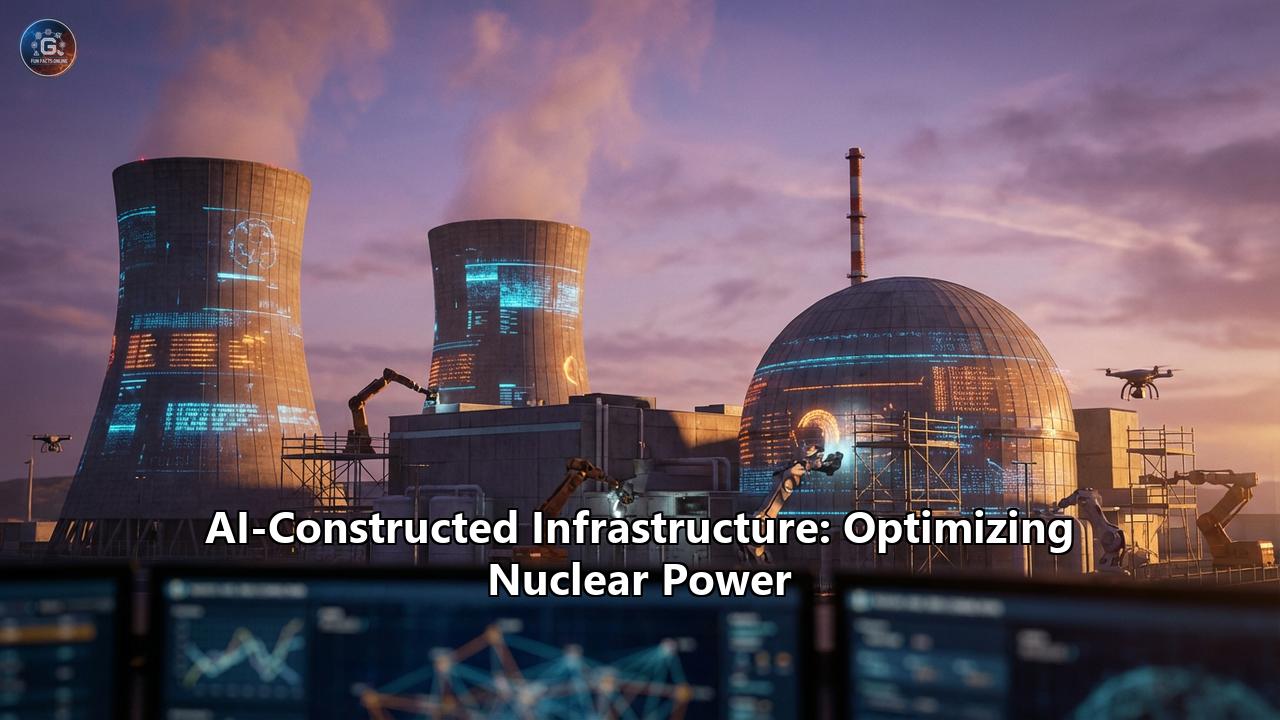
The world stands at a precarious intersection of two rapidly accelerating curves: the exponential growth of artificial intelligence and the desperate, non-negotiable demand for clean, firm energy. For decades, nuclear power has been the sleeping giant of the energy transition—unrivaled in energy density and reliability, yet hobbled by exorbitant costs, glacial construction timelines, and a public perception rooted in the fears of the 20th century. Today, however, the script is being rewritten. The very technology that is driving a spike in global energy consumption—AI—is simultaneously offering the tools to solve nuclear power’s oldest and most intractable problems.
We are witnessing the birth of "AI-Constructed Infrastructure," a paradigm shift where nuclear facilities are no longer just built of concrete and steel, but are woven from data, optimized by neural networks, and operated by digital sentinels that never sleep. This is not merely an incremental improvement; it is a total reimagining of the atomic lifecycle, from the molecular design of fuel pellets to the robotic dismantling of decommissioned cores.
Part I: The Digital Blueprint – AI in Design and Licensing
The traditional narrative of a nuclear project involves years of delays before a single shovel hits the ground. The complexity of designing a system with millions of components, coupled with the rigorous demands of regulatory bodies like the Nuclear Regulatory Commission (NRC) or the IAEA, creates a bottleneck that stifles innovation. Artificial Intelligence is shattering this bottleneck through Generative Design and Large Language Models (LLMs).
Generative Design and the Optimization of Geometry
In the past, reactor design was a linear process. Engineers would propose a layout, run simulations, discover thermal inefficiencies or structural weaknesses, and return to the drawing board. This cycle could take months. Today, Generative AI algorithms act as co-engineers. By defining specific constraints—such as maximum thermal output, available footprint, material costs, and safety margins—AI systems can generate thousands of potential design permutations in the time it takes a human team to draft one.
These algorithms utilize topology optimization, a mathematical method that optimizes material layout within a given design space. For a reactor's cooling system, an AI can evolve piping geometries that look organic—resembling the branching of lungs or blood vessels—maximizing heat transfer efficiency in ways that Euclidean geometry never could. These "evolved" designs are often lighter, stronger, and more efficient than anything a human engineer would intuitively create.
The Paperwork Prophecy: LLMs in Regulatory Compliance
Perhaps the most unglamorous yet transformative application of AI is in the realm of licensing. A typical nuclear license application can run tens of thousands of pages. Reviewing these documents involves armies of lawyers and engineers cross-referencing decades of codes and standards.
Recent collaborations, such as the partnership between Westinghouse and Google Cloud, have introduced "Compliance LLMs." These specialized AI models are trained on the entire corpus of nuclear regulation—every NUREG document, every safety code, and every historical precedent. When engineers draft a new safety system, the AI can instantly scan the proposal against this regulatory library, flagging potential non-compliance issues before they become entrenched in the design. This "pre-validation" has the potential to shave years off the licensing phase, turning a decade-long slog into a streamlined digital verification process.
The Digital Twin: Simulation Before Creation
Before a single cubic meter of concrete is poured, the modern nuclear plant exists as a "Digital Twin." This is not a mere 3D CAD model; it is a living, physics-based simulation of the entire facility, often powered by platforms like NVIDIA’s Omniverse or Siemens’ Xcelerator.
In this virtual multiverse, engineers can simulate construction sequences to the minute. They can test how a reactor vessel fits through a containment hatch, or how a specific crane maneuver might interfere with other site activities. More importantly, they can simulate failure. AI agents can run millions of "Monte Carlo" simulations within the digital twin, introducing random variables—a pipe rupture, a cyberattack, a seismic event—to see how the plant responds. This allows safety systems to be stress-tested against scenarios that are too dangerous or costly to replicate in the real world. The plant is effectively "built" and "operated" thousands of times virtually, ironing out every flaw, before the physical construction begins.
Part II: The Intelligent Jobsite – AI in Construction
The "curse" of nuclear power has always been construction. The industry is notorious for projects that run billions over budget and years behind schedule. This is rarely due to the technology itself, but rather the immense logistical complexity of managing a nuclear construction site, which resembles a small city with strict security and quality control requirements. AI is entering the jobsite as the ultimate project manager.
Predictive Scheduling and Supply Chain Orchestration
Companies like ALICE Technologies are deploying AI to dynamic scheduling. On a nuclear site, a delay in delivering a specific grade of rebar can cascade, delaying the concrete pour, which delays the installation of the pressure vessel, and so on. Traditional Gantt charts are static and cannot easily adapt to this butterfly effect.
AI schedulers treat the construction project as a complex optimization puzzle. If a delivery is delayed, the AI instantly recomputes the entire project schedule, rearranging thousands of other tasks to minimize the impact on the critical path. It might suggest reallocating crews to a different zone or switching the order of non-dependent tasks. This "liquid scheduling" ensures that downtime is obliterated and resources are never idle.
Furthermore, AI-driven supply chain monitors track global logistics in real-time. By analyzing weather patterns, shipping routes, and geopolitical stability, these systems can predict delays in critical components—like large forgings or specialized valves—months in advance, allowing procurement managers to activate backup suppliers before a crisis hits.
Autonomous Construction and Robotics
The physical act of building is also evolving. We are moving toward "lights-out" manufacturing for modular components. Small Modular Reactors (SMRs) are designed to be factory-built, and these factories are becoming hives of autonomous activity. AI-guided welding robots, equipped with computer vision, can perform nuclear-grade welds with superhuman consistency. These robots analyze the molten pool of metal in real-time, adjusting current and travel speed millisecond-by-millisecond to prevent porosity or cracking.
On the construction site itself, autonomous heavy machinery is beginning to appear. AI-controlled excavators and cranes can execute complex earthmoving and lifting operations with mathematical precision, guided by the Digital Twin. This reduces the risk of human error—a critical factor when moving components worth hundreds of millions of dollars.
Part III: The Sentient Core – AI in Operations and Maintenance
Once the plant is operational, AI transitions from architect and builder to nervous system. The goal is the "unbreakdownable" plant—a facility that predicts its own ailments and heals them before they disrupt generation.
Predictive Maintenance (PdM) 2.0
Traditional maintenance is either "reactive" (fix it when it breaks) or "preventive" (fix it on a schedule, whether it needs it or not). Both are inefficient. Reactive maintenance causes downtime; preventive maintenance wastes money on unnecessary repairs.
AI enables "Predictive Maintenance." A modern nuclear plant is instrumented with hundreds of thousands of sensors measuring vibration, temperature, acoustic signatures, voltage, and fluid flow. This data is fed into a centralized AI brain. By using unsupervised learning algorithms, the AI builds a model of "normal" behavior for every pump, valve, and turbine.
It can then detect the subtlest anomalies—a bearing vibrating at a frequency invisible to the human ear, or a micro-degree shift in a heat exchanger's temperature profile. These are the "pre-tremors" of failure. The AI alerts operators not just to a problem, but to a specific prognosis: "Coolant Pump B will fail in 340 hours due to inner-race bearing degradation." This allows maintenance to be scheduled during planned outages, maximizing the plant's capacity factor.
Fuel Cycle Optimization
Nuclear fuel management is a complex combinatorics problem. Engineers must decide exactly where to place fresh fuel assemblies and how to shuffle partially spent ones to maintain a flat power distribution across the core. This "loading pattern" determines how long the reactor can run before refueling.
AI algorithms, specifically Reinforcement Learning (RL) agents, treat core design like a game of 3D chess. They play millions of iterations of fuel loading, seeking patterns that maximize energy extraction while adhering to thermal safety limits. These AI-generated loading patterns have been shown to extend fuel cycles and reduce the amount of high-level waste produced, squeezing more energy out of every gram of uranium.
Part IV: The Fusion Frontier – DeepMind and the Plasma Tamers
While fission plants are being optimized, fusion energy—the holy grail of physics—is being accelerated by AI. In a tokamak reactor, hydrogen plasma is heated to 100 million degrees, becoming an unruly, writhing storm of charged particles. To sustain fusion, this plasma must be suspended in mid-air by powerful magnetic fields, without touching the reactor walls.
Controlling this plasma is a task beyond human reflexes. It requires adjusting the voltage of magnetic coils thousands of times per second to counteract the plasma's chaotic instabilities.
Deep Reinforcement Learning Control
In a landmark breakthrough, Google’s DeepMind collaborated with the Swiss Plasma Center to train a Deep Reinforcement Learning agent to control a tokamak. The AI was not taught the equations of magnetohydrodynamics. Instead, it was placed in a simulation and told to keep the plasma stable. Through trial and error, it learned to manipulate the magnetic coils with virtuoso skill.
Crucially, the AI learned to shape the plasma into new configurations—"snowflakes" and "droplets"—that physicists had theorized but struggled to create. This proves that AI can not only control fusion reactors but can help discover the physics necessary to make them commercially viable.
Part V: The Small Modular Revolution (SMRs) and Microreactors
The future of nuclear is smaller, and AI is the key to the economics of Small Modular Reactors (SMRs). The economic thesis of SMRs relies on mass production and low operating costs. You cannot hire a staff of 500 to run a 50 MW reactor; the economics don't work.
AI enables the "autonomous battery" concept. Microreactors are being designed to run with minimal human intervention, monitored remotely from centralized command centers. An AI on-board the microreactor handles routine load-following—adjusting power output to match the grid or a data center's demand—while the human operators at the command center simply supervise a fleet of dozens of reactors.
Part VI: Safety, Ethics, and the Human-AI Symbiosis
The integration of AI into nuclear infrastructure raises profound questions. The "Black Box" problem—the fact that deep neural networks cannot always explain why they made a decision—is unacceptable in nuclear safety.
Explainable AI (XAI)
To bridge this trust gap, the industry is investing in Explainable AI. Systems like Argonne National Laboratory’s PRO-AID don't just flash a red light; they provide a causal graph. They explain: "I am detecting a fault in Sensor A because it conflicts with the physics-based predictions of Model B and Model C." This "glass box" approach allows human operators to verify the AI's logic, keeping the human in the loop for critical safety decisions.
The Robotics Vanguard
Robots like Boston Dynamics’ Spot, equipped with radiation sensors and AI navigation, are replacing humans in hazardous zones. These "robo-dogs" can autonomously patrol high-radiation areas, mapping dose rates and inspecting equipment, sparing humans from cumulative exposure. In decommissioning, AI-driven robots are essential for cutting and sorting radioactive waste, identifying materials that would be lethal to a human sorter.
Conclusion: The Atomic Symbiosis
We are entering an era of Atomic Symbiosis. The relationship between AI and Nuclear is reciprocal. AI needs Nuclear to provide the massive, carbon-free, 24/7 baseload power required by the next generation of data centers. Nuclear needs AI to shed its legacy of high costs and complexity, becoming agile, safe, and efficient.
This convergence is not just about better technology; it is about the survival of our industrial civilization in a warming world. By fusing the splitting of the atom with the learning of the machine, we are constructing an infrastructure that is robust enough to power the future and intelligent enough to protect it. The nuclear plant of tomorrow will not just be a structure of concrete; it will be a thinking, evolving organism, optimizing the fundamental forces of the universe to light the world.
Deep Dive: The Technological Pillars of AI-Nuclear Infrastructure
To truly understand the magnitude of this revolution, we must look under the hood at the specific technologies driving these changes.
1. The Digital Twin: From Static Model to Dynamic Oracle
The concept of the Digital Twin in nuclear energy surpasses its application in other industries due to the sheer density of physics involved. A nuclear digital twin integrates neutronic, thermal-hydraulic, and structural mechanics codes into a single unified environment.
The Physics-ML Hybrid:Pure machine learning models can hallucinate—they can predict physical outcomes that violate the laws of nature. In nuclear, this is non-negotiable. Therefore, the industry uses "Physics-Informed Machine Learning" (PIML). In this architecture, the neural network is constrained by partial differential equations (PDEs) representing the laws of thermodynamics and fluid dynamics. The AI cannot "invent" a scenario where energy is not conserved. This hybrid approach allows for the speed of AI inference (milliseconds) with the reliability of rigorous physics simulations (which usually take hours).
Operational Scenarios:Consider a Load-Following scenario. As renewable energy from wind and solar fluctuates, the nuclear plant must ramp its power up or down. This puts thermal stress on the reactor components. A Digital Twin can simulate the stress of a proposed ramp rate in real-time, advising the operator: "Ramping at 5% per minute will reduce the fatigue life of the steam generator nozzle by 0.01%. Ramping at 3% is recommended." This level of granular asset management was impossible in the analog era.
2. Advanced Computer Vision in Construction and Inspection
Computer Vision (CV) is the eyes of the AI infrastructure. Modern Convolutional Neural Networks (CNNs) can detect defects that are invisible to the naked eye.
Automated Radiography Analysis:In construction, thousands of welds must be X-rayed (radiographed) to ensure integrity. Historically, certified human inspectors examined these films—a slow, subjective process prone to fatigue. AI systems now scan these digital radiographs, detecting pores, slag inclusions, or cracks with accuracy rates exceeding human experts. They never get tired, and their criteria are mathematically consistent.
Concrete Monitoring:During the pouring of massive concrete containment domes, the curing temperature and moisture must be perfectly controlled to prevent cracking. Sensors embedded in the concrete transmit data to an AI that visualizes the curing process in 3D heat maps. If a "hot spot" develops, the AI directs the cooling systems to adjust locally, ensuring the monolithic integrity of the structure.
3. The Autonomous Control Room
The control room of the future looks less like a cockpit with thousands of analog switches and more like a data visualization center.
Alarm Floods and Cognitive Load:In the Three Mile Island accident, operators were overwhelmed by hundreds of flashing alarms and could not discern the root cause. AI solves the "Alarm Flood" problem. It suppresses nuisance alarms and aggregates related alerts into a single "meta-alert." Instead of seeing "Valve A Low Pressure," "Pump B High Vibration," and "Flow C Low," the operator sees: "Loss of Coolant Inventory in Loop 2." This cognitive decluttering allows humans to focus on strategy rather than raw data processing.
Autonomous Startup and Shutdown:The most risky phases of nuclear operation are startup and shutdown. These involve complex sequences of valve manipulations and control rod adjustments. AI agents are being trained to execute these sequences autonomously, monitoring thousands of parameters simultaneously to ensure a perfectly smooth transition, eliminating the "human factor" from routine but critical maneuvers.
The Economic Equation: How AI Makes Nuclear Cheaper
The primary argument against nuclear has been cost. AI attacks the cost structure from three angles: CAPEX (Capital Expenditure), OPEX (Operational Expenditure), and Risk Premium.
1. Sashing CAPEX with Schedule Certainty:Interest during construction is a massive killer of nuclear projects. If a plant takes 10 years to build instead of 5, the accrued interest on the billions borrowed can double the cost. By using AI for logistics, 4D scheduling (time + 3D space), and regulatory streamlining, the goal is to compress construction timelines significantly. If AI can ensure a project finishes on time, it effectively slashes billions off the price tag.
2. Reducing OPEX with Automation:Labor constitutes a large portion of nuclear OPEX. Security forces, maintenance crews, and administrative staff are expensive. AI-enabled security (using smart cameras and drones) reduces the need for large standing guard forces. Predictive maintenance reduces the spare parts inventory and overtime labor for emergency repairs.
3. Lowering the Risk Premium:Investors charge high interest rates for nuclear projects because they are seen as risky. By demonstrating that AI-driven designs are pre-validated against regulations and that construction is managed by algorithmic schedulers, the perceived risk drops. This lowers the cost of capital—the interest rate—which drastically reduces the Levelized Cost of Electricity (LCOE).
The Fusion Future: A Symphony of Data
Fusion energy requires materials that can withstand the neutron bombardment and heat flux of a star. Discovering these materials traditionally takes decades of trial and error.
AI-Accelerated Material Discovery:Researchers are using Graph Neural Networks (GNNs) to predict the properties of millions of theoretical alloys. They can simulate how a specific crystal lattice will degrade under neutron irradiation without having to wait years for a physical test in a reactor. This "Material Informatics" is identifying candidates for "self-healing" metals—alloys that can repair their own radiation damage at the atomic level—which are essential for the commercial viability of fusion power plants.
Conclusion: The Inevitable Convergence
The skepticism surrounding "AI-Constructed Infrastructure" is fading as the results materialize. We are seeing concrete poured faster, safety margins calculated tighter, and reactors operating smoother.
This is not a distant sci-fi future. The code is being written today. The sensors are being installed today. The first generation of AI-native nuclear engineers is graduating today. They will build the infrastructure that powers the 21st century—a grid that is clean, inexhaustible, and intelligent. The optimization of nuclear power by artificial intelligence is not just an industrial upgrade; it is the cornerstone of a sustainable, high-energy civilization.
Reference:
- https://carboncredits.com/from-code-to-core-how-ai-is-fueling-the-rise-of-small-modular-reactors/
- https://www.neimagazine.com/analysis/ai-and-a-golden-age-for-nuclear-power/
- https://devcabin.tech/blog/the-role-of-generative-ai-in-advancing-nuclear-energy
- https://blogs.trx-international.com/how-ai-and-robotics-are-changing-the-nuclear-industry/
- https://discoveraccelerant.com/ai-in-nuclear-plants/
- https://www.bestpractice.ai/ai-case-study-best-practice/edf_energy_wishes_to_monitor_power_station_conditions_in_real_time_and_predict_maintenance_requirements_using_machine_learning
- https://euro-fusion.org/member-news/epfl-and-deepmind-use-ai-to-control-plasmas-for-nuclear-fusion/
- https://www.neimagazine.com/advanced-reactorsfusion/using-ai-in-nuclear-decommissioning-10580423/