
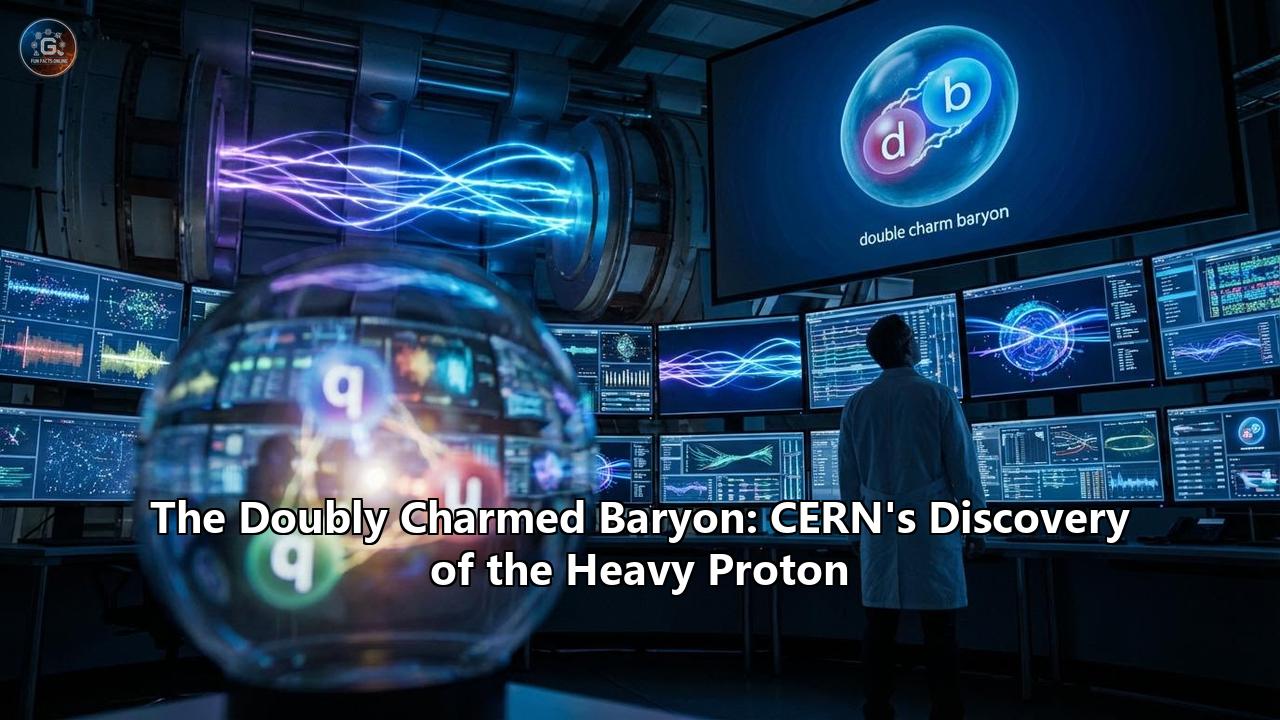
Deep within the subterranean tunnels of the Swiss-French border, humanity has constructed the most complex machine in the history of civilization: the Large Hadron Collider (LHC). Within this 27-kilometer ring of superconducting magnets, scientists routinely recreate the violent, unimaginably hot conditions that existed mere fractions of a second after the Big Bang. They do this not merely to smash matter apart, but to listen to the subatomic echoes of those collisions. It is within this chaotic debris that the deepest secrets of the universe are written.
In the summer of 2017, physicists working on the LHCb (Large Hadron Collider beauty) experiment announced a discovery that sent ripples through the global scientific community. They had found a new particle—a heavy, exotic cousin to the familiar proton that resides in every atom of our bodies. Known as the doubly charmed baryon, or mathematically as $\Xi_{cc}^{++}$ (pronounced Xi-cc-plus-plus), this particle is a heavyweight of the microscopic world. Its discovery was not just the addition of another stamp to the collection of the subatomic particle zoo; it was the unlocking of a unique quantum laboratory—a microscopic "binary star system" that is now allowing physicists to probe the fundamental force that holds the visible universe together.
To truly understand the magnitude of this discovery, the decades-long ghost hunt that preceded it, and the ongoing revelations that continue to emerge from CERN, we must take a journey into the strange, counterintuitive realm of the Standard Model of particle physics.
The Architecture of Reality
If you were to zoom in on a drop of water, you would eventually see molecules of $H_2O$. Zoom in on the hydrogen and oxygen, and you will find atoms consisting of electron clouds orbiting a dense nucleus. Zoom into that nucleus, and you will find protons and neutrons. For a long time, humanity believed the Russian nesting doll of reality stopped there. But in the mid-20th century, high-energy particle accelerators revealed a startling truth: protons and neutrons are not fundamental. They are composite objects, filled with a seething, bubbling quantum soup of even smaller particles called quarks.
Quarks are the ultimate building blocks of atomic matter. They come in six distinct "flavors," whimsically named by physicists: up, down, charm, strange, top, and bottom. The up and down quarks are the lightest and most stable. A standard proton is made of two up quarks and one down quark (uud), while a neutron is made of two down quarks and one up quark (udd). These light quarks are the bedrock of the everyday world. Everything you can see, touch, or interact with is made of just these two quark flavors, bound together.
But what of the other four? The charm, strange, top, and bottom quarks are the heavy, unstable cousins of the up and down quarks. Because they are much more massive, they require immense amounts of energy to be created ($E=mc^2$ dictates that mass and energy are interchangeable). Once brought into existence, these heavy quarks are highly unstable and decay into lighter particles in a fraction of a blink of an eye. They were abundant in the primordial furnace of the early universe, but today, they can only be found in the collisions of cosmic rays or within the high-energy crucibles of particle accelerators.
Quarks are notoriously social creatures. Due to a principle known as "color confinement," a quark can never be observed in isolation. They are eternally bound together by the strong nuclear force, mediated by particles appropriately named "gluons." When quarks group together, they form composite particles known collectively as "hadrons." Hadrons come in two main varieties: mesons (composed of one quark and one antiquark) and baryons (composed of three quarks).
Since protons and neutrons are baryons made of light quarks, physicists in the 1970s, shortly after the discovery of the charm quark, began to ask a tantalizing question: What if we could build a proton not out of light quarks, but out of heavy ones? What if we could construct an entirely new family of exotic matter?
The Blueprint of a Heavyweight
The $\Xi_{cc}^{++}$ is exactly that: a manifestation of this theoretical blueprint. It is a baryon composed of two heavy charm quarks and one light up quark (ccu).
The properties of this particle are startling. Because charm quarks are immensely heavy compared to up and down quarks, the $\Xi_{cc}^{++}$ tips the subatomic scales at a mass of approximately 3621 MeV/c$^2$. To put that in perspective, it is almost four times heavier than a standard proton. It possesses roughly the same mass as an entire Helium-3 nucleus, packed into a single, infinitesimal point of baryonic matter.
Furthermore, the particle carries a double positive electric charge (hence the "$++$" in its name). An up quark has a fractional electric charge of +2/3. A down quark has a charge of -1/3. Therefore, a proton (up-up-down) has a total charge of +1. However, the charm quark, like the up quark, carries a charge of +2/3. Add them together—charm (+2/3), charm (+2/3), up (+2/3)—and you get a total electric charge of +2. It is quite literally a doubly charged, immensely heavy proton.
But the most fascinating aspect of the $\Xi_{cc}^{++}$ is not its mass or its charge, but its internal architecture. Inside a normal proton, the three light quarks are all roughly the same mass. They buzz around each other at velocities near the speed of light in a chaotic, impossibly complex dance. Trying to calculate their exact positions and interactions using the mathematics of the strong force is a nightmare that brings supercomputers to their knees.
The doubly charmed baryon, however, offers a breathtakingly elegant physical analogy. The two charm quarks are so massive compared to the up quark that they move relatively sluggishly. They sit at the center of the baryon, orbiting each other tightly, much like a binary star system in astrophysics. The lightweight up quark, meanwhile, circles this heavy central pair at a much greater distance, behaving like a solitary planet orbiting the binary stars.
This "planetary" or "binary star" configuration is a gift to theoretical physicists. It allows them to apply approximations—similar to the Born-Oppenheimer approximation used in molecular chemistry—where the complex three-body problem of the baryon is mathematically reduced to a much simpler two-body system. "Finding a doubly heavy-quark baryon is of great interest as it will provide a unique tool to further probe quantum chromodynamics," explained Dr. Giovanni Passaleva, the former spokesperson for the LHCb collaboration. By comparing theoretical calculations of this binary star model to the actual empirical data gathered at CERN, physicists can rigorously test their understanding of the strong force.
The 15-Year Ghost Hunt: The SELEX Anomaly
While the $\Xi_{cc}^{++}$ was unequivocally discovered in 2017, the hunt for doubly charmed baryons had been fraught with controversy, false starts, and deep mysteries for over a decade prior.
In 2002, the SELEX (Segmented Large-X Baryon Spectrometer) experiment at Fermilab in Batavia, Illinois, sent shockwaves through the physics world. SELEX was a fixed-target experiment that fired a beam of high-energy hyperons (baryons containing strange quarks) into a target made of copper and diamond. The SELEX collaboration analyzed their data and announced that they had found a strong signal for the $\Xi_{cc}^+$—a closely related doubly charmed baryon composed of two charm quarks and one down quark (ccd). They reported its mass at roughly 3519 MeV/c$^2$.
The announcement was met with initial excitement, but that excitement quickly curdled into profound confusion. The laws of physics dictate that if the SELEX particle was real, it should also be produced in other, higher-energy particle accelerators. Yet, when massive electron-positron colliders like BaBar in California and Belle in Japan searched their vast datasets for the particle, they found absolutely nothing. The FOCUS experiment, which used a high-energy photon beam, also searched for it and came up empty-handed. Even the early runs of the LHCb experiment at CERN failed to see the SELEX particle.
The discrepancy became one of the most stubborn anomalies in modern particle physics. How could one experiment see the particle so clearly, while the most powerful detectors in the world saw nothing but background noise? Was SELEX seeing a statistical fluke—a "ghost" in the machine—or was there some bizarre, unknown law of physics that only allowed doubly charmed baryons to be created in the specific hyperon-beam conditions of Fermilab?
For 15 years, the doubly charmed baryon remained a phantom. It was predicted by the Standard Model, purportedly glimpsed in Illinois, but stubbornly invisible everywhere else. The field needed a definitive answer. It needed a machine capable of producing heavy quarks in such sheer volume that, if the doubly charmed baryon existed, it would have no place to hide.
The Ultimate Machine: LHCb
Enter the Large Hadron Collider and its dedicated heavy-flavor hunter: the LHCb detector.
When most people think of CERN, they think of the ATLAS and CMS detectors—the massive, barrel-shaped, multi-story behemoths that discovered the Higgs boson in 2012. The LHCb detector looks entirely different. It is not a barrel that surrounds the collision point from all sides. Instead, it is a "forward spectrometer," a series of massive, specialized detectors stretched out over 20 meters along the beam pipe.
Why this unique design? When the LHC smashes two protons together at nearly the speed of light, heavy particles like charm and bottom quarks are not sprayed out equally in all directions. Instead, the laws of momentum dictate that they are overwhelmingly hurled forward, traveling close to the beamline. LHCb was specifically designed to catch these forward-flying exotic particles.
Creating a doubly charmed baryon is a phenomenally rare event. In a typical proton-proton collision, generating a single charm quark-antiquark pair is somewhat common. But to create a doubly charmed baryon, the collision must generate two distinct charm quark-antiquark pairs in the exact same microscopic instant, within the exact same infinitesimal volume of space. Furthermore, those two charm quarks must be close enough, and moving at the right relative velocities, to bind together with a light quark before they fly apart. It is a subatomic lottery ticket where the odds of winning are staggeringly low.
To find it, the LHCb had to sift through trillions of proton collisions. But finding the particle is only half the battle; because it is unstable, the $\Xi_{cc}^{++}$ decays in a fraction of a picosecond (one trillionth of a second). It never actually reaches the detectors. Instead, scientists must look for the "shrapnel"—the lighter, more stable particles it decays into—and work backward, reconstructing the trajectory and energy of the debris to prove that the heavy baryon was there in the first place.
The 2017 Breakthrough: A Golden Signal
The turning point came during the LHC's "Run 2," which operated at an unprecedented collision energy of 13 Tera-electronvolts (TeV). The higher the energy, the greater the probability of creating heavy quarks.
A dedicated team of physicists, led by researchers from the University of Glasgow (including Dr. Patrick Spradlin), developed highly sophisticated algorithms to sift through the LHCb data. They were looking for a very specific decay chain. Theoretical models suggested that if the $\Xi_{cc}^{++}$ existed, it would eventually decay via the weak nuclear force into four lighter particles: a singly charmed baryon called a $\Lambda_c^+$ (Lambda-c-plus), a negatively charged Kaon ($K^-$), and two positively charged pions ($\pi^+$).
The detector's Vertex Locator (VELO) was the key. The VELO sits mere millimeters from the proton collision point. It is so precise that it can track a particle that travels just a fraction of a millimeter before decaying. The researchers looked for collisions where a $\Lambda_c^+$, a Kaon, and two pions suddenly materialized from a "displaced vertex"—a point in empty space just slightly away from the main proton crash site. This displacement proved that an invisible, short-lived parent particle had traveled that microscopic distance before exploding into the four detectable particles.
When the researchers plotted the invariant mass of these four pieces of shrapnel combined, they expected to see a smooth, featureless curve of random background noise. Instead, at exactly 3621 MeV/c$^2$, a massive, undeniable spike appeared in the data.
In particle physics, discoveries are measured in standard deviations, or "sigma." A 3-sigma signal is considered "evidence." A 5-sigma signal is the gold standard for a "discovery," representing a 1-in-3.5 million chance that the signal is a statistical fluke. The peak observed by the LHCb team in their 13 TeV dataset contained over 300 events and boasted a statistical significance of more than 12 sigma. The probability of this being a fluke was functionally zero. Furthermore, they went back to their older 8 TeV data from 2012 and found the exact same peak, sitting at a perfectly consistent 7 sigma.
The announcement was made on July 6, 2017, at the European Physical Society Conference on High Energy Physics (EPS-HEP) in Venice, Italy. The ghost hunt was over. The $\Xi_{cc}^{++}$ was real, it behaved exactly as the Standard Model predicted, and it had finally been caught.
"This is the first time that a baryon has been conclusively observed containing two heavy charm quarks and is a new frontier in understanding the strong force that binds quarks together," noted Professor Paul Soler, a prominent physicist at the University of Glasgow.
Probing the Un-testable: Quantum Chromodynamics
Why were physicists so ecstatic about finding a heavy, ephemeral particle that vanishes almost as soon as it is born? The answer lies in the deeply frustrating mathematics of the strong nuclear force.
The theory that describes the strong force is called Quantum Chromodynamics (QCD). Unlike gravity or electromagnetism, which weaken over distance, the strong force operates on a principle of "color charge" and acts like a rubber band. The further you pull two quarks apart, the stronger the force pulling them together becomes. If you pull hard enough, the energy stored in the "rubber band" eventually snaps, converting into mass ($E=mc^2$) and spontaneously creating new quark-antiquark pairs out of the vacuum. This is why quarks are never found alone.
At extremely high energies (such as during the instant of a particle collision), quarks act as if they are free—a phenomenon known as "asymptotic freedom," which won the 2004 Nobel Prize in Physics. In this high-energy regime, QCD equations can be solved using a technique called perturbation theory.
However, at lower energies—the energies that govern how quarks bind together to form stable matter like protons and neutrons—perturbation theory completely breaks down. The math becomes wildly non-linear, infinitely self-interacting, and impossible to solve analytically. To make predictions, physicists must rely on "Lattice QCD"—a brute-force computational method that simulates space and time as a discrete grid on supercomputers—and Effective Field Theories.
The $\Xi_{cc}^{++}$ is the ultimate test subject for these theoretical workarounds. Because the two charm quarks act like a slow-moving, heavy binary star, and the up quark acts like a fast-moving, distant planet, the complex interactions between them can be separated mathematically. Physicists can calculate the dynamics of the central binary pair separately from the dynamics of the orbiting light quark.
By measuring the precise mass of the $\Xi_{cc}^{++}$, its lifetime, and its production rates, physicists can feed this data back into their Lattice QCD simulations. "Such particles will thus help us improve the predictive power of our theories," stated Dr. Passaleva. If the computer models can accurately retro-predict the properties of the doubly charmed baryon, physicists can be confident that their models are correct. And if those models are correct, they can be applied to understand the ultra-dense hearts of neutron stars, the behavior of matter in the immediate aftermath of the Big Bang, and the fundamental stability of the universe itself.
The Symphony Continues: New Decays and Advanced Upgrades (2018–2026)
The 2017 discovery was not the end of the story; it was merely the opening of a new chapter. Once the LHCb knew exactly where and how to look, they began to extract an astonishing wealth of data regarding the doubly charmed baryon.
The first major follow-up was the measurement of the particle's lifetime. Determining how long the $\Xi_{cc}^{++}$ lives is crucial for understanding the weak nuclear force, which governs its decay. In 2018, the LHCb collaboration measured the lifetime of the particle to be approximately 256 femtoseconds (a femtosecond is one millionth of a billionth of a second). While this sounds absurdly brief to a layperson, in the subatomic world, it is a relative eternity. It proved definitively that the $\Xi_{cc}^{++}$ decays via the weak interaction rather than the strong interaction, exactly as theoretical physics had demanded.
As the Large Hadron Collider underwent massive upgrades between 2018 and 2022, preparing for "Run 3" with vastly improved detector sensitivity, the data analysis of the previous runs continued. In recent years, researchers have pushed the boundaries of their analytical techniques, finding the doubly charmed baryon in entirely new decay channels.
For example, in a major paper published in 2025 by the Journal of High Energy Physics (JHEP), the LHCb collaboration announced the observation of the $\Xi_{cc}^{++}$ decaying into a different set of particles: a $\Xi_c^0$ (a singly charmed baryon containing a charm, strange, and up quark) and two pions ($\pi^+ \pi^+$). This new measurement was a massive triumph for theoretical physics. By comparing the rate at which the particle decays into this new channel versus the original 2017 channel, physicists were able to measure the branching fraction ratio.
Why does this matter? "This measurement provides critical input for testing QCD factorisation methods in the weak decays of doubly-heavy baryons," the LHCb paper noted. It allows scientists to quantify notoriously difficult "nonperturbative effects"—such as final-state interactions where the decay products bounce off each other before escaping, and the complex process of "hadronisation," where energy is converted into a shower of new particles. Every new decay mode discovered is like finding a new Rosetta Stone, allowing physicists to translate the incomprehensible quantum static into the clear, elegant language of mathematics.
The Family Tree: What Awaits in the Shadows?
The definitive observation of the $\Xi_{cc}^{++}$ has triggered a renewed frenzy of excitement—and a highly competitive race—to find the rest of its exotic family. The quark model dictates that an entire spectrum of doubly heavy baryons must exist.
First and foremost is the search for its sister particle, the $\Xi_{cc}^+$ (the particle containing two charm quarks and one down quark that SELEX claimed to have found in 2002). Despite the LHCb now knowing how to identify doubly charmed states, the $\Xi_{cc}^+$ remains elusive at the LHC. Subtle differences in quark flavor have substantial impacts on a particle's lifespan; theoretical models predict that the $\Xi_{cc}^+$ decays significantly faster than the $\Xi_{cc}^{++}$ due to destructive quantum interference between its internal quarks. This rapid decay makes its "displaced vertex" much harder to spot, requiring even more data and tighter analytical precision.
Beyond the charm family lies the tantalizing prospect of strange and bottom quarks. Physicists are actively hunting for the $\Omega_{cc}^+$ (Omega-cc-plus), a baryon made of two charm quarks and one strange quark (ccs). Theoretical lattice QCD models have precisely predicted its mass to be around 3712 MeV/c$^2$, making it the prime candidate for the "next" doubly charmed baryon to be discovered at CERN. In 2021, LHCb conducted a dedicated search for the $\Omega_{cc}^+$, setting stringent upper limits on its production rate, but the data was not quite voluminous enough to claim a discovery. As Run 3 of the LHC continues to generate astronomical amounts of data with an upgraded detector, the discovery of the $\Omega_{cc}^+$ feels imminent.
Even more thrilling is the prospect of doubly bottom baryons ($\Xi_{bb}$). The bottom quark is roughly three times heavier than the charm quark. A baryon containing two bottom quarks would be a truly monstrous entity—an even more perfect, tightly bound "binary star" system that would allow for an unprecedentedly clean test of Heavy Quark Effective Theory. There is also the mixed-heavy family, such as the $\Xi_{bc}$ baryons, containing one bottom quark, one charm quark, and one light quark. The internal dynamics of a baryon where all three quarks have vastly different masses (heavy, medium, light) would provide an entirely new playground for quantum theorists.
"This discovery opens a new field of particle physics research," the LHCb physicists declared in the wake of the 2017 announcement. "Furthermore, other hadrons containing different configurations of two heavy quarks... are waiting to be discovered".
The Enduring Mystery of Matter
The discovery of the doubly charmed baryon $\Xi_{cc}^{++}$ is a masterclass in the scientific method. It represents a theoretical prediction made in the 1970s, a baffling experimental anomaly in the early 2000s, an engineering triumph in the construction of the LHCb, and a breathtaking analytical victory in 2017. It proves that despite the overwhelming complexity of the universe, nature follows profound mathematical rules—rules that human beings can deduce, predict, and ultimately verify.
But particle physics is never truly finished. The Standard Model, for all its spectacular success in predicting the existence of the $\Xi_{cc}^{++}$, is known to be incomplete. It does not explain dark matter, it does not incorporate gravity, and it cannot explain why there is more matter than antimatter in the universe.
By studying these exotic, heavy, and ephemeral particles, physicists are essentially stress-testing the Standard Model. They are looking for the microscopic cracks in the foundation of modern physics. Every measurement of a doubly charmed baryon's mass, every recording of its decay, and every calculation of its internal strong-force dynamics is a step closer to finding the breaking point of the theory. It is at that breaking point—where the math no longer matches reality—that the next great revolution in human understanding will begin.
For now, the heavy proton stands as a monumental achievement of modern science. It is a fleeting, microscopic binary star, burning brilliantly for a fraction of a picosecond within the heart of the world's greatest machine. And through its brief life, it whispers the ancient, enduring secrets of the strong nuclear force to anyone willing to listen.
Reference:
- https://eticasintetica.com/doubly-charmed-cern/
- https://physicsworld.com/a/first-doubly-charmed-baryon-spotted-by-lhcb/
- https://www.sci.news/physics/doubly-charmed-baryons-05019.html
- https://www.gla.ac.uk/news/archiveofnews/2017/august/headline_535649_en.html
- https://www.researchgate.net/publication/11164750_First_Observation_of_the_Doubly_Charmed_Baryon_X_c_c
- https://vixra.org/hep/1707
- https://quantumzeitgeist.com/lhcb-experiment-cerns-particle/
- https://pos.sissa.it/314/408/
- https://oamonitor.ireland.openaire.eu/national/search/publication?pid=10.1103%2Fphysrevd.99.031501
- https://dspace.mit.edu/handle/1721.1/163501?show=full
- https://dspace.mit.edu/bitstream/handle/1721.1/136754/11433_2021_Article_1742.pdf?sequence=1&isAllowed=y
- https://arxiv.org/abs/2110.01380
- https://arxiv.org/abs/1701.03284