
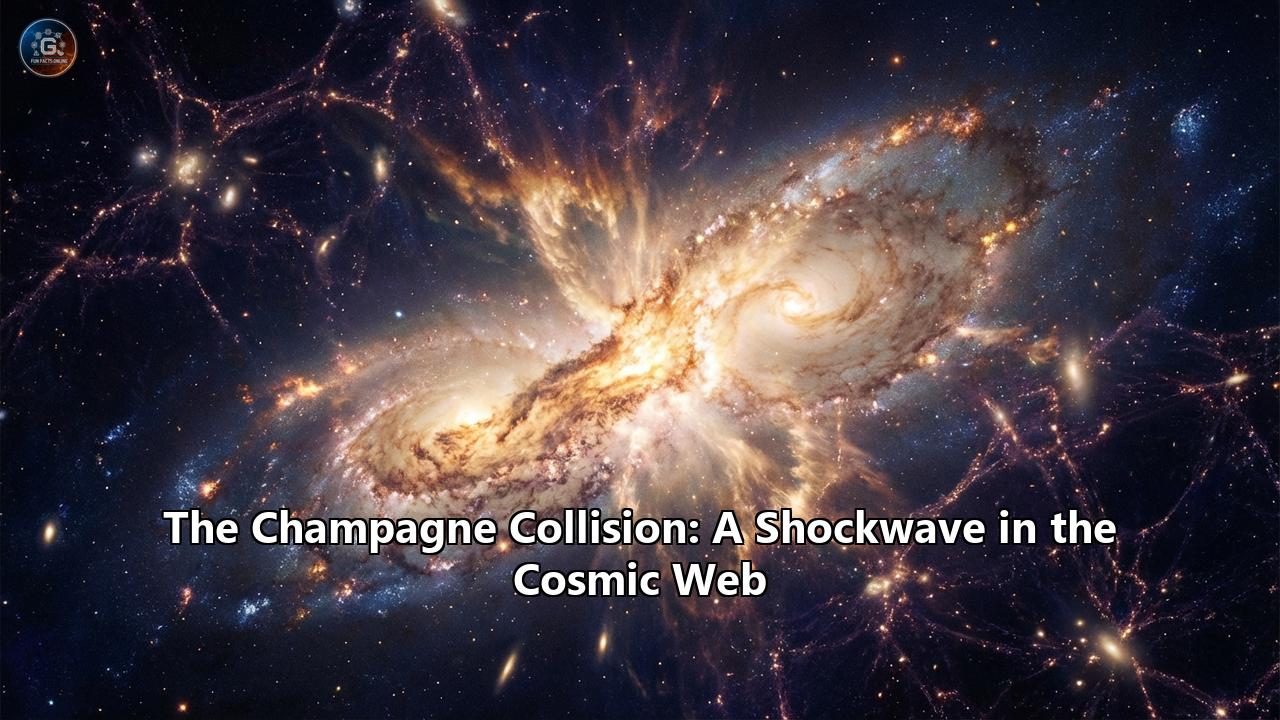
On the eve of a new year, while Earth celebrated one complete orbit around its star, the cosmos unveiled a cataclysmic event of a magnitude that defies human comprehension. Astronomers, peering deep into the fabric of the universe using a synthesis of X-ray and radio telescopes, announced the discovery of a structure that has since been christened "The Champagne Cluster."
Technically cataloged as RM J130558.9+263048.4, this celestial leviathan is not merely a static collection of galaxies. It is a crime scene, a snapshot of a violent collision between two massive galaxy clusters that occurred hundreds of millions of years ago, the light of which is only now reaching our sensors. But it is the nature of this collision that has sent ripples—quite literally—through the scientific community.
The Champagne Cluster represents a "dissociative merger," a rare and violent class of cosmic event where the visible matter (galaxies), the hot gas (intracluster medium), and the invisible dark matter are torn apart from one another. The result is a shockwave of epic proportions, a tsunami of energy rippling through the tenuous filaments of the "Cosmic Web," the vast, invisible scaffolding that holds the universe together. The discovery, announced with a touch of poetic timing on New Year’s Eve, earned its festive nickname not just from the calendar, but from the effervescent, bubble-like structures of superheated gas and magnetic fields detected in its wake—a cosmic bottle uncorked, spilling energy into the void.
II. The Anatomy of a Titan: What is a Galaxy Cluster?To understand the Champagne Collision, one must first grasp the scale of the players involved. Galaxy clusters are the largest gravitationally bound structures in the universe. Containing hundreds to thousands of individual galaxies, they are the "cities" of the cosmos. Our own Milky Way is part of a smaller group, the Local Group, which is drifting toward the larger Virgo Cluster.
However, the galaxies themselves—the shining islands of stars like Andromeda or the Milky Way—account for only a tiny fraction of a cluster's mass, perhaps 1% to 5%. The vast majority of the "normal" (baryonic) matter in a cluster exists as the Intracluster Medium (ICM). The ICM is a soup of superheated plasma, consisting mostly of hydrogen and helium ions, burning at temperatures of nearly 100 million degrees Celsius. This gas is so hot that it glows brightly in X-rays, invisible to the naked eye but blindingly obvious to space telescopes like NASA’s Chandra X-ray Observatory or the European Space Agency’s XMM-Newton.
Yet, even the galaxies and the ICM combined are dwarfed by the cluster's true master: Dark Matter. Making up roughly 85% of the cluster's mass, dark matter is the invisible halo that provides the gravity necessary to hold the fast-moving galaxies and hot gas together. Without it, the cluster would fly apart.
When two such titans collide, it is the most energetic event in the universe since the Big Bang itself.
III. The Physics of the Crash: Dissociation and the "Bullet" EffectThe Champagne Cluster is a "post-pericenter" merger. In orbital mechanics, the "pericenter" is the point of closest approach. This means the two sub-clusters have already smashed through each other and are now racing apart, leaving chaos in their wake.
This is where the physics becomes fascinating. The three components of the clusters—galaxies, gas, and dark matter—behave differently during the crash.
- The Galaxies: Stars within galaxies are incredibly far apart relative to their size. When two clusters collide, the galaxies act like ghosts passing through walls; they fly past each other without making physical contact, guided only by gravity.
- The Dark Matter: Like the galaxies, dark matter is "collisionless." It interacts only via gravity. The dark matter halos of the two clusters pass through each other, ghost-like, and continue on their trajectory.
- The Gas (ICM): The gas, however, is a fluid. It has pressure and viscosity. When the two clouds of intra-cluster gas collide, they slam into each other like two water balloons meeting in mid-air. They experience drag force (ram pressure), slow down, and heat up to extreme temperatures.
The result is a "dissociation." The dark matter and galaxies continue speeding outward, while the gas lags behind, stuck in the middle of the wreck. In the Champagne Cluster, X-ray maps reveal a massive peak of superheated gas stranded between two clumps of galaxies. This separation is the "smoking gun" for dark matter: we see the gravity of the invisible matter pulling the galaxies away from the visible gas.
IV. The Shockwave: Lighting Up the Cosmic WebThe most spectacular feature of the Champagne Collision—and the reason for the excitement surrounding it—is the shockwave.
When the clusters collided, they were moving at supersonic speeds relative to the surrounding gas, likely exceeding 2,000 kilometers per second (over 4 million miles per hour). This motion creates a "bow shock," similar to the sonic boom created by a supersonic jet or the wake of a boat moving through water.
In the case of the Champagne Cluster, and similar giants like Abell 3667, these shockwaves are colossal. They can span millions of light-years, stretching larger than the clusters themselves. As the shock front travels outward, it compresses the tenuous gas of the intergalactic medium.
This compression does two things:
- Heating: It raises the temperature of the gas, causing it to shine in X-rays.
- Particle Acceleration: The shock acts as a giant cosmic particle accelerator. Protons and electrons bounce back and forth across the magnetic fields within the shock front (a process known as Diffuse Shock Acceleration or Fermi Acceleration). These particles are accelerated to near the speed of light. When these relativistic electrons spiral around magnetic field lines, they emit "synchrotron radiation," which glows in radio waves.
For years, astronomers have theorized that the "Cosmic Web"—the filamentary network of gas connecting galaxy clusters—should be glowing with these radio waves, lit up by shockwaves. The Champagne Collision provides one of the clearest views of this phenomenon. The radio emission traces the shock front like a neon sign, outlining the invisible magnetic skeleton of the universe.
V. The "Champagne" Structure: A Bubbly MysteryThe specific morphology of RM J1305—the Champagne Cluster—is what captivated the imagination. Unlike the clean "bullet" shape of the famous Bullet Cluster (1E 0657-56), the Champagne Cluster exhibits a complex, turbulent structure.
The radio relics (the glowing arcs of radio emission caused by the shock) in this system appear twisted and fragmented, resembling the effervescence of bubbles rising in a glass or the chaotic flow of liquid spilling over. This complexity suggests that the collision was not a simple head-on smash. It was likely an "off-axis" merger, a glancing blow that set the entire system spinning and tumbling.
These "bubbles" are likely regions of low density where the magnetic fields have expanded, pushing the hot plasma aside. Studying these structures allows astrophysicists to map the magnetic fields of the intergalactic medium—a property of the universe that is notoriously difficult to measure. The strength and orientation of these magnetic fields are crucial for understanding how the universe evolved from a smooth soup of particles after the Big Bang into the structured web of galaxies we see today.
VI. Comparing the Giants: The Champagne Cluster vs. The RestTo appreciate the Champagne Cluster, we must place it in the context of other famous cosmic pile-ups.
- The Bullet Cluster (1E 0657-56): The gold standard for dark matter proof. It is a clean, high-speed collision with a classic "bow shock" shape. The Champagne Cluster is messier, likely older, and offers a look at the turbulence that follows the initial crash.
- Abell 3667: This cluster hosts one of the largest shockwaves ever seen, a radio arc stretching 6.5 million light-years. The Champagne Cluster’s shockwaves are comparable in scale, suggesting that we are seeing a merger of similar titanic energy. The "champagne" nickname may even be a nod to the specific "flute-like" shape of shock structures seen in simulations of such mergers.
- Abell 1758: Often confused with the Champagne Cluster in early reports, Abell 1758 is a "quadruple" merger—two pairs of clusters colliding simultaneously. It represents the chaotic future that the Champagne Cluster will eventually settle into: a massive, relaxed ball of galaxies.
The Champagne Collision is not happening in isolation. It is occurring at a "node" of the Cosmic Web.
The universe is structured like a sponge or a neural network. Vast voids of nothingness are surrounded by thin filaments of dark matter and gas. Galaxies flow along these filaments like cars on a highway, heading toward the massive intersections (nodes) where galaxy clusters grow.
The shockwaves from the Champagne Collision are propagating into these filaments. This is a crucial area of study. By observing how the shockwave illuminates the filaments, astronomers can measure the density and temperature of the Cosmic Web itself. This "warm-hot intergalactic medium" (WHIM) is thought to hide about half of the normal matter in the universe, which has been "missing" from our census of stars and galaxies. The Champagne shockwave acts as a flashlight, revealing this hidden matter for the first time.
VIII. Instruments of Discovery: How We Saw ItThe unveiling of the Champagne Cluster was a triumph of "multi-messenger" astronomy, utilizing data from across the electromagnetic spectrum:
- X-Ray Eyes: NASA's Chandra X-ray Observatory provided the high-resolution maps of the superheated gas (the "fluid" that lagged behind). Without Chandra, we would not see the dissociation that proves the existence of dark matter.
- Radio Ears: Ground-based arrays like the MeerKAT telescope in South Africa or the LOFAR (Low Frequency Array) in Europe likely played the key role in detecting the "champagne bubbles" and the shockwave itself. These instruments are sensitive to the faint synchrotron radiation emitted by the accelerated electrons.
- Optical Witnesses: Telescopes like the Subaru Telescope or the Hubble Space Telescope mapped the location of the galaxies and, crucially, used "gravitational lensing" (the bending of light by gravity) to map the invisible dark matter.
What happens next? The collision we see today actually happened hundreds of millions of years ago. In the eons since, gravity has begun to win the battle against the outward momentum of the crash.
The two sub-clusters of the Champagne system will eventually slow down, stop, and fall back together. They will pass through each other again and again, each time stripping away more gas and damping the shockwaves. Eventually, billions of years from now, the two cores will merge into a single, massive, spherical galaxy cluster. The beautiful radio relics and shockwaves will fade, and the violent "champagne" effervescence will settle into a quiet, hot equilibrium.
But for now, for us as observers, the bottle has just popped. The Champagne Cluster offers a perfect laboratory to study the extreme physics of the universe: magnetic fields stretching millions of light-years, particles accelerated to the brink of light speed, and the invisible scaffolding of dark matter that holds it all together.
X. Conclusion: A Toast to the Dynamic UniverseThe Champagne Collision serves as a stark reminder that the universe is not a static painting, but a dynamic, violent, and evolving movie. The serene pinpoints of light we see in the night sky mask the tremendous energies at play in the deep cosmos.
Events like RM J1305 demonstrate that the processes of creation are still ongoing. The Cosmic Web is still twitching, growing, and snapping into place. As we enter a new era of astronomy, with instruments like the Square Kilometre Array (SKA) and the Athena X-ray observatory on the horizon, we can expect to find many more such "champagne" moments—shocks and flows that reveal the hidden pulse of the living universe.
So, here is a toast to the Champagne Cluster: a shockwave in the dark, a light in the void, and a spectacular beginning to a new year of discovery.
Reference:
- https://www.researchgate.net/figure/The-color-magnitude-diagram-of-A2142-The-early-type-galaxies-in-clusters-are-well_fig1_1807354
- https://arxiv.org/html/2501.09901v2
- https://www.youtube.com/watch?v=ZVk3uwpqiN8
- https://chandra.harvard.edu/photo/2019/cluster_merge/
- https://www.itweb.co.za/article/meerkat-picks-up-shock-wave-extending-65m-light-years/PmxVEMKl5JVqQY85
- https://stuff.co.za/2022/02/25/sas-meerkat-radio-telescope-reveals-a-gigantic-6-5-million-light-year-long-shockwave/
- https://www.qu.uni-hamburg.de/activities/news/2022/22-02-23-shock-waves-meerkat.html
- https://www.sarao.ac.za/media-releases/fast-and-furious-a-shock-wave-that-extends-for-6-5-million-light-years/
- https://www.sciencealert.com/colossal-intergalactic-shockwave-dwarfs-the-milky-way
- https://earthsky.org/space/shock-wave-galaxy-clusters-abell-3667-6-5-million-light-years/
- https://www.sci.news/astronomy/chandra-mega-merger-galaxy-clusters-abell-1758-07741.html