
In the strange and counterintuitive zoo of quantum physics, few residents are as elusive as Positronium. It is an atom with no nucleus, a ghost made of substance and anti-substance dancing in a death spiral. It is the lightest atom in the universe, composed not of protons and neutrons, but of a single electron paired with its antimatter twin, the positron. For decades, it has been a theoretical darling—a perfect laboratory for testing the laws of the universe. But it had one fatal flaw: it vanishes.
Positronium (Ps) is unstable. The moment it is born, its internal clock starts ticking toward annihilation. In a fraction of a microsecond, the matter and antimatter collide, converting their entire mass into a flash of gamma-ray energy. For physicists, this made Positronium the ultimate "look but don't touch" object. You couldn't bottle it, you couldn't hold it, and you certainly couldn't shoot it in a straight line to see how it behaved.
Until now.
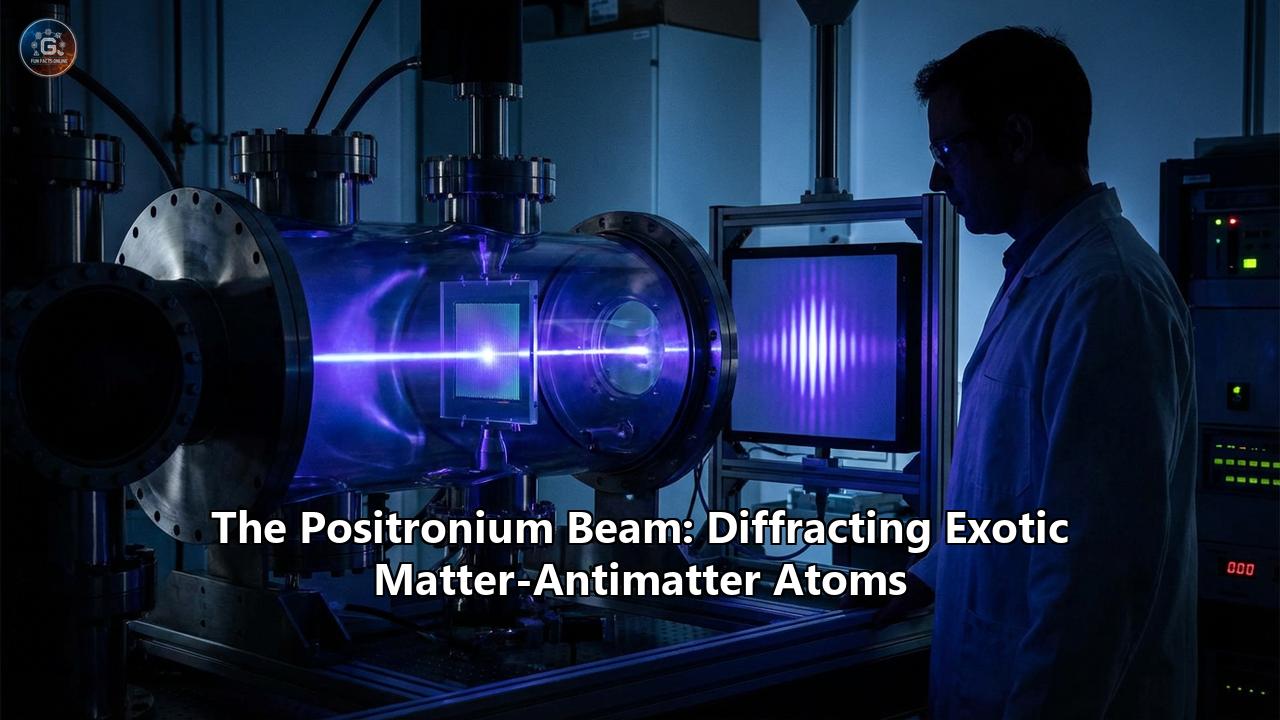
On January 19, 2026, the physics world was rocked by a breakthrough that had been deemed nearly impossible for half a century. A team at the Tokyo University of Science, led by Professor Yugo Nagata, successfully demonstrated the diffraction of a positronium beam. For the first time, these fleeting, self-destructing atoms were not only corralled into a coherent beam but forced to behave like waves, rippling through a crystal lattice just as quantum mechanics predicted.
This achievement does not just validate a century-old theory; it hands humanity a new key to unlock the deepest mysteries of gravity, antimatter, and potentially the fabric of reality itself.
The Dance of Doom: What is Positronium?
To understand the magnitude of this engineering triumph, one must first appreciate the fragility of the subject. Positronium is often called an "exotic atom," but that feels like an understatement. It is a pure leptonic system. A standard hydrogen atom is a massive proton anchoring a flighty electron. Positronium, however, has no anchor. The electron and the positron have the exact same mass. They orbit a common center of gravity, whirling around each other like binary stars.
There are two main types of this exotic atom, defined by the "spin" of their components:
- Para-positronium (p-Ps): The spins are opposite. This version is short-lived, surviving for only about 125 picoseconds (trillionths of a second) before annihilating into two gamma rays.
- Ortho-positronium (o-Ps): The spins are aligned. This state is the "long-lived" version, surviving for a whopping 142 nanoseconds.
To a physicist, 142 nanoseconds is an eternity—long enough to perform experiments, provided you are quick. But to an engineer trying to build a beam, it is a nightmare. Light travels only about 40 meters in that time. If you want to direct positronium at a target, you have to move fast, and you have to move precisely.
The Engineering Challenge: Herding Ghosts
The fundamental problem with creating a "beam" of positronium is that it is electrically neutral.
In particle accelerators like the Large Hadron Collider (LHC), physicists use powerful magnetic fields to steer and accelerate particles. Protons have a positive charge; electrons have a negative charge. Magnets can grab them and whip them around a ring. Positronium, however, has a net charge of zero ($+1 + -1 = 0$). It is invisible to standard magnetic steering. It drifts like a ghost, unaffected by the electromagnetic walls that contain other particles.
For years, the only way to make positronium was to fire a beam of positrons into a porous silica target. The positrons would capture electrons from the silica and emerge as a puff of positronium gas. But this was a chaotic cloud, spraying in all directions at different speeds—useless for precision interference experiments.
The breakthrough required a change in tactics. Instead of trying to steer the neutral atom, researchers decided to disguise it.
The Trick: The Negative Ion Gateway
The method used by the Tokyo team relies on a clever bit of atomic alchemy: the Positronium Negative Ion ($Ps^-$).
By creating an environment rich in electrons, researchers can force a positron to bond not just with one electron, but with two. This creates a three-body system: two electrons and one positron. Crucially, this ion has a net negative charge.
Because it is charged, the $Ps^-$ ion can be accelerated using electric fields. It can be focused, steered, and energized, just like a standard electron beam. The researchers accelerated these ions to high energies (around 3.3 keV), creating a tight, fast-moving stream.
But a negative ion is not positronium. To get the pure exotic atom, the team employed a technique called laser photodetachment. Just as the beam of ions raced toward the target, a high-powered laser pulse struck them. The laser was tuned to the exact energy required to knock off that extra, third electron.
Instantly, the charged beam transformed into a neutral beam. The electric fields no longer affected it, but the momentum remained. The result was a coherent, high-speed beam of pure neutral positronium atoms, hurtling through the vacuum before they could realize they were supposed to annihilate.
The Diffraction Milestone: January 2026
With the beam generated, the question remained: would it behave like a wave?
Quantum mechanics tells us that all matter has a wavelength (the de Broglie wavelength). Pitch a baseball, and it has a wavelength (though infinitesimally small). Fire an electron, and its wave nature is obvious—it diffracts. But positronium? A composite system made of matter and antimatter?
The theory said yes, but nature often has surprises. If the electron and positron acted independently, the diffraction pattern would look one way. If they acted as a single, bound quantum entity, the pattern would be different.
The Tokyo team fired their positronium beam at a sheet of graphene—a single layer of carbon atoms arranged in a honeycomb lattice. Because graphene is so thin, it acts as the ultimate diffraction grating for atoms.
The results, published just days ago, were unmistakable. The positronium atoms passed through the graphene and spread out, creating a diffraction pattern of peaks and troughs on the detector. The pattern matched the theoretical prediction for a single composite particle perfectly.
"This diffraction pattern shouldn't exist in a classical world," noted one observer. "You are seeing a particle that is essentially a suicide pact, holding it together long enough to ripple through a crystal like a wave of light."
Why This Matters: The Gravity of the Situation
While diffracting exotic atoms is a triumph of quantum optics, the implications go far beyond pretty interference patterns. This technology is the missing piece of the puzzle for one of the most significant experiments in modern physics: The Test of Antimatter Gravity.
The Weak Equivalence Principle, a cornerstone of Einstein’s General Relativity, states that gravity acts on all mass and energy equally, regardless of composition. A feather and a hammer fall at the same rate on the Moon. Matter and antimatter should fall at the same rate on Earth.
However, we have never directly measured the fall of antimatter with high precision. Some fringe theories (and a lot of science fiction) suggest that antimatter might experience "antigravity"—falling upward, or simply falling at a slightly different rate than normal matter. If this were true, it would break General Relativity and rewrite our understanding of the universe.
The problem has always been the charge. Trying to measure gravity on a positron is like trying to weigh a feather in a tornado; stray electric fields completely overwhelm the tiny tug of gravity.
Positronium is the answer. It is neutral. It doesn't care about electric fields. But until now, we couldn't control it well enough to measure its fall.
With a coherent positronium beam and the ability to perform interferometry (using wave interference to measure tiny shifts in position), scientists can now build a "gravity interferometer." By splitting the positronium wave and recombining it, they can measure exactly how much the beam "sagged" due to gravity as it traveled.
Collaborations like QUPLAS (Quantum Interferometry and Gravity with Positrons and Lasers) and experiments at CERN are already racing to utilize these beam techniques. The Tokyo result proves the interferometry part is possible.
The Cooling Revolution: Freezing the Fire
While the Tokyo team mastered the fast beam, another revolution has been happening in parallel: the mastery of the cold cloud.
In 2024, the AEgIS collaboration at CERN achieved the first laser cooling of positronium. Laser cooling is a standard technique for normal atoms—hitting them with photons to slow their momentum, effectively freezing them. But doing it to positronium was incredibly difficult because of its low mass and short life.
AEgIS succeeded in dropping the temperature of positronium from 380 Kelvin down to 170 Kelvin. It sounds modest, but it is a proof of concept. The goal is to reach millikelvin temperatures.
Why do we need cold positronium?
- Precision: The slower the atom, the longer you can observe it.
- BEC: If you can get positronium cold enough and dense enough, you could theoretically create a Bose-Einstein Condensate (BEC).
The Holy Grail: The Gamma-Ray Laser
A Bose-Einstein Condensate of positronium is the stuff of science fiction dreams. In a BEC, all atoms march in lockstep, behaving as a single macroscopic quantum wave.
If you could make a BEC of positronium, you would have a state of matter where millions of matter-antimatter pairs are perfectly coherent. When they eventually annihilate, they would do so in unison.
Instead of a random spray of gamma rays, you would get a coherent beam of high-energy gamma photons—a Gamma-Ray Laser.
Such a device would be thousands of times more energetic than any optical laser. It could probe the nucleus of atoms, image the structure of proteins with unprecedented resolution, and potentially serve as a propulsion mechanism for interstellar spacecraft (though that remains far in the future). The successful diffraction of positronium is the first proof that we can manipulate the wave nature of this material, a necessary step toward the BEC.
A New Window into the Quantum World
The successful generation and diffraction of a positronium beam marks the transition of antimatter from a theoretical curiosity to a technological tool. We are no longer just observing the ghostly decay of these atoms; we are grabbing them, speeding them up, cooling them down, and bending them to our will.
As we stand in 2026, looking at the interference fringes on the detector screens in Tokyo, we are looking at the prelude to a new physics. We are on the verge of knowing, once and for all, if the reflection of our universe in the mirror of antimatter behaves just like us, or if it follows a strange, reversed logic of its own.
The ghost has been tamed. Now, it’s time to see what it can do.
Reference:
- https://www.youtube.com/watch?v=qG3hoYEsfgw
- https://en.wikipedia.org/wiki/Positronium
- https://scienceblog.com/when-matter-meets-antimatter-in-perfect-symmetry/
- https://cerncourier.com/a/the-promise-of-laser-cooled-positronium/
- https://physics.stackexchange.com/questions/236/how-does-positronium-exist
- https://www.techexplorist.com/strange-atom-acted-quantum-wave/101867/
- https://news.liverpool.ac.uk/2024/02/26/unlocking-the-mysteries-of-antimatter-positronium-laser-cooling-breakthrough/
- https://atrium.in2p3.fr/nuxeo/nxfile/default/986d4906-c6c0-4133-9484-38d08cdf9bde/blobholder:0/GBAR_CS-IN2P3_juin2024.pdf
- https://ep-news.web.cern.ch/content/aegis-experiment-breakthrough-laser-cooling-opens-door-new-antimatter-studies
- https://www.infn.it/en/cern-first-laser-cooling-of-a-cloud-of-positronium-atoms/