
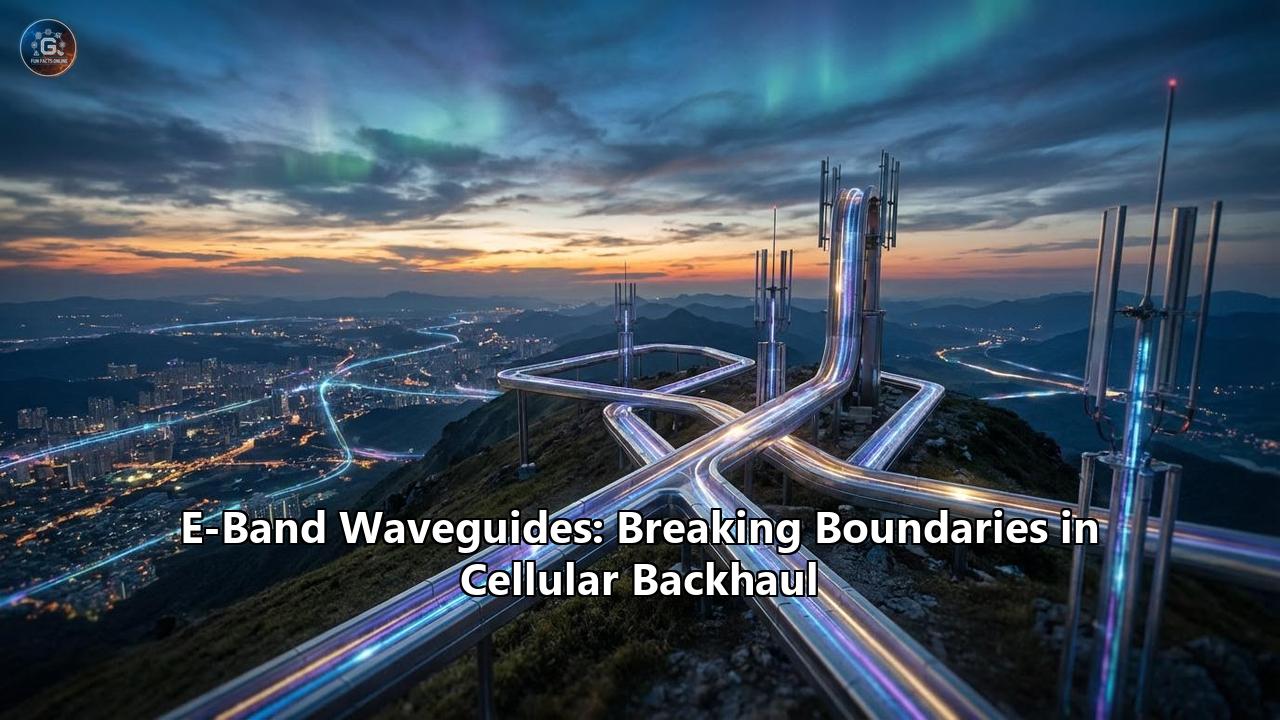
As we stand deep into the 2020s, the digital ecosystem is undergoing a tectonic shift. The proliferation of 5G, the dawn of 6G research, the explosion of artificial intelligence, and the relentless rise of the Internet of Things (IoT) have created an insatiable appetite for data. The smartphone in your pocket, the autonomous vehicle navigating the streets, and the robotic arms operating in smart factories all rely on a constant, uninterrupted flow of information.
Yet, beneath the glossy interface of user applications lies a grueling engineering challenge: how do we physically transport these staggering volumes of data from the cell tower back to the core network? This process, known as cellular backhaul, is the invisible plumbing of the modern internet. While fiber-optic cables are often heralded as the ultimate solution—offering virtually unlimited bandwidth—they are not always the answer. Trenching fiber is notoriously expensive, environmentally disruptive, and often logistically impossible in dense urban jungles or rugged rural terrains.
Enter wireless backhaul, specifically the revolutionary technologies operating in the E-Band spectrum (71–76 GHz and 81–86 GHz). At these ultra-high frequencies, traditional cables and wires fail, choked by physics. To harness the E-Band, engineers rely on a technology that is conceptually simple yet mathematically profound: the waveguide.
E-Band waveguides are the unsung heroes of the 5G and 6G revolution. They are precision-engineered hollow metal conduits that guide electromagnetic waves with near-zero loss, enabling the wireless transmission of gigabits—and soon terabits—of data per second. This article explores the deep physics, intricate manufacturing, and global network implications of E-Band waveguides, illustrating how they are fundamentally breaking the boundaries of cellular backhaul.
The Cellular Backhaul Bottleneck and the Millimeter-Wave Solution
To understand the importance of E-Band waveguides, one must first understand the anatomy of a cellular network. When your device connects to a mobile network, it communicates wirelessly with a local Radio Access Network (RAN) antenna. From that antenna, the data must travel back to the mobile switching center and out to the broader internet.
Historically, this backhaul was achieved using traditional microwave frequency bands ranging from 6 GHz to 42 GHz. These traditional bands are incredibly reliable and can travel tens of kilometers, but they suffer from a fatal flaw in the 5G era: spectral starvation. The channel bandwidths available at lower frequencies are typically narrow—often just 28 MHz or 56 MHz wide. Even with highly advanced modulation schemes like 4096-QAM (Quadrature Amplitude Modulation) and Cross-Polarization Interference Cancellation (XPIC), physical limits dictate how much data can be squeezed through such narrow pipes, generally capping out around 1 to 2 Gbps.
5G networks, however, require backhaul links capable of 10 Gbps to 25 Gbps, and emerging 6G networks will push this requirement to 100 Gbps. To achieve these fiber-like speeds wirelessly, Shannon’s Theorem tells us we need wider channels, and wider channels can only be found higher up the radio frequency spectrum.
The E-Band: A Spectrum Goldmine
This brings us to the millimeter-wave (mmWave) spectrum, specifically the E-Band. The E-Band is comprised of two distinct blocks of frequencies:
- Lower E-Band: 71 GHz to 76 GHz
- Upper E-Band: 81 GHz to 86 GHz
Together, these blocks offer a staggering 10 GHz of available spectrum. To put this in perspective, this single allocation is significantly larger than all the traditional microwave bands and legacy cellular bands combined.
Regulators worldwide have structured the E-Band to allow for massive channel sizes—typically 250 MHz, 500 MHz, or even 2 GHz wide. By transmitting over a 2 GHz channel using 128-QAM or 256-QAM, an E-Band radio link can easily deliver 10 to 20 Gbps of full-duplex capacity. Furthermore, E-Band frequencies are generally "lightly licensed," meaning network operators can deploy links rapidly with low regulatory fees compared to heavily contested lower-frequency bands.
However, manipulating electromagnetic waves at 80 GHz introduces a hostile physical environment. Wavelengths in the E-Band are roughly 3.5 to 4 millimeters long. At these tiny wavelengths, standard coaxial cables—the traditional method for moving RF signals between a transmitter and an antenna—become highly inefficient. The inner dielectric materials of coaxial cables absorb high-frequency energy, converting precious signal power into heat. Furthermore, the "skin effect" drives the current to the extreme outer edge of the conductors, skyrocketing resistance.
To move an 80 GHz signal from a radio's power amplifier to its antenna without losing the signal entirely, engineers must abandon cables and use waveguides.
The Physics of E-Band Waveguides
A waveguide is, in its most basic form, a highly polished, hollow metallic pipe. Instead of conducting electrical current like a wire, a waveguide acts as a boundary that confines and guides electromagnetic fields. Because the interior is filled with air (or an inert gas) rather than a solid dielectric material, the dielectric loss is virtually zero.
Dimensions and Cutoff Frequencies
The magic of a waveguide lies in its precise dimensions. A rectangular waveguide operates based on a specific electromagnetic mode, most commonly the Transverse Electric (TE10) mode. For an electromagnetic wave to propagate through a waveguide, its frequency must be higher than the waveguide's "cutoff frequency," which is determined purely by the width of the internal rectangular cavity.
For the E-Band (71–86 GHz), the industry standard is the WR-12 waveguide. The "WR" stands for Waveguide Rectangular, and the "12" indicates an internal width of 0.122 inches (approximately 3.098 mm). The height is typically half the width, around 1.549 mm.
Because the dimensions of a WR-12 waveguide are so minuscule, the physical tolerances required during manufacturing are extraordinarily tight—often measured in micrometers. A deviation of just a few thousandths of a millimeter can alter the impedance of the waveguide, causing signal reflections (measured as Return Loss or Voltage Standing Wave Ratio, VSWR) and degrading the backhaul link's performance.
Surface Roughness and Skin Depth
At 80 GHz, the electromagnetic waves only penetrate the very surface of the waveguide's inner metal walls—a phenomenon known as the skin depth. At E-Band frequencies, the skin depth is roughly 0.2 to 0.3 micrometers.
Because the current flows entirely in this microscopic top layer, the surface roughness of the inside of the waveguide becomes a critical factor. If the microscopic hills and valleys of the metal surface are larger than the skin depth, the electromagnetic wave will constantly crash into these imperfections, scattering energy and increasing the Insertion Loss (attenuation) of the component. Consequently, E-Band waveguides are often precision-milled from aluminum or brass and then plated with highly conductive, low-resistance metals like silver or gold to optimize surface conductivity.
Crucial Waveguide Components in a Backhaul Radio
An E-Band cellular backhaul radio is essentially a masterclass in waveguide plumbing. Inside the compact outdoor unit (ODU) mounted on a cell tower, several discrete waveguide components work in unison:
- Diplexers/Filters: Since E-Band links operate in Frequency Division Duplex (FDD) mode, one frequency block (e.g., 71–76 GHz) is used to transmit, while the other (81–86 GHz) is used to receive. Waveguide diplexers act as highly selective filters, ensuring the massive transmission power doesn't blind the highly sensitive receiver port.
- Orthomode Transducers (OMTs): To double the capacity of a link, network operators transmit two distinct data streams simultaneously on the exact same frequency by polarizing one wave vertically and the other horizontally. An OMT is a sophisticated waveguide junction that splits or combines these orthogonal polarizations with incredibly high isolation (preventing them from bleeding into each other).
- Isolators: These are the "one-way valves" of the RF world. Using ferrite materials and magnetic fields, waveguide isolators allow signals to flow forward toward the antenna but absorb any reflections coming back, protecting the delicate internal Power Amplifiers (PAs) from burning out.
- Flanges: The interfaces where two waveguides connect. The standard for E-band is the UG-387 anti-cocking flange. Ensuring a perfect, flush mating between two WR-12 flanges is critical; a slight misalignment or microscopic gap will cause radiation leakage and signal degradation.
Atmospheric Physics: Taming the Elements at 80 GHz
While the internal physics of the waveguide are well understood, transmitting E-band signals through the Earth's atmosphere introduces an entirely different set of challenges.
The Oxygen Absorption Myth vs. Rain Fade Reality
It is a common misconception that all mmWave frequencies are absorbed by the atmosphere. This confusion largely stems from the V-Band (57–66 GHz). At 60 GHz, electromagnetic waves perfectly resonate with the oxygen molecules (O2) in the Earth's atmosphere. This resonance acts like a massive wall of friction, absorbing the radio energy and limiting V-Band links to ultra-short distances, typically under 1 kilometer.
The E-Band, however, operates in an "atmospheric window". At 70–86 GHz, oxygen absorption drops precipitously. In clear weather conditions, E-Band signals experience an atmospheric attenuation of only about 0.5 decibels per kilometer (dB/km). In a vacuum, E-band links could easily travel dozens of miles.
The true enemy of the E-Band is rain fade. Because an 80 GHz wavelength is approximately the same size as a heavy raindrop, the rain physically scatters and absorbs the signal. In heavy downpours (e.g., tropical storms where rainfall exceeds 100 mm/hour), rain attenuation in the E-Band can spike to 17 dB/km or even 31 dB/km.
Adaptive Coding and Modulation (ACM)
To combat rain fade and maintain carrier-grade reliability (the coveted 99.999% uptime, or "five nines"), engineers utilize high-gain waveguide antennas and intelligent software.
An E-Band antenna, often a Cassegrain reflector fed by a waveguide horn, focuses the RF energy into an incredibly narrow "pencil beam". A typical 2-foot (60 cm) E-Band antenna can achieve a staggering gain of over 50 dBi, with a beamwidth of less than 0.5 degrees. This laser-like focus concentrates the power precisely on the receiving tower, punching through moderate weather.
When torrential rain strikes, the backhaul radio detects the drop in Received Signal Strength Indicator (RSSI) and instantly engages Adaptive Coding and Modulation (ACM). The system shifts dynamically from a highly complex, fragile modulation scheme like 512-QAM down to a robust, resilient scheme like QPSK (Quadrature Phase Shift Keying). The data capacity of the link drops temporarily, but the connection remains alive, ensuring critical 5G control-plane traffic and voice calls are not dropped.
The Rise of Multi-Band (Dual-Band) Links
To conquer the distance limitations imposed by rain fade, the telecommunications industry has recently pioneered Multi-Band (or Dual-Band) solutions.
A Multi-Band link combines an E-Band radio and a traditional Microwave radio (e.g., 18 GHz or 23 GHz) onto a single, specially designed dual-band antenna, utilizing Radio Link Aggregation (RLA).
- The E-Band layer acts as the high-speed data pipe, providing 10 Gbps of throughput during 99% of the year.
- The Traditional Microwave layer acts as the unbreakable safety net. Because lower frequencies are largely unaffected by rain, the 18 GHz link easily bridges distances of 5 to 10 kilometers.
When a massive storm passes through, the E-band link may temporarily degrade or drop entirely due to rain fade. Instantly, all priority traffic (voice, critical IoT, low-latency applications) is routed seamlessly over the traditional microwave link. Once the storm passes, the E-band waveguide components re-establish the Gbps pipe, and full network throughput is restored. This architecture is widely considered the ultimate future-proof strategy for macro-cell 5G backhaul.
The Manufacturing Revolution: Forging E-Band Waveguides
For decades, the high cost and difficult manufacturing of millimeter-wave components restricted their use to military radar, radio astronomy, and satellite communications. As the 5G rollout democratized the E-band, the industry faced an existential challenge: how to mass-produce highly complex, microscopic waveguide topologies cost-effectively.
Traditional Precision Machining
Traditionally, E-Band waveguides and filters are manufactured using Computer Numerical Control (CNC) milling. A solid block of metal (aluminum or brass) is precisely machined into two halves—a "split block". The complex cavities, irises, and resonant chambers are carved out with microscopic drill bits. The two halves are then aligned using guide pins and bolted tightly together.
While highly effective, CNC milling has drawbacks. The internal corners of a milled cavity can never be perfectly square (due to the radius of the drill bit), which requires engineers to heavily modify their electromagnetic designs to compensate for rounded corners. Furthermore, CNC machining is slow, tool-wear is high, and the costs can be prohibitive when scaling to millions of 5G base stations.
The Additive Manufacturing (3D Printing) Paradigm
The most exciting frontier in waveguide manufacturing is Additive Manufacturing, commonly known as 3D printing. Through techniques like Selective Laser Sintering (SLS) and Micro Laser Sintering (MLS), powerful lasers fuse microscopic metallic powder layer by layer to build complex waveguide geometries that are impossible to create with standard drills.
Another popular method is Stereolithography (SLA), where the waveguide is printed using a high-resolution photopolymer resin. Because plastic is transparent to RF signals, the 3D-printed plastic waveguide is subsequently coated with a thin layer of copper or silver via electroless plating and electroplating.
Additive manufacturing offers unprecedented advantages for E-Band backhaul:
- Monolithic Construction: Unlike CNC split-blocks, 3D-printed waveguides can be printed as a single, contiguous piece. This completely eliminates the "seam" between metal plates, preventing radiation leakage and mitigating passive intermodulation (PIM) issues.
- Weight Reduction: Titanium and advanced polymer printed waveguides offer up to 40% weight savings compared to solid copper or aluminum blocks. In cellular backhaul, where tower wind-load and weight restrictions dictate installation costs, lighter equipment is incredibly valuable.
- Complex Geometries: Engineers can design internal waveguide topologies—such as stepped impedance matching, twisted waveguides, or integrated horn antennas—that follow fluid, organic curves rather than rigid, blocky CNC toolpaths. This allows for smaller form factors and reduced insertion loss.
However, 3D printing still faces challenges regarding surface roughness. Unpolished 3D-printed metal can be grainy, which, as discussed earlier, wreaks havoc on the skin depth of 80 GHz signals. To counter this, manufacturers employ advanced chemical polishing and tumbling techniques to achieve a mirror-like finish inside the waveguide cavities before silver-plating.
Silicon Micromachining and DRIE
For the ultimate integration, the industry is looking toward Silicon Micromachining. Using processes borrowed from the semiconductor industry, such as Deep Reactive Ion Etching (DRIE), intricate waveguide channels can be etched directly into silicon wafers. The wafers are then metallized and bonded together. This allows complete waveguide diplexers and filters to be integrated directly alongside the silicon RF integrated circuits (RFICs) in a single microscopic package. Companies are actively utilizing this approach to shrink E-Band and future sub-Terahertz radios down to the size of a postage stamp.
E-Band Waveguides in Action: Enabling 5G Architectures
The deployment of E-Band waveguides has fundamentally altered how telecom architects design cities' network infrastructure.
Urban Small Cells and Street-Level Connectivity
One of the core tenets of 5G is densification. Because mmWave signals used by 5G handsets do not penetrate walls easily, networks rely on thousands of "small cells" mounted on streetlights, bus stops, and utility poles. Connecting every single streetlight to a fiber optic cable is an insurmountable municipal nightmare.
E-Band waveguides provide the perfect "fiber extension". An E-Band radio, utilizing an integrated flat-panel waveguide array antenna, is roughly the size of a textbook. These visually unobtrusive units can beam 10 Gbps of backhaul capacity down a street corridor from one lamppost to another, eventually daisy-chaining back to a master hub where fiber is available. Because the 0.5-degree waveguide beamwidth is so narrow, dozens of E-band links can operate in the same geographic intersection without interfering with one another, an impossible feat with lower-frequency spectrums.
Fronthaul, Midhaul, and CPRI
Modern 5G networks have broken apart the traditional monolithic cell tower base station into discrete components: the Central Unit (CU), Distributed Unit (DU), and Radio Unit (RU). The connections between these components are known as Fronthaul and Midhaul.
Fronthaul protocols, such as CPRI (Common Public Radio Interface) and eCPRI, demand not only massive throughput (10 to 25 Gbps) but also ultra-low latency (often under 100 microseconds) and precise phase synchronization. Traditional wireless backhaul introduces too much processing delay for these protocols. However, the raw analog bandwidth provided by E-Band waveguides allows for "transparent" transmission. Modern E-Band systems can process gigabits of data with latencies under 20 microseconds, fully satisfying the draconian timing constraints of 5G Open RAN (O-RAN) fronthaul architectures.
Network Security
An underappreciated benefit of E-Band waveguide technology is inherent physical security. A traditional microwave link operating at 6 GHz might have an antenna beamwidth of 3 to 4 degrees. Over a few kilometers, that beam spreads out, illuminating a large physical area. A malicious actor with a receiver could theoretically sit miles away, slightly off-axis, and attempt to intercept the unencrypted physical layer.
At 80 GHz, the waveguide focuses the energy into a highly concentrated, pencil-thin beam. To intercept an E-Band signal, a hacker would have to physically place a receiver directly in the line of sight between the two towers, hovering in mid-air. Combined with 256-bit AES encryption at the data layer, E-band backhaul provides an incredibly secure infrastructure for sensitive corporate and government communications.
Beyond E-Band: The Terahertz Frontier (W-Band and D-Band)
As astonishing as 10 to 20 Gbps backhaul sounds today, telecom engineers are already looking beyond the horizon to 6G. Anticipated for commercial rollout in the early 2030s, 6G aims to deliver peak data rates of 1 Terabit per second (Tbps), holographic communications, and pervasive AI integration.
To backhaul 6G, the 10 GHz of spectrum in the E-Band will not be enough. The industry is aggressively pioneering the next frontier of the electromagnetic spectrum:
- W-Band: 92 GHz to 114 GHz
- D-Band: 130 GHz to 175 GHz
The D-Band offers an astonishing 45 GHz of contiguous spectrum. At these frequencies, channel sizes can be widened to 5 GHz or 10 GHz, capable of pushing well past 100 Gbps on a single link.
However, moving to the D-band escalates the waveguide engineering challenge exponentially. A WR-5 waveguide, standard for the D-band, has internal dimensions of roughly 1.3 mm by 0.65 mm. At these scales, human hands can barely assemble the components, and traditional CNC milling is approaching its absolute physical limits. The surface roughness requirements become so severe that even a speck of dust or a microscopic scratch can destroy the waveguide's performance.
This is why the innovations in Silicon Micromachining (DRIE) and high-resolution 3D printing mentioned earlier are not just theoretical exercises—they are mandatory for the survival of 6G. Researchers are already demonstrating fully functional D-band waveguide diplexers manufactured via Micro Laser Sintering (MLS), paving the way for the terabit backhaul radios of the future.
Furthermore, engineers are exploring Integrated-EBG (Electromagnetic Bandgap) ridge waveguides. These revolutionary structures utilize artificial periodic structures (metamaterials) to prevent RF leakage even if there is a physical gap between two metal plates. This eliminates the need for expensive diffusion bonding or flawless flange mating, drastically reducing the manufacturing costs of sub-Terahertz flat-panel waveguide antennas.
Conclusion: The Unbreakable Invisible Thread
The evolution of wireless cellular networks is often told through the lens of the smartphone—sleeker screens, faster processors, and new applications. But the true foundation of this digital age is built high above the streets, on the steel towers and rooftops where data is quietly, relentlessly transported across the sky.
E-Band waveguides represent a pinnacle of radio frequency engineering. They are the critical bridge between the theoretical physics of millimeter waves and the practical, economic reality of global telecommunications. By manipulating invisible electromagnetic fields through precisely machined metallic channels, waveguides bypass the limitations of cables, dodge the oxygen absorption traps of the lower mmWave spectrum, and deliver the fiber-like capacity that modern society demands.
As we push deeper into the era of 5G, and as the blueprint for 6G is drafted, the reliance on high-frequency waveguides will only intensify. From combating rain fade with intelligent algorithms and dual-band antennas to leveraging 3D printing and silicon etching for molecular-level manufacturing precision, the innovation surrounding E-Band technology is staggering.
The next time you stream a high-definition video, execute a flawless video call in a crowded city, or witness the seamless operation of an autonomous vehicle, take a moment to look up at the nearest cell tower. Hidden inside the gray boxes mounted against the sky are tiny, perfectly polished metal corridors, funneling the lifeblood of our digital world through the air at the speed of light. They are the E-Band waveguides, breaking boundaries, and weaving the unbreakable, invisible thread of human connection.
Reference:
- https://tejte.com/blog/e-band-71-86ghz-mmwave-5g-backhaul-guide/
- https://www.zte.com.cn/global/about/magazine/zte-technologies/2017/6/en_729/466190.html
- https://www.dolphmicrowave.com/default/10-leading-microwave-waveguide-producers-globally/
- https://winncomus.com/bead/wp-content/uploads/2024/04/E-Band_and_MW_Dual-Band_Radio_Links_Enhance_Range_n_Performance_of_4G-5G.pdf
- https://in.nec.com/en_IN/pdf/Whitepaper-TheNextGenerationBackhaulNetworksEband.pdf
- https://www.researchgate.net/publication/254059218_D-Band_Micromachined_Silicon_Rectangular_Waveguide_Filter
- https://www.rcrwireless.com/20190828/5g/microwave-5g-backhaul-analyst-angle
- https://www.simplifinetworks.com/blog/70-80-ghz-e-band
- https://thesis.lib.nycu.edu.tw/bitstreams/17c62831-5994-4eb6-8e21-0822ca1b944b/download
- https://www.researchgate.net/publication/322088165_Metallic_3D-Printed_K-Band-Stepped_Double-Ridged_Square_Horn_Antennas
- https://research.chalmers.se/publication/526380/file/526380_Fulltext.pdf
- https://www.eumw.eu/wp-content/uploads/2025/07/EuMW-2023_compressed.pdf
- https://www.scribd.com/document/391302960/Abs-Book
- https://www.microwave-link.com/e-band-millimeter-wave-technology/
- https://www.researchgate.net/publication/281022438_E-band_Microwave_Radios_for_Mobile_Backhaul