
In the macroscopic world we inhabit, the arrow of time seems absolute. A hot cup of coffee left on a table cools down until it matches the room’s temperature. A drop of ink in a glass of water spreads until the liquid is a uniform pale blue. These are manifestations of thermalization, the universal drive of nature toward equilibrium. It is the bedrock of statistical mechanics: given enough time, energy distributes itself continuously among all available particles, and the detailed history of the system is erased, leaving only a few macroscopic variables like temperature and pressure.
But in the ultra-cold, ultra-isolated quantum realm, this rule is not absolute. There exists a class of systems—known as integrable gases—that refuse to forget. Like a pendulum that swings forever in a vacuum, or a hall of mirrors where images never fade, these quantum systems defy the chaos of thermalization. They bounce, collide, and interact billions of times, yet they remain locked in a perpetually non-thermal state, remembering their initial conditions for eternity.
This is the story of the Integrable Gas, a system that has forced physicists to rewrite the textbooks of thermodynamics, leading to the discovery of new states of matter, the development of "Generalized Hydrodynamics," and the creation of the Quantum Newton’s Cradle.
Part 1: The Coffee Cup and the Quantum Cradle
To understand why the integrable gas is so bizarre, we must first appreciate the tyranny of thermal equilibrium. In a standard gas—like the air in a room—molecules are essentially billiard balls. They collide chaotically. If you were to start all the air molecules in one corner of the room moving in a perfect line, within a fraction of a second, collisions would scatter them. Their organized kinetic energy would be converted into random thermal motion. The memory of that initial "line" would be lost forever, replaced by a generic Maxwell-Boltzmann distribution of speeds.
This erasure of memory is called ergodicity. An ergodic system explores all possible microstates allowed by its energy. It doesn't matter how you started; the destination is always the same: equilibrium.
The Quantum Exception
For decades, physicists wondered if there were exceptions. Mathematically, they knew of systems that were "integrable"—solvable models where the equations of motion possessed so many conserved quantities that the system was constrained to a specific track in phase space, forbidden from ever reaching equilibrium. But these were often viewed as mathematical toys, idealized abstractions that wouldn't survive the messy reality of the lab.
That changed in 2006, with a landmark experiment by David Weiss and his team at Penn State University. They created a Quantum Newton’s Cradle.
You have likely seen a classical Newton’s Cradle: a row of steel balls suspended by wires. Pull one back and release it; it strikes the line, and a single ball pops off the other end. Ideally, this motion repeats forever. In reality, sound, friction, and imperfect alignment eventually cause the balls to jiggle randomly, and the motion dies out into a thermal shudder.
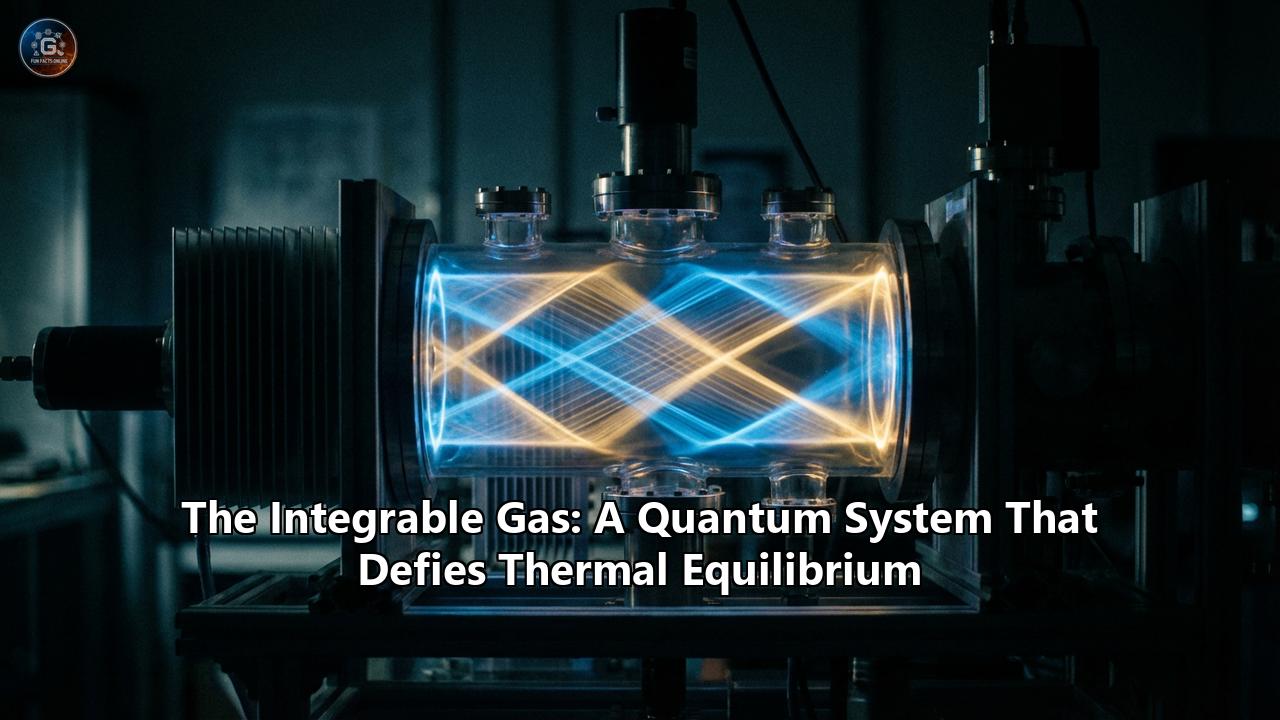
Weiss’s team built a quantum version using Rubidium-87 atoms. They trapped these atoms not with wires, but with tubes of laser light, creating a one-dimensional (1D) waveguide. They cooled the atoms to near absolute zero, creating a Bose-Einstein Condensate (BEC), and then split the cloud into two halves. Using laser pulses, they kicked these two clouds toward each other, making them collide in the center of the trap.
In a normal 3D gas, these colliding clouds would smash into each other, scatter in all directions, and almost instantly turn into a stationary, hot ball of gas. Thermalization would be immediate.
But in the 1D tubes, something magical happened. The clouds passed through each other, oscillated to the edges of the trap, turned around, and collided again. And again. And again. They collided thousands of times. Yet, the momentum distribution did not relax to a Gaussian thermal shape. The atoms refused to thermalize. They retained the memory of their initial "kick" almost perfectly.
The system was behaving not like a chaotic gas, but like a ghostly fluid that could flow through itself without ever mixing. This was the experimental realization of an Integrable Gas.
Part 2: The Lieb-Liniger Model and the Bethe Ansatz
The theoretical underpinnings of this refusal to thermalize lie in a model proposed in 1963 by Elliott Lieb and Werner Liniger. The Lieb-Liniger model describes bosons moving in one dimension with point-like contact interactions.
In 3D, particles can collide at glancing angles, trading momentum in continuous ways. This redistribution is what leads to chaos. But in 1D, the geometry is strict. If two identical point-particles collide in 1D, they can’t go "around" each other. If they bounce elastically, they simply swap momenta.
Imagine two identical balls on a line, one moving right at $v$, the other left at $-v$. After an elastic collision, the one moving right is now moving left at $-v$, and vice versa. Since the particles are identical quantum mechanically, this "bounce" is indistinguishable from the particles simply passing through each other without interacting at all.
This property implies that the set of momenta in the system is conserved. In a normal gas, only total energy and total momentum are conserved. In the Lieb-Liniger gas, the individual momentum of every single constituent quasiparticle is a conserved quantity.
If you have a gas of $N$ particles, you have $N$ conserved quantities (integrals of motion). These conservation laws act as straitjackets, preventing the system from wandering through phase space to find thermal equilibrium. The system is "integrable."
The Bethe Ansatz
To solve such a system, physicists use a mathematical tool called the Bethe Ansatz (named after Hans Bethe). It is a guess (ansatz) for the wavefunction that assumes particles scatter only in pairs. Even if three particles meet at the same spot, the event decomposes into a sequence of two-particle collisions.
Because of this factorization, the complex, chaotic multi-particle entanglements that drive thermalization never form. The particles effectively rearrange their phases but keep their speeds (rapidities). This is why the Quantum Newton’s Cradle doesn't stop. The atoms are playing a game of quantum leapfrog, constantly swapping identities but never losing their collective energy profile.
Part 3: The Generalized Gibbs Ensemble (GGE)
The discovery of the non-thermalizing gas posed a crisis for statistical mechanics. If the system doesn't go to the Gibbs ensemble (the standard thermal state $e^{-E/k_B T}$), where does it go? Does it oscillate forever, or does it settle into a different kind of steady state?
This question led to the development of the Generalized Gibbs Ensemble (GGE).
In standard thermodynamics, we maximize entropy subject to constraints. Usually, the constraints are Energy ($H$) and Particle Number ($N$). This gives us the density matrix:
$$ \rho \propto \exp(-\beta H - \mu N) $$
where $\beta$ is inverse temperature and $\mu$ is chemical potential.
But for an integrable gas, we have thousands of conserved charges $Q_1, Q_2, Q_3, \dots, Q_N$. To describe the steady state of such a system, we must maximize entropy subject to all these constraints. The resulting state is the GGE:
$$ \rho_{GGE} \propto \exp\left( - \sum_i \lambda_i Q_i \right) $$
Here, $\lambda_i$ are "generalized temperatures" corresponding to each conserved quantity.
The GGE predicts that an integrable system will relax, but not to a thermal state. It relaxes to a state that retains maximum information about the initial conditions allowed by the conservation laws. It is a "memory-preserving" equilibrium.
This framework has since been verified experimentally. In 2015, Jörg Schmiedmayer’s group in Vienna performed interferometry on split 1D Bose gases and confirmed that the system relaxes to a state described by the GGE, not the standard thermal ensemble. The "temperature" of the gas was not a single number, but a complex function dependent on the initial preparation.
Part 4: Generalized Hydrodynamics (GHD) – The Fluid with a Memory
For a long time, there was a gap between the microscopic description (Bethe Ansatz) and the macroscopic description of how these gases move in a trap. Standard hydrodynamics (Navier-Stokes equations) failed because it assumes local thermal equilibrium.
In 2016, a breakthrough occurred with the introduction of Generalized Hydrodynamics (GHD).
GHD treats the integrable gas as a fluid, but a very special one. Instead of describing a fluid cell by just density and temperature, GHD describes each cell by a full distribution of rapidities. It assumes that locally, every small chunk of the fluid is in a GGE state.
This theory allows physicists to simulate the motion of the Quantum Newton’s Cradle with unprecedented accuracy. It explains how the gas expands, contracts, and oscillates.
- Normal Fluid: Flows from high density to low density, smoothing out variations (diffusion).
- Integrable Fluid (GHD): The "fast" particles separate from the "slow" particles (ballistic transport). The cloud shears apart in phase space rather than diffusing.
GHD has become the "standard model" for 1D quantum gases, successfully predicting phenomena like shock waves and the strange heat transport properties of these systems.
Part 5: Breaking the Spell – The Dipolar Cradle and Quantum Scars
The story gets even more interesting when we introduce imperfection. What happens if the system is almost integrable?
Benjamin Lev’s group at Stanford University built a Dipolar Quantum Newton’s Cradle using Dysprosium atoms. Dysprosium is highly magnetic. Unlike Rubidium, which interacts only when atoms touch (contact interaction), Dysprosium atoms feel each other from afar via magnetic dipole-dipole forces.
This long-range interaction breaks the strict integrability of the Lieb-Liniger model. It introduces a way for the system to eventually thermalize. Lev’s experiment allowed them to tune the strength of this interaction, effectively turning a knob between "integrable" and "chaotic."
They observed a new regime called pre-thermalization. The gas would quickly settle into a GGE-like state (the "pre-thermal" plateau) and stay there for a long time, only to eventually, slowly drift toward true thermal equilibrium.
Furthermore, they found evidence of Quantum Many-Body Scars. In classical chaos, a "scar" is a periodic orbit that remains stable even in a chaotic sea. In the quantum many-body version, these are special high-energy eigenstates that evade thermalization. Even when the Dysprosium gas was kicked into a chaotic regime, certain initial states would refuse to thermalize, oscillating like a zombie version of the Newton’s Cradle. This connects the physics of ultracold atoms to the same mechanisms that might protect quantum information in future quantum computers.
Part 6: Why Does This Matter? Applications and Future
The study of integrable gases is not just an abstract curiosity. It has profound implications for quantum technology.
- Quantum Memory and Coherence:
Thermalization is the enemy of quantum coherence. It destroys the delicate superposition states needed for quantum computing. Systems that defy thermalization—like the integrable gas or Many-Body Localized (MBL) systems—suggest ways to engineer materials that naturally protect quantum information for long periods.
- Precision Sensors (Atom Interferometry):
Atom interferometers use the wave nature of atoms to measure gravity and acceleration with incredible precision. These devices often use 1D waveguides. Understanding the non-thermal dynamics of the gas is crucial for reducing noise. If the gas doesn't thermalize, it doesn't suffer from the same "thermal blurring" as a normal gas, potentially allowing for sharper interference fringes and more sensitive detectors for dark matter or gravitational waves.
- Quantum Simulators:
The 1D Bose gas acts as a pristine quantum simulator. By tuning the interactions (using Feshbach resonances), physicists can simulate the behavior of electrons in wires, magnetic chains, and even early universe cosmology. The "Tonks-Girardeau" regime of the gas, where bosons repel each other so strongly they act like fermions, is a prime example of using this system to engineer new states of matter.
Conclusion
The Integrable Gas is a rebel in the universe of thermodynamics. It reminds us that the "laws" of statistical mechanics are not absolute, but emergent properties that rely on chaos and information loss. In the pristine isolation of 1D quantum traps, we can peel back this layer of chaos and observe the underlying, deterministic clockwork of the quantum wavefunction.
From the first bouncing clouds in Weiss’s cradle to the magnetic complexity of Lev’s Dysprosium experiments, the journey of the integrable gas has revealed a hidden world where heat does not flow, memories do not fade, and the arrow of time can be held in suspension. As we master Generalized Hydrodynamics and explore the boundaries of integrability, we are not just playing with quantum toys—we are learning how to control the very flow of entropy itself.
Reference:
- https://www.sciencealert.com/physicists-build-quantum-newtons-cradle-for-quantum-chaos
- https://news.stanford.edu/stories/2018/05/toy-inspires-experiment-behavior-quantum-systems
- https://arxiv.org/abs/1707.07031
- https://people.smp.uq.edu.au/KarenKheruntsyan/pubs/GHD_review.pdf
- https://wucj.physics.ucsd.edu/teach/Phy239_2019fall/Lect1_TwoMagnon.pdf
- https://amahadevan99.github.io/files/bethe_ansatz.pdf
- https://www.youtube.com/watch?v=0i8kXH-viuk
- https://austen.uk/courses/tqm/lieb-liniger-model/
- https://arxiv.org/pdf/2309.02008
- https://en.wikipedia.org/wiki/Bethe_ansatz
- https://par.nsf.gov/servlets/purl/10304132
- http://matterswaves.com/atom-interferometry