
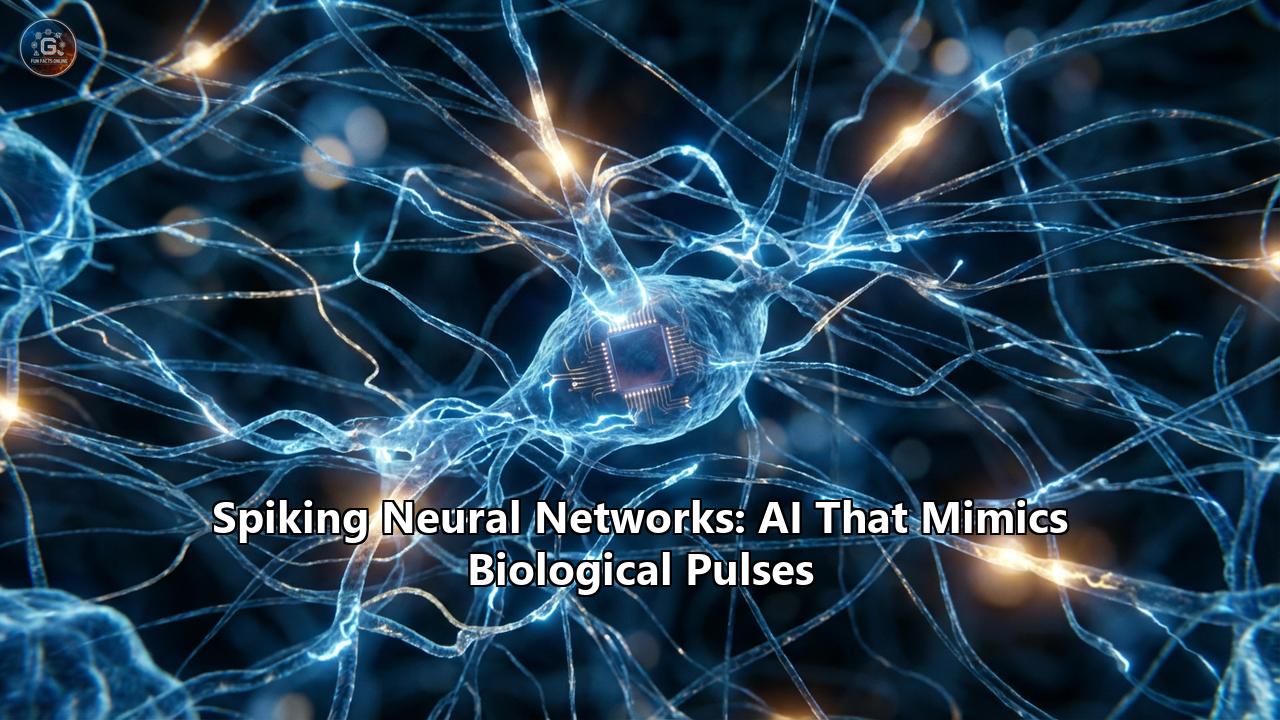
In the cavernous server halls of modern data centers, the air hums with the sound of fans cooling thousands of GPUs. These silicon beasts are the engines of the current AI boom, crunching numbers in massive matrices to power everything from ChatGPT to self-driving cars. They are brilliant, capable, and voraciously hungry. To train a single state-of-the-art Large Language Model (LLM) today consumes as much electricity as a small town does in a year.
Now, compare this to the three-pound organ sitting inside your skull. The human brain manages to write symphonies, calculate trajectories for a tennis serve, process complex emotions, and regulate a heartbeat—all simultaneously—on a power budget of roughly 20 watts. That is less energy than a dim lightbulb.
For decades, computer scientists have looked at this disparity with envy. The result of that envy is a technology that has finally, in the years leading up to 2026, graduated from the laboratory to the real world. They are called Spiking Neural Networks (SNNs).
Unlike the Deep Neural Networks (DNNs) that dominate the headlines, SNNs do not just loosely inspire themselves on the brain; they mimic its fundamental language. They don't calculate in continuous flows of numbers; they communicate in pulses, spikes, and events. They are the third generation of neural networks, and they promise to sever the iron link between artificial intelligence and massive energy consumption.
The Problem with "Loud" AI
To understand why SNNs are revolutionary, we must first understand the inefficiency of traditional AI.
Imagine a security guard watching a monitor displaying an empty hallway. In a traditional Deep Neural Network (used by most standard computer vision systems), the AI analyzes every single pixel of that empty hallway, frame by frame, sixty times a second. It continuously shouts to the processor: "Nothing here! Nothing here! Still nothing! Wall is white! Floor is gray!" It processes data even when nothing is happening. It is a "loud" system, constantly burning energy to re-confirm the status quo.
A Spiking Neural Network, by contrast, operates like a biological eye. If the hallway is empty, the SNN is silent. The neurons are dormant. They consume almost no energy. But the moment a person steps into the frame, the pixels detecting the change spike. They fire an electrical pulse. The network wakes up instantly, processing only the movement, only the event.
This is Event-Driven Processing, the heart of the SNN advantage. In a world drowning in data, SNNs teach machines the most valuable skill of all: the ability to ignore what doesn't matter.
How It Works: The Physics of the Spike
At the core of an SNN is the Leaky Integrate-and-Fire (LIF) neuron model. It is a mathematical approximation of how your own neurons function.
- Integration: The artificial neuron receives electrical signals (spikes) from its neighbors. It accumulates this charge, like a cup filling with water.
- Leakage: If no new signals come in, the charge slowly dissipates (leaks). This ensures that old, irrelevant information fades away—a crucial feature for real-time processing.
- Firing: Once the accumulated charge hits a specific threshold, the neuron "fires." It sends a single, sharp spike down its axon to connected neurons and immediately resets its charge to zero.
This binary, all-or-nothing communication (spike or no spike) is radically different from the continuous decimal numbers used in standard AI. It creates sparsity. In a typical SNN, at any given moment, 90% to 99% of the network might be inactive. This sparsity is where the massive energy savings originate.
Furthermore, SNNs introduce the dimension of time into the neural network equation. In standard AI, the order of inputs in a static image doesn't matter temporally; the whole image is processed at once. In SNNs, the timing of the spike carries information. A spike arriving 2 milliseconds before another can mean something entirely different than if it arrived 2 milliseconds later. This makes SNNs inherently superior at processing temporal data: video, audio, vibration, and radar signals.
The Hardware Renaissance: 2024–2026
Software is only half the battle. To run a brain-like code efficiently, you need a brain-like chip. We are currently witnessing a "Cambrian Explosion" of Neuromorphic Hardware—chips designed specifically to execute SNNs.
The Giants: Intel and IBM
As of late 2025, Intel has continued to push boundaries with its Loihi architecture. The latest iterations (Loihi 2 and its 2026 successors) have moved beyond research curiosities. With millions of neurons packed into a single chip, they are now being used to solve optimization problems that stump classical supercomputers—like routing railway traffic or optimizing financial portfolios—at a fraction of the energy cost.
IBM’s NorthPole chip has similarly redefined efficiency, eliminating the "von Neumann bottleneck" (the energy-wasting shuttle of data between memory and processor) by intertwining memory and computation, just like the brain does.The Agile Specialists: SynSense, Innatera, and Prophesee
While giants build supercomputers, agile startups are putting brains into edge devices.
- SynSense has emerged as a titan in the low-power vision space. Following its strategic consolidation with iniVation, SynSense now dominates the "neuromorphic vision" market. Their chips are not sitting in server racks; they are in toys, smart home hubs, and even "Smart Husbandry" devices—collars for livestock that monitor health and behavior by analyzing movement patterns in real-time for months on a single coin-cell battery.
- Innatera, a spin-off from Delft University, made waves in 2025 with its Spiking Neural Processor T1. This chip is designed for the "sensor edge"—it sits directly next to microphones and radar sensors in wearables. It allows hearables (smart headphones) to filter out background noise using SNNs to distinguish human speech from traffic, reacting in microseconds without needing a connection to the cloud.
- Prophesee has revolutionized the "eye" of the machine. Their event-based Metavision sensors (neuromorphic cameras) do not capture frames. They capture changes. If you shoot a spinning fan with a Prophesee camera, you don't get a blur; you get a crisp stream of spikes representing the moving blades. This technology has become the gold standard for high-speed industrial inspection and autonomous driving.
The Memory Link: Weebit Nano
A critical piece of the 2026 puzzle is memory. Weebit Nano has successfully commercialized ReRAM (Resistive RAM), a type of non-volatile memory that functions remarkably like a biological synapse. By integrating ReRAM with neuromorphic circuits, engineers can now build hardware where the "learning" (changing synaptic weights) happens physically in the memory cell itself, further closing the gap between silicon and biology.
Killer Applications: Where SNNs Are Winning
The theoretical phase is over. SNNs are now deployed in the field, solving problems where standard AI fails due to power or latency constraints.
1. The Autonomous Nervous System: Mercedes-Benz & The EQXX
In the race for autonomous driving, reaction time is everything. A standard camera running at 30 or 60 frames per second has a "blind time" between frames. At highway speeds, a car travels blind for meters during those intervals.
Mercedes-Benz, particularly through its Vision EQXX program and partnerships with the University of Waterloo, has bet big on neuromorphic computing. By using event-based cameras and SNN processors, their ADAS (Advanced Driver Assistance Systems) can react to a pedestrian stepping off a curb in milliseconds, orders of magnitude faster than frame-based systems. Furthermore, because SNNs are so energy-efficient, they extend the range of electric vehicles (EVs) by reducing the massive power drain of the onboard flight computer.2. AI in Orbit: NASA and the "Space-CPN"
Space is the ultimate energy-constrained environment. Solar panels provide limited juice, and radiating heat away is difficult.
In 2025, NASA's "Beyond the Algorithm" challenge highlighted the agency's shift toward neuromorphic solutions for Earth science. Traditional satellites capture massive images and downlink them to Earth for processing—a slow, bandwidth-heavy process. SNN-equipped satellites can process data in orbit.
For example, a satellite monitoring for forest fires doesn't need to send terabytes of "no fire" images. An onboard SNN can monitor the visual stream in low-power sleep mode, spiking only when it detects the specific visual signature of smoke or flame, and then instantly beaming a high-priority alert to ground stations. This concept is evolving into the Space Computing Power Network (Space-CPN), where satellites act as a distributed, intelligent mesh network above the atmosphere.
3. The "Mars Drone" Problem
Flying on Mars, where the atmosphere is thin, requires spinning rotors at incredible speeds, draining batteries rapidly. Every milliwatt saved on computing adds seconds to flight time. The Parallax "Martian Flight" project, aimed at next-generation Mars helicopters, utilizes neuromorphic processors for motion estimation. By processing visual data using spikes, the drone can navigate and stabilize itself with a fraction of the power required by the original Ingenuity helicopter's traditional chips.
The Spiking Transformer: Merging SNNs with LLMs
Perhaps the most exciting development of late 2025 is the hybridization of SNNs with the architecture of Large Language Models.
For years, SNNs struggled with accuracy compared to Deep Learning. You couldn't "chat" with an SNN. But researchers have recently cracked the code on "Spiking Transformers" (e.g., NeurTransformer, SpikeLLM).
By converting the "Attention Mechanisms" of Transformers (the 'T' in GPT) into spike-based operations, scientists have created language models that are 10-20x more energy-efficient than their standard counterparts. This is the breakthrough that will eventually allow a ChatGPT-level assistant to run locally on your smartphone without draining your battery in an hour. It is a "quiet" LLM, activating only the specific neurons needed to answer your specific query, rather than lighting up the whole network.
The Challenges Ahead
Despite the triumphs, the road to a fully neuromorphic future has speed bumps.
- The Training Dilemma: We still don't know exactly how the brain learns. Standard AI uses "Backpropagation," a calculus-based method that requires continuous numbers. Spikes are non-differentiable (you can't do calculus on a sudden step). Researchers use "Surrogate Gradients" (smoothing out the spike for the math) to train these networks, but it remains a complex, computationally expensive process.
- The Conversion Tax: Many current SNNs are just standard Artificial Neural Networks converted into spikes. While efficient, they often lose a bit of accuracy in the translation. The "Holy Grail"—networks trained directly in the spiking domain to learn temporally—is still an active research frontier.
The Future: Toward Organic Computing
As we look toward 2027 and beyond, the line between biology and technology is blurring. We are moving from "Artificial Intelligence" to "Organoid Intelligence"—computing systems that don't just mimic the brain but might eventually incorporate biological components or synthetic biology.
But for now, Spiking Neural Networks represent the most significant shift in computing architecture since the invention of the transistor. They are teaching our machines to listen to the rhythm of the world rather than just the volume. They are proving that in the quest for true intelligence, silence is just as important as the signal.
Reference:
- https://group.mercedes-benz.com/innovations/product-innovation/autonomous-driving/neuromorphic-computing.html
- https://www.youtube.com/watch?v=y0YUjvNaYnw
- https://www.weebit-nano.com/news/press-releases/weebit-nano-reports-on-2025-targets-achievement/
- https://www.elprocus.com/top-neuromorphic-chips-in-2025/
- https://insidehpc.com/2024/06/neuromorphic-company-innatera-attracts-21m-in-series-a-funding/
- https://www.prophesee.ai/
- https://www.eenewseurope.com/en/industrial-camera-taps-prophesee-event-driven-ai-sensor/
- https://www.nasa.gov/directorates/stmd/prizes-challenges-crowdsourcing-program/center-of-excellence-for-collaborative-innovation-coeci/coeci-news/nasa-announces-call-for-new-computing-approaches-to-earth-science/
- https://www.spacedaily.com/reports/Satellites_lined_up_for_shared_space_computing_power_networks_999.html
- https://emergentdefense.com/f/a-coming-revolution