
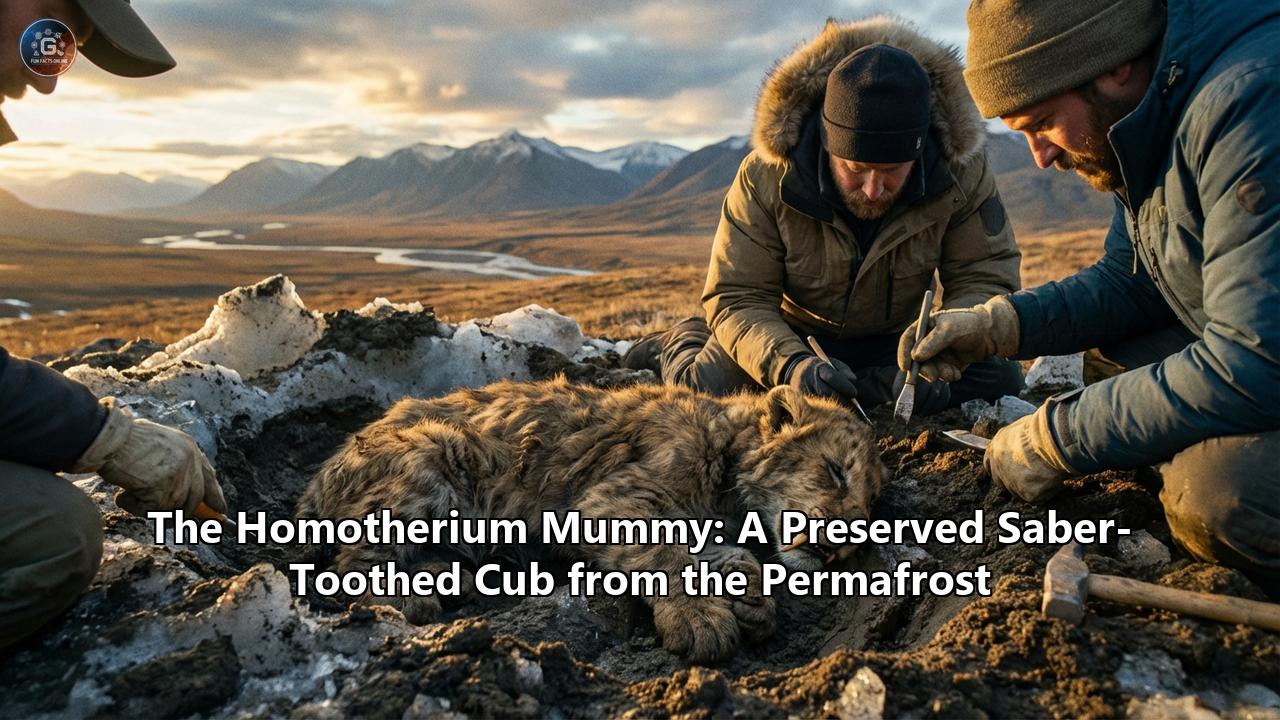
The Siberian winds have blown across the Yana-Indigirka Lowland for millennia, guarding secrets locked deep within the frozen earth. For tens of thousands of years, the permafrost has acted as a suspended animation chamber, a chaotic museum of the Pleistocene where time simply stopped. In 2020, along the crumbling banks of the Badyarikha River, the ice finally yielded one of its most startling treasures. It was not another mammoth tusk, nor the woolly rhino bones that tusk hunters often trade for a living. It was a face.
A face that no human eyes had seen in nearly 37,000 years.
Emerging from the frozen mud was the mummified head and upper body of a cub. But this was no ordinary wolf or cave lion. It possessed a massive, thick neck, strangely elongated forelimbs, and a mouth designed to house weapons that have become the stuff of nightmares and legends. It was a Homotherium latidens—the Scimitar-Toothed Cat.
For the first time in history, we were not looking at bare bones or an artist’s speculation. We were looking at the animal itself.
This is the story of the Badyarikha Mummy, a discovery that has fundamentally rewritten our understanding of the Ice Age’s most elusive predators. It is a story of survival in the Mammoth Steppe, of evolutionary marvels, and of the ghost lineage of cats that once ruled the Northern Hemisphere.
Part I: The Discovery at the Edge of the World
The River of BonesThe Yakutia region (The Sakha Republic) in northeastern Russia is a land of extremes. In winter, temperatures plunge to -60°C; in the short summer, the top layer of soil thaws into a boggy sludge, destabilizing the riverbanks. It is here, in the vast Indigirka River basin, that the Badyarikha River cuts through layers of sediment deposited during the Karginian interstadial—a warmer blip in the last Ice Age.
For local "tuskers"—men who hunt for valuable mammoth ivory to sell on the international market—these riverbanks are a goldmine. But in 2020, the prize was biological, not just financial. encased in a block of frozen sediment was a small, tawny shape. As the ice melted away, the features became undeniable: the soft pads of a paw, the sharp curve of claws, and the closed eyes of a kitten.
The specimen was rushed to the Borissiak Paleontological Institute of the Russian Academy of Sciences in Moscow. There, a team led by Professor Alexey V. Lopatin began a meticulous examination. Radiocarbon dating of the fur placed the cub’s age at approximately 35,000 to 37,000 years old. This meant the cub lived and died during the Late Pleistocene, a time when the northern hemisphere was a teeming Serengeti of cold-adapted megafauna.
Condition of the FindThe preservation was nothing short of miraculous. The mummy consists of the head, the neck, the entire shoulder girdle, the forelimbs, and part of the ribcage. The pelvic bones and hind legs were found nearby, trapped in the same ice block.
What stunned the researchers was the soft tissue. The fur was intact. The whiskers (vibrissae) were still embedded in the muzzle. The fleshy pads of the paws were preserved down to the texture of the skin. The brain was likely desiccated but present inside the skull. For the first time, paleontologists didn't have to guess how muscle attached to bone or how thick the skin was. They could measure it.
Part II: Unveiling the Face of a Ghost
For two centuries, Homotherium has been known only from skeletons. Artists have drawn them, painted them, and animated them, but every image was an educated guess. We assumed they might be spotted, like cheetahs, or tawny, like lions. We guessed at the shape of their ears and the size of their lips.
The Badyarikha cub silenced the guessing game. It provided hard data.
The Coat of Many QuestionsOne of the most shocking revelations was the color of the fur. Modern lion cubs are born with spots (rosettes) that help camouflage them in the dappled light of the den or tall grass. The Homotherium cub, however, was covered in a coat of short, thick, dark brown fur. There were no spots. No stripes. Just a uniform, rich earth tone.
This suggests that Homotherium did not rely on the dappled camouflage of forest edges. Instead, their dark, uniform coats might have been an adaptation to the open, stark environment of the Mammoth Steppe, or perhaps a thermoregulatory feature to absorb sunlight in the frigid Arctic air.
The Face of a PredatorThe cub's head offered even more surprises. When researchers compared it to a modern lion cub of the same age (approx. 3 weeks old), the differences were drastic:
- The Mouth: The Homotherium cub had a significantly wider mouth opening (oral fissure). Even at 3 weeks old, the anatomy was preparing for the massive gape required to deploy large, serrated canines.
- The Ears: The ears were small and positioned differently than a lion's. Small ears are a classic adaptation to cold environments (Allen's Rule) to minimize heat loss—similar to the difference between a desert fennec fox and an arctic fox.
- The Neck: The neck region was massive. Even in this infant, the muscles were thicker and more robust than in a lion. This points to the distinct hunting style of the adult cat, which used powerful neck muscles to drive its "scimitar" teeth into prey.
Part III: Anatomy of a Born Runner
To understand why this cub is so special, we must understand what it was growing up to become. The Homotherium was not a "tiger." In fact, it wasn't even closely related to modern tigers or lions. It belonged to the Machairodontinae, a completely extinct subfamily of felids that split from the ancestors of modern cats over 20 million years ago.
The "Scimitar" vs. The "Saber"Pop culture often lumps all big prehistoric cats into the "Saber-Toothed Tiger" bucket (technically Smilodon). But Homotherium was different.
- ---Smilodon--- was the heavyweight wrestler: stocky, bear-like, with long, fragile, dagger-like fangs. It was an ambush predator.
- ---Homotherium--- was the marathon runner: tall, lanky, with shorter, serrated, curved teeth like a steak knife (a scimitar).
The mummy confirmed these "runner" traits were present even in infancy.
- Elongated Forelimbs: The cub’s front legs were remarkably long compared to its body size. Adults had a hyena-like sloping back, built for high-efficiency looting and long-distance trotting.
- The Paws: This was a major discovery. The cub’s paw pads were round, not oval like a modern cat's. Crucially, it lacked the carpal pad (the "wrist" pad found on the back of the leg in modern cats and dogs). The absence of this pad, combined with the wide, round shape of the foot, suggests a specialized adaptation for walking on snow. It was a natural snowshoe, designed to distribute weight over soft surfaces.
This animal was built to patrol the endless white horizon of the Arctic, covering vast distances in search of mammoth calves or reindeer.
Part IV: The World of the Mammoth Steppe
To picture the life of this cub, we must erase the modern taiga forests of Siberia. 35,000 years ago, this region was the Mammoth Steppe—a biome that has no modern analog. It was a dry, cold, endless grassland that stretched from Spain, across Siberia, and over the land bridge into Alaska.
It was not a barren wasteland. It was teeming with life, supported by nutrient-rich grasses and herbs.
The NeighborsIf the cub had survived, it would have opened its eyes to a world of giants:
- Woolly Mammoths: The architects of the steppe. They knocked down trees and churned the soil.
- Woolly Rhinoceros: Massive, grumpy herbivores with horns longer than a human is tall.
- Steppe Bison & Wild Horses: The bread-and-butter prey for the large carnivores.
- Cave Lions (Panthera spelaea): The Homotherium’s main rival. Cave lions were larger than modern lions and hunted in similar territories.
How did Homotherium and Cave Lions coexist without killing each other off? The anatomy of the mummy gives us clues. Cave Lions were likely the "heavy hitters," taking down bison and perhaps hibernating in caves (as their name suggests, though they roamed widely). Homotherium, with its lanky build and serrated teeth, was likely a cursorial predator—hunting like a wolf or a hyena.
They likely hunted in packs, wearing down prey over miles of open tundra. They may have targeted juvenile mammoths, using their serrated teeth to slash the thick skin and cause blood loss, rather than the suffocating bite used by modern lions. The discovery of the cub in the open permafrost (rather than a cave) supports the idea that Homotherium may have denned in open sites or dense willow thickets along riverbanks.
Part V: The Science of Eternal Ice
How does a 3-week-old kitten survive 37,000 years? The answer lies in the unique chemistry of the Yakutian permafrost.
The Freeze-Drying ProcessWhen the cub died—perhaps abandoned, perhaps killed by a rival, or succumbing to the cold—it was likely buried quickly. This could have been a mudslide, a collapsing riverbank, or a drifting snowstorm that turned to ice.
Once encased in the frozen soil, two things happened:
- Cold: The temperature halted bacterial decomposition immediately.
- Desiccation: The permafrost acts like a giant freeze-dryer. It pulls moisture out of the soft tissue, preserving the structure of the skin and muscle while preventing rot.
There is a bitter irony in this discovery. We are finding these treasures now because the Arctic is melting. As global temperatures rise, the permafrost that has held these secrets for millennia is thawing. This creates a "gold rush" for paleontologists, who are racing to recover mammoths, wolves, birds, and now cats before they rot away in the modern sun.
Part VI: Why This Matters
The Badyarikha Mummy is not just a curiosity; it is a Rosetta Stone for felid evolution.
1. Correcting the ArtPaleo-artists will have to redraw their Homotherium. No longer can they be depicted with generic lion-like ears or arbitrary spotting. We now know they were chocolate-brown, small-eared, wide-mouthed runners of the north.
2. Phylogenetic ConfirmationFor years, there was debate about whether Homotherium truly lived in late Pleistocene Asia. Most fossils were found in North America or Europe. This find confirms their range was continuous. It proves they were a truly trans-continental success story, spanning the entire top of the globe.
3. Soft Tissue BiologyWe can now study the thickness of the skin and the distribution of fat. We can analyze the keratin in the claws. Most excitingly, scientists will likely attempt to sequence the genome from the soft tissue. While we have retrieved DNA from bones before, soft tissue can sometimes yield higher quality genetic material. This could tell us about their vision (were they diurnal?), their metabolism, and exactly how they fit into the cat family tree.
Conclusion: The Cub Who Time Traveled
The Homotherium cub of the Badyarikha River lived for only three weeks. It likely never hunted, never roared, and never saw a full summer. But in death, it has achieved an immortality that no other member of its species ever did.
It has bridged a gap of 37,000 years to look us in the eye. It reminds us that the world we live in is built on the bones of giants, and that the history of life on Earth is far richer, stranger, and more tangible than we often dare to imagine. As the permafrost continues to weep its meltwater into the Arctic Ocean, we are left to wonder: What other faces are waiting in the ice, ready to stare back at us?
Reference:
- https://www.courthousenews.com/dna-study-of-prehistoric-cat-reveals-a-deadly-long-distance-hunter/
- https://www.youtube.com/watch?v=MpWBMAoVLlc
- https://en.wikipedia.org/wiki/List_of_Ice_Age_species_preserved_as_permafrost_mummies
- https://www.reddit.com/r/Paleontology/comments/jc35m8/analysis_of_homotherium_genome_suggests_it_was_a/
- https://en.wikipedia.org/wiki/Homotherium
- https://www.youtube.com/watch?v=Ns4JfQiL8js
- https://www.youtube.com/watch?v=r78twqHrl0o
- https://www.iflscience.com/mummies-from-a-mysterious-arctic-civilization-found-in-the-permafrost-42822
- https://www.researchgate.net/publication/7862187_Pleistocene_Park_Return_of_the_Mammoth's_Ecosystem
- https://science.nasa.gov/kids/earth/what-is-permafrost/