
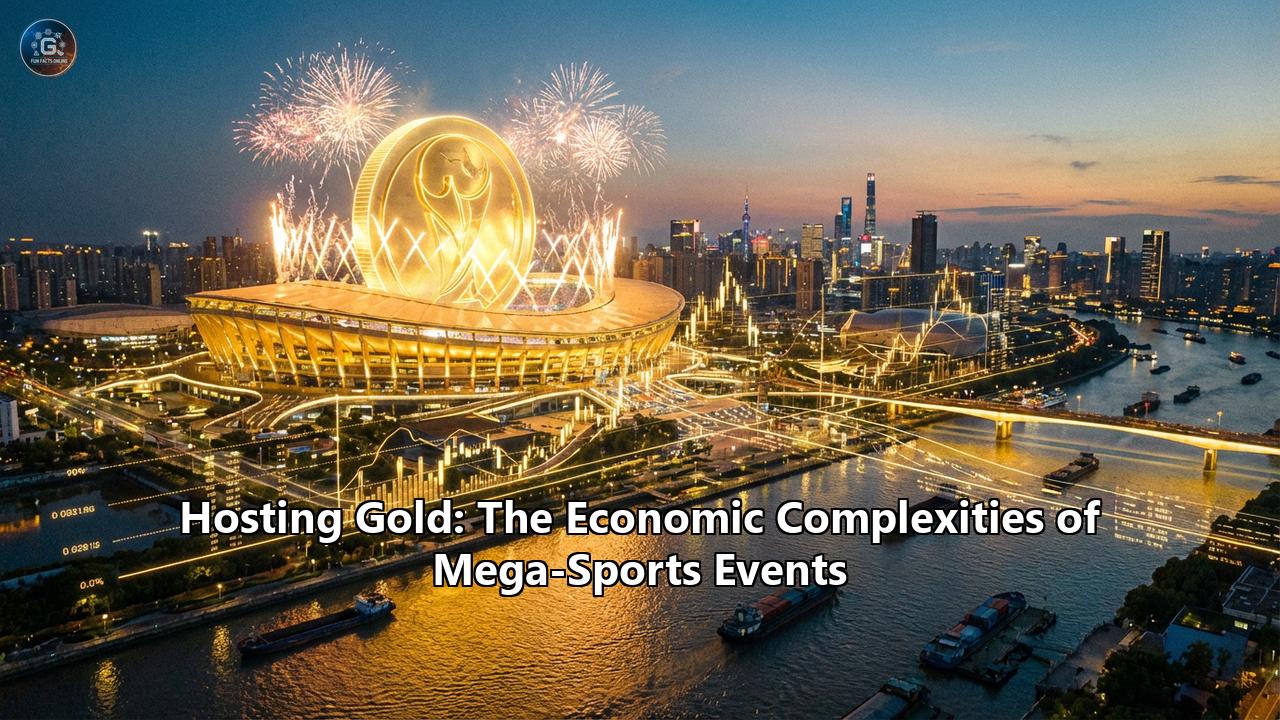
The world watches with bated breath as the opening ceremony begins. Fireworks paint the night sky, thousands of athletes march in national colors, and a host city glimmers under the gaze of billions. For a few weeks, this city is the center of the universe. The narrative broadcast to the globe is one of unity, athletic excellence, and a modernized nation welcoming the future. But when the flame is extinguished and the crowds disperse, a different reality often settles in—one of debt, abandoned concrete, and economic hangovers that can last for decades.
This is the high-stakes gamble of hosting mega-sports events like the Olympic Games and the FIFA World Cup. For decades, world leaders and city planners have been seduced by the promise of "hosting gold"—the idea that these events will turbocharge local economies, modernize infrastructure, and rebrand nations on the global stage. The pitch is always seductive: a boom in tourism, a legacy of world-class facilities, and an intangible boost in national pride and soft power.
Yet, as the history of the 20th and 21st centuries has shown, the economic reality is far more complex, often darker, and deeply unequal. From the debt-ridden cautionary tale of Montreal 1976 to the abandoned "white elephants" of Athens 2004 and Rio 2016, the path to hosting glory is paved with financial peril.
Part I: The Seduction of the Bid
To understand the economic complexities of mega-events, one must first understand the machinery of the bid. Why do cities voluntarily sign up for a venture that economists have warned against for years?
The Winner’s CurseIn economics, the "Winner’s Curse" is a phenomenon that occurs in auctions with incomplete information. The winner is often the bidder who most overestimates the value of the prize. In the context of the Olympics or World Cup, the "prize" is the right to host. To win this right against global competitors, cities must promise the moon: the most state-of-the-art stadiums, the most efficient transport networks, and the most secure environment.
The bidding process itself incentivizes low-balling costs and overestimating benefits. A city that presents a realistic, conservative budget is likely to lose to a rival promising a dazzling, transformational vision. This structural flaw means that almost every mega-event begins its life based on a financial fiction. Planners rely on "best-case scenario" multipliers for economic growth while ignoring the inevitable inflation of construction costs, security concerns, and logistical nightmares.
The Political EgoBeyond the spreadsheet, there is the political dimension. For politicians, hosting a mega-event is a legacy project of the highest order. It offers a tangible deadline for infrastructure projects that might otherwise languish in bureaucratic limbo for decades. A new subway line, an airport expansion, or a revitalized waterfront can be pushed through under the guise of "national necessity" for the Games.
Furthermore, the event serves as a potent signal of modernity. For emerging economies, hosting is often viewed as a "coming out party." The 1964 Tokyo Olympics signaled Japan’s rehabilitation and technological resurgence after World War II. The 2008 Beijing Olympics was China’s declaration of superpower status. The 2010 World Cup in South Africa was meant to showcase a unified, post-apartheid Africa ready for business. For these nations, the return on investment (ROI) is calculated not just in dollars, but in diplomatic standing and global perception.
Part II: The Cost of Ambition
Once the bid is won, the reality of construction sets in. The history of mega-events is a history of budget overruns. A study by the University of Oxford found that the Olympics have the highest average cost overrun of any type of megaproject, at 156% in real terms. Unlike building a bridge or a dam, the deadline for a mega-event is immovable. You cannot delay the Opening Ceremony because the roof isn't finished. This "deadline pressure" strips host cities of their bargaining power with contractors, leading to skyrocketing costs as the date approaches.
The Infrastructure TrapThe costs fall into two main categories: operational costs (running the event) and infrastructure costs (building the venues and supporting city upgrades). Operational costs—security, catering, transport for athletes, ceremonies—are massive, but infrastructure is where budgets go to die.
Consider the 2014 Sochi Winter Olympics. Russia spent an estimated $50 billion (more than all previous Winter Olympics combined) to transform a subtropical resort town into a winter sports capital. This included building a railway and road link through difficult mountain terrain that cost nearly $9 billion alone—more than the entire budget of the 2010 Vancouver Games. While the region gained infrastructure, the cost per mile was astronomical, fueled by corruption and the immense engineering challenges of forcing a mega-event into a landscape not designed for it.
Security: The Hidden LeviathanSince the tragedy of the Munich 1972 Olympics and the heightened threat landscape post-9/11, security costs have exploded. Athens 2004 spent over $1.5 billion on security alone, deploying tens of thousands of police and military personnel. This is a "sunk cost"—money spent that leaves no physical legacy, no new train line, and no community benefit once the athletes leave. It is purely an expense to ensure the event happens without incident.
Part III: The Revenue Illusion
If costs are the tragedy of mega-events, revenue is the farce. Proponents often cite massive figures for potential economic impact, usually derived from "ex-ante" (before the event) economic studies commissioned by the bidders themselves. These studies frequently rely on generous "multipliers"—the idea that a dollar spent by a tourist circulates through the economy multiple times.
However, independent "ex-post" (after the event) analyses tell a different story.
The Crowding Out EffectOne of the most persistent myths is the tourism bonanza. While it is true that hundreds of thousands of sports fans descend on a host city, they often displace the "regular" tourists who would have visited anyway. Regular tourists stay away to avoid the crowds, high prices, and security hassles.
During the London 2012 Olympics, popular West End theaters reported a drop in ticket sales, and major museums saw foot traffic decline. The "Olympic tourist" is a specific breed: they are there for the sport. They spend their time in venues and official fan zones, often eating at sponsor-franchised kiosks rather than local mom-and-pop restaurants. The regular high-spending cultural tourist, who might buy art, dine in luxury restaurants, and tour historical sites, often avoids the host city entirely during the Games.
LeakageEven when money is spent, much of it "leaks" out of the local economy. The International Olympic Committee (IOC) and FIFA are experts at ring-fencing revenue. Ticket sales, broadcasting rights, and top-tier sponsorship deals largely flow back to these Switzerland-based organizations, not the host city.
Hotels and large retail chains, often owned by multinational corporations, capture the bulk of the visitor spending. The local taxi driver or street vendor might see a temporary bump, but the structural wealth transfer is often negligible. In Brazil 2014, FIFA notoriously forced the country to suspend its ban on alcohol in stadiums to satisfy major sponsor Budweiser, prioritizing corporate revenue over local laws.
Part IV: The White Elephant Syndrome
Perhaps the most visible scar of the mega-event model is the "White Elephant"—expensive, state-of-the-art sporting venues that sit empty and decaying after the closing ceremony.
The Tragedy of AthensThe 2004 Athens Olympics is the textbook example. Greece, a nation with a population of only 11 million, built permanent, world-class venues for niche sports like softball, baseball, and kayaking. Once the games ended, there was no local demand for these facilities. The maintenance costs proved crippling. As the Greek debt crisis unfolded in the years following, these venues fell into disrepair. The Hellinikon Olympic Complex became a ghost town of rusting fences and cracked concrete—a symbol of fiscal irresponsibility that contributed to the country's economic collapse.
Brazil’s Stadiums to NowhereThe 2014 World Cup in Brazil saw the construction of the Arena da Amazônia in Manaus, a city in the heart of the rainforest with no top-tier football team. The stadium cost $300 million to build. To import the steel, materials had to be shipped from Portugal, across the Atlantic, and up the Amazon River. Today, it struggles to find events to cover its maintenance bills. Similarly, the Estádio Nacional in Brasília, which cost nearly $1 billion, has been used as a parking depot for municipal buses because there are rarely enough spectators to fill it.
These structures are not just neutral; they are negative assets. They occupy valuable urban land and siphon millions of dollars in annual maintenance from public budgets—money that could be spent on schools, hospitals, or sanitation.
Part V: The Intangible Balance Sheet
If the direct economics are so poor, why do nations persist? The answer lies in the intangibles: Soft Power and the "Feel-Good Factor."
Putting a Nation on the MapBarcelona 1992 is the "Gold Standard" every city chases. Before the Olympics, Barcelona was an industrial backwater known largely to business travelers. The city used the Games as a catalyst to completely redevelop its waterfront, removing industrial railways and creating miles of beaches. They didn't just build stadiums; they built a new city. The televised images of divers leaping with the Sagrada Família in the background rebranded Barcelona as one of Europe’s premier cultural and tourism destinations. The economic legacy was real and sustained, transforming the city's trajectory for decades.
However, Barcelona is the exception, not the rule. It succeeded because the Games were part of a decades-long urban master plan, not the other way around.
Social Cohesion and PrideThere is a measurable psychological benefit to hosting. For a brief moment, a nation feels unified. The London 2012 Olympics famously buoyed the British national mood, presenting a confident, multicultural face of the UK to the world. For South Korea in 1988 or South Africa in 2010, the events were moments of profound national validation. This "psychic income" is real, though it is difficult to quantify in a spreadsheet. Politicians bet that the voter satisfaction from a successful event will outweigh the eventual tax burden.
Part VI: The Human Cost
The economic narrative often ignores the distributional effects of hosting. Who pays, and who benefits?
Displacement and GentrificationTo build Olympic Parks and stadiums, land is required. Often, this land is occupied by the city’s poorest residents. In preparation for the 2008 Beijing Olympics, an estimated 1.5 million people were displaced as historic neighborhoods (hutongs) were bulldozed to make way for modern infrastructure. In Rio de Janeiro, favelas were cleared or "pacified" with aggressive police tactics to create security perimeters for the Games.
This displacement is often permanent. The areas around Olympic parks undergo rapid gentrification. Rents rise, local businesses are priced out, and the communities that originally lived there reap none of the benefits of the new amenities. The "regeneration" of East London for the 2012 Games brought new housing, but much of it was unaffordable for the original residents of the borough of Newham, one of the poorest in the UK.
The Environmental TollMega-events are carbon bombs. The construction of massive concrete structures, the intercontinental air travel of millions of fans, and the energy consumption of venues create a massive environmental footprint. The 2022 Qatar World Cup claimed to be "carbon neutral," a claim widely debunked by environmental watchdogs who pointed out that the calculations ignored the massive emissions from constructing seven new stadiums in the desert, including the energy-intensive air conditioning of outdoor venues.
Winter Olympics face an existential crisis due to climate change. Beijing 2022 relied almost entirely on artificial snow, requiring massive water diversion and energy use in a region already suffering from water scarcity. As the planet warms, the number of cities capable of hosting winter games without massive environmental engineering is shrinking.
Part VII: A New Paradigm?
The era of the "blank check" mega-event is ending. The pool of willing host cities is drying up. For the 2022 Winter Olympics, European cities like Oslo, Stockholm, and Krakow withdrew their bids due to public backlash over costs, leaving only Beijing and Almaty, Kazakhstan. Western democracies are finding it increasingly difficult to justify the expense to taxpayers.
This crisis of legitimacy is forcing the IOC and FIFA to pivot.
Agenda 2020 and the New NormThe IOC’s "Agenda 2020" initiative aims to reduce the cost of bidding and hosting. It encourages the use of existing and temporary venues. We are seeing this shift in real-time.
Paris 2024: The Sustainability TestThe Paris 2024 Olympics are positioned as the antithesis of Sochi or Rio. 95% of the venues are existing or temporary. Beach volleyball is played under the Eiffel Tower; equestrian events are at the Palace of Versailles. Instead of building a new "White Elephant" stadium, they are using the Stade de France. The Athletes' Village is designed to be converted into eco-friendly housing for locals immediately after the games, specifically targeting a neglected area of the Seine-Saint-Denis district. If Paris succeeds in delivering a cost-effective, sustainable Games, it could save the Olympic model.
Los Angeles 2028: The "No-Build" OlympicsLos Angeles 2028 is taking this further. The city is using entirely existing infrastructure. With world-class stadiums like the SoFi Stadium, the LA Coliseum, and Crypto.com Arena already in place, LA does not need to build a single permanent sporting venue. This radically changes the economic calculus, shifting the focus from construction risk to operational execution.
The 2026 World Cup: The Gigantism of Joint HostingThe 2026 FIFA World Cup will be the first to be hosted across three nations: the USA, Canada, and Mexico. It expands the tournament to 48 teams. While this increases the scale, the joint hosting model allows costs to be spread. The US already has the NFL stadiums required; Canada and Mexico have established infrastructure. This regional approach may be the future—sharing the burden so that no single economy is crushed by the weight of the world’s attention.
Conclusion: Is It Worth It?
The question "Is hosting worth it?" has no single answer.
If the goal is immediate financial profit, the answer is almost unequivocally no. The costs are too high, the revenue leakage too great, and the opportunity costs of public funds too severe.
If the goal is urban regeneration, the answer is maybe, but only if the event is a small part of a decades-long master plan (like Barcelona) rather than a vanity project driving the planning (like Athens).
If the goal is nation-building and soft power, the answer is yes, but at a price. The price is paid in debt, in displacement, and in the diversion of resources from the mundane but vital needs of a citizenry.
As we look to the future, the definition of a "successful" Games is changing. It is no longer about who can build the biggest stadium or the most spectacular opening ceremony. It is about who can host the party without destroying the house. The era of excess is over; the era of smart, sustainable, and socially responsible hosting must begin, or the torch may one day be extinguished for good.
Reference:
- https://journalistsresource.org/economics/economic-and-cultural-benefits-of-the-olympics-research-roundup/
- https://www.unilim.fr/ebooks/531
- https://visionarymarketing.com/en/2025/04/10/2024-paris-olympics-success/
- https://growthlab.hks.harvard.edu/publication/bringing-home-the-gold-a-review-of-the-economic-impact-of-hosting-mega-events/
- https://www.hlb.global/the-economic-impact-of-hosting-large-sporting-events/
- https://en.wikipedia.org/wiki/Cost_of_the_Olympic_Games
- https://www.weforum.org/stories/2016/07/the-cost-to-cities-of-hosting-the-olympics-since-1964/
- https://static.poder360.com.br/2025/04/FIFAWC26_04042025_USA.pdf