
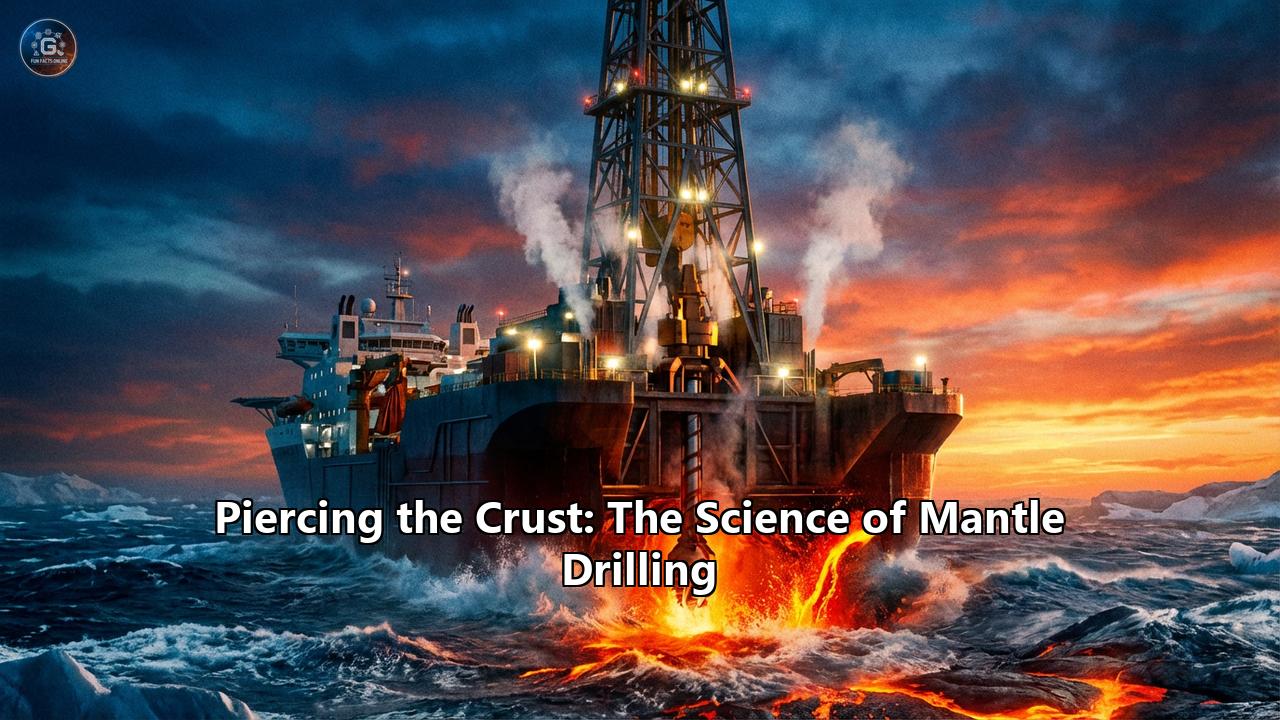
The heavy, rhythmic thrum-thrum-thrum of the thrusters is the heartbeat of the Chikyu. It is a sound that vibrates through the soles of your boots, up your shins, and settles deep in your chest—a constant reminder that you are floating on a speck of steel above four miles of crushing ocean, trying to thread a needle into the skin of the planet.
It is January 2026. Ten months ago, in the sapphire waters of the Tyrrhenian Sea, humanity finally touched the forbidden kingdom. We didn't just scratch the surface; we pierced the veil. The recovery of pristine mantle peridotite from the Magnaghi-Vavilov Basin was the geological equivalent of the moon landing—a feat that transformed the "impossible" into the "cataloged." But as the celebrations fade and the samples sit in argon-purged vaults in Kochi and Bremen, the real work begins. We are no longer just knocking on the door of the Earth's interior; we have kicked it open.
This is the story of that journey—not just the triumphs of the last year, but the seventy-year war against physics, heat, and pressure that got us here. It is a story of diamond-studded teeth grinding against rock harder than steel, of mud that acts like liquid armor, and of the men and women who live their lives in twelve-hour shifts, suspended between the starry sky and the fiery deep.
Part I: The Dream of the Inner Space
To understand why we drill, you have to understand the tantalizing ignorance of the human condition. We have mapped the far side of the moon, sent robots to rove the Martian deserts, and listened to the whispers of pulsars billions of light-years away. Yet, until very recently, our direct knowledge of our own planet extended only a few measly miles down.
The Earth is an onion of rock and metal, roughly 6,371 kilometers (3,959 miles) in radius. The crust—the cold, brittle shell upon which all of human history has played out—is vanishingly thin, ranging from 5 to 70 kilometers. Beneath that lies the mantle, a 2,900-kilometer thick engine of solid but flowing rock that drives plate tectonics, feeds volcanoes, and ultimately controls the habitability of our surface world.
For over a century, the boundary between the crust and the mantle was a line on a seismograph, a ghost defined by the way earthquake waves sped up when they hit it. We called it the Mohorovičić discontinuity, or the "Moho," named after the Croatian seismologist Andrija Mohorovičić who identified it in 1909. But seeing a ghost and touching it are two very different things.
The Legacy of Project Mohole
The dream of "piercing the crust" was born in the heady, scientifically optimistic days of the late 1950s. If we could race to the moon, why not race to the mantle? A group of American scientists, calling themselves the "American Miscellaneous Society" (a name that belied their serious credentials), proposed Project Mohole.
Their logic was elegant: drilling through the continental crust is a nightmare because it is thick (30-50 km). But the oceanic crust? That is thin—sometimes only 5 or 6 km. If you could park a ship in deep water and drop a drill string through 4 km of ocean, you only had to drill a relatively short distance to hit the mantle.
In 1961, off the coast of Guadalupe, Mexico, they proved it was possible. They drilled 183 meters into the seafloor from a floating barge, a technological miracle for the time that invented the field of "dynamic positioning"—using engines to keep a ship steady over a hole without anchors. But politics and budget overruns killed Project Mohole in 1966 before it could reach the prize. The samples they did retrieve, however, proved that the ocean floor was a geological archive of immense value.
The Soviet Giant: Kola
While the Americans looked to the sea, the Soviets looked to the land. In 1970, on the frozen, windswept Kola Peninsula, they began drilling the Kola Superdeep Borehole. For 24 years, they ground their way down. It was a brute-force assault on the Earth. They reached 12,262 meters (7.6 miles)—still the deepest artificial point on Earth.
They didn't reach the mantle—the continental crust there was too thick—but they found hell. Or rather, they found that our models of the deep Earth were wrong. The rock wasn't dry and dense as predicted. It was fractured and saturated with water that shouldn't have been there. And it was hot—far hotter than expected, reaching 180°C (356°F) at the bottom. The granite had turned into a plastic, gooey mess that flowed into the borehole, closing it up as fast as they could drill it. The drill bits, grinding against rock that behaved like hot taffy, would wear out in hours. In 1992, the drilling stopped. The project was abandoned, leaving a rusted metal cap welded shut in the middle of a ruin, the stuff of urban legends about "screams from hell."
But science doesn't stop; it learns. The failure of Kola and the cancellation of Mohole taught us that brute force wasn't enough. We needed finesse. We needed technology that didn't exist yet. We needed the Chikyu.
Part II: The Leviathans—Ships that Eat Rock
If you stand on the helipad of the Chikyu, the Japanese deep-sea drilling vessel, looking forward, you are looking at the most complex machine ever built for marine science. It is 210 meters long, topped with a derrick that towers 130 meters above the waterline—a skyscraper floating on the Pacific.
Built in 2005, Chikyu (Japanese for "Earth") was designed with one singular, terrifying goal: to drill where no one else could. Unlike its predecessor, the legendary JOIDES Resolution (which was sadly decommissioned in late 2024 after 40 years of service), Chikyu uses "riser drilling."
The Riser Revolution
In traditional "riserless" drilling, like that used by the JOIDES Resolution, you drop a drill pipe through the water, bore a hole, and pump seawater down the pipe to flush out the cuttings. The cuttings (rock chips) just spill out onto the seafloor. This works fine for shallow holes. But if you go deep, or hit high-pressure pockets of gas, the hole collapses or blows out.
Riser drilling changes the game. It involves lowering a massive outer pipe—the riser—all the way from the ship to the seafloor. This creates a closed loop. We can pump heavy, engineered "drilling mud" down the drill pipe, which flows back up the space between the drill pipe and the riser, carrying the rock cuttings back to the ship.
This mud is magic fluid. It balances the immense pressure of the rock walls, preventing the hole from collapsing. It cools the drill bit. And by analyzing the mud and cuttings returning to the ship, scientists get real-time data on what's happening miles below. It allows Chikyu to drill safely into unstable fault zones and high-pressure reservoirs that would destroy a lesser ship.
The End of an Era: The JOIDES Resolution
We cannot talk about mantle drilling without pouring one out for the JOIDES Resolution (the "JR"). For four decades, this workhorse drilled thousands of holes, rewriting our understanding of climate change, plate tectonics, and the extinction of the dinosaurs. Its final mission, Expedition 403 to the Fram Strait in 2024, was a bittersweet victory lap, recovering critical data on Arctic climate history even as the crew knew their ship was destined for the scrap yard.
The emotional toll on the scientific community was immense. "The JR was more than a ship; it was a floating university, a home, and a time machine," wrote one chief scientist in a farewell blog post. The loss of the JR has put immense pressure on Chikyu and the European consortium's mission-specific platforms to carry the torch. The "2050 Science Framework," the roadmap for ocean drilling, now relies heavily on these remaining assets and new international collaborations to fill the void.
Part III: The Engineering of Hell
Drilling to the mantle is not just about digging a deep hole. It is about engineering a system that can survive conditions designed to destroy it. The challenges are a "unholy trinity" of depth, heat, and hardness.
1. The Geometry of the String
Imagine holding a piece of spaghetti by one end. Now imagine that piece of spaghetti is two miles long, and you are trying to use it to drill a hole in a concrete sidewalk while suspended from a drone that is being buffeted by wind. That is the scale problem. The drill string—the steel pipe that connects the ship to the bit—is incredibly flexible over these lengths. It doesn't just spin; it vibrates, whips, and buckles.
To manage this, we use Active Heave Compensation (AHC). The Chikyu's derrick is equipped with massive hydraulic pistons that move the entire drill string up and down in perfect opposition to the ship's heave. If a wave lifts the ship 3 meters, the compensator pays out 3 meters of line instantly. Without this, the drill bit would be pounded into the rock or yanked off the bottom with every swell, destroying it in minutes.
2. The Heat Death of Electronics
As we learned from Kola, the Earth gets hot fast. In the mantle, temperatures soar above 250°C (482°F) even at shallow entry points. This is the "electronic death zone." Standard silicon chips fry at around 150°C. Batteries explode. Seals melt.
For the 2025 Tyrrhenian expedition, engineers developed a new generation of "high-temperature logging tools." These aren't your iPhone's chips. They use Silicon-on-Insulator (SOI) technology and wide-bandgap semiconductors like Silicon Carbide (SiC), which can operate happily at 300°C.
But it's not just the chips; it's the batteries. You can't run a power cord to the drill bit. Downhole tools need power to measure radiation, resistivity, and magnetic fields. The new "thermal batteries"—using lithium-thionyl chloride chemistries encased in vacuum flasks—were essential. They function like a thermos for electricity, keeping the sensitive chemistry cool(er) for the duration of the run.
3. The Diamond Teeth
The mantle is made of peridotite. It is dense, crystalline, and abrasive. It eats steel. A standard tri-cone drill bit, the kind used for oil wells, would last maybe 10 hours in peridotite before its bearings seized or its teeth shattered.
The solution lies in Polycrystalline Diamond Compact (PDC) bits. These are solid-state bits with no moving parts. The "cutters" are black, man-made industrial diamonds sintered onto tungsten carbide studs. They don't grind the rock; they shear it, shaving off rock like a cheese grater.
For the recent ultra-deep successes, engineers utilized "Hybrid Bits"—Frankenstein monsters that combine the shearing action of PDC cutters with the crushing action of rolling cones. They also deployed new "impregnated diamond" bits, where the entire cutting matrix is a ceramic mixed with diamond grit. As the matrix wears away, it exposes fresh, sharp diamonds, allowing the bit to self-sharpen as it dies.
4. The Mud: Liquid Technology
Perhaps the most unsung hero is the drilling fluid. In the high-temperature environment of mantle drilling, standard bentonite clay muds turn into a solid brick. You can't pump a brick.
The mud engineers ("mud doctors") onboard Chikyu mix a witch's brew of synthetic polymers and graphite. They use high-temperature deflocculants (chemicals that stop clay particles from sticking together) based on zirconium and sulfomethylated phenolic resins. They also maintain a precise "Mud Weight Window." If the mud is too light, the borehole collapses from the pressure of the rock. If it's too heavy, it fractures the rock and leaks away, draining the ship's tanks and leaving the drill string stuck. It is a balancing act performed with pumps and equations, monitored 24/7 on glowing screens in the driller's shack.
Part IV: Life at the Limit
Technology is impressive, but it is people who drill holes. Life onboard a scientific drill ship is a unique subculture, a mix of high-stakes industrial labor and high-minded academic pursuit.
The 12-Hour World
On the Chikyu, time is binary: you are either "on tower" (on shift) or you are off. The shifts run noon-to-midnight and midnight-to-noon. This creates two tribes on the ship: the Day Walkers and the Night Owls.
"The crossover meeting at 11:45 AM/PM is the hinge of the world," says Dr. Elena Rossi, a petrologist who sailed on Expedition 405. "You walk into the lab, groggy with coffee, and the outgoing shift looks manic, covered in mud or rock dust, their eyes wide with the adrenaline of discovery or the frustration of a stuck pipe. They hand you the baton—the state of the hole, the core recovery rate, the drama of the last 12 hours."
The Galley: The Heart of the Ship
Food is morale. On a Japanese ship like Chikyu, the galley is legendary. It’s not just sustenance; it’s a culinary tour. There is a Japanese line serving miso soup, rice, and grilled fish for breakfast. There is a Western line with bacon and eggs. And there is the "Curry Friday" tradition—a staple of the Japanese Navy adopted by the scientific fleet.
"You measure the expedition in meals," says a roughneck from the drilling floor. "You don't think 'we have three weeks left.' You think, 'we have three more Curry Fridays.'"
The galley is also where the hierarchy flattens. A world-famous professor sits next to a 19-year-old wiper from the engine room. They talk about cricket, anime, or the storm brewing off the starboard bow.
Isolation and Connectivity
In 2026, the isolation is different than in the 1970s. Starlink terminals provide high-speed internet. Crew members FaceTime their kids before bed; scientists upload data to the cloud in real-time. But the psychological distance remains. You are a small city floating on an abyss. When a storm hits—like the "medicane" (Mediterranean hurricane) that threatened the Tyrrhenian expedition—the internet cuts out, the dynamic positioning thrusters scream to hold the station, and the ship rolls 15 degrees. You realize then that no amount of bandwidth can save you from the ocean.
"The smell is what gets you," Rossi recalls. "The ship smells of diesel, grease, and ozone. After two months, you forget what dirt smells like. When we docked in Naples after the mantle success, the smell of wet earth and pine trees drifted out to us. I saw grown men cry just smelling the land."
Part V: The Science – Why We Pierce the Crust
Why spend billions of dollars and risk lives to bring up a cylinder of green rock? Because that green rock tells the story of how we—and our planet—came to be.
1. The Moho: Not a Line, but a Gateway
For decades, the Moho was taught as a sharp boundary. Crust above, mantle below. The samples from the Tyrrhenian Sea and recent detailed seismic work have shown us it is far more complex. In many places, especially slow-spreading ridges, the Moho isn't a sharp line. It's a "transition zone" where crustal gabbros and mantle peridotites are mixed together, churned by tectonic forces.
In some areas, the mantle is "exhumed"—pulled up to the seafloor by faulting, bypassing the crust entirely. This is what made the Magnaghi-Vavilov Basin such a prime target. We didn't have to drill through 6 km of crust; the crust had already been ripped apart, leaving the mantle covered only by a thin veneer of sediment and basalt.
2. The Deep Carbon Cycle
We worry about carbon in the atmosphere, but the vast majority of Earth's carbon is locked in the mantle. It cycles in and out over millions of years—sucked down in subduction zones (where one plate dives under another) and burped back up by volcanoes.
Understanding this cycle is crucial for modeling long-term climate stability. The samples recovered in 2025 showed unexpected veins of carbonate minerals deep in the mantle rocks. This suggests that the mantle can store vastly more carbon than we thought. It implies that peridotite alteration might be a massive, natural carbon sequestration engine. If we can understand the chemistry of how the mantle locks up carbon, we might be able to replicate it to fight climate change.
3. Serpentinization: The Engine of Life?
This is the holy grail for the astrobiologists onboard. When mantle rock (peridotite) is exposed to seawater, it doesn't just get wet; it reacts chemically. This process is called serpentinization.
The reaction is exothermic (it produces heat). It turns the rock green and scaly (hence "serpentine"). But most importantly, it releases Hydrogen gas (H2) and creates alkaline fluids.
Here is the magic equation:
Olivine (rock) + Water → Serpentine + Magnetite + Hydrogen + HeatThen, a second reaction happens, often catalyzed by the metals in the rock:
Hydrogen + Carbon Dioxide → Methane (CH4) + WaterThis is the Fischer-Tropsch process, occurring naturally, abiotically (without life) deep in the Earth. It produces methane and hydrogen—food for microbes.
The "Lost City" hydrothermal field in the Atlantic, discovered in 2000, is a natural laboratory for this. But drilling gives us the "plumbing" underneath. The cores recovered this year were teeming with evidence of this process. We found fluid inclusions trapped in the rock containing high concentrations of hydrogen and methane.
And we found life.
Deep in the cracks of these mantle rocks, shielded from the sun, under crushing pressure, scientists found microbial communities—methanogens that eat the hydrogen produced by the rock. They don't need the sun. They don't need oxygen. They live on rock and water.
This has profound implications for the origin of life on Earth. Did life start not in a "warm little pond" on the surface, but in the dark, warm fractures of the mantle? And if it did, could the same thing be happening right now on Europa (Jupiter's moon) or Enceladus (Saturn's moon), where we know liquid water touches a rocky mantle?
"When we hold these cores," says Dr. Rossi, "we are holding the recipe book for life in the universe."
Part VI: The Future – 2030 and Beyond
The success of the 2025 Tyrrhenian drilling and the JTRACK expedition to the Japan Trench (Expedition 405) has revitalized the community. The "2050 Science Framework" is no longer just a wishlist; it is a battle plan.
The M2M Project: Moho to Mantle
The next big prize is a full penetration of intact oceanic crust into the mantle—the original "Project Mohole" goal. The target is likely the Pacific, where the crust is uniform and "fast-spreading," offering a simpler geology than the chaotic Mediterranean.
A new generation of drilling technology is being blueprinted. This includes:
- Automated Rigs: Using AI to control the drill brake, detecting "kicks" (pressure spikes) faster than a human can react.
- Laser Drilling: Still experimental, but concepts for using high-energy lasers to spall (thermal fracture) rock instead of grinding it are being tested for the ultra-hard/ultra-hot depths.
- Casing-while-Drilling: Technology that lines the hole with steel as it is drilled, preventing the "gumbo" collapse issues that plagued the Kola project.
JTRACK and the Earthquake Hunters
While mantle drilling seeks origins, other projects seek survival. The JTRACK expedition (IODP Exp 405) has been installing observatories in the Japan Trench. These aren't just holes; they are permanent listening posts. Sensors lowered into these boreholes measure temperature and strain in real-time, looking for the frictional heat signatures of fault slip.
The goal is to understand "shallow slip"—the mechanism that caused the devastating tsunami in 2011. By drilling directly into the fault zone, Chikyu is acting as a planetary stethoscope, trying to hear the heartbeat of the next mega-quake before it strikes.
Conclusion: The Vertical Frontier
As 2026 unfolds, the Chikyu prepares for its next deployment, perhaps to the Nankai Trough, perhaps back to the deep Pacific. The data from the Tyrrhenian Sea is being published in Nature and Science, fueling debates that will last a decade.
We live on a thin raft of cool rock floating on a churning ocean of fire. For most of history, we have been content to map the raft. But the drive to pierce the crust, to reach down and touch the fire, is about more than just geology. It is about connection. It is about realizing that the Earth is not a static stage for human drama, but a dynamic, living entity.
The drill bit turns. The mud pumps scream. The derrick groans under the load. And slowly, foot by painful foot, we lower our bucket into the well of deep time, hoping to draw up the water of understanding. We have pierced the crust. The journey has just begun.
Reference:
- https://psu.pb.unizin.org/sciod/chapter/joides-resolution/
- https://astrobiology.nasa.gov/news/science-communication-aboard-the-joides-resolution/
- https://eos.org/opinions/expedition-403-sailing-the-last-expedition-of-the-joides-resolution
- https://iaga-aiga.blogspot.com/2023/12/a-paleomagnetist-on-board-joides.html
- https://blogs.oregonstate.edu/ceoaschronicles/2023/03/02/a-day-in-the-life-of-a-shipboard-scientist/
- https://www.frontiersin.org/journals/microbiology/articles/10.3389/fmicb.2023.1257597/full
- https://en.wikipedia.org/wiki/Serpentinization
- https://www.jamstec.go.jp/chikyu/e/exp405/expedition.html
- https://iodp3.org/expedition/405/
- https://www.researchgate.net/publication/398910936_Expedition_405_Preliminary_Report_Tracking_Tsunamigenic_Slip_Across_the_Japan_Trench_JTRACK