
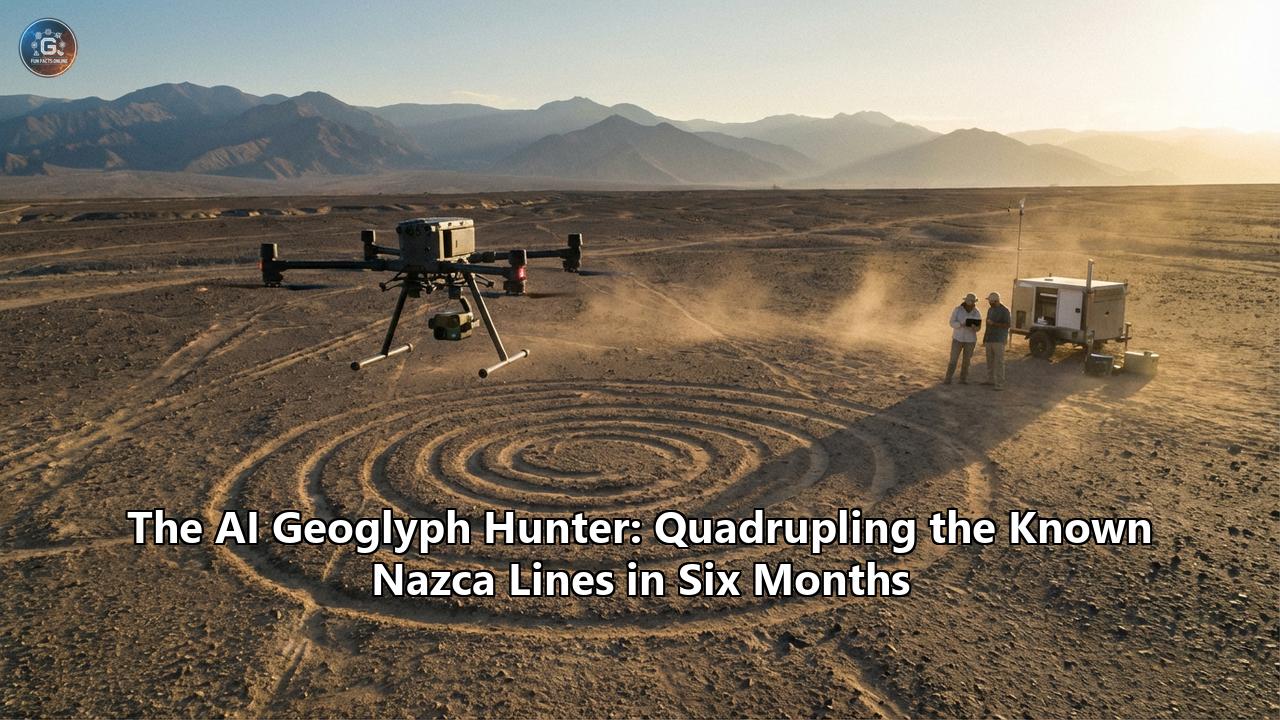
In the arid, sun-baked expanse of the Peruvian desert, a silent revolution has taken place—one that has fundamentally rewritten the history of one of the world’s most enigmatic archaeological wonders. For nearly a century, the Nazca Lines have captivated the imagination of scientists, historians, and mystics alike. These ancient geoglyphs, etched into the pampa by the Nazca culture between 200 BC and 700 AD, have long been the subject of wild theories ranging from astronomical calendars to alien landing strips. For decades, the discovery of these lines was a slow, painstaking process, relying on the human eye, aerial photography, and fortuitous shadows cast by the setting sun. By the early 21st century, after nearly 100 years of exploration, archaeologists had cataloged approximately 430 figurative geoglyphs.
Then, in a span of just six months, everything changed.
In a groundbreaking collaboration that marries ancient history with futuristic technology, a team of archaeologists from Japan’s Yamagata University, working alongside IBM Research, utilized artificial intelligence to shatter the ceiling of what was thought possible. In a single, blistering campaign of digital analysis and ground-truthing, they identified 303 previously unknown figurative geoglyphs. When combined with other recent finds facilitated by this technology, the number of known geoglyphs has skyrocketed, effectively doubling the known catalog of figurative works in a heartbeat and putting the field on a trajectory to quadruple the total count as the project continues.
This is the story of the "AI Geoglyph Hunter"—the technology that peered into the desert sands and saw what the human eye had missed for millennia.
Part I: The Sleeping Giant of the Pampa
To understand the magnitude of this discovery, one must first appreciate the canvas. The Nazca Desert is a high, arid plateau that stretches between the towns of Nazca and Palpa in southern Peru. It is one of the driest places on Earth, a geographic anomaly that has acted as a natural preservative for the artworks scratched into its surface two thousand years ago. The surface of the pampa is covered in a layer of reddish-brown iron oxide-coated pebbles. When these pebbles are removed, they reveal the lighter, lime-rich soil underneath. The contrast between the dark stones and the white earth creates the lines.
For the Nazca people, this was a sacred act. They created thousands of geometric shapes—trapezoids, triangles, and spirals—and hundreds of "figurative" drawings, which are recognizable depictions of animals, plants, and humans. The most famous of these—the Hummingbird, the Monkey, the Spider—are massive. They span hundreds of meters and are best viewed from the air, a fact that has fueled the "ancient astronaut" theories of the 20th century.
However, these massive "line-type" geoglyphs are only half the story. There exists another category of geoglyphs, often older and smaller, known as "relief-type" geoglyphs. These were carved into the slopes of hills and are often smaller (averaging 9 meters or 30 feet) and harder to spot. Weathered by wind and time, their outlines have blurred, blending into the surrounding rocks. For decades, they remained hidden in plain sight, invisible to high-altitude planes and easily missed by weary hikers.
Enter Masato Sakai, a professor of archaeology at Yamagata University. Sakai had spent years walking the desert, convinced that the pampa held more secrets than it had surrendered. He knew that the vastness of the area—over 400 square kilometers—made traditional foot surveys impossibly slow. He also knew that the human eye is fallible, prone to pareidolia (seeing patterns where none exist) or fatigue. He needed a partner that never slept, never blinked, and could process visual data at a scale no human could match.
He found that partner in IBM.
Part II: Training the Machine
The collaboration between Yamagata University and IBM Research was not just about using a computer to look at pictures; it was about teaching a computer to think like an archaeologist. The challenge was immense. In the world of Deep Learning—the subset of AI that powers facial recognition and self-driving cars—models usually require tens of thousands of examples to learn a pattern. If you want an AI to recognize a cat, you feed it a million images of cats.
But there weren't a million Nazca Lines. There were only a few hundred known examples, and they varied wildly in style, preservation, and lighting conditions.
The team at IBM, led by researchers who specialized in computer vision, had to be ingenious. They employed a technique known as "transfer learning," taking AI models that had already been trained to interpret general imagery and fine-tuning them with the limited dataset of known geoglyphs. They sliced high-resolution aerial photographs—some taken by planes, others by sophisticated drones—into thousands of smaller tiles.
The AI was taught to look for specific anomalies: the subtle difference in texture where stones had been moved, the faint shadow of a groove in the earth, the geometric improbability of a straight line in a chaotic landscape. It was trained to distinguish between a natural wash created by a flash flood and a deliberate stroke made by a human hand.
Once the model was trained, the researchers unleashed it on a massive dataset of geospatial imagery covering the entire Nazca Pampa. The AI scanned the desert inch by inch, processing terabytes of data that would have taken a team of human analysts decades to review.
The results were instantaneous and overwhelming. The AI generated a "probability map," flagging thousands of locations with a high likelihood of containing a geoglyph. It didn't just find the obvious ones; it found the ghosts—the faint, eroded, and overgrown figures that had eluded discovery for centuries.
Part III: The Discovery Explosion
Armed with the AI's "treasure map," Professor Sakai and his team returned to Peru in late 2022. The ground-truthing phase was critical. An AI can flag a shadow as a monkey, but only a human standing in the dust can confirm if it’s truly an ancient artwork or just a pile of rocks.
The efficiency was staggering. In previous years, a field season might yield a handful of new discoveries—perhaps five or ten if they were lucky. With the AI's guidance, the team was finding new geoglyphs daily. They weren't just finding vague lines; they were finding complex, narrative scenes.
In just six months of fieldwork, the team confirmed 303 new figurative geoglyphs. To put that in perspective, it took the entire archaeological community nearly 100 years to find the first 430. The AI had accelerated the rate of discovery by a factor of 20.
But it wasn't just the number of lines that was shocking; it was what they depicted.
The famous "line-type" geoglyphs—the ones featured in every documentary—are mostly animals: birds, whales, spiders. They are gigantic and situated on flat ground.
The newly discovered 303 geoglyphs were different. They were predominantly "relief-type," carved into hillsides. And their subject matter was far more human—and far more unsettling.
The AI Hunter had uncovered a gallery of the bizarre and the macabre. Among the new finds were:
- The Headless Humanoids: Strange, abstract figures of people appearing to hold objects, sometimes decapitated heads, suggesting a link to the Nazca culture's known practice of taking trophy heads.
- The Knife-Wielding Orca: A terrifying depiction of a killer whale holding a knife, a motif that appears in Nazca ceramics but had rarely been seen in the geoglyphs.
- Domesticated Life: While the giant lines honored wild beasts, these smaller reliefs depicted llamas, parrots, and scenes of daily life, suggesting a more intimate purpose.
- The "Alien" Motifs: Figures with large eyes and strange headdresses that, while certainly human in origin, fuel the mystery of the Nazca iconography.
Part IV: Rewriting the Nazca Narrative
The sheer volume of these new discoveries has allowed archaeologists to perform statistical analyses that were previously impossible. With over 700 figurative geoglyphs now mapped, distinct patterns have emerged that are reshaping our understanding of the Nazca civilization.
The research suggests a clear dichotomy in the purpose of the lines, divided by type.
The Giant Line-Types (The Temple Floors):The massive geometric and animal figures on the flat pampa appear to be ritual spaces. The lines are not just drawings; they are pathways. The earth inside the lines is compacted, suggesting that people walked on the lines, perhaps in single-file processions, chanting, praying, or dancing to appease the gods of water and fertility. These were community-level monuments, built and used by large groups for high-stakes ceremonies.
The Relief-Types (The Roadside Billboards):The 303 new geoglyphs discovered by the AI tell a different story. These figures are almost exclusively located within viewing distance of ancient trails and footpaths that crisscross the desert. They were not hidden; they were meant to be seen by travelers walking the paths.
Professor Sakai theorizes that these smaller geoglyphs served as a form of ancient communication. They were "roadside billboards" or waymarkers. As travelers moved from the coast to the Andes, they would pass these images. A depiction of a killer whale might mark a path toward the sea. A figure of a llama might indicate a trading route for wool and meat. Or, more ominously, the scenes of decapitation might have served as warnings or markers of territory—a "Keep Out" sign etched in stone.
This distinction humanizes the Nazca people. They weren't just mystics obsessed with the sky; they were travelers, traders, and storytellers who used their landscape to communicate information to one another. The AI has transformed the Nazca lines from a static mystery into a dynamic, living system of social signaling.
Part V: The Future of Digital Archaeology
The success of the "AI Geoglyph Hunter" in Peru is a watershed moment for the entire field of archaeology. It is a proof-of-concept that is already sending ripples through universities and research institutions worldwide.
If an AI can find 300 geoglyphs in the barren desert, what can it find in the dense jungles of the Amazon? Lidar technology has already begun to peel back the canopy to reveal lost Mayan cities, but AI can process that Lidar data to identify specific structures—houses, temples, roads—that a human analyst might miss in the visual noise.
In Europe, similar AI models are being trained to spot burial mounds (tumuli) in satellite imagery of farmland. In the Middle East, they are tracking the looting of archaeological sites by identifying new "pockmarks" in the sand. Underwater, AI is analyzing sonar data to identify shipwrecks.
The "Quadrupling" alluded to in the title of this new era is not just about the number of Nazca lines; it is about the exponential increase in archaeological data globally. We are entering an age where we will likely discover more about the ancient world in the next ten years than we did in the previous hundred.
Part VI: The Race Against Time
There is an urgency to this work that goes beyond academic curiosity. The Nazca Lines, having survived for two millennia, are under threat. Climate change is altering weather patterns in the Pacific, bringing unprecedented rains to the Atacama and Nazca deserts. Flash floods can wash away a relief geoglyph in minutes.
Furthermore, urban expansion and economic development pose a direct threat. Squatters, mining operations, and unsuspecting truck drivers (like the infamous incident in 2018 where a truck plowed through a UNESCO site) can destroy history before we even know it's there.
The AI Geoglyph Hunter is not just a tool for discovery; it is a tool for preservation. By rapidly identifying and mapping these sites, Sakai and his team can work with the Peruvian Ministry of Culture to designate protected zones. You cannot protect what you do not know exists. The speed of the AI allows conservationists to stay one step ahead of the bulldozers and the rain.
Conclusion: The Message in the Sand
The discovery of 303 new geoglyphs is a triumph of technology, but it is ultimately a victory for the human spirit—both the ancient hands that carved the stones and the modern minds that sought to find them.
It reminds us that the past is not dead; it is merely waiting. For centuries, we walked past these figures, blind to their presence. We looked at the desert and saw emptiness. Now, through the "eyes" of artificial intelligence, we see a landscape teeming with life, stories, and warnings.
As the Yamagata University and IBM team continues their work, they estimate there are hundreds, perhaps thousands, more geoglyphs waiting to be found. The count will rise. The "quadrupling" is on the horizon. But the true value lies not in the numbers, but in the connection they provide. Across two thousand years of silence, the Nazca people are finally speaking to us again, and for the first time in history, we have the technology to listen.
Reference:
- https://indiandefencereview.com/ai-solved-303-nazca-geoglyphs-rewriting-ancient-peru/
- https://www.theguardian.com/world/2024/sep/26/nazca-lines-peru-new-geoglyphs
- https://www.futura-sciences.com/en/ai-cracks-a-2000-year-old-mystery-buried-in-the-desert_22705/
- https://www.capitol.ai/story/dc751ca0-52cf-4719-ad50-a87e033ff8ef
- https://getcoai.com/news/hundreds-more-ancient-nazca-lines-discovered-in-peru-thanks-to-ai/
- https://www.jpost.com/archaeology/article-868967
- https://www.forbes.com/sites/carlymiller/2024/09/29/ai-discovers-303-nazca-geoglyphs-from-aerial-photos-of-the-peruvian-desert/
- https://www.pnas.org/doi/10.1073/pnas.2407652121
- https://caliber.az/en/post/ai-takes-flight-over-peru-303-new-nazca-geoglyphs-discovered
- https://www.sciencefocus.com/planet-earth/how-were-about-to-solve-the-worlds-greatest-archaeological-puzzle
- https://en.wikipedia.org/wiki/Nazca_lines
- https://latinamericanpost.com/science-technology/revealing-old-secrets-with-ai-in-latin-america/
- https://japannews.yomiuri.co.jp/science-nature/science/20240926-213384/
- https://www.theartnewspaper.com/2025/08/14/248-nazca-lines-discovered-artificial-intelligence-peru