
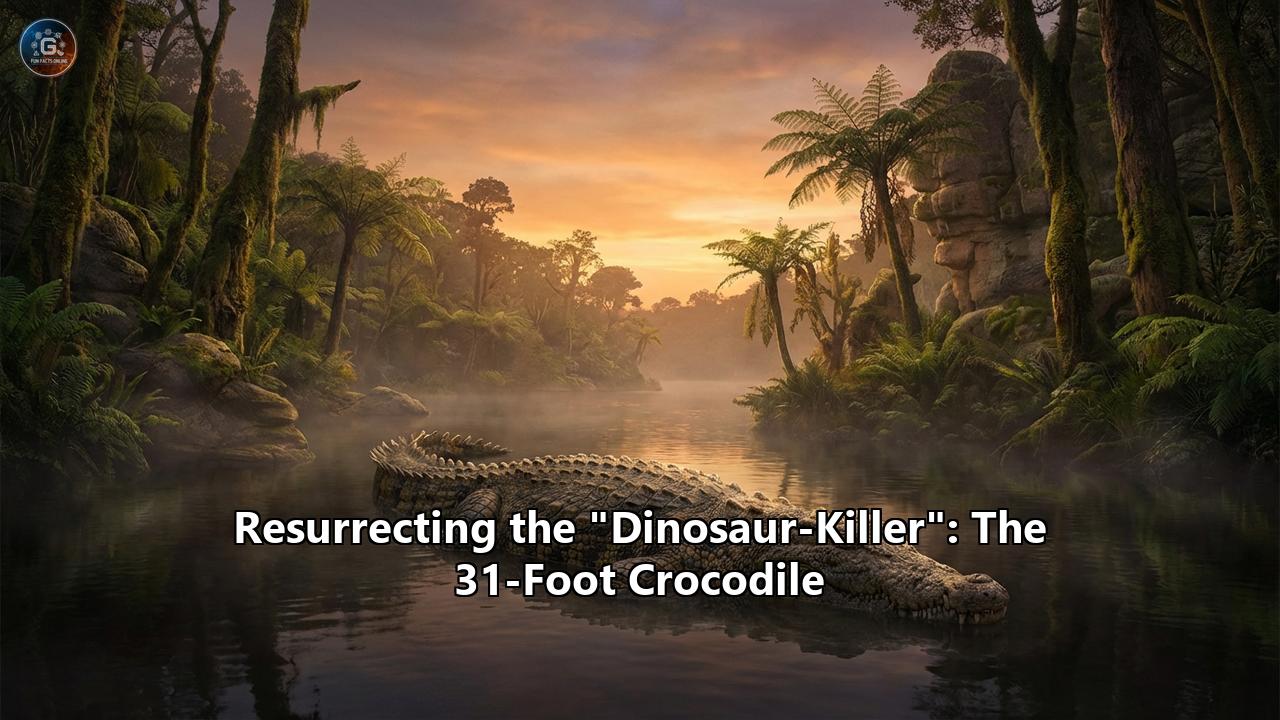
The sun beats down on the humid, verdant marshlands of what will one day be Georgia. The year is 78 million B.C., deep in the Campanian stage of the Late Cretaceous. The air is thick with the buzz of prehistoric insects and the calls of primitive birds. A herd of hadrosaurs—duck-billed dinosaurs—wades cautiously into the brackish water of a wide estuary to drink, their eyes scanning the treeline for the tyrannosaurs that stalk the land.
They are watching the wrong place.
Beneath the turbid surface of the water, a shadow moves. It is not a fish, nor a marine reptile. It is a living log, thirty-one feet of armored muscle and malice. It has been holding its breath for an hour, its heart rate slowed to a crawl. It senses the vibrations of the drinking dinosaurs through sensitive pressure receptors along its jaw. Slowly, silently, the shadow rises. Two bulbous eyes break the surface, followed by nostrils. It locks onto a sub-adult hadrosaur.
In an explosion of whitewater, the surface erupts. Jaws spanning six feet open to reveal teeth the size of bananas. The bite snaps shut with a force of 23,000 pounds per square inch—crushing bone like dry twigs. The dinosaur roars in agony, but the predator is already engaged in a backward slide, dragging three tons of struggling prey into the depths. The "Terror Crocodile" has fed.
This is not a scene from a movie. This was the daily reality of the North American coastlines during the age of dinosaurs. The predator is Deinosuchus, a creature so massive and powerful that it turned the "Age of Reptiles" into a horror story for even the largest dinosaurs. For decades, this creature existed largely in the imagination of paleontologists, pieced together from fragments. But now, thanks to a groundbreaking reconstruction project and decades of research, the "Dinosaur-Killer" has been resurrected in unprecedented detail.
Resurrecting the "Dinosaur-Killer": The 31-Foot Crocodile
Part I: The Resurrection of a Monster
For over a century, Deinosuchus (Latin for "Terrible Crocodile") was a ghost. We knew it existed. We found its teeth—thick, sturdy spikes designed for crushing—scattered across the American continent. We found its armor plates, or osteoderms, which were so large they were initially mistaken for the armor of ankylosaurs. But a complete picture of the animal remained elusive.
That changed recently with a monumental project at the Tellus Science Museum in Cartersville, Georgia. Working in tandem with Dr. David Schwimmer (a paleontologist, not the actor), one of the world's leading experts on the genus, experts at Triebold Paleontology embarked on a mission to build the most scientifically accurate reconstruction of Deinosuchus schwimmeri ever attempted.
The result is a 31-foot-long skeletal masterpiece that now dominates the museum floor. This is not a composite of guesswork; it is a high-fidelity assembly based on the best available fossil material. It represents a creature that was the apex predator of its domain, an animal that grew to the size of a school bus and possessed a bite force that makes the Tyrannosaurus rex look modest by comparison.
This reconstruction serves as a time machine, transporting us back to the lost continent of Appalachia. It forces us to confront a terrifying truth about the Cretaceous period: the water was not safe.
Part II: Anatomy of the King
To understand Deinosuchus, one must first discard the image of a modern crocodile scaled up. While it shares the basic crocodilian body plan, Deinosuchus was an entirely different class of biological machinery.
The Scale of the Beast
Size estimates for Deinosuchus have fluctuated wildly over the decades. Early 20th-century reconstructions, based on limited skull fragments, projected lengths of up to 50 feet, turning it into a kaiju-sized monster. Modern science has tempered these estimates, but the reality is hardly less terrifying.
The species Deinosuchus riograndensis, found in the western United States (Laramidia), is estimated to have reached lengths of 35 to 39 feet (10-12 meters) and weighed up to 8.5 tons. The eastern species, Deinosuchus schwimmeri, represented by the Tellus reconstruction, was slightly smaller but still colossal, averaging 31 feet.
To put this in perspective:
- Saltwater Crocodile (Modern Record Holder): ~20 feet, 1 ton.
- Tyrannosaurus Rex: ~40 feet, 8-9 tons.
- Deinosuchus: ~31-35 feet, 5-8 tons.
While the T. rex was longer and taller, Deinosuchus was a low-slung tank. In the water, where buoyancy negated the constraints of gravity, it was the undisputed heavyweight champion.
The Skull: Built for Destruction
The most distinct feature of Deinosuchus was its skull. Unlike the slender, fish-catching snouts of modern gharials or the V-shaped snouts of crocodiles, Deinosuchus possessed a broad, U-shaped snout characteristic of alligatoroids. This structural choice is significant. A broad snout dissipates the stress of a bite more effectively than a narrow one, allowing the animal to clamp down on struggling, heavy prey without risking jaw fracture.
The teeth were the primary weapons. At the front of the jaw, the teeth were sharp and conical, designed for piercing and gripping flesh. But as you moved back into the mouth, the teeth transformed. They became thick, blunt, and rounded—resembling crushing pestles more than knives. These posterior teeth were adapted for "durophagy"—the eating of hard objects. They could pulverize turtle shells and crush the dense bones of dinosaurs with sickening ease.
The Bite: A Hydraulic Press
Biomechanics experts have modeled the bite force of Deinosuchus based on its skull architecture and muscle attachment points. The results are staggering.
- Human: ~160 psi
- Lion: ~650 psi
- Great White Shark: ~4,000 psi
- Tyrannosaurus rex: ~12,800 psi
- Deinosuchus: ~23,000 to 28,000 psi
A bite force of over 20,000 psi is difficult to comprehend. It is equivalent to having a medium-sized box truck pressed down on your thumb. When Deinosuchus clamped onto a limb, it didn't just cut skin; it shattered the underlying skeletal structure instantly.
Armor Plating
Deinosuchus was not just a hammer; it was also an anvil. Its back was covered in heavy, deeply pitted osteoderms (bone skin). These plates were far heavier and more rugged than those of modern alligators. Some paleontologists hypothesize that this heavy armor served a dual purpose: it acted as ballast to help the massive animal stay submerged, and it provided protection during intraspecific combat—fights with other Deinosuchus.Part III: The Lost World of Appalachia
To truly appreciate this animal, we must visualize its home. During the Late Cretaceous, North America was not one continent. It was cut in two by the Western Interior Seaway, a massive inland ocean that stretched from the Arctic to the Gulf of Mexico.
- Laramidia: The western landmass (modern-day Montana, Utah, Texas, etc.). Home to famous dinosaurs like T. rex and Triceratops.
- Appalachia: The eastern landmass (modern-day Georgia, Alabama, New Jersey). This was the domain of Deinosuchus schwimmeri.
Appalachia was a humid, subtropical environment, a lush tapestry of river deltas, estuaries, and swamps. It was a "greenhouse world" with no polar ice caps. Sea levels were high, and the coastlines were dynamic environments teeming with life.
In these brackish waters, Deinosuchus was the king. While Laramidia had the famous giant theropods, Appalachia's terrestrial predators were generally smaller. The dominant predators on land were smaller tyrannosauroids like Appalachiosaurus, which reached about 20-25 feet in length. This created a unique ecological dynamic: the largest predator in the ecosystem wasn't on land. It was in the water.
This reversed the typical predator hierarchy. In most ecosystems, the land predator fears nothing. In Appalachia, even the tyrannosaurs had to watch their step near the water's edge.
Part IV: The Diet of a Deity
What do you eat when you are a 31-foot crocodile? The answer is simple: Whatever you want.
The Turtle Crusher
Fossil evidence suggests that a significant portion of the Deinosuchus diet consisted of sea turtles. The warm, shallow waters of the Interior Seaway and the Atlantic coast were populated by massive turtles like Bothremys. We have found numerous turtle shells with bite marks that perfectly match the spacing and shape of Deinosuchus teeth. In some cases, entire sections of shell appear to have been bitten cleanly off. This explains the blunt, crushing back teeth of the crocodile; they were evolutionary nutcrackers designed to pop open turtle shells to get to the meat inside.
The Dinosaur Killer
While turtles provided a steady snack, they were not enough to sustain an 8-ton metabolizing engine. Deinosuchus needed red meat, and plenty of it.
For years, the idea of crocodiles eating dinosaurs was speculation. Then came the smoking gun. In 2002, Dr. David Schwimmer published findings detailing dinosaur fossils with peculiar damage.
- Hadrosaurs: Tail vertebrae from duck-billed dinosaurs were found with deep, puncture-like tooth marks.
- Theropods: Bones of Appalachiosaurus (the local tyrannosaur) and Albertosaurus were found with similar scarring.
The forensics were undeniable. The bite marks showed no signs of healing, suggesting the attack was fatal or occurred shortly before death. The shape of the punctures matched the robust, conical teeth of Deinosuchus. This was direct evidence of predation (or at least scavenging) on dinosaurs.
Consider the physics of such an attack. A modern Nile crocodile attacks wildebeest and zebras that weigh roughly the same as itself or less. Deinosuchus was attacking prey that stood 15 feet tall and weighed several tons. To bring down a hadrosaur, Deinosuchus likely utilized the "ambush and drown" strategy.
Lying in wait at a river crossing or watering hole, it would explode from the water, grabbing a leg or the muzzle of the dinosaur. Using its immense mass and torque, it would drag the victim into deep water. Once the dinosaur lost its footing, the game was over. Deinosuchus would likely perform a "death roll," spinning its body to shear off massive chunks of meat or to disorient and drown the prey.
Part V: The Science of Growth
One of the most fascinating discoveries about Deinosuchus comes from the study of its growth rings. Modern reptiles grow continuously, but their growth slows down significantly as they age. Dinosaurs, on the other hand, grew rapidly, reaching adult size in a sprint of 10-15 years.
Paleontologists Gregory Erickson and Christopher Brochu analyzed the osteoderms of Deinosuchus and found growth lines, similar to tree rings. Their findings were surprising. Deinosuchus did not grow like a dinosaur. It grew like a crocodile—slow and steady.
However, it kept that growth rate up for an exceptionally long time. A typical alligator might grow for 10-20 years. Deinosuchus appears to have maintained its growth rate for 35 to 50 years. It was a creature of immense longevity. A full-grown, 31-foot individual might have been 50, 60, or even 70 years old.
This "Methuselah strategy" has terrifying implications. It means that an adult Deinosuchus would have seen generations of dinosaurs come and go. It would have been a permanent, ancient fixture of the landscape, a surviving monster that learned and adapted over half a century of hunting.
Part VI: The War of the Super-Crocs
Deinosuchus is often cited as the largest crocodile ever, but it has rivals for the throne. The title is hotly contested by two other prehistoric giants: Sarcosuchus and Purussaurus.The Challengers
- Sarcosuchus imperator ("SuperCroc"): Lived in Early Cretaceous Africa (approx. 110 million years ago). It was incredibly long, reaching up to 40 feet. However, it had a long, narrow, gharial-like snout.
Verdict: While longer, Sarcosuchus was likely lighter and had a much weaker bite. It was a fish specialist that probably couldn't handle large dinosaur prey in the same way Deinosuchus could. It was a different tool for a different job.
- Purussaurus brasiliensis: Lived in the Miocene Amazon (approx. 8 million years ago). This was a caiman on steroids.
Verdict: Purussaurus is the closest rival in terms of bulk and bite force. Some estimates put it slightly larger than Deinosuchus, while others put them neck-and-neck. However, Purussaurus lived in a world of giant mammals, whereas Deinosuchus had to contend with the most dangerous terrestrial predators in Earth's history.
The consensus today places Deinosuchus firmly at the top tier. Whether it was technically heavier than Purussaurus by a few hundred pounds is academic; in its specific ecosystem, it was unrivaled. It was the only crocodilian confirmed to have engaged in combat with Tyrannosaurids.
Part VII: Taxonomy – Not Actually a Crocodile?
Here is a taxonomic twist: Deinosuchus is technically not a crocodile.
In the strict scientific classification, "Crocodile" refers to members of the family Crocodylidae (like Nile and Saltwater crocs). Deinosuchus belongs to the superfamily Alligatoroidea. It is a stem-alligator. It is more closely related to the American Alligator in the Florida Everglades than it is to the Nile Crocodile.
This relationship is evident in its anatomy. Its broad snout and the placement of its teeth (where the lower teeth fit inside the upper jaw, unlike the interlocking teeth of crocodiles) are classic alligator traits. So, when you look at the 31-foot skeleton in Georgia, you are looking at the great-great-grand-uncle of the gator in the local golf course pond.
Part VIII: The End of the Reign
Why did Deinosuchus vanish? It disappeared around 73 million years ago, several million years before the asteroid impact that killed the non-avian dinosaurs.
The extinction of Deinosuchus is likely linked to the shrinking of the Western Interior Seaway. As the climate cooled slightly and tectonic plates shifted, the seaway began to recede. The massive estuaries and brackish deltas that served as the hunting grounds for these giants began to dry up or change drastically.
Deinosuchus was a specialist of the "edge" environments—where the river met the sea. As those environments disappeared, so did the specialized prey and the habitat required to support such massive bodies. The "Dinosaur Killer" didn't go out with a bang, but with a slow, starving whimper, leaving the niche of apex riparian predator vacant until the end of the Mesozoic.Conclusion: A Legacy in Bone
The resurrection of the Deinosuchus at the Tellus Science Museum is more than just a display of bones. It is a reminder of the power of deep time. It reminds us that the Earth has hosted monsters that defy our current understanding of biology.
Dr. David Schwimmer’s work and the new reconstruction allow us to stand face-to-face with a creature that hunted the ancestors of our birds and lizards. It forces a perspective shift. We often think of the T. rex as the ultimate biological weapon, the terrifying climax of evolution. But in the rivers of Georgia and Texas, 78 million years ago, the T. rex's cousins were looking at the water with fear.
The "Dinosaur Killer" has returned. And this time, we can marvel at it from the safety of a museum rail, thankful that 75 million years separate us from that terrible, crushing bite.
Reference:
- https://en.wikipedia.org/wiki/Deinosuchus
- https://www.nationalgeographic.com/science/article/deinosuchus-croc-crocodile-dinosaurs-north-america
- https://scitechdaily.com/scientists-reconstruct-a-giant-31-foot-dinosaur-killer-crocodile-in-unprecedented-detail/
- https://www.greenmatters.com/pn/this-31-foot-prehistoric-reptile-once-ate-dinosaurs-now-its-a-georgia-museum-showstopper
- https://www.youtube.com/watch?v=7lJOMAkfQRE
- https://dinopedia.fandom.com/wiki/Deinosuchus
- https://a-z-animals.com/blog/epic-battles-the-largest-alligator-ever-vs-a-t-rex/
- https://hoasrc.com/2023/06/21/which-animal-has-the-greatest-bite-force/
- https://www.reddit.com/r/Dinosaurs/comments/1d9wz66/t_rex_compared_with_the_largest_crocodilian_to/
- https://museum.wa.gov.au/explore/dinosaur-discovery/deinosuchus
- https://www.earth.com/news/dinosaur-killer-crocodile-deinosuchus-schwimmeri-goes-on-display/
- https://www.prehistoric-wildlife.com/species/deinosuchus/
- https://www.reddit.com/r/Naturewasmetal/comments/i78sdi/whos_the_real_king_of_the_crocodylians/